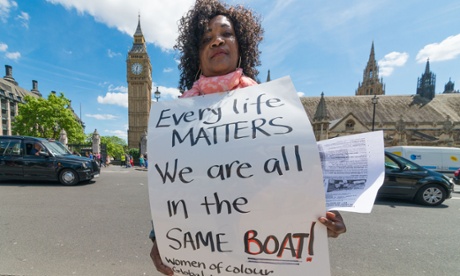
There are more people displaced globally now than since the end of the second world war, yet in the midst of this upheaval, Europe is building walls.
Spain and Bulgaria have constructed barricades at migration pressure points along their borders, while other European nations seem to be erecting mental barriers aimed at deterring asylum seekers from trying to gain entry at a rate in almost direct proportion to the urgency of the problem.
And the problem is urgent: of the estimated 500,000 men, women and children waiting to cross the Mediterranean from Libya, some will be among the thousands desperate to escape the brutal dictatorship ruling Eritrea, many will be from Libya itself, fleeing what is effectively a failed state. More still will be those seeking a route out of the poverty that continues to blight sub-Saharan Africa.
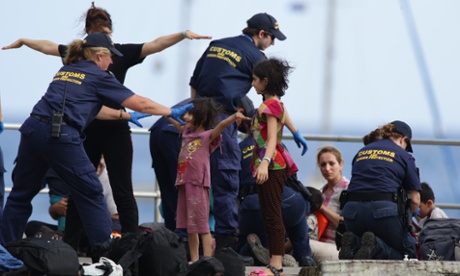
Away from Europe, Australia has closed its ports to asylum seekers arriving by boat. Those who do make it are subjected to a regime of indefinite detention in purpose-built facilities in nearby client states such as Nauru and Papua New Guinea.
To debate the issue, Guardian Members and journalists came together at a Guardian Live event in London.
The view on the ground
Patrick Kingsley, the Guardian’s Egypt and migration correspondent, said many people in Europe felt that the cancellation of Operation Mare Nostrum, the Italian government’s year-long air and naval mission to rescue migrants from the Mediterranean, would be accompanied by a drop in the numbers of those attempting to make the crossing.
“The events of the first few months of this year have shown that’s entirely false,” he said. “A Syrian refugee I spoke to said: ‘Even if you bomb the boats, that still wouldn’t stop us from coming.’”
Kingsley said that Turkey has become one of the main routes through which refugees – in particular those coming from Syria – are trying to find a way in to Europe. “There’s no longer the option of going to Egypt and taking a boat from there. There isn’t the option of taking a large boat from Turkey to Italy; that option has been closed by the Turkish coastguard. And there isn’t the option of going to Algeria and going over the border to Libya anymore.”
Public perceptions
There is clearly a problem, but do public perceptions about migration square with the reality? Guardian columnist Natalie Nougayrède doesn’t think so. “I’m struck by the difference between the realities and the perception, and the political manipulation that comes into this,” she said, emphasising the need to consider the numbers in context.
“If you look at the statistics in Europe overall, you’ve got roughly 600,000 applications for asylum. That’s a big number, but it’s 600,000 for the whole of Europe, which is 500 million people. Among those 600,000, Germany has taken the largest share; roughly a third.
“In the UK, for every one million people, there are 500 asylum seekers. Those are the numbers. So think about that and then think about the discourse being built up around this.”
Ian Traynor, the Guardian’s Europe editor, believes this gap in understanding has contributed to the rise of right-wing populism in Europe: “It’s an incredibly toxic political issue everywhere you look in Europe, in terms of the rise of populist parties.” Traynor drew attention to the political gains made by Front National in France, the Freedom party in Austria and, closer to home, Ukip.
Mike’s story
The panel was joined by a special guest, a recently arrived asylum seeker from the Middle East, introduced only as Mike, who shared his story. “I think whoever comes here to claim asylum is really desperate,” he said, pointing out the dangers involved in crossing the Mediterranean.
But the difficulties don’t stop once a refugee reached safety. Mike has found that the reception afforded to asylum seekers in Britain is, sadly, not as welcoming as we would like to think: “I’ve tried to hide from people that I’m an asylum seeker or a refugee, because once they know they change their behaviour.” He added that many people seem to think that he and others like him are simply “here to consume from the country”, rather than contribute.
Fortress Australia
In Australia, asylum has been a bitterly divisive political issue for more than a decade. Ben Doherty, Guardian Australia columnist and regional correspondent, recalled how in the 2013 federal election, the Liberal party’s Tony Abbott pledged that a conservative coalition would “stop the boats” if it was elected to power.
“Ian used a really interesting word before when he said ‘toxic’,” said Doherty. “Toxic kind of sums up the Australian debate around this issue,”
Despite the damage to Australia’s international reputation by the deaths of asylum seekers in detention facilities and the alleged payment to people smugglers by the Australian government to turn boats around, Doherty said that the policy is still considered a success by the country’s conservative government.
“For that government it’s been a very successful policy, because the boats are no longer arriving. It is now seen not to be Australia’s problem. But the problem hasn’t been solved, the problem has been pushed over the horizon.”
Coherent policy
So can anything be done? Traynor sees the beginnings of a unified European policy emerging in the wake of the tragic loss at sea of 800 migrants in April.
“We’re seeing the first moves towards a coherent European policy on immigration, using the Mediterranean to introduce quotas that countries have to share, along with a whole sort of series of incremental steps which would create a precedent that we could build a policy on,” he said.
But it also became clear that before policies could change, the attitudes of many politicians and citizens towards asylum seekers would have to change first.
“What I’ve noticed being in Europe this summer is this increasingly hostile and increasingly militaristic language being used around the issue of asylum seekers,” said Doherty. “That creates a perception that these people are a threat, that they are something we need to be defended from.”
Kingsley believes that it is the role of the media to counter this discourse; not only by laying bare the facts, but by allowing asylum seekers – even people smugglers – to tell their stories. “When people talk about waves and hordes of migrants coming in, obviously that’s a lie and the media should be able to spell that out,” he said.
Nougayrède echoed this, adding: “It’s part of our European values that asylum seekers should be granted protection. We have to create safe channels so these people are not forced to rely on that horrendous trip across the sea.”
It was fitting that the night should have closed with a question for Mike, the only member of the panel able to speak from personal experience as an asylum seeker.
When asked by a member of the audience what he would do about the issue “if he was in charge”, Mike said that our attitudes should be based on the principle that even if only one person out of a hundred was a genuine asylum seeker, then that individual is still deserving of respect and protection. “We need to prepare people in the country to accept refugees as human beings,” he said.
Guardian Live is a series of debates, interviews and festivals exclusively for Guardian Members. Find out what else is coming up and how to sign up for Membership.