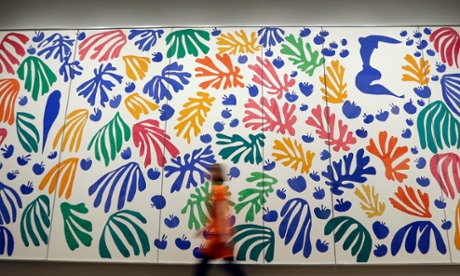
A landmark exhibition currently showing at Moma in New York, Henri Matisse: the Cut-Outs, has redefined the artist’s reputation. Once, the artworks he made with pieces of painted paper cut-outs were regarded as a minor late phase of his career, divorced from his earlier innovations in painting. Now, however, they are seen as a blaze of new inspiration in the artist’s final years, as fundamental to Matisse’s art as the dancers or interiors he painted in his youth. On Friday, Guardian US art critic Jason Farago interviewed Moma’s senior curator Jodi Hauptman and senior conservator Karl Buchberg about the show at a free event for Guardian Members.
Discussing the room-sized cutout The Swimming Pool, which Matisse made aged 82, Farago compared it to an installation before the term was commonly recognised. Hauptman and Buchberg described the way Matisse had come up with an entirely new form of work almost by accident. In the early 1930s, he had been commissioned to make a mural by the collector Albert C Barnes, and rented a garage in Nice in which to work. He painted enormous sheets of paper, cut them into the shapes of dancers, and stood them up on the walls. Somehow ashamed of the technique, Matisse asked his son Pierre, also his dealer, not to tell Barnes that he was using it.
Hauptman and Buchberg said it was only with Jazz, a book of cut-outs he completed at the end of the second world war, that Matisse realised that he had created something new. Though it is revered as one of the great art books of the 20th century, Matisse was disappointed by the translation of cut-out collages to stenciling on paper. In print, the cut-out collages were flat and lifeless; they looked, said the artist, “like taxidermy”. It convinced him that the cut-outs were a viable and vital new medium in their own right.
The talk gave a vivid insight into Matisse’s studio and home, surrounded by the cut-outs, the works in constant flux. Assistants would paint vast sheets of paper in different colours, about which Matisse would be incredibly specific. Hauptman said there are 17 different oranges alone in the cut-outs, while the artist removed pinks and purples from his palette when he noticed the way they faded. He did not draw on the paper before cutting it, preferring the freedom of working freehand, but drew alongside it as well. Some of the cut-outs still bear pencil marks, but Hauptman and Buchberg said Matisse would trace around them before mounting them on their backgrounds, and sometimes the pencil would slip.
One of the most startling elements of the show is the cut-outs Matisse made as preparatory materials from the chapel at Vence in the south of France. Matisse built and decorated it from the stained glass windows to the priest’s vestments, using the cut-outs as a guide. Though Matisse’s feelings were not strong – many critics have assumed he was an atheist – he was serious about the chapel, selling one of his paintings in order to raise funds to build it.
The talk provided fascinating context and deep insights into Matisse’s cutouts. When the audience went upstairs to see the exhibition, the work sang more loudly than ever.
- To find out more about Guardian membership, click here