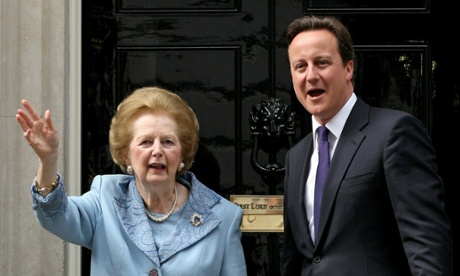
On the face of it, David Cameron seems mild in comparison to the UK’s arguably most divisive leader, Margaret Thatcher. In his time as prime minister since 2010, he has hugged hoodies, ushered in gay marriage and promised the greenest government in UK history. But in front of a Guardian audience in London’s Conway Hall, Polly Toynbee and David Walker discussed their latest book, Cameron’s Coup, with political commentator Steve Richards, and made the case that Cameron’s government is the most radical in the UK’s history.
Austerity has masked an agenda
Toynbee kicked off the discussion saying the global financial crisis was a pretext for Cameron’s distinctly pro-Thatcher agenda. “Dogmatic commitments have been carefully hidden from the public gaze before the election,” she said, “but in office he has gone further than even Thatcher ever dared.”
Cameron’s austerity cuts do far outstrip anything under Thatcher: looking at spending as a percentage of GDP, it rose in Thatcher’s first years of power, going down during the 1980s and rising in the early 1990s, despite weathering two recessions.
Cameron’s political genius was to seize the moment in 2010, when cutting the social state could be disguised very successfully as economic necessity, argued Toynbee.
Walker agreed, calling Cameron’s time in office “a remarkably radical government, pursuing distinctly rightwing policies under cover of deficit reduction”. “Spending and income had to be adjusted after the crash – no one disputes that,” he said. “It’s how, over what timetable, and in what relationship to growth.”
In every £5 adjustment made to public spending, £4 comes from cuts, against £1 made from increases in taxation. “This means, inevitably, that the burden falls disproportionately on the poorest,” Walker said, dubbing the 2012 tax cut for high earners from 50% to 45% “hugely symbolic” of Cameron’s radical rightwing ideology to help “those who go to dinner parties in the Cotswolds”. “The fair-minded among you may say they rose the threshold for the personal allowance to take the lowest earners out of tax. Yes indeed they did, and it cost £10bn, of which £7.5bn benefited higher-earning households,” he said.
The new definition of employment
Under Thatcher, the unemployment rate rose from 5.3% in 1979 to 7.5% by the end of 1990, peaking in 1984 at 11.9%. In comparison, Cameron started with 8.0% unemployment, a figure that has generally steadily decreased to 5.8%.
“Yes, unlike previous recessions, new jobs have been created,” Toynbee said, “but they are mostly low-wage, insecure, zero-hours or self-employed. The underemployed and overqualified workforce is expanding and it’s teeming with graduates who will never earn enough to pay back their student loans.” The current unemployment figures, she argued, are disguising a greater problem than high unemployment: a culture where employers can cut costs by keeping their employees both uncertain and entirely dependent on sporadic income.
Since 2010, £12bn has been stripped from benefits through freezes and cuts. Walker argued that Cameron’s cuts were seen as justified by employed members of the public because they found satisfaction in his ideology that the unemployed are just lazy. “There is a bogus distinction made that the spiralling DWP [Department for Work and Pensions] budget is due to idlers,” he said, “but the unemployed take only £1 of every £33 spent on the whole social security budget; pensions take over half.”
An enabling lack of united opposition
Cameron’s conservatism has been enabled by a lack of opposition on all fronts, even Lib Dem leader and coalition partner Nick Clegg, who has been a “useful idiot”, according to Toynbee. “The Tories went further than they would have done if they didn’t have the Liberal Democrats for cover; their assumed ‘reasonableness’ justified the austerity,” she said. “Cameron would not have wished for a coalition government; he would have liked to win outright. But I think he realised it was an opportunity to use the Lib Dems as a fig leaf for everything they wanted to do.”
The radical extent of Cameron’s cuts and shake-ups has been possible because of the “institutional feebleness” of the opposing parties: “The more we looked at quite how radical the upheavals have been in health, education and a whole lot of other fields,” Toynbee said, “we saw how easily the system caved in, how little opposition there was. There was a certain amount of acquiescence from ministers who would roll their eyes in private but never stopped it.”
Both Toynbee and Walker argued that a lack of probing into Cameron’s election promises back in 2010 had allowed certain cuts to be disguised. As promised, annual spending on the NHS was not cut and, in fact, has risen by 0.6% a year – but that is five times less than the average annual increase in the NHS since 1948, at a time when the population has grown and aged fast.
Child poverty rose in 2010, for the first time breaking a steady downward trend, while food banks have sprouted up around the country. Aside from cuts, revenue-generating measures, such as increasing university fees to a maximum of £9,000, have yet to show a positive effect; in the case of university fees, the National Audit Office thinks that 35% of student loans will inevitably have to be written off.
National disunity has been ignored
Walker acknowledged that a certain proportion of the population – and of the audience on the night – were very well off under Cameron’s government, but said, while interviewing for the book: “Our interviews uncovered scratchiness, unhappiness, even among the affluent, about the disuniting of the kingdom under Cameron.”
The creation of “British values” lessons in schools and the revamp of the citizenship test; the sharp right escalation in their immigration policies with the rise of Ukip; the last-minute attempt to intervene in the Scottish Referendum: according to Toynbee, all these demonstrate a disregard for anything outside Cameron’s old-fashioned definition of Britishness, a definition that is dividing the country. “He believes that common sense is the Tory point of view,” she said, “but the Tory point of view has moved further and further right – everything else is bizarre and ideological and they are not.”
So, what might the future hold?
After the next election, Toynbee predicts a Labour-Liberal Democrat coalition, while Walker predicts a Labour minority government. He also foresees “half a dozen” departments of state disappearing if Cameron wins a second term. “Communities and local government; culture, media and sport; probably energy and environment – these departments would disappear because government would have shrunk,” he said, citing draft policy papers. “A reasonable argument is you would not need these departments as there would not be much happening in them.”
With fewer than 100 days until the next election, it is not surprising that hands shot up around Conway Hall when it came to questions. The majority of those questions related to what were obviously personal experiences: cuts in legal aid, the increased cost of workplace tribunals, turning to independent politics.
While the majority of those who asked questions appeared to not support the Conservatives, one audience member voiced their approval for the coalition’s work on the national railways. But the overwhelming feeling was of frustration and anger that Labour had failed to question the coalition or take advantage of public discontent – something Labour may have to reflect on if they lose the election.
Guardian Live: Is Cameron more radical than Thatcher? took place at Conway Hall, London on 2 February 2015.
Interested in Guardian Live events? Take a look at the full list of forthcoming discussions, debates and interviews and find out how to become a Guardian Member.