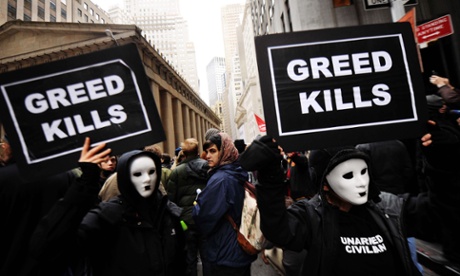
The one thing Tudor statesman Thomas Cromwell, Austrian-American economist Joseph Schumpeter, and Eurovision song contest winner Conchita Wurst have in common is that they were all referenced by Channel 4 economics editor Paul Mason as he set out his theory that we are on the brink of an epochal moment in history – the end of capitalism as we know it.
He took the stage alone to open the sold-out Guardian Live event, insisting that he was no Moses, still less a “postcapitalist Lenin”.
But he did have a big idea to deliver. In a nutshell it is that capitalism is not a system – it is an organism, and one that is singularly failing to adapt. The evidence of this failure can be seen not only in Greece, where Mason told us he had interviewed people who exhibited the trauma of war victims, but also in English cities such as Coventry, whose streets are deserted at night and where poor families are targeted with window displays offering white goods at mind-boggling interest rates.
Although in its death throes, the organism is still dangerous. Mason said that the troika of the European Central Bank, the European Union and the IMF has effectively punished the Greek people for electing a government that did not accept the consensus. “They were told: ‘it’s either regime change or we will destroy you,’” he said.
Mason quoted Wolf Hall to explain that just as Henry VIII’s chief minister had understood that a hierarchy based on fealty was under attack from the subversive demands of money, the pecking order produced by today’s establishment is now giving way to the new rulers of info-capitalism.
The change won’t happen overnight, he pointed out, but it has already started and it will have incalculable consequences. “In 20 years time we’ll see all of Google’s trade secrets open to everyone,” he said.
John Mulholland, editor of the Observer, chaired the event and brought with him four panellists to test Mason’s ideas.
Zoe Williams, Guardian columnist, noted the irony that the keepers of the left wing flame always seemed hostile to anything that threatens to pull down the supposed capitalistic enemy. “There is a huge amount of suspicion on the left,” she said. “They seem to think they have to hoodwink the not-so-poor into helping the poor.”
Douglas Murray, associate director of the Henry Jackson Society and Spectator columnist, articulated the right’s view of capitalism’s woes, pointing out that hedge fund bosses had shown an amazing ability to adapt. “There is too much emphasis on the importance of financial systems in people’s everyday lives,” he said. “It’s as if it’s the only thing we know how to lean on.”
Pat Kane, writer, musician, activist and director of The Play Ethic, took issue with the idea that all working class lives were blighted under capitalism, and argued that book clubs, the collaborative approach of musicians and other artistic projects have long provided an open source, sharing economy that political parties have ignored. He asked: “If the state has a role to play, who will take it forward and how will it be exercised?”
Julia Powles, a lawyer working on technology law and policy at the University of Cambridge, said it was not useful to look to trendsetters and early adopters for any clues as to the direction in which a postcapitalist society might move. “I’m not sure the flat white drinking bearded hipster in Shoreditch is going to be the one to emancipate us,” she said.
A member of the audience gave an illustration of the limits of a postcapitalist market exchange system in her neighbourhood. “Everybody was offering Indian head massages,” she said. “But they all wanted their electrics fixed.”
“That’s a report from the front line of postcapitalism,” said Mulholland. “It’s not going well.”
But at the end of the evening, only one member of the panel, Douglas Murray, thought that capitalism was not on its last legs. “Capitalism has not had its day,” he said. “It’s the only system that makes even its greatest critics richer.”
Guardian Live is our series of events, debates and festivals exclusively for Guardian Members. Find out what else is coming up and how to sign up for Membership.