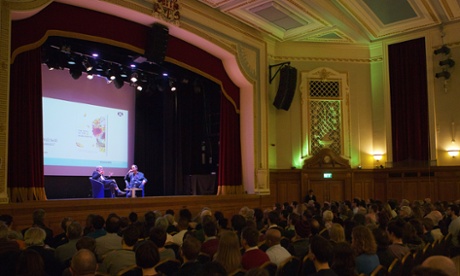
In his new book, The Soul of the Marionette, political philosopher John Gray draws together the religious, philosophical and fantastical traditions that question the idea of human freedom. At a sold-out Guardian Members’ event he talked to Will Self about free will and human behaviour.
1. The world can’t conceive of the future
Gray said the thread that links his books from 1998’s False Dawn: The Delusions Of Global Capitalism onwards is the idea of there being no progress in history.
He believes it’s also the reason the book received hostile reviews because “the idea that globalisation could break down was seen as abhorrent at the time”. This is partly, he said, because the idea that a country as big as Russia could default on its debt had never been factored in before. A few years later, the financial crisis proved that globalisation could, in fact, break down.
Similarly, in 2003 he wrote a spoof article for the New Statesman about the modernisation and promotion of torture in war situations. The piece wasn’t taken seriously and yet this scenario was played out later that year through the invasion of Iraq.
Gray said that although we can’t predict certain scenarios – partly because we can’t be wholly objective from our point in time – there is a pattern of history repeating itself. Once you see that’s the way history is, you gain some clarity.
This notion is compounded by an overall lack of progress, with knowledge gained by each generation challenging political and ethical structures ultimately lost when that generation dies.
2. Global warming is unstoppable, but humans are adaptable
Gray believes that our slide towards environmental disaster has been unstoppable. “The idea that because humans started it humans can stop it is wrong,” he said, suggesting that the reverse effects of ‘global dimming’ are evidence that this theory is a fallacy. Gray said there was no possibility for “a communal, global effort” to stop global warming because of the situations in Syria, Ukraine and the “commercial exploitation of polar caps”.
Still, he said that the situation was not completely hopeless because of our ability to adapt. “We need less continuity in our lives than we think. Humans can go through hardships and survive.”
3. We have little understanding of our actions
The motif used in Gray’s latest book The Soul Of The Marionette is that of the marionette, envied by the narrator because it is free from the burden of choice. But this idea that “freedom” means gaining the knowledge that liberates you from the burden of choice is a fallacy, Gray said.
In modern times there’s the idea that we can emancipate ourselves from what we truly are – “dying animals” – through scientific knowledge. However, Gray argues that the massive stumbling block in this theory is that we have little understanding of why we act as we do.
He compared our reading of our lives and history to “reading a Ouija board” because although we have bits of knowledge, we don’t have the whole picture. Keats called the belief that a person cannot really know why they do certain things “negative capability”.
4. Self-knowledge does not lead to freedom
To clarify, Gray said he was not attacking the concept of free will, just the idea that we will somehow have more freedom if we understand our motivations, which is one of the perceived benefits of psychoanalysis. “Autobiographical knowledge is elusive,” he said, suggesting it was a short journey from “self-knowledge” to “paranoia”. “Paranoia is finding meaning where there is none. It’s a protest against insignificance.”
He added that maybe self-knowledge does not actually lead to freedom. “The best things in our lives come from our lack of knowledge and epiphanies,” he said.
5. AI has its own problems
So what does the idea that only humans have free will mean for the future, a future where we will most likely be living with artificial intelligence (AI)? Gray believes that AI beings would “develop flaws”, experiencing this idea of free will themselves and would then begin to question things. “They would become like us, not the perfect marionettes.”
In the future, Gray believes that many professions will be obliterated because we will have worked out algorithms to do them. Technologies, he added, were “ambiguous in their effects”, posing problems but also opening up new ways of living. Not only that but privacy will be completely obliterated as well, if it isn’t already. “Andy Warhol said that in the future everyone will be famous for 15 minutes. Well 15 minutes of anonymity is impossible now,” he said.
Guardian Live is our series of events, debates and interviews exclusively for Guardian Members - find out how to sign up.