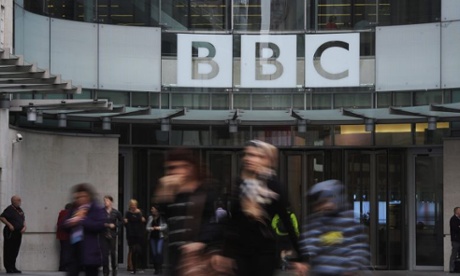
With the possible exception of the NHS, no other institution in Britain occupies such a heightened place in the public consciousness as the BBC. But as the broadcaster approaches its royal charter renewal in 2016, its future is far from settled. Facing ongoing questions over the licence fee and the quality of its programming, as well as government scrutiny of the political tone of its news coverage, the terms of its next charter period are sure to be the subject of heated debate.
Despite this, many people still believe in the future of a licence-fee funded state broadcaster, including the majority of those who came to a Guardian Live event in London, to discuss the organisation’s future.
Future perfect
The event’s chair, broadcaster and writer Steve Hewlett, said everyone on the panel broadly supported the BBC, but agreed that there was a need, or would be a need, to look at the future of the organisation, which is at a “critical moment”.
BBC Trust board member, and a former BBC editor, Richard Ayre, asked what it actually meant to “need” the BBC. “Will the earth still spin on its axis after the BBC ceases to exist?” he asked. “Clearly yes, but without Brian Cox we may not comprehend it quite so clearly. Will the day still dawn? Absolutely, but without the Today programme we may feel less equipped to face the day ahead.”
Martin Bell, the veteran correspondent turned independent MP, joined BBC News in 1965 and said he’d never known it at a time when it was not in a state of crisis. “Everything has always been critical, we’re always under siege,” he said. Despite this he described the broadcaster as being in relatively good shape. “We have a much-admired institution; admired hugely abroad and sometimes even at home.”
To further reinforce the case, the broadcaster’s director of strategy, James Purnell, suggested that based on the numbers, the organisation’s need is self-evident. “Why do we need it now?” he asked. “Just go to how people are using it now – the BBC is the most widely used public service in the country. It’s used by 48 million people every day on average.”

That was then, this is now
Asked by Hewlett to comment on the culture and creative climate of the BBC, Guardian columnist and author, Charlotte Higgins, contrasted the sense of innovation and room for eccentrics that characterised the broadcaster’s early years with the environment today.
“Do we still have that sense of extraordinary invention on the spot? I think probably not,” she said. “The BBC has been at its best when it has been able to accommodate difficult, trenchant and extremely creative people.”
Despite this, Higgins believes that at this point in its history, aspects of the commissioning process and the relentless pressure on the broadcaster to justify itself in numerical terms have “crushed writers and crushed talented people” working within the institution.
It was left to Jed Mercurio, writer of Line of Duty – among other things – to argue for the continuing relevance of the BBC for writers and creatives. “All I can say is that in comparison to the other UK broadcasters the BBC does feel like a very opening and welcoming place,” he said, emphasising the importance of its openness to new talent.
To inform, educate and entertain
What was not so clear was whether or not the BBC is doing a good job of living up to its famous mission statement, or even whether its current order reflected the broadcaster’s priorities and output.
Of its duty to inform, Bell was clearly flummoxed by what he described as the ongoing “stupidefication” of news at the BBC and elsewhere. “I think we’re living in the most dangerous time since the Cuban missile crisis of 1963, and I’m not sure that the news agendas are up to it,” he said.
As to its ability to educate and entertain, Hewlett challenged Purnell to respond to the multitude of criticisms the BBC has faced in recent years regarding the quality of some of its programming.
“The truth is that if you want to do something challenging you actually want people to watch it, so that choice been ratings and quality has actually always been a false choice,” said Purnell. “What you want is the two be in creative tension with each other.”
“Actually, when the BBC has tried to be popular we’ve often failed and a lot of the things that are most popular about the BBC are the things that are the most esoteric.”
Without fear or favour
Independence is perhaps the singular principle of the BBC from which its many others follow. But as pressure mounts on its controllers to justify the organisation in market terms, along with the government questioning its impartiality, is the broadcaster’s independence at risk?
“We live in this interesting constitutional arrangement where the BBC’s independence has been well established essentially through custom and behaviour; that is something that needs to be constantly monitored and constantly defended,” said Purnell.
Bell also reminded the panel and audience that political interference is not necessarily a new thing. “We talk about the independence of the BBC but in my time two directors-general have lost their jobs because of political intervention,” he said. “What I’m looking for and hoping for is a BBC which has courage under fire.”
Higgins set the broadcaster’s independence against the wider context of diminishing publicly held assets. “This sense that the BBC has existed in the public realm, that it costs the same for everyone to use it, is an astonishing and generous notion,” she said.
“It seems to me of profound importance that the BBC is there holding the line as the impartial centre in news terms, even though it doesn’t always do it, and it seems to me that it’s important that it continues to entertain, inform and educate us.”
Guardian Live is a series of debates, interviews and festivals exclusively for Guardian Members. Find out what else is coming up and how to sign up for Membership.