Hope you enjoyed the debate. That’s all from us here for today. See you for more tomorrow.
Sincere apologies to those expecting tonight’s edition of Mumbai Agenda - it’s been delayed until 3pm GMT / 8.30 IST, owing to some important news NDTV are currently showing. We’ll be streaming the debate then, so we hope you can come back to watch what promises to be an important discussion about Mumbai security, precisely six years on from the terrorist attack on this city. MH
Updated
Also, before we pause the blog to take the live feed from NDTV, here’s a teaser for you: what are the six novels that best sum up this great city? Renowned local author Jerry Pinto has named his six - but do you agree? Here’s Jerry’s list:
The Moor’s Last Sigh, by Salman Rushdie
Raavan and Eddy, by Kiran Nagarkar
Baumgartner’s Bombay, by Anita Desai
A Fine Balance, by Rohinton Mistry
No God in Sight, by Altaf Tyrewala
Love and Longing in Bombay, by Vikram Chandra
Which other novels set in Mumbai/Bombay would you add? Share your favourite books about the city on Twitter, using the hashtag #GuardianMumbai.
Updated
We’re counting down to today’s NDTV-Guardian Cities debate at 1.30pm GMT (7pm IST) with the help of regular bulletins from Saptarshi Ray, who is out on a small fishing boat chasing today’s catch. Here are some of his latest texts:
7km out: Waves getting quite big. Thought we saw a shark fin but it was a beer bottle ...
9km out: Waves seem massive now, although I might be high on diesel fumes.
10km out: We’ve spotted three dolphins ... The nets are out, illuminated by naked flames on kerosene lamps. Now to wait for the haul.
Took 25 mins to put the nets out. Feeling sick from diesel fumes so have moved to front of boat. Sea is calm now, and we drink milky chai as sun sets over Arabian Sea.
There will be more from Saptarshi later - or possibly tomorrow, depending on when our intrepid fisherman returns. We’ll also be hearing from Nick, who’s been in Sanjay Gandhi National Park trying to locate leopards. Gosh, what an intrepid lot. MH
Updated
Remembering 26/11
Today is, of course, the sixth anniversary of the terror attacks in Mumbai, on 26 November 2008. As we look ahead to our live discussion with NDTV exploring safety in Mumbai, photographer Ritesh Uttamchandani shares with us his series of powerful photos capturing the events of that tragic day. Warning:contains graphic images.
@guardiancities Sharing my account of photographing the terror attack in Mumbai on 26/11/2008, http://t.co/NgOU5twjpA
— Ritesh Uttamchandani (@photowallah) November 26, 2014
We’ll be live-streaming today’s discussion at 1.30pm GMT / 7pm IST right here on the live blog. Stay tuned - and share your thoughts on Twitter using #NDTVGuardianMumbai
Big game, big fish, big city
We’ve been on the hunt this week for a sighting either of Sachin or a leopard - a prize to the first person to take a photo of either.
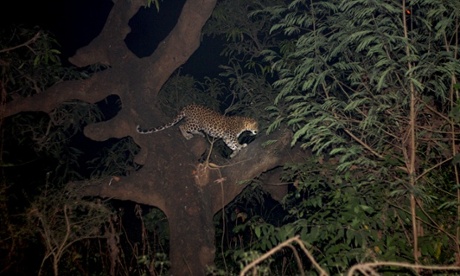
But be careful: leopards can kill, of course. Elizabeth Soumya reports for us on the 21 leopards that live in Mumbai’s northern national park - and the 250,000 residents who co-exist with them inside the park’s boundaries.
Here in Chuna, a tribal hamlet of 40 houses inside the park’s boundary, seeing a leopard is not a scandal but a routine, and residents receive a visit from the big cats several times a week.
Do recent fatalities mean we should change how we think of the leopards? Read her full report. Our intrepid Nick Mead, meanwhile, is in Sanjay Gandhi national park as I write this, on the hunt for “eye gleam” - a telltale giveaway. More to come from him. (We hope.)
Staying with wildlife, Saptarshi Ray has spent the day with the Koli fishing community of Chimbai Village in Mumbai, just west of Bandra; a “smidgen of relative calm a mere line cast away from the thrash on Mumbai’s main streets”.
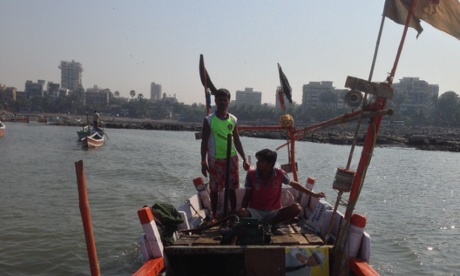
My hosts Pramod and Naresh took me out on their boat the Bhavna Putra to give me a brief glimpse of their fishing routes, and again and again the issue of security came up. Today is obviously the anniversary of the 2008 attacks, but they say their day-to-day occupation now involves constant vigilance that they may be boarded at any time - especially at night - to face rigorous identity inspections. This causes problems in a village community where it seems half the people share the same name - Chimbaikar (from Chimbai) - all this while simultaneously being the “eyes and ears of the security apparatus of the country”, according to one naval official.
More from Sap later, both on the anti-terror angle and tracking how fish go from sea to plate to belly in this city.
Remaking public space in Mumbai
This week, The Urban Vision and a team of volunteers have been transforming two underused spots in Mumbai’s Powai and Borivali neighbourhoods into better public spaces for the whole community, as part of an “Urbanism Makathon”. We’ve been following their progress, and our reporter Yasir Mirza joined in the fun on Monday. Today is the last day of this DIY placemaking: volunteers are applying the finishing touches on the spaces, including a Wish Plaza that incorporates Mumbaikars’ dreams for an ideal city.
Prathima Manohar, founder of The Urban Vision, says the project is “an example of collaborative city-making. Collaborations between businesses, local community stakeholders and various artists.” FP
Day 3 begins with much excitement, fun & colours. #ReMakeBby @theurbanvision pic.twitter.com/DRcxVzqIyA
— Ashwini Nair (@AshwiniNair19) November 26, 2014
#ReMakeBBY Creative Placemaking & tactical Urbanism is a popular performing arts in India..:) See the crowds we draw. pic.twitter.com/UdmmRQBB88
— Prathima Manohar (@prathimamanohar) November 26, 2014
#ReMakeBBY Our incredible city dreams canvas ...In awe in Borivili's wish plaza. Hugs to @StartMumbai pic.twitter.com/JW1z5leVSQ
— Prathima Manohar (@prathimamanohar) November 26, 2014
Mumbai has a space crunch. We need more of such places where we&our children can hangout. #ReMakebby @theurbanvision pic.twitter.com/O43t5DINSF
— Ashwini Nair (@AshwiniNair19) November 26, 2014
#ReMakeBBY Colourfull tires now ready to made into a Amphitheatre ..Lovable spaces..:) at Borivili's Wish Plaza pic.twitter.com/lohrby8Qon
— Prathima Manohar (@prathimamanohar) November 26, 2014
True crime in Mumbai
As mentioned, today is the sixth anniversary of the Mumbai terror attacks. Jason Burke has reported on the resurgent threat to the city, and tonight we co-host a TV debate on terrorism, airing live on NDTV and streaming here from 7pm.
Meanwhile, Brijesh Singh is an officer of the Indian Police Service, currently serving as an additional commissioner with Mumbai police. Quantum Siege, a fast-paced thriller about a terrorist threat to India, is his first novel, and draws on his experience of day-to-day life in the police. His friend, Hussain Zaidi, is a popular author of crime fiction, which he bases on the stories he learned during his former career as a journalist.
We got them together for a special discussion on the reality and perception of policing in Mumbai ...
Memories of 26/11
HZ: “Where were you during the 26 November 2008 attacks?”
BS: “I was in Nagpur at that time, 1,000km away. But I was on the phone with my wife and kids. My house is just adjacent to the Cama Hospital and all night there was firing going on. Yet I couldn’t even take a gun and, you know, rush into it. It was very bad!
“I used to be in charge of that area until two or three months before [the 26 November attack], when I was shifted to a paramilitary force: the state reserve police force. But I still knew that area like the back of my hand, and I knew what was going on.
“Very early on, when the phone calls started pouring in, I knew it was a terrorist attack. But at that time there was so much confusion, so much information flowing from everywhere – in retrospect we know that this many people came from here, but at the time it was just mayhem.”
HZ: “Senior officers, such as Mr Karkare and Mr Kamte, I think they got killed close to your house, in the same area that you live?”
BS: “Yes, it was very close to my house.”
HZ: “So was there some fear when you heard they were prowling in your area and around your place?”
BS: “I was continuously on the phone to my family. I told them to put all the lights off. Even so, there was so much firing going on in the vicinity that a stray bullet could definitely have entered.”
Continued here. CM
Updated
Food and shelter
“They speak just like us,” Akash joked. The SlumGods’ crew member had just finished a two-hour session of b-boying lessons with an enthusiastic and incredibly athletic audience of orphan boys, age 7-15, at the YMCA shelter on Juhu Beach.
After the popping and locking was over, Akash and Steve, who led the session, hung around with the kids, teaching them beatboxing 101 and exchanging slang: which, it turns out, they draw from the same pool. “It’s very funny.”
B-boying with the SlumDogs and the boys of Juhu Beach YMCA shelter #guardianmumbai @guardiancities pic.twitter.com/ZMBlnwsIsx
— Chris Michael (@chrismichaelgdn) November 25, 2014
I’ll be heading back to the shelter tonight, for a cooking class with Dinesh Bahrani, formerly of the Taj Hotel. He’ll be teaching the boys (and you) how to update what they already cook for themselves every day - the variants will include a black daal and chicken in coconut. I’ll tweet photos and post the recipes.

Speaking of food, how hygienic IS Mumbai’s street food? Freelance journalist Sana Merchant took a pav-bhaji to the lab. The results ... may ASTOUND you!
(Disclaimer: absolutely not a double-blind peer-reviewed scientific study. But fun nonetheless.)
CM
Updated
Our intrepid correspondents
Aditya Chakraborrty, who is with us in Mumbai this week reporting on wealth disparities and the squeeze on India’s fragile middle class, checks in:
A quick update before I dash outside: I’m just off to Dharavi for a wander with the Slum Gods. Tours of the megaslum and its cottage industries have themselves become a cottage industry. I’ll be interested to see how the Mumbai hip-hop crew duck the usual cliches. To find out more, read this bit of excellence. OK: Mahim (west), here I come.
Saptarshi Ray, meanwhile, is about to hop on the Bhavna Putra, a tiny fishing boat, to head 10km out into the Arabian Sea on his quest to follow a fish from net to market to belly.
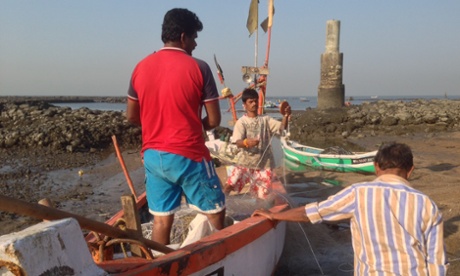
He’s wearing a yellow shirt and pink shorts, inaugurating a new style, Bengali-Battersea fish-walla. Photos soon, I promise. CM
Updated
Guardian Cities on NDTV: our live debates so far
Part of our Mumbai week includes a live-to-air TV series, in association with NDTV. Tune in tonight at 7pm for a special anniversary debate about terrorism in Mumbai, streamed live right here. Watch previous clips here and follow the debates on Twitter using #NDTVGuardianMumbai.
The first, at the Hive in Bandra, was a sizzling and frequently hilarious discussion about the state of women in Mumbai, featuring panelists including comedian Aditi Mittal, film-maker Paromita Vohra and esteemed journalist Bachi Karkaria. It touched on the feng shui of toilets, the role of public space, and whether women have a responsibility to dress “properly” - a comment from Karkaria that sparked a particularly fiery exchange.
Last night, meanwhile, film stars Imran Khan and Sohum Shah and director Anand Gandhi told the unvarnished truth about how tough it is to make good independent films in Mumbai. They touched on rampant homophobia, the promising rise of a new audience interested in more universal themes than Bollywood typically is, and the heavyhanded role of the censor board: turns out, among other things, that you can’t show any bill featuring Gandhi’s face if it’s used in a bribe. “It is old news that officials are corrupt,” joked Khan. “I’m only surprised now that anyone is surprised.” Watch it here.
Speaking of indies v Bollywood, over at the NH7 music festival in Pune, Amit Gurbaxani asks: can Bollywood ever be indie?
CM
Updated
Gooooooood morning Mumbai!
Chris here, very excited at the prospect of our Sachin v a Leopard contest going 1-0 to the leopard: more about that soon.
But today is also the sixth anniversary of the terror attacks on luxury hotels and other targets in India’s commercial capital, and as Jason Burke reveals in a special report, officials fear “another storm is coming”.
The drawdown of US troops in Afghanistan, weakness of the Pakistani government and surge of the Islamic State mean the risk of attack is highest in years, analysts say.
Although a few Muslim Indians have left to join the Islamic State, the number of radicalis is negligible compared to the country’s Muslim population of 180 million, Burke writes. The power vacuum in Afghanistan is a bigger threat.
Groups active in Afghanistan include Lashkar-e-Toiba, the Pakistan-based organisation behind the 2008 attacks on Mumbai. Michael Kugelman, of the Woodrow Wilson Center in Washington, said the Afghan factor was “the big one”. “You have all these militants who are anti-Indian at root in search of a new target. That’s the obvious threat,” Kugelman said.
Read his special report here.
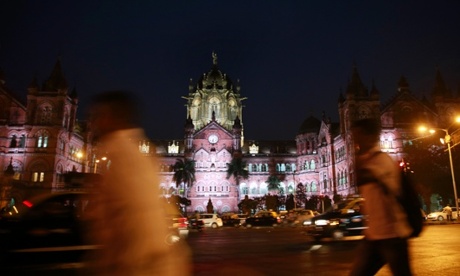
On 27 November 2011, three years on from the siege, Shonan Kothari organised a flash-mob in Chhatrapati Shivaji railway station.
We asked her what brought it about:
It came about through joy. After the 2008 terror attacks, the city’s perception of its main train station had been wounded. We thought pure fun itself embodied a wealth of things. The intention was to find joy and freedom in the moment, to represent the city and the station in a happier way, and firmly tack on a new memory to their history.
We’ve got plenty of other stuff on the agenda today: some time up close with the SlumGods; a Mumbai cooking special including recipes plus our own Saptarshi Ray following a fish “from net to market to belly”; and a golden chance to spot a leopard. (No sign of Sachin, meanwhile: a prize to the first reader photo of the cricketing legend.) Stay with us.
CM
Updated