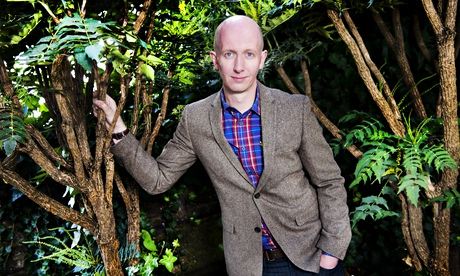
Piers Torday joins a distinguished list of previous Guardian children’s fiction prizewinners, including Jacqueline Wilson, Philip Pullman and Richard Adams.
The Dark Wild is the second book in a trilogy and sequel to The Last Wild. The series tells the story of 12-year-old Kester, who can’t speak to humans but discovers he can telepathically communicate with animals – and finds the last ones left alive in the world after a mysterious plague has almost wiped them out. In The Dark Wild we discover more about the sinister aspect of the disease and the evil baddie Selwyn Stone’s dastardly plot for global domination.
Torday was inspired to write by his father Paul Torday, who died in December 2013 after writing seven critically acclaimed books, the first of which was the surprise hit Salmon Fishing in the Yemen. It was written in 2007 when he was 59, so, although Piers had a famous literary father, he didn’t grow up with one. “He’d been a businessman all his life,” explains Torday. “I knew he loved books and had an English degree. But when he told us he’d got this deal and Salmon Fishing was being sold all around the world we were gobsmacked.” Just a year later his father was diagnosed with advanced kidney cancer. “I thought, you’ve just discovered this amazing new life and now this … he had seven years of treatment and managed to write seven books before he died, but it made me think I don’t want to wait that long to start writing.”
Torday, at that time a freelance TV and screenplay writer, booked himself on a residential writing course. “It was a week that changed my life,” he explains. “I was very nervous, wondering if I was kidding myself, but the tutors’ exercises shook me up. They got me thinking about different ways to write. One of the big things for me was narrative voice, particularly exploring first person, and Kester’s voice came from that. My first drafts were third-person, but it was a bit stiff. I hadn’t relaxed into it. I went on that course thinking I want to be a writer and I left feeling I am a writer – even though I only had three chapters of The Last Wild, I knew it would happen somehow.”
Paul Torday got to see his son’s first book published, and he read The Dark Wild just before he died. “This was so important to me. But he was very modest about his ability, and wouldn’t dream of giving me direct editorial notes, he was just quietly supportive and made the odd thoughtful comment or suggestion.”
The last in the trilogy, The Wild Beyond, will be published next spring and together the three books explore a time set in an unspecified future that is probably “the end of this century” where one company has dominated the food supply, and real food, farming and most wildlife have been wiped off the Earth. Instead, humans are forced to survive on a disgusting prawn-cocktail-crisp-flavoured manmade food called Formul-A, and live in glass towers isolated from a seemingly barren wilderness.
It’s a real little-man-against-the-world scenario where human characters Kester, Polly and Aida – together with some animal friends – fight against the horrors around them. “People call it a dystopian novel,” says Torday, “but I would say that a world where animal species are massively under threat, a world in which huge corporations and special interest groups disrupt political process, a world where children aren’t listened to isn’t dystopian, really. I’d say I’m exaggerating what’s going on, but most of the things in the book are happening in some way. We are living in the age of the sixth extinction, which is driven by humans. I didn’t set out to write dystopia, I set out to write about an imaginary world where we can explore things.”
Despite the theme, the books are far from depressing and are interlaced with sweet humour. “I’m an optimist,” he explains. “I don’t believe in a bleak outlook, I believe in people overcoming difficult situations, which is quite a different position.” In fact, Torday has even coined a new term for what he’s writing: “Dis-hopian”, which he’s hoping will catch on.
Some readers might initially be put off by the fact that one of his heroes is a talking cockroach, the General. “Look, I don’t want a cockroach in my house or crawling on my face any more than the next man, but they are wonderful animals. They work together; they are very social, with strong units. They are nature’s natural recyclers. We need to value all species, not just the beautiful ones.”
Torday’s knowledge of environmental politics influences his stories, providing “a swirling background of context. I don’t have any answers and my views are changeable – I’m an author not a scientist. It’s almost too late for our generation to make changes. But the kids reading my books now, I’m hoping some of them might be able to come up with a solution.” He isn’t interested in sending messages to children through his books, but in challenging their thinking. “I think it’s everyone’s job to do that, whatever you do. I don’t want people to panic and think they must never go in a car again, but to think about the world they live in a little more carefully. And to appreciate that it’s a beautiful planet that we live on and to cherish it – how you do it is up to you.”
Torday beat shortlisted authors SF Said (Phoenix), Kate DiCamillo (Flora and Ulysses) and E Lockhart (We Were Liars) to the £1,500 prize. This year’s prize panel was chaired by Guardian children’s books editor Julia Eccleshare and judged by fellow writers Frank Cottrell Boyce, Katherine Rundell and Gillian Cross. Cottrell Boyce found The Dark Wild “wildly inventive, moving and gripping”; Rundell said it was “full of suspense without ever sacrificing warmth”; Cross saw it as “a fantastic example of how a book for children can be serious without preaching … a sobering parable about our attitude to the natural world.”
“It’s an incredible honour to be judged by the people who write the books,” says Torday. “The peer recognition is a real thrill.”
• Piers Torday’s The Last Wild and The Dark Wild are published by Quercus. To order copies go to bookshop.theguardian.com or call 0330 333 6846. See the Guardian children’s books site for reviews of The Dark Wild written by children and to find out the winners of our Young Critics of the Year competition.