The only downside of winning last year’s Guardian Charity Awards, Naomi Marek says with a smile, is how much extra work her small charity has had to do. Marek, chief executive of Sky Badger, a virtual organisation that supports families with disabled or seriously ill children, says: “The demand for services has gone through the roof thanks to the publicity we got after we won. Since November we have had 172,000 users. In the six months prior to the win we had just 64,000 users so it shot right up. We’ve had to take on a member of staff just to apply for funding to keep up.”
It’s not just numbers that have increased. So too has the confidence of the team and it has big plans for the future. “Winning the award has meant that people sit up and listen to us and take us a bit more seriously,” says Marek.
Now in their 23rd year, the Guardian Charity Awards aim to give a priceless leg-up to small and medium-sized charities that are often overshadowed by the sector’s big players. At a time when many smaller charities are struggling to remain afloat, Sky Badger and the four other winners at the ceremony last November are flourishing.
The National Council of Voluntary Organisations’ annual almanac, published last week, shows how income and expenditure has continued to flatline with many charities finding it hard to cope as government funding dries up. In 2012-13, the sector’s income was around £1.6bn lower than that seen in the “peak” year of 2007-08 (£42.1bn). Provisional data for income in 2013-14 (£40.7 bn) indicates a picture of stagnation.
David Kane, a senior research officer at NCVO, explains: “There’s a real range of different funding strategies and work that small charities do. Some will have insulated themselves from the financial problems like the recession. But for many of them it will have had a huge impact.”
It’s for this reason that the prize money has been invaluable to the winners. Sky Badger was able to invest more hours in its popular e-helpdesk, which supports often isolated families. Marek says: “What we do goes from the most serious to the most silly. But it matters to everyone. Recently a parent contacted us about their child who was in their last stages of life in a hospital and all the toys on that particular day had been taken away for deep cleaning so there was nothing left. We found a local toy library and organised delivery and that child had toys within three hours.”
The National Ugly Mugs scheme works with thousands of sex workers to identify sex offenders who target sex workers. It warns sex workers through email and text reports and alerts. It was launched in 2012 by the UK Network of Sex Work Projects (UKNSWP), an umbrella organisation that represents sex work projects. Alex Feis-Bryce, its director of services, says the Guardian charity award meant the world to the team, which has doubled from three to six members since the win.
“It was fantastic to win partly because sex workers are one of the most stigmatised groups in society. Our work is pure harm reduction and saves lives but it often doesn’t get the recognition or funding it should, so receiving such a well-respected award was huge for us. I believe we have a good story to tell but often our story isn’t heard so it was great that the judging panel saw our work for what it is.”
In Glasgow, Paul Fletcher’s feet have barely touched the ground since the charity he works for, A&M Training (since rebranded A&M Scotland) won an award. “I forgot that it was only seven months ago because it’s flown by. Things are going really well for us. We’ve grown in size, taken on more staff, and we’re working with more young people from the most deprived areas,” he says
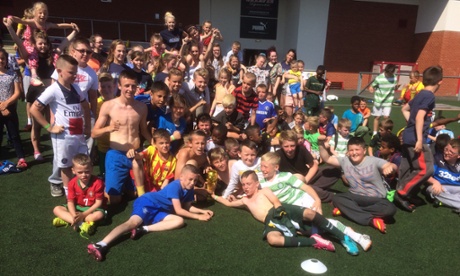
As well as providing diversionary activities such as football and dance to thousands of poor Glaswegian teenagers, A&M Scotland runs employability and personal development sessions and organises volunteering. Last year Police Scotland recognised the benefit A&M Scotland has had on the community with vandalism, youth disorder and street drinking figures all plummeting in the areas where the charity runs activities.
“Getting recognition from a UK paper meant a lot,” says Fletcher.
One problem many small charities have is not being able to get funding simply for running costs and staffing. Fletcher says: “Not long after, we also received a few donations of £5,000 here and £5,000 there which we’d never had before. Ninety percent of our funding is tied to restrictive projects with very tight criteria. Because we’re more visible now, it’s created more opportunities.”
The Personal Support Unit gives free legal advice to people who are facing civil court proceedings and don’t have representation. Hundreds of volunteers keep the service going and, since the huge cuts to legal aid, demand has been higher than ever. Its director, Judith March, says winning a Guardian charity award felt fantastic. “Having public recognition that we were a serious charity and that we had support increased our reputation with our stakeholders, who include the judiciary, civil servants, the legal profession and funders. I’m absolutely certain that made a difference. A lot of our volunteers were hugely proud of it. It was a huge pat on the back for them.”
Part of the prize was a tailor-made package from the Media Trust. March says she was impressed with what they received. “They did a film of us which is now on YouTube, which we’re really pleased with.”
The Back-Up Trust, which supports people who sustain spinal cord injuries through accident or illness with a small team and more than 400 volunteers, says the award has given everyone a boost, “The awards are hugely competitive so for a small charity like us to even get to the shortlist felt amazing,” says its spokeswoman Natasha Theobald. “When we’re having conversations with potential funders or other organisations we might want to work with, it’s great that they recognise it and see that the charity is doing good things.”
How to enter
The Guardian Charity Awards 2015, in association with Zurich, are open to small and medium-sized charities with an annual income of between £5,000 and £1.5m. The judges will be looking for entries that show outstanding innovation, concrete evidence of having made an impact on the people they are supporting and an overall contribution to social welfare. Entrants will also need to show how the award could help them to become sustainable and grow.
David Brindle, the Guardian’s public services editor, is chair of the judging panel, which includes Jane Asher, president of the National Autistic Society; Lynne Berry, deputy chair of the Canal and River Trust; Pauline Broomhead, chief executive of the FSI; Caroline Diehl, chief executive of Media Trust; Baroness Howarth of Breckland, president of Livability and Joe Irvin, chief executive, Living Streets.
The awards are supported by the FSI, Jigsaw24, Media Trust and the National Council for Voluntary Organisations. Each of the five winners will receive a package of support including a cash prize, an iPad Mini, courtesy of Jigsaw24, one year’s free membership of NCVO, tailored support from the FSI, which builds the capacity of small charities, and personalised communications support from Media Trust.
The closing date for entries is 5 August 2015. The winners will be celebrated at an award ceremony in central London in December.
To enter the awards, complete our online form with an outline of your charity’s aims and objectives and why you should win an award.