GUANTANAMO BAY NAVAL BASE, Cuba _ A Saudi captive accused in the Sept. 11 plot was treated for hemorrhoids in outpatient-style surgery at the base hospital in October _ not repair of a torn or prolapsed rectum as claimed by his attorney, a doctor testified Monday.
The attorney for Mustafa al Hawsawi, 48, tried to ask the doctor, an Army major who testified anonymously, about the link between the captive's ongoing pain and Hawsawi's treatment in CIA custody a decade or more ago.
But the judge, Army Col. James L. Pohl, cut attorney Walter Ruiz off, insisting that court testimony stick to the aftermath of the Oct. 14 procedure at Guantanamo's base hospital, on the Friday night after the last pretrial hearing.
Monday marked the first time that prison officials described the nature of the surgery, which Hawsawi's lawyers had consistently described as repair of a fissure in Hawsawi's anus related to mistreatment of his rectum in CIA custody.
"This man was sodomized; he's not the average individual," said Ruiz, a reserve Navy commander serving on the case as a civilian, at one point shouting at the judge that his court was "disrespectful to our flag, disrespectful to our system of justice."
It was a day of drama at the war court capped by Pohl's ruling that pretrial hearings would continue all week. Hawsawi himself refused to testify, his lawyer said he was too unwell, and the judge found insufficient evidence that the Saudi was in too much pain seven weeks after the procedure to work with his legal team.
Hawsawi's doctor _ an Army physician called the senior medical officer of Guantanamo's most clandestine prison, Camp 7 _ disclosed that he approved surgery for hemorrhoids after trying to treat the captive's pain in other ways. While it can be painful, and Hawsawi was prescribed a narcotic called Tramadol that can cause dizziness and sleepiness, the doctor of seven years who specializes in internal medicine said the Saudi should be able to sit through six or seven hours of hearings each day.
Hawsawi is accused of helping some of the hijackers who killed nearly 3,000 people on Sept. 11, 2001, with money, Western clothing, travelers' checks and credit cards, and like the other four awaiting trial as conspirators, could face military execution if convicted. Pohl ruled that Hawsawi could choose to skip the rest of the week's hearings and stay behind in his Camp 7 cell, but that he would have to sign a form declaring his waiver voluntary _ and not blame his poor health. Otherwise he would be compelled to sit in court and watch.
The doctor, who has been working at the prison since September, also said Hawsawi was in good spirits at a Nov. 29 post-operative check-up with himself and the surgeon.
Doctors and patient shared a laugh, the Army officer said, when one physician asked the Saudi if his bowel movements were "the consistency of hummus."
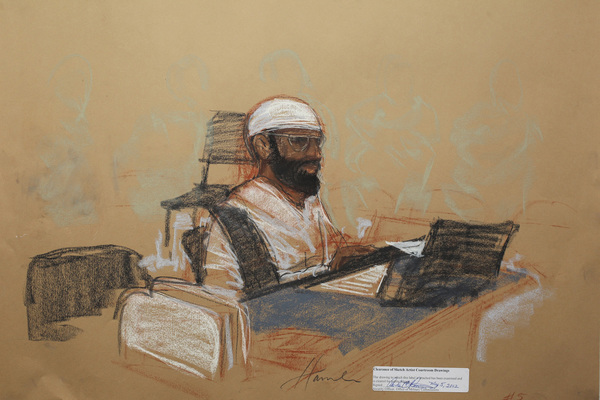
Earlier in the day, soldiers wheeled Hawsawi into court in a detention center restraint chair typically used to carry out forced feedings at the prison. He was buckled in at the waist but not shackled, according to reporters who watched his arrival, stood on his own in court and sat gingerly on the defendant's chair _ after soldiers rested a large bed pillow atop it.
At issue, said Pohl, was whether, if Hawsawi was in too much pain to work with his legal team and wanted to go back to his cell to recuperate, was his attendance waiver voluntary. He provisionally found him fit enough and ordered him brought to court Monday over the objections of attorney Ruiz, who called the judge "inhumane."
Hawsawi was captured in Rawalpindi, Pakistan, in March 2003 with the alleged mastermind of the 9/11 attacks, Khalid Sheikh Mohammed, and was held by the CIA until his delivery to Guantanamo in September 2006.
He has sat on a pillow at the war court since his first appearance in 2008. But the reason was not publicly known until release of a portion of the so-called Senate Torture Report on the CIA program in December 2014, which described agents using quasi-medical techniques called "rectal rehydration" and "rectal re-feeding."
In October, Ruiz described the surgery as reconstructing his client's rectum. "When he has a bowel movement, he has to reinsert parts of his anus back into his anal cavity," Ruiz said, which "causes him to bleed, causes him excruciating pain."
The doctor on Monday said Hawsawi does bleed after bowel movements because he is still healing from the hemorrhoid surgery.