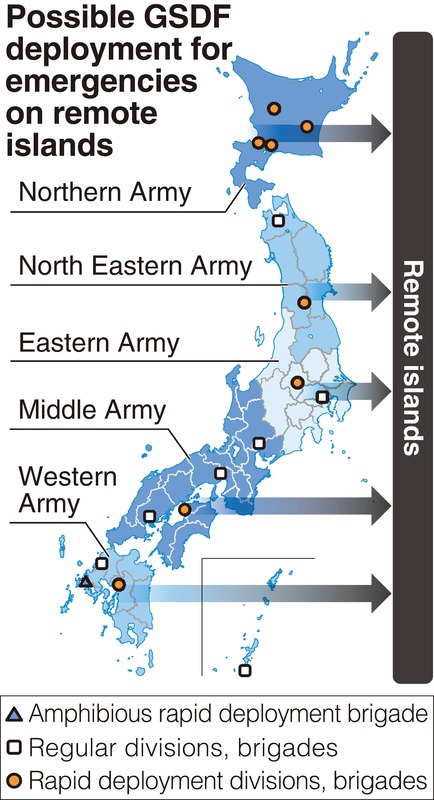
The Ground Self-Defense Force will establish on Tuesday the Ground Component Command (GCC), which will control overall operations of GSDF brigades and divisions across the nation, the GSDF has announced. The Amphibious Rapid Deployment Brigade will also be created, it said.
This reorganization is the biggest restructuring of the GSDF since it was formed in 1954, and aims to boost the force's ability to agilely respond to contingencies on remote islands such as the Senkakus in Okinawa Prefecture, and natural disasters that cause damage over wide areas, such as is expected when a huge earthquake occurs in the Nankai Trough off the Pacific coast.
The Amphibious Rapid Deployment Brigade would be responsible for operations including retaking remote islands occupied by foreign forces.
The GCC would have 180 personnel and be headquartered at Camp Asaka, which straddles the border of Tokyo and Saitama Prefecture. In the event of a contingency, the GCC will take command of the operations of the GSDF's five regional armies, which currently operate under their own commanding generals with jurisdiction over regions such as northern Japan, northeastern Japan and eastern Japan.
The Amphibious Rapid Deployment Brigade will have about 2,100 personnel and be based at Camp Ainoura in Nagasaki Prefecture. Equipped with amphibious vehicles, it would be the central GSDF unit in operations to retake remote islands seized by a foreign military force.
The GSDF reorganization also will include transforming two of the GSDF's 15 divisions and brigades across the nation into a rapid deployment division and a rapid deployment brigade. These two units would be under the command of the GCC commander and could also swiftly deploy to areas outside the jurisdiction of their regional army. The GSDF eventually plans to transform a total of eight brigades and divisions into rapid deployment versions.
The ground, maritime and air branches of the Self-Defense Forces command their units based on decisions made by the Joint Staff Office. The Maritime Self-Defense Force has the Self-Defense Fleet, and the Air Self-Defense Force has the Air Defense Command, which have been centrally responsible for overall command since the 1950s and have served as the gateways for coordination with the Joint Staff Office. However, the GSDF had split the authority to issue commands so each regional army could carry out combat operations on its own.
How will personnel get there?
This reorganization of the GSDF has laid the foundation for units to swiftly move into action, but challenges still abound -- not least problems with securing the capability to transport personnel.
In preparation for a contingency on a remote island, the Defense Ministry planned to buy 17 Osprey transport aircraft and station them at Saga Airport in Saga Prefecture to carry personnel in the Amphibious Rapid Deployment Brigade. However, a GSDF helicopter crash in the prefecture in February angered not only fishery operators who had originally opposed the Osprey deployment, but also prompted the prefectural assembly and the governor to switch to a more cautious stance. The prospects for stationing the tilt-rotor aircraft at the airport have become unclear.
The MSDF has only three transport vessels for carrying amphibious vehicles. Carrying the 52 amphibious vehicles scheduled to be introduced would require these MSDF vessels to shuttle back and forth.
Even after the reorganization has been implemented, each regional army will in principle issue commands to units that do not straddle different regions, in cases such as when a disaster has occurred in a localized area.
"There is concern that, depending on the situation, the chain of command could become confused," a senior GSDF official said.
Read more from The Japan News at https://japannews.yomiuri.co.jp/