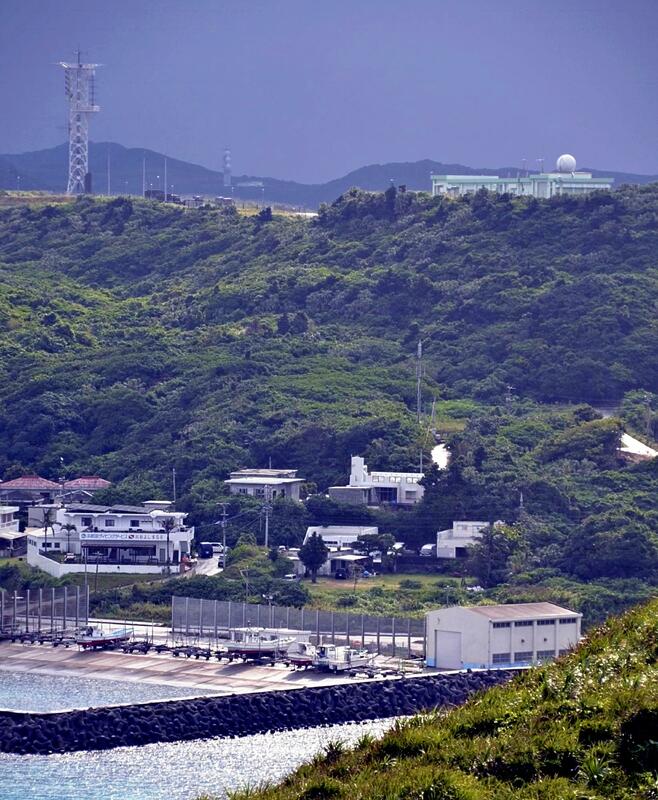
YONAGUNI, Okinawa -- To this westernmost point of territorial Japan, a Ground Self-Defense Force detachment was deployed on March 28, 2016, and has been stationed on the west of Yonagunijima island since.
Residents of the island in Yonaguni, Okinawa Prefecture, had at first been divided over the deployment of the GSDF, but the GSDF members have integrated into the local community, leading the opposition movement to wane.
As there have been concerns that military tensions could grow over Taiwan, which is close to Yonagunijima, how to respond in a contingency has become an issue.
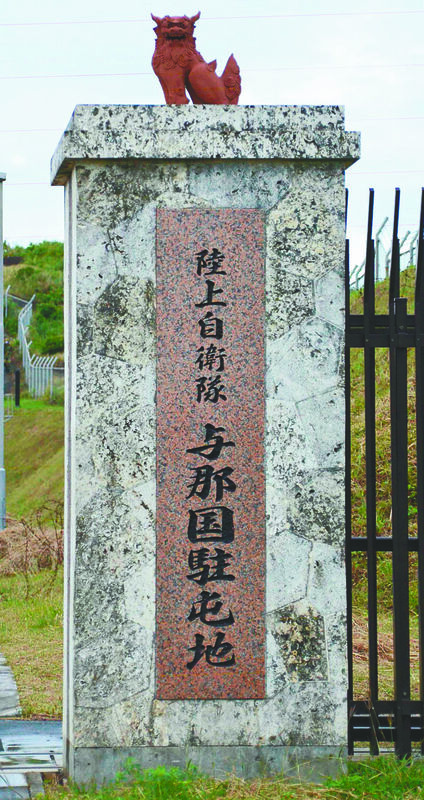
Deputy Chief Cabinet Secretary Manabu Sakai stressed the significance of the deployment of the GSDF detachment, saying at a press conference on Friday, "Camp Yonaguni plays an important role in strengthening the defense of the vast southwestern area, which spans about 1,200 kilometers."
The island has a population of about 1,700, and about 160 of them are Self-Defense Force members belonging to the Yonaguni Coastal Observation Unit. The members keep an eye on the surrounding waters and the Chinese mainland from two radar towers on the island.
In a 2015 referendum on agreeing to the deployment of the GSDF detachment to the island, the votes in favor were 632, while the votes against amounted to 445.
As residents were divided, some people were concerned about negative feelings remaining after the referendum. Nonetheless, the SDF members and their families have tried to deepen exchanges with local residents by actively participating in volunteer activities on the island, such as cleaning up roads and setting up venues for track and field events, which are commonly held there.
The town's finances have also improved as the population has risen since the GSDF detachment was deployed. About 20% of the town's tax revenue now comes from the resident tax paid by the SDF personnel. The annual land rent of 15 million yen paid by the GSDF is also a valuable source of revenue for the town.
"I'm still against the GSDF deployment to the island, but there is no opposition movement currently seen on the island," said Kunio Uechi, the 78-year-old director of a social welfare corporation who led a group asking residents to vote in the referendum against the deployment.
Yonagunijima is about 110 kilometers from Taiwan. In the event of an emergency involving Taiwan, the island could become the target of a Chinese military invasion.
However, the lightly armed GSDF coastal observation detachment is mainly tasked with gathering information, so it is regarded as not being capable of handling actual warfare.
While some residents of the island call for expanding the ability of the GSDF detachment to defend the island and its residents in case of an emergency, others remain wary, with one saying, "If the number of SDF members increases too much, this island will no longer be for us islanders."
Yonaguni Mayor Shukichi Hokama told The Yomiuri Shimbun that as long as the percentage of SDF personnel "doesn't rise above 15% of the town's population, increasing the number is acceptable."
The Defense Ministry also plans to deploy an electronic warfare unit on the island by the end of fiscal 2023 to collect electromagnetic waves and conduct jamming activities.
"The increase in the number of SDF members will be small," a senior Defense Ministry official said. "So there should be no opposition from island residents."
-- Seeking to deter China
The Nansei Islands are a strategic area for Japan and the United States as well as for China. The Japanese government is proceeding with deploying more SDF units to the region in order to strengthen deterrence against China.
Starting with the deployment of the Yonaguni Coastal Observation Unit in 2016, the government has stationed security and other units such as on Amami Oshima island in Kagoshima Prefecture and Miyakojima island in Okinawa Prefecture in March 2019.
In addition, new SDF bases are scheduled to be established on Ishigakijima island in Okinawa Prefecture by the end of fiscal 2023 and on Mageshima island in Kagoshima Prefecture in the middle of the 2020s.
The Nansei Islands span about 1,200 kilometers, which is comparable to the length of the Japanese archipelago, and are located in the so-called first island chain that stretches through Taiwan to the Philippines.
China has drawn up an anti-access and area-denial strategy (A2AD) to prevent U.S. forces from entering the island chain. Under the strategy, Beijing has increased activities of its naval vessels and other units in the vicinity.
In response, Japan and the United States intend to strengthen the defense of the Nansei Islands to halt China's advance. The United States is seeking the possibility of deploying missiles in the first island chain to counter China's medium-range missiles, of which Beijing has an advantage in their development. However, Japan is taking a cautious stance.
Read more from The Japan News at https://japannews.yomiuri.co.jp/