
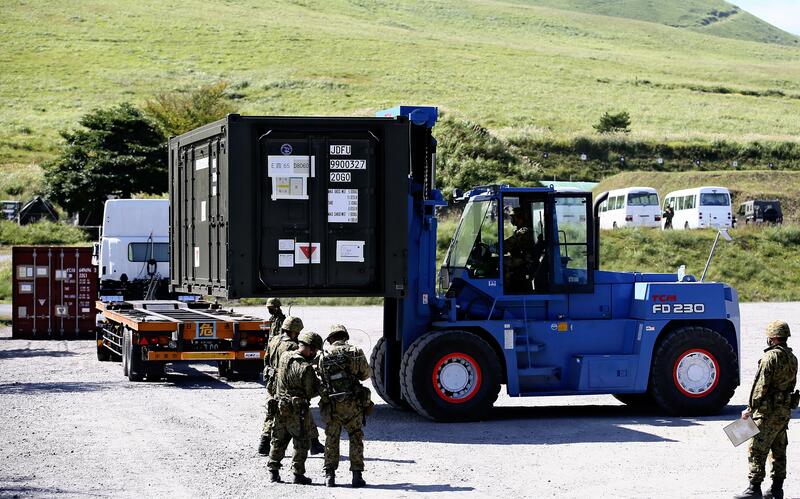
Exercises involving all units of the Ground Self-Defense Force have been carried out across the country, focusing on basic logistics such as loading food onto trucks and transporting personnel in the largest training operation in about 30 years.
On Oct. 4, GSDF exercises were open to the media at the Hijudai Maneuver Area and the Jumonjibaru Maneuver Area, both in Oita Prefecture. GSDF members performed simple missions such as digging holes and hiding fuel drums to prevent enemies from finding them, installing air conditioners at field first-aid stations, and lining up cargo containers and checking inside.
The exercises were designed to simulate GSDF units confronting enemies on the front line, but the atmosphere was different from the image of a drill with moving tanks and a missile launch. GSDF members opened boxes containing bandages, tourniquets and other hygiene items and sorted them out, giving these exercises a feeling of moving house.
"It's very simple training, isn't it?" a participating member said while wiping away sweat.
The supplies were moved out from SDF garrisons in Hokkaido, the Tohoku region and elsewhere in the nation two to three weeks ago. Some of the supplies were transported by civilian ships, trains and aircraft. Training to transport medical supplies by civilian drones was also carried out in GSDF maneuver areas.
According to the GSDF, these exercises began on Sept. 15 in various parts of Japan and will continue for about 2-1/2 months until the end of November. They will involve about 100,000 participants, or 70% of all GSDF personnel.
This series of exercises focuses on preparations before the start of missions and the transport of supplies. GSDF units nationwide are being gathered in the Kyushu region, which is a priority area for the SDF.
Dispatching SDF units is a daunting task. In the case of the GSDF Second Division based in Asahikawa, Hokkaido, about 1,800 vehicles were used to transport its 5,200 members to the Hijudai Maneuver Area, located 1,500 kilometers away.
In addition to ammunition and food, washing machines, bathtubs and other daily equipment are needed for SDF personnel to conduct long-term activities. During these exercises, GSDF members inspected the equipment and items they planned to take in about 160 garrisons and other locations across Japan, and examined the routes they would take to Kyushu.
How quickly SDF units are dispatched and how they can be kept supplied is an issue that affects the foundation of SDF activities.
"Such [logistic] drills have been neglected, compared to live-fire exercises and other training," a senior GSDF official said. "We need to determine all the issues and examine if the fundamental parts of these units have weakened."
This is the first time in 28 years, since fiscal 1993, that the GSDF has conducted an exercise involving its all units.
At a press conference held after the training started, Gen. Yoshihide Yoshida, the GSDF chief of staff, stressed the need to focus on the logistic and hygiene divisions that handle supply and other basic operations. "We need to shine a light on them and get them ready for operations," Yoshida said.
-- Private-sector cooperation
The SDF has its limits in its ability to transport a large number of personnel, supplies, ammunition and vehicles. The GSDF has therefore sought cooperation from the private sector, to draw on their transport capabilities.
During an exercise, employees of Nippon Express Co. and Japan Freight Railway Co. joined GSDF personnel at the JR Tokyo Freight Terminal Station in Shinagawa Ward, Tokyo. The drill was intended to transport three Type 96 wheeled armored personnel carriers (WAPC), which had arrived from Tagajo, Miyagi Prefecture, to the Kyushu region by cargo train. It is unusual for combat vehicles to be loaded on a train in central Tokyo.
The GSDF asked companies in the shipping, railroad, aviation and transportation sectors for cooperation, and about 20 accepted the request.
However, a person at one participating shipping company said, "If the word gets out that we cooperate with SDF training, it could lead to a loss of customers or invite antipathy from port-related people."
A GSDF member in charge of the exercises said, "It took a lot of effort to find even one company to cooperate."
Read more from The Japan News at https://japannews.yomiuri.co.jp/













