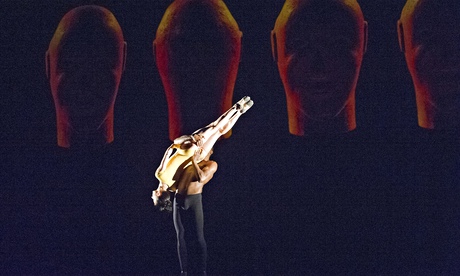
The Pederneiras brothers, Paulo and Rodrigo, have built themselves a superb choreographic instrument in their jointly run company, Grupo Corpo. Their 22 dancers are masters of a scintillating eclecticism of style, able to whip a languorous Latin shimmy into a sharp pirouette, to flip from samba to jazz to ballet in a single phrase. Yet from the evidence of the company’s latest programme, their collective talents appear to have become stuck in a very repetitive groove.
In Triz (2013), Rodrigo Pederneiras puts his dancers on display in choreography of tight, shifting geometric formations, an endurance test of coordination and stamina on a stark black-and-white stage. He describes Triz as an exploration of a tension, a physical state that’s a hair’s breadth between order and chaos, and it’s an idea that is given lots of potential within the dancers’ own bodies. Working in the movement’s formal constraints, they’re allowed to play with a potentially disruptive range of speeds and styles: little bouncing steps topped with lazily sensual rolls of the head, fluttering undulations of the spine that break into shearing leaps. It’s a play of formalism and anarchy that’s vivid in each performer.
Yet structurally the idea doesn’t go anywhere. The accompanying score, by the Brazilian composer Lenine, is a serious limitation on its developmental possibilities, a muddle of electronically treated strings with little drive or argument. Yet Pederneiras’s choreography, in all its quasi-minimalist repetitions and geometries, is equally static in its ambitions. Even with a cast of 18 to play with, it jigs along on a safe middle ground, rarely playing with extremes of dynamic or scale, rarely attempting to shift space and time. Only in the closing minutes, when the entire cast floods the stage, do we sense the power of what this great body of dancers could do.
There are similar problems with the progamme’s companion piece, Parabelo (1997). Musically, it occupies a different world, based on traditional rhythms and melodies of Brazil, and choreographically there’s a slight shift towards more expansive, earthy movement. But Pederneiras works with the same formal tropes of repetition and recycling, and his patterning of the dancers remains uneventful. Towards the end, the stage suddenly opens up to reveal a backdrop of old-fashioned family photographs, a fiesta of brightly coloured dance and costumes. The audience responds with joy – but it all feels like too little too late.
• Until 4 October. Box office: 0844 412 4300. Venue: Sadler’s Wells, London.