The number of junior high evening schools (see below) is gradually increasing, with a total of 34 nationwide in 10 prefectures and more being considered or prepared in those areas. These schools are mainly for students who have not finished their compulsory education. Today, about 80% of the attending students are foreign nationals.
The newest evening school was opened in April in Joso, Ibaraki Prefecture, following two in 2019.
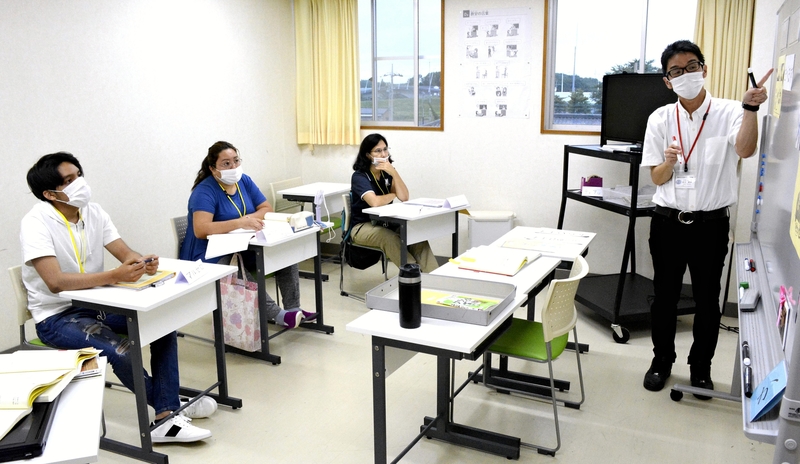
"Mo yoru gohan wa tabemashita ka?" (Have you had dinner yet?), a teacher asked the students in a Japanese language evening class given at the municipal Mitsukaido Junior High School in Joso on July 13. A foreign national student answered, "Hai, mo tabemashita" (Yes, I had).
Although this junior high evening school was set up in April, classes had not been given until June due to the coronavirus pandemic. It has 19 students ranging in age from their teens to seventies who live in the city or are from neighboring areas.
This school gives four lessons on weekdays. They are for the same subjects as those given at regular public junior high schools, including math and physical education.
About 70% of the students are foreign nationals. And they take different courses depending on their Japanese language levels.
"I'd wanted to study for a long time," said Yokoyama Claudia Christina, 31, a third-generation Japanese-Brazilian of Brazilian nationality. Yokoyama, who came to Japan when she was 15, was not able to adequately receive an education due to family-related reasons.
The population of Joso has the highest ratio of foreign residents, or about 9%, in the prefecture. The city decided to set up the first junior high evening school in the prefecture to "promote a multicultural society."
The school's vice principal Kunihiko Ishitsuka, who was involved in its preparation, said: "Junior high evening schools are the last bastion of compulsory education. It's important to have no student here drop out."
Behind its opening is the enactment of a law to ensure education opportunities. This mandate was passed in December 2016 and urges that junior high evening schools be set up.
A survey by the Education, Culture, Sports, Science and Technology Ministry shows that as of January, 11 prefectures are considering or preparing the opening of such schools, including the school in Joso, which was opened after the survey was conducted. Tokushima and Kochi prefectures are planning to open such schools in April next year, and Sapporo in April 2022 -- while Sagamihara, Kanagawa Prefecture and Omuta, in Fukuoka Prefecture, are considering opening these schools.
The reality, however, is far from the central governmental goal of providing at least one such school in each prefecture.
A major obstacle is that it is hard for local education officials to predict the number of new students that would enroll, unlike at regular elementary and junior high schools.
An official of the Kochi prefectural board of education, which aims to open a junior high evening school near JR Kochi Station, said: "Our prefecture is very broad from east to west. For some people, the location of this school isn't within a commutable distance. It's not easy to project the actual number of new students to come."
There is also a financial challenge. However, the ministry plans to provide support such as subsidizing costs for the opening and maintenance of these schools.
--80% foreign nationals
The survey by the education ministry also shows that as of January, the number of students enrolled with 33 junior high evening schools is 1,729, an increase of 42 from the previous survey in July 2017.
About 80% of the students, or 1,384, are foreign nationals, an increase of 28 from the previous survey.
Of the foreign students, 532 are Chinese nationals, the largest group by nationality, followed by 272 Nepalese nationals.
Asked about the reason for entering these schools, 47% of the foreign nationals stated that they can acquire Japanese speaking skills there. Asked about their postgraduation path, 59% of the total number of students said they want to attend senior high school. These ratios are the highest in the respective questions.
Of the total number of students of junior high evening schools, 197 Japanese nationals have not finished compulsory education, decreased by 61, and 148 Japanese nationals have graduated from junior high school, an increase of 75.
-- Junior high evening school
Junior high evening schools are located in public junior high schools and are established by local governments to provide evening classes. This system was launched in 1947 as many children were not able to go to school during the post-World War II chaos. Students at these schools today are people at the age of 15 or older who have not finished compulsory education; people who have graduated from junior high school but are rarely attending school for such reasons as refusal to go or illness; or foreign nationals who have not adequately received compulsory education in their countries.
Read more from The Japan News at https://japannews.yomiuri.co.jp/