The following is the third installment of a series looking at efforts by the tourist industry to survive the economic effects of the novel coronavirus outbreak.
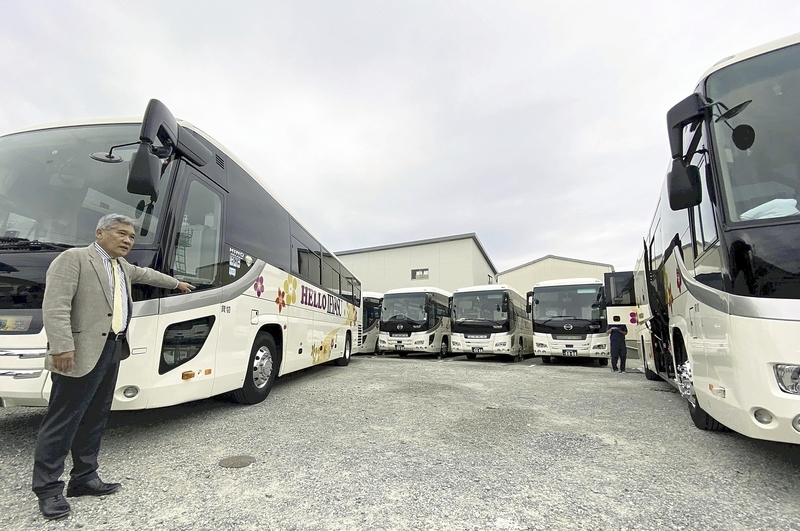
More than 20 idle tourist buses fill the parking lot of Ieyasu Corporation, a charter bus company in Onojo, Fukuoka Prefecture.
"I didn't expect that the tourism industry would be so fragile," lamented Ieyasu President Tsukasa Kaieda.
The industry got a shock at the end of January, when the coronavirus infection began to spread in China, and the Chinese government banned group travel abroad. Ieyasu was counting on more than 80% of its customers being foreign visitors, mainly from China. Demand suddenly evaporated.
The company had no choice but to lay off about 30 of its 70-plus employees to keep the company afloat. The employees who chose to stay in the company were allowed to work a second job on the side to compensate for the drop in income.
Meanwhile, the company embarked on a new business outside its field: Ieyasu's drivers became salespeople, visiting hospitals and offices to promote facial-recognition cameras with temperature detection functions.
According to the Land, Infrastructure, Transport and Tourism Ministry, the bus utilization rate -- which indicates how many buses owned by a company are in operation -- was 22.4% in September, showing some improvement from August's 11%, but still 30 percentage points lower than in the same month last year. The number of operators who suspended or closed operations due to the pandemic reached 112 in total between February and September.
-- Buses losing market value
"Our buses keep losing their value, and the market price for used buses has been halved as a whole," a used bus dealer in eastern Japan said.
Old buses painted completely white to cover up corporate names and logos are seen parked at the dealership's lot. Since May, calls have kept coming in asking the dealer to buy more buses.
Until the coronavirus crisis shutdown, the demand for sightseeing buses was on the rise amid the growing number of visitors to Japan.
Just a few years ago, purchasers had to wait for up to three years to get a new bus after ordering, a salesperson at the dealership said. Back then, a standard 45-seat new bus cost more than 30 million yen, while 10-year-old coaches were priced at around 15 million yen. Now, a bus of the same caliber has dropped to about 7 million yen to 8 million yen.
The dealership now receives offers to buy new buses that are only a couple of years old, or bundles of five buses. It recently had to say no to some offers. The balance between buyers and sellers has been reversed.
The revised Road Transportation Law, which was enforced in 2000, eased restrictions of the charter bus business, making it easier for newcomers to enter the market and also widening the options for travelers, such as by increasing the number of cheap bus tours. Driven by the government's tourism policy, the number of chartered bus operators increased to 4,127 in fiscal 2018, almost double the number of operators from 20 years before.
Buses cost more than half a million yen per month (excluding labor costs) to maintain if they are not running. So if demand disappears, the repayment of loans and lease payments can quickly become a burden. The current used bus market situation highlights the fact that an increasing number of operators have been forced to give up their buses.
Demand other than from foreign visitors has also been slow to recover. Schools have been a steady source of revenue for the charter bus business. It is believed that the 45-seat number in large buses derives from the fact that most classrooms have about 40 students.
This year, many schools are foregoing field trips and excursions to make up for the classroom time lost when simultaneously closed at the outset of the coronavirus outbreak.
Nara Kotsu Bus Lines Co., based in Nara, said its sales for school trips in October decreased by 40% compared with the same month last year.
-- Search for new business
Kotohira Bus Co., based in Kotohira, Kagawa Prefecture, has launched an online bus tour through the use of the Zoom videoconferencing software.
"We are leaving for Shimane Prefecture," a tour guide called out to virtual passengers at home, and an empty bus departed from Takamatsu.
The participants sang "Seto no Hanayome" (A bride in the Seto Inland Sea) in chorus as they passed the Seto Ohashi bridge. In Hamada, Shimane Prefecture, the tour destination, the participants enjoyed watching Iwami Kagura traditional masked dance, while tasting Hamada's specialty called akaten -- kamaboko fish cake with red pepper mixed -- along with local sake.
A guide gives a live tour while airing the video footage of previously recorded scenery from the Seto Ohashi bridge and Iwami Kagura. The local specialty food and sake are delivered to the participants' home before the tour. The 1-1/2-hour-long tour costs about 5,000, yen and participants can sign up from anywhere in Japan.
Kotohira Bus, which has suspended its bus tours since March, launched this online program in mid-May as a last-ditch effort. The company has conducted 14 kinds of tours on 100 occasions. It accepts 15 participants per tour, and the tours are almost always full. The operator is enjoying an increasing number of regular customers now.
The online tours have helped the company keep costs down, allowing it to make a meager profit of about 1 million yen a month.
"We hope to bring customers who have experienced the online tour to actual bus tours," said Kotohira Bus executive officer, who also is a tour guide.
Alpico Kotsu Co. of Matsumoto, Nagano Prefecture, began online tours of the Kamikochi tourist spot on a trial basis on Sunday. Tokan Kotsu Co., based in Narita, Chiba Prefecture, is marketing the use of shuttle buses to companies in anticipation of the need to avoid congestion on commuter trains.
The Nihon Bus Association is demonstrating safety measures against coronavirus infections in various locations, whereby white smoke filling a closed bus disappears in five minutes to indicate that the air inside the bus is ventilated.
"The time will come when chartered buses will become required, even if that doesn't happen now. We need to prepare for that time comes," the association's chairman said.
Read more from The Japan News at https://japannews.yomiuri.co.jp/