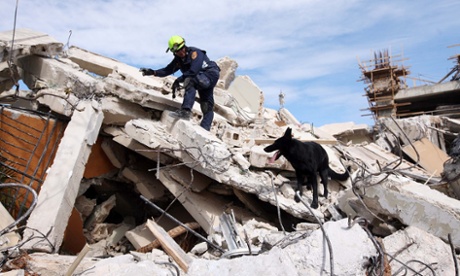
An earthquake that struck Haiti in 2010 killed more than 200,000 people. A quake of a similar magnitude in the US killed just one person. Why? Because richer countries have the resources to take advantage of advances in earthquake engineering and build resilient buildings. Buildings in earthquake-prone developing countries are not so sophisticated.
Social scientists predict that by 2050, the number of people living in cities vulnerable to earthquakes will have trebled. “You can’t prevent earthquakes from happening, but you can mitigate the effects and help save a lot of lives,” says Dr Barnali Ghosh, a senior engineer with engineering consultancy Mott MacDonald.
With a PhD in earthquake engineering from the University of Cambridge, Ghosh has worked in this field for the past 16 years, and is currently focusing on the design of a metro system in New Delhi that will be able to withstand a certain level of earthquake.
She’s also involved in projects to design earthquake-resilient hydro dams in areas such as Georgia and Pakistan. “Hydro power will be important in the coming years. In the past, engineers have always reacted in the face of disasters; now the focus has shifted to prevention. Advances in seismology mean that what was once too risky is now feasible.”
Although the UK isn’t a high-risk earthquake zone, some universities here focus on earthquake engineering and research, and many leading engineering design consultancies, such as Atkins and Arup, have UK bases. While undergraduate engineering degrees generally don’t cover this specialised area, the universities of Bristol, Surrey, Sheffield and Dundee, plus Imperial College and University College London, offer specialist postgraduate degrees, and the job prospects are healthy.
“Our postgraduates are in high demand; there aren’t many specialists around,” says Professor Ahmed Elghazouli, director of the MSc in earthquake engineering at Imperial College London. “Many find work with large, UK-based consulting firms.”
Insurance firms employ earthquake specialists to carry out risk analyses and the nuclear industry is another big employer. Even in areas of low risk, such as the UK, nuclear facilities must be designed to withstand earthquakes, no matter how unlikely an occurrence.
About 10% of Imperial’s students, most of whom come from structural engineering backgrounds, go on to further research: “The MSc sets you up well for this,” says Elghazouli. Despite the huge improvements in structural engineering over the past 40 years, many challenges remain.
“The focus now is how to balance risk with cost, designing cost-effective structures that can minimise the damage of an earthquake – particularly in developing regions such as South America and Asia. In more developed countries, the onus is on how to keep infrastructure going and minimise the costs of interruption to businesses.”
Each master’s course has a slightly different emphasis, but covers the fundamentals in structural engineering before moving on to more specialist areas; students at Imperial cover areas as varied as bridge design and non-linear structural analysis.
“Another big area is retro-fitting existing infrastructure so it might survive an earthquake,” says Ghosh. “No two jobs are the same. One day I could be designing a bridge, the next a nuclear power plant or a dam.”
“If I can improve the way the built environment survives in an earthquake I could save a lot of lives.”
Adam Crewe completed a PhD at the University of Bristol in 1999. He now heads the department of civil engineering, while researching how various structures respond to earthquakes
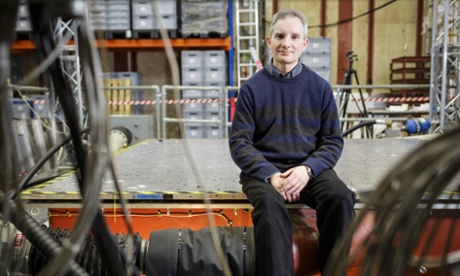
“I work with a ‘shaking table’ – a three metre square platform on eight hydraulic actuators that can recreate the movement of an earthquake. It’s the only one in the UK.
“We use the table to test industrial equipment and models of buildings to see how they would survive in an earthquake. At the moment I’m testing a nuclear reactor model that weighs around seven tonnes. Most of the testing we do is on models about a quarter of the size of the real thing. We have a strong multidisciplinary approach at Bristol, pulling in expertise from across mechanical, civil engineering and computer science departments.
“Research is all about making a difference. If I can even slightly improve the way the built environment survives in an earthquake I could save a lot of lives. For example stopping a bridge falling down so an emergency vehicle gets to a disaster scene quicker, for example.
“One future challenge is strengthening low-cost housing in the developing world. We are good at building new structures that don’t fall down in earthquakes, but you can’t apply the same techniques to mud-brick buildings or historic structures. There are also issues surrounding tsunamis and how to protect coastal cities in vulnerable zones.”
Keep up with the latest on Guardian Students: follow us on Twitter at @GdnStudents – and become a member to receive exclusive benefits and our weekly newsletter.