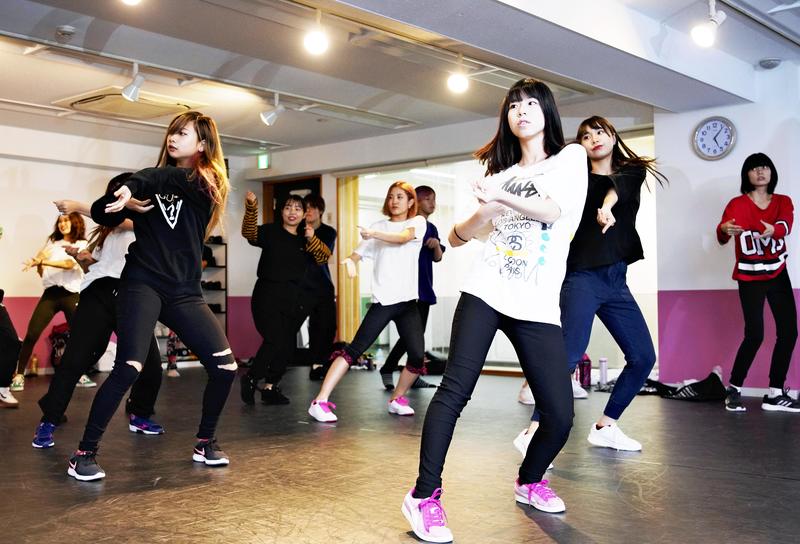
OSAKA -- With a dream of emulating the K-pop idols they so admire, more and more young Japanese are taking singing and dancing lessons. In response, a music vocational school in Osaka has started a special course dedicated to this entertainment genre, with participants aspiring to the day they can make their debut on the South Korean stage.
K-pop is a word used to designate the current form of popular music in South Korea. It is characterized by its highly precise choreography.
The rapid spread of K-pop's popularity around the world -- one group has already hit the top of the charts in the United States -- belies the current icy state of political relations between Japan and South Korea.
In Japan, two South Korean groups, BTS and Twice, both landed in the top 10 in Oricon's album rankings for the year in 2018.
As more look to K-pop as a means of achieving a thaw, the Osaka School of Music (OSM) Upper Secondary Specialized School, a high school-level vocational school located in the city's Nishi Ward, is doing its part with its K-pop course. Started in April last year, it drew about 20 students ready to sweat their way to stardom.
"Raise your shoulders in time with the steps," says the South Korean instructor of the class. "Be more sexy."
Mizuki Sasai, a 16-year-old student who attends the class, said of her aspirations: "What appeals to me about K-pop is the perfect synchronization of the dancing, and the singing skills. My aim is to head to South Korea after I graduate."
As the ultimate goal is a debut in South Korea, the course also includes Korean language lessons. Last spring, three affiliated schools located in Osaka, Tokyo and Fukuoka started classes simultaneously, drawing about 40 students.
"There were many students who wanted to do K-pop," OSM vice principal Akiko Inamura says of the response. "We started the course, and already we have had inquiries from South Korean production companies."
The spreading popularity of K-pop hit new heights last year when an album by the boy band BTS hit No. 1 on the chart of U.S. magazine Billboard -- the first time ever for a South Korean artist.
The South Korean government is also providing a push, with its Korean Cultural Centers located around the world holding K-pop courses in 25 countries including the United States, China and France. It has even held global contests for "cover dancing," in which participants imitate the choreography of top artists.
There is no shortage of fans in Japan, and the Korean Cultural Center Osaka, located in Kita Ward, Osaka, put on its first K-pop course in July last year. Applications for the four classes on singing, dancing or other aspects well exceeded the limit of 20 participants each.
In June last year, a world competition of K-pop cover dancing was held in Seoul, drawing 3,100 teams from 65 countries. Emerging victorious was the dance team Magnet from Kadoma, Osaka Prefecture.
It was in the early 2000s that the fire of interest in South Korean culture first started to spread with the hit television drama "Fuyu no Sonata" (Winter Sonata), which was hugely popular with housewives. What differentiates this latest spike in popularity is that it is concentrated among high school girls and other youths.
Recent events, such as South Korean court rulings for payment from Japanese companies to Korean requisitioned workers, have worsened Japan-South Korea relations. That makes cultural exchanges through K-pop or other means all the more vital, says Kim Sung-min, an associated professor at Hokkaido University.
"The K-pop boom is in a place separate from the political realm. While relations deteriorate between the two countries, this can become a tool to continue interaction."
Jung Tae-gu, the head of the Korean Cultural Center Osaka, also sees this a good chance to enhance relations.
"It is not an introduction to South Korean culture," Jung says. "We want the Japanese to learn about K-pop in South Korea. We will offer help as they aim to make their debut, and support exchanges that go both ways."
Read more from The Japan News at https://japannews.yomiuri.co.jp/