As we all adjust to a new life while the planet deals with the COVID-19 virus, we are getting used to living without live sports. To help fill the gap, the NFL has made their GamePass product available for free until the end of May. Some of you might be taking the plunge into GamePass, and the “All-22” for the first time. As someone who has been using the product for years, here are some tips on how you can grind the tape like a pro.
Getting Started

At first glance, the NFL GamePass system might be a bit overwhelming. But here are some pointers on how to get started.
When you enter the system, you will see a screen that looks almost identical to this one:

In the top blue bar you see, working from left to right, the following: “Games,” “NFL Originals,” “Film Session,” “Search,” and “Teams.” This is the place to begin. If you click on “Games,” as the above screen indicates, you will then be able to navigate through each week of the season. The default setting is the most recent week, and as you see the Super Bowl is the only game listed.
“NFL Originals” brings you to an incredible library of everything the NFL has produced, from the “America’s Game” series to “Hard Knocks” to “All or Nothing” and everything else you can imagine. “Film Session” is the film series with Brian Baldinger and Ron Jaworski breaking down game film with players like Cameron Jordan, Thomas Davis and Adam Thielen, plus coaches like Doug Pederson. “Search” is a topic on its own, and finally the “Teams” section will allow you to pick a single team, and pull up its entire season:


That’s what you see first when you click on “Teams,” and then when you click on the Baltimore Ravens. All of their 2019 games in reverse chronological order, plus you can also find original content featuring the Ravens such as “Sound FX: Ray Lewis” or “America’s Game: 2000 Baltimore Ravens.”
So now, let’s watch a game. To get started, say with the Super Bowl, you drag your cursor over the game, and you will see the following:

These are the four different ways of watching a game. The “Full Replay” is just the replay of the broadcast version, complete with the replays. As we will see in a moment, that also allows you to skip throughout the game by selecting a particular play. The “Condensed” version is an edited, shortened version of the broadcast version, usually somewhere between 30 to 40 minutes. Replays are stripped out, and you cannot skip around between plays. “Listen” allows you to hear the radio calls from both the home and the away teams. Then finally, the “Coaches Film” brings you to the All-22 goodness.
So let’s click on that and get started:

The player immediately brings you to the opening kickoff of the game. Now there are a few things to note before we start talking about the film itself. In the upper right corner you see the bar graph. Clicking on that allows you to view stats for the game. In the bottom left you’ll see the “-10” and “+10” options. That allows you to rewind or fast forward each play by ten seconds. That and the “Play/Pause” button are going to get a workout.
You’ll also see what looks to be a three item list, next to the stats option in the upper right. Click on that and the film window will shrink, but it will pull up a very handy feature for you:

That brings up the play-by-play list for the entire game. So if you wanted to work through the game focusing on all running plays, all passing plays, or you know a play in particular you wanted to watch, say, a huge third down conversion in the fourth quarter, you can click to that play and within seconds, there it is:

Look away San Francisco 49ers fans…
So now we know the basic mechanics. Now the fun begins. Let’s talk about what to watch for on the All-22.
Don’t hit play just yet

It probably sounds much easier than it is to accomplish in reality, but the beauty of the “All-22” angle is just that: You can now see everything. So resist the urge to hit the play button too quickly before each play. Removed from the constraints of the broadcast angle, you can let your eyes just…go.
Look at the above photo, captured from before a play between the Dallas Cowboys and the New Orleans Saints. Suddenly everything that the quarterback sees before the play, you can see. So rather than racing through the plays, take some time to soak in the information available to the quarterback before the snap. The more you know before the play, the more you’ll appreciate what happens as the play unfolds. So spend some time and get into the quarterback’s mind as best you can.
You can start with the offensive personnel and formation. Most offenses these days use 11 offensive personnel (three wide receivers, one tight end and one running back) as their base offensive package. See who is on the field for the offense, and where they are lined up. Here, the Cowboys have their 11 offensive personnel on the field in a 3×1 formation. Tight end Jason Witten is detached from the right tackle, with two receivers outside of him.
Now look at how the defense responds with their personnel. Here, the Saints use a 4-2-5 nickle defense.
Now we go through the pre-snap indicators. Look at the above still again and work through the quarterback’s pre-snap checklist. Start with the safeties. What do you see there? Two safeties, deep in the middle of the field. That is a pre-snap indicator to quarterback Dak Prescott that the Saints are in some variation of a two-high, middle-of-the-field-open (MOFO) coverage. It might be a basic Cover 2, a Cover 2 Man Underneath, perhaps Cover 4, or they could be bluffing. But Prescott’s understanding of the defense starts with that foundation.
Next, look at the cornerbacks. Where are they looking? How are their feet aligned? Are their feet staggered, with their eyes and hips facing into the offensive backfield? That is usually a zone coverage indicator. But look at the cornerbacks above: Feet parallel, eyes trained on the receivers. That is an indication that they are in man coverage on this play.
Next, try and see if there are any “capped” defenders. What does that mean? A cornerback, usually a slot corner but sometimes a boundary corner, with a safety aligned behind them. That is a signal that the corner might be blitzing, and the safety is in position to pick up their man coverage responsibility. If you look at the above still, the slot corner is somewhat capped by the safety to the strong side of the offense, so Prescott might want to at least be ready for a potential blitz.
For a great example of how the “capped” defender indicator works on a play, watch this adjustment by Carson Wentz and the Philadelphia Eagles:
See how the safety “caps” Nelson Agholor in the slot? That is an indicator to Wentz before the play that the slot cornerback is blitzing. Wentz audibles to a bubble screen to beat the blitz.
After looking at the secondary, now look at the defensive front. How many down lineman are there, and are there any indicators of a potential stunt or twist upfront? Sometimes you might see a defender staggered off the line of scrimmage a bit, and that could be a clue that they are stunting or looping. Are there any overload looks? Is a fearsome edge defender aligned inside? Don’t ignore what is happening up front.
Let’s work through the big play from Super Bowl 54, the 3rd and 15 conversion. Here is the pre-snap look:

Let’s start with the offensive personnel and formation. Patrick Mahomes is in the shotgun and the Kansas City Chiefs have a 3×1 formation, with three on the left. The personnel package is actually 12 offensive personnel. Tight end Travis Kelce is the inside receiver to the trips side while fellow TE Blake Bell is the single receiver on the right, using a tight split from right tackle Mitchell Schwartz.
Now let’s look at the defense. The first thing you might notice are the two safeties high, a potential Cover 2 (or two-high variation) indicator. But there is something else you might notice, and this is why it is important to note the offensive personnel the offense has on the field. Remember, the Chiefs have a tight end on the right side of the field alone, in Blake Bell. The defender to that side of the field? Richard Sherman, a cornerback. Either the 49ers are using a coverage cornerback on a reserve tight end, or some kind of zone coverage is in play.
So Mahomes, thanks to the alignment, can be pretty sure the defense is using zone coverage. But while he might expect a two-high look, he will need to confirm that once the play begins.
Now, let’s hit play. But don’t run through the entire play, instead take a note of what happens right after the ball is snapped:
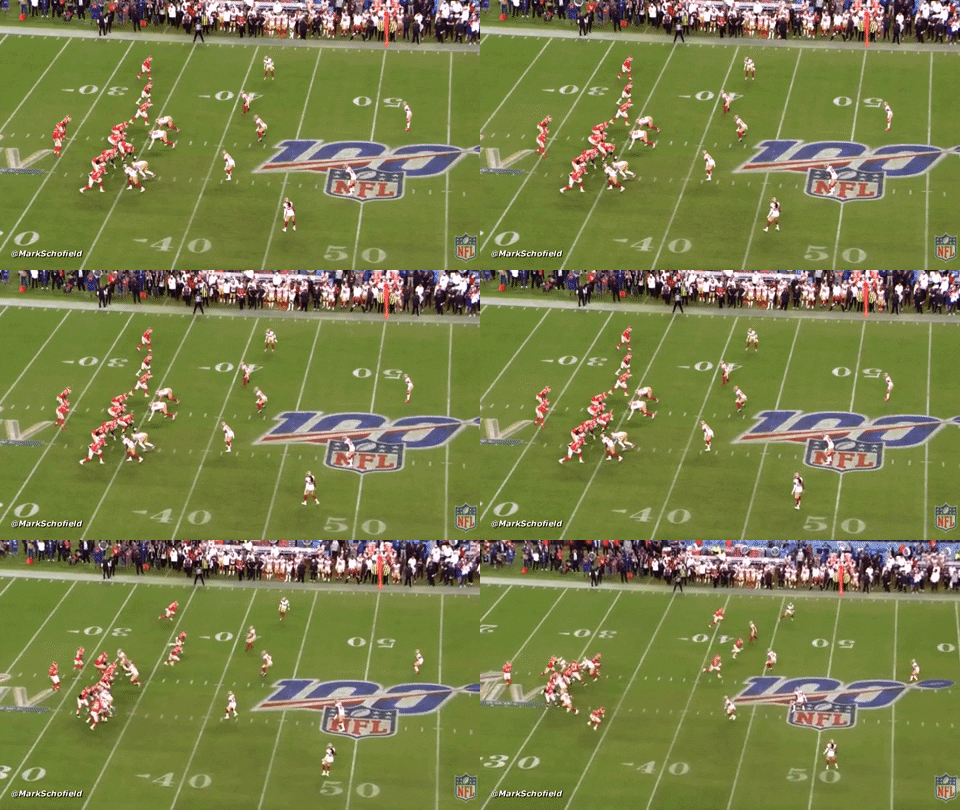
Did you notice what happened right before, and right after the snap? Sherman retreats a few steps right before the snap, and then one safety drops down after the snap. The 49ers are indeed in zone coverage, but instead are running a three-high zone coverage called Cover 6 Buzz. The weak safety is the safety rotating down while the strongside safety drops to the deep middle of the field.
So now we know the coverage, and as stated earlier, we can appreciate that much more how the play unfolds. Sammy Watkins runs a deep in route, and the outside cornerback to the top of the screen has to respect that route because he has no safety help over the top. Kelce also runs a deep crosser, which draws the attention of the linebackers and the safety rotating down into the box. That allows Tyreek Hill to get vertical and it creates a one-on-one with him and the free safety, and the FS is in a bad spot:
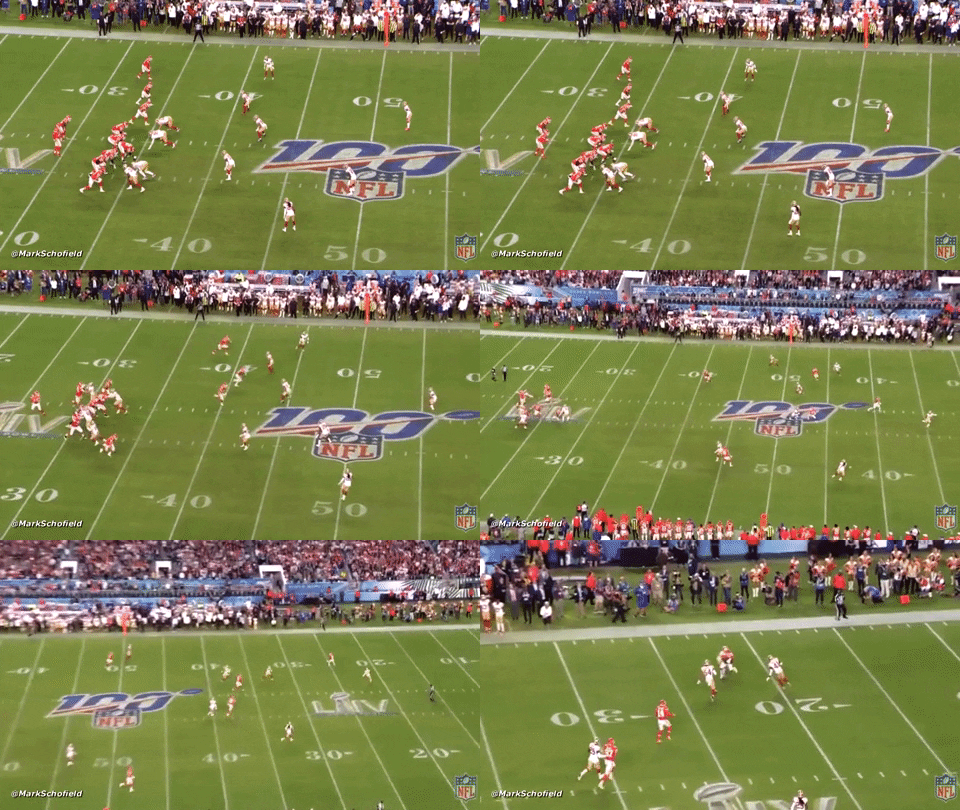
Hill spins the safety around, Mahomes hits him with the deep throw, and Super Bowl 54 changes on the spot.
Now the All-22 or “Coaches Tape” also gives you the end zone angle of every play, which is fascinating to see as well:
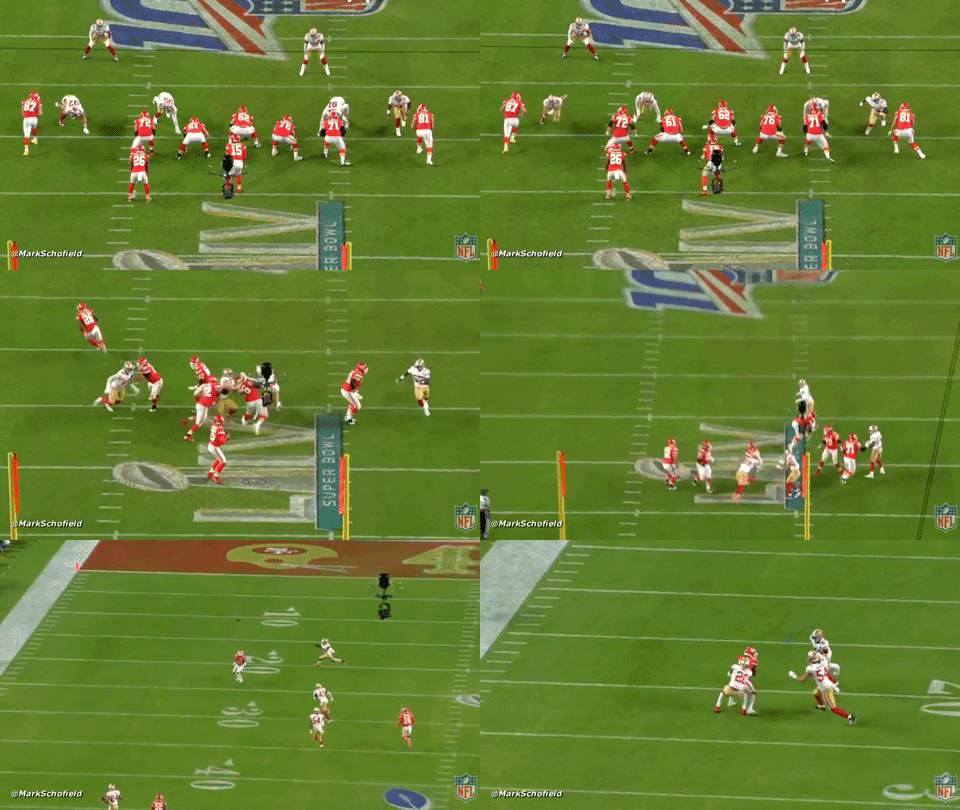
What do we see here? Before the snap we see the 49ers using two different “Wide-9” alignments. Nick Bosa is aligned well outside the left tackle, while Dee Ford is in a two-point stance inside of Bell, the tight end and outside of Schwartz, the right tackle.
As the play begins, the Chiefs slide their protection towards Bosa, with center Austin Reiter sliding to the left to join the left tackle and left guard. Bosa tries to knife to the inside while defensive tackle DeForest Bucker loops to the outside. Left tackle Eric Fisher stays on Bosa and drives him to the inside and the top of the pocket, keeping him away from Mahomes. But this puts left guard Stefen Wisniewski in a bad spot, as he has to stay on the looping Bucker. He manages to do that, giving Mahomes just enough time to uncork the deep ball on this slow-developing play.
Another feature of the end zone angle, besides seeing just how incredible the battles in the trenches are? You can engage in a favorite pasttime of football writers and play the game “Is this inside zone or is this duo?”
The end zone angle allows you to see how the blocking develops on running plays, and you can often figure out the difference between gap/power plays (where the blockers are blocking a man and creating a crease) versus zone plays (where the blockers are blocking zones or areas, and the running back is reading the flow of the play). But there is a catch. Inside zone plays often look like “Duo,” which is variation of power sometimes termed “power without the puller” with a pair of double-team blocks.
If you’d like a handy thread on how to identify Duo, I would recommend this thread from former University of Wisconsin quarterback Nate Tice:
Leftovers and recommendations

A few more thoughts to share before you start diving into “the tape.”
If you are on Twitter during the NFL season you might see, say on a Tuesday morning, various NFL writers griping. Especially if the Chicago Bears have just played a home game. Why? Because of the notorious Soldier Field “All-22” angle.

Yeah, it is…not that helpful. Basically just a wider angle of the broadcast tape. So while you might be excited to dive into a ton of film, maybe skip the games where the Bears are at home.
Speaking of the broadcast film, if you are looking at watching wide receivers, replays from the broadcast tape are also a great way to see isolated matchups of a receiver versus a cornerback. Say you wanted to see a closeup of Hill’s “Wasp” route on the big third down conversion, after watching the All-22 of the play. You can switch to the “Broadcast” version of the game, and you will still have the ability to see the list of each play as outlined earlier in the “Coaches Tape” discussion. Scroll to the play in particular and select that play. Now, sometimes the play does not exactly match up (for example if you select the 3rd and 15 conversion it brings you to just before Mahomes releases the pass, so you can rewind with the “-10” button) but eventually you’ll see the replay of Hill’s route:
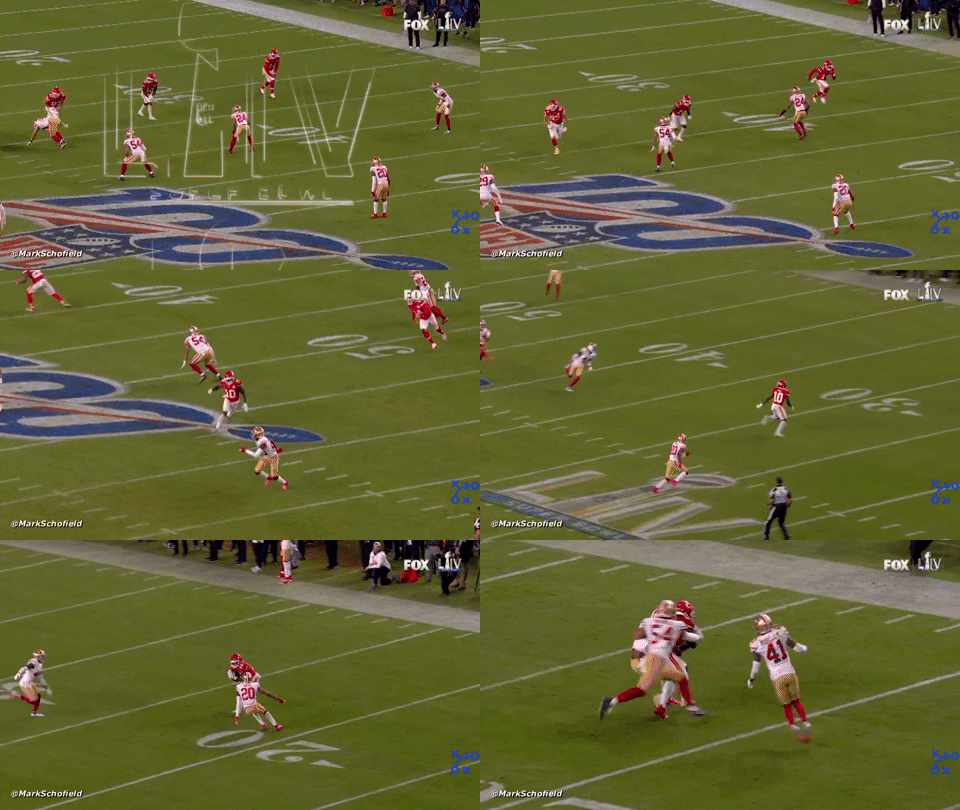
The replay angles are great to get a detailed look at technique from WRs and CBs.
The other thing to point out is the “Search” function. Now, I’ve been writing about football professionally since the 2014 season. I’m embarassed to tell you know long it took me to figure out how to use it…so I won’t. But I’ll walk you through it.
If you click on “Search” it brings up these three options: “Team Search,” “Player Search” and “In-Game Highlight:”

Team search is similar to the team option already highlighted, as it allows you to search by team through the NFL’s catalog of shows. “In-Game Highlight” looks like this when you select it:

You can change the parameters in terms of play type (here “Complete Passes” are selected but you can also select things like “Big Plays,” Fumbles, Interceptions and other options), season and week. The above still has all complete passes from Week 3 of 2018. And for each play, you can see either the Broadcast angle (the play button) or the All-22 (the film icon):

One thing to keep in mind is that in the search function, every play is listed as a “goal to go” situation, and the game time is listed but not the quarter. The Steelers did not have a 1st and goal on their own 10 yard line anytime in Week 3…
As a result, when using search it helps to have a play-by-play window opened as well, either with Pro Football Reference or ESPN, to sync things up.
The final option is “Player Search.” That looks like this:

This allows you to do specific searches by a player. You can look for, say, all of Julian Edelman’s targets from 2019 by adding his name into the search field, then clicking on “Plays” and selecting both complete passes, interceptions and incomplete passes (to cover all the bases) and then the search button:

Edelman had 153 targets in the regular season and five more in the Wild Card round, so this roughly checks out. Dive in and see what Tom Brady had to throw to last season, if you dare…
So now that you’re ready to start watching the tape, where to begin? Allow me to make a few recommendations. The 2018 Monday night game between the Chiefs and the Los Angeles Rams is a fantastic study from an offensive perspective, as is almost anything from the Rams’ 2018 campaign. You can fire up Lamar Jackson and the Ravens from this past season, two good games are their opener against the Miami Dolphins and their Sunday night dismantling of the New England Patriots. Speaking of New England, their Super Bowl against the Rams was not the most enjoyable to watch live, but that is a great game to study both in terms of how the Patriots defended the Rams, and how the New England offensive line handled Aaron Donald in the trenches.
For my money, given the ability to study safeties, watch some Buffalo Bills games, paying particular attention to their safeties Micah Hyde and Jordan Poyer. The Bills and their pair of safeties do a great job at spinning their coverage and confusing quarterbacks from pre-snap to post-snap. Try and study them if you can.
Enjoy the tape!