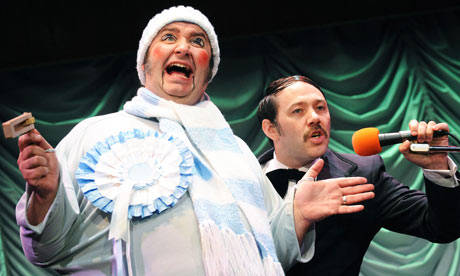
It's fascinating watching Trevor Griffiths's 1975 play Comedians, now running at the Lyric Hammersmith, with 21st-century standup comedy in mind. Griffiths dramatises the night on which six wannabe comics compete at a local talent contest, and in doing so, explores what makes the art form tick. Is there more to comedy than making people laugh? Should standups look up to their audience, or assume the worst of them? And – most important of all – should comedy be about entertainment, or about the truth?
The latter may have been an urgent question in the 1970s, when the unreconstructed, "my mother-in-law" generation, made famous by ITV's The Comedians – featuring Bernard Manning, Frank Carson, Jim Bowen, et al – were about to be elbowed aside by an angry mob of truth-tellers. Nowadays, though, entertainment versus truth seems like a false opposition. Most standups don't see them as mutually exclusive, and almost all are situated on a continuum between those poles rather than (as per Griffiths's play) uncompromisingly at one end or the other.
But Sean Holmes's revival is still welcome – and not only because it's so unusual these days to hear standup comedy spoken of in terms of love, truth and morality. An argument between comedy student Mick Connor – who "want[s] to be rich and famous. And what's wrong with that, Mr Waters?" – and his idealistic teacher Eddie (played by Matthew Kelly), who insists that "we work through laughter, not for it," seems timeless. Plenty of standups, then and now, would agree with Keith Allen's judge Challoner, who says of the audience/comic relationship: "We're servants. They demand. We supply."
There is certainly still dishonesty in comedy, even if it's perhaps better able to disguise itself than in earlier eras. When the going gets tough, Griffiths's amateur standups resort to lazy stereotypes about the Irish, the Africans and the wife. Today's get-laughs-quick equivalents might be less blatant, but they're scarcely more "truthful": the knob gag; the provocative misogynist or outre remark; the national (but safely non-racist) stereotype. And then there are an apparently endless list of Men-from-Mars-Women-from-Venus routines that collect a tiny observation and stretch it into the least authentic of general truths.
The act that Griffiths offers as a possible way forward is that of Connor, an Irishman who makes his own identity the basis of his standup. Thirty years later, that routine looks almost as cheap as the crude Manningisms Griffiths wished it would replace. Stewart Lee has ruthlessly spoofed the comedy of identity, which at its worst is a kind of internalised stereotyping: "My mother is from [Country X] and my father is from [Country Y]. So when I see a potato, I don't know whether to eat it or shove it up my arse." One generation's truth, then, is another's hollow cliche. Griffiths's play falls foul of that fact – and reminds us why it's important to know the difference.