Against South Africa, they rolled out their big units; for the quarter-final against Australia on Sunday, Scotland are going for light and pacy. Not that they have much choice in the matter.
The controversial three-week bans handed down from World Rugby this week to Ross Ford and Jonny Gray mean that Scotland lose a significant degree of physicality up front and that trend has been furthered by the loss of Matt Scott in the centre to a back strain. Fraser Brown, two stone lighter than Ford, and Tim Swinson, two inches shorter than Gray, come into the pack, while Peter Horne, a ball-playing centre cum fly-half a stone and a half lighter than Scott, takes on the No12 shirt. As if to pursue the theme to its logical conclusion, Vern Cotter has chosen Blair Cowan to partner John Hardie on the flank, ahead of the burlier Johan Strauss – work-rate in defence getting the nod over ball-carrying and close-quarter mauling.
Cowan will wear the No6 shirt, having worn No7 in all but one of his 12 starts for Scotland, but Cotter argued that he is at least as good a blindside flanker as he is an openside. Certainly, he has ample experience at club level in all three positions of the back row.
The plot has thickened further with the news that David Pocock is out of Australia’s lineup. Michael Hooper might be seen as a like-for-like replacement, but Australia also bring in Ben McCalman for Sean McMahon. In other words, for this match Australia are dispensing with the policy of fielding two opensides in their back row, while Scotland are embracing it.
So much for the tactical niceties. Scotland will go into the match with a plan, Australia will go in with one, but the outcome, or at the very least Australia’s margin of victory, will be determined by deeper energies. Scotland have been hammered by the citing officers and written off as the longest shot of the quarter-finals’ underdogs. They stride out on to a Twickenham field that has not yielded them a win for 32 years. Their status as underdog is as hard set as ever, no matter that this is as dangerous a Scotland team as we have seen in recent years.
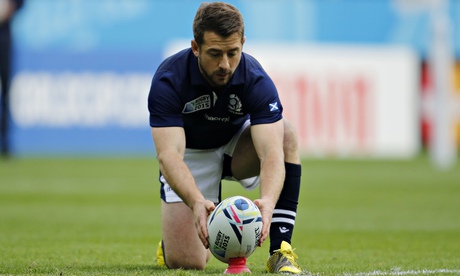
“We need to come out fighting, regardless of the players missing,” said Greig Laidlaw, Scotland’s captain. “We’re not going to sit back and just let Australia play at us. We’re in the quarter-finals, and we deserve our place there. The enthusiasm of the boys coming into the squad has been obvious. They’ve been given an opportunity and they need to grab it with both hands, put in a massive performance.”
Twickenham may have proved a joyless venue for Scotland, but Australia have not been entirely ungiving opponents. Indeed, Scotland have won two of the last three matches between the two: one a dogfight three years ago in the wind and rain of New South Wales, Laidlaw landing three penalties for a 9-6 win; the other a scarcely believable defensive stand in a 9-8 win at Murrayfield in 2009, when Matt Giteau missed five shots at goal.
“I think psychologically it’s good that we’ve beaten Australia before,” said Laidlaw. “It’s not like New Zealand, who we’ve never beaten. To not have that burden to overcome, all these little things add up. Australia have probably been the best team so far in the tournament – but we’re looking to put a stop to that on Sunday.”
Scotland are better equipped to win – maybe even with a touch of panache – than they were in either of those two previous wins, but they remain no less the underdogs. That is because Australia look a lot better too. The appeals of Ford and Gray will be heard on Saturday morning, but the team have long since handed the matter over to the suits. Scotland will draw on the anger that the bans have inspired and, as ever, on that of a team dismissed as without a chance. The last quarter-final of the weekend may yet prove as competitive as the others.
Scotland: Hogg; Maitland, Bennett, Horne, Seymour; Russell, Laidlaw (capt); Dickinson, Brown, Nel, Swinson, R Gray, Cowan, Hardie, Denton. Replacements: Bryce, Reid, Welsh, Strokosch, Strauss, Pyrgos, Vernon, Lamont.