This is a sport riven with seemingly unresolvable contradictions. It demands athletes go ever faster, higher, longer while tying itself in knots over the consequences. With a nervous eye on the day when Usain Bolt no longer commands the eyes of the world, it cries out for personality.
Yet too often individuality is crushed under training schedules and obscured by the demands of “teamship” and the unspoken requirement not to bite the hand that feeds.
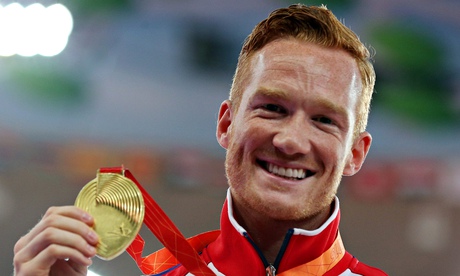
Greg Rutherford, who styles himself as the outspoken rebel against the British Athletics rulebook, has encouraged the sport’s leaders to slacken the reins if they want the public to see rounded personalities rather than tracksuited automatons.
“The issue we have as athletes is that I think we’re seen as a bit boring because nobody ever says anything,” says Rutherford, the morning after proving his doubters wrong by seizing victory in the Bird’s Nest and completing a set that also includes Olympic, Commonwealth and European golds. “Ex-athletes sometimes do, and we have seen with Linford [Christie] over the years he’s come out and said how the system hasn’t worked with him and other ex-athletes,” said Rutherford.
“But nobody within the sport is saying what it’s currently like. If in 10 years’ time I came out and said when I was doing it, it was rubbish, that’s not changing anything and it’s a bit late to do that. In my opinion there are things that need to change and that’s the opinion of a lot of people.”
It is striking that all three gold medallists so far in Beijing – the Super Saturday trio of Rutherford, Jessica Ennis-Hill and Mo Farah – have to various extents thrived outside the British Athletics eco-system rather than inside.
With his eve of championships outburst about the way in which Lottery funding is means-tested and his misgivings about the removal of the union flag from the kit in order to build the British Athletics “brand” he certainly did not endear himself to officialdom. However, the 28-year-old insists that many within the team share his concerns and are scared of speaking out for fear of losing their own funding.
Caught between striking while the iron is hot and a reluctance to tarnish his post-victory glow with recriminations, Rutherford said he planned to sit down with the UK Athletics chairman, Ed Warner, and chief executive, Niels de Vos, after the championships and outline his concerns.
“Absolutely I will look to sit down with them and some other people as well. I’m trying to build up enough people’s views and experiences so that we actually have a solid case to discuss and move forward with,” he said.
There are two sides to every story and there are those within the system who see Rutherford as an egoist with one eye on his commercial appeal and the other on his post athletics career. They wonder if it might not have been better to raise his issues in private rather than in public on the eve of a major championships.
They point to the fact that despite his insistence that he wanted to go his own way after his London 2012 triumph British Athletics have at various points employed his coaches, offered him medical assistance (albeit at their Loughborough hub rather than his house) and paid for travel. Yet while Rutherford can probably be difficult, he cannot help but also appear inherently honest. Athletics is an unusual sport in the tension between the necessarily selfish individualism required to succeed and the team dynamic that applies when it comes to major championships.
But it is hard to argue with Rutherford when he says that many athletes fail to offer their opinions on matters both big and small due to fear of losing their funding and that athletics lags behind other sports in allowing them to assert their opinions. “Definitely I think athletes should speak out if they see something wrong or if somebody has wronged you in some way,” he said.
“Rather than just keeping it in and sticking with the status quo and living with it, try and change it. There is a fear for certain people but in actual fact as long as you qualify for things like funding speaking out and having an opinion shouldn’t influence that.”
Following in a proud lineage that stretches from Daley Thompson to Phillips Idowu, Rutherford is determined not to run with the pack and will continue to kick against the tide. From nearly quitting the sport in the wake of his post London 2012 crash, which hit rock bottom around the time that injury and poor form decimated his 2013 world championship hopes, he has proved an athlete of supreme resilience.
His latest victory with a more than respectable leap of 8.41m will bring personal reward – he has a new agent and a kit deal with Nike – but hopefully also peace of mind as he returns home to his partner and young son.
From being the eager-to-please “ginger kid” who craved acceptance to his steely focus in overcoming adversity, he has not only proved the doubters wrong but perhaps proved something to himself.
“All I want is for people to be really pleased when I do well,” he insists. “I don’t want it to be me having to come out and saying ‘I’m not a fluke’ and trying to prove people wrong. All I’ve ever wanted is acceptance.”