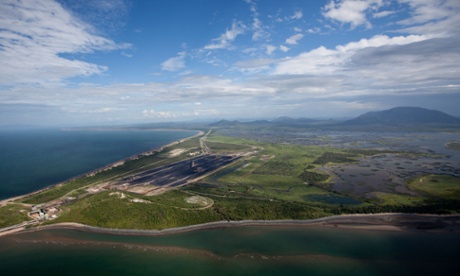
Greg Hunt, the federal environment minister, has hit out at activist group GetUp over a legal challenge targeting his handling of a plan to dump seabed sediment on to a sensitive wetlands area near the Great Barrier Reef.
The Alliance to Save Hinchinbrook, a Queensland conservation group, launched court proceedings in Brisbane on Thursday, using funds donated from a GetUp campaign.
The legal action is seeking an injunction and judicial review of what conservationists call Hunt’s “rushed” assessment of a Queensland government plan to dump sediment dredged in order to expand the Abbot Point port near the town of Bowen.
Hunt had already approved a plan to dump the sediment in the waters of the Great Barrier Reef but after an outcry a new plan was devised to dispose of the material within the nearby Caley Valley wetlands.
The court action claims Hunt did not make a thorough assessment of this new plan and allowed just 10 business days before Christmas for consultation.
The environment minister, however, pointed out that he has yet to make a decision over whether to approve the dumping, accusing GetUp! of spreading “completely false” information.
“GetUp ignores the truth either due to their own ignorance or blatant desire to run a political campaign,” Hunt said.
“Green groups claimed that a federal decision would be rushed before Christmas. This was always false and has now been proved to be false, deceptive and misleading.”
Hunt said GetUp had remained “overwhelmingly silent” over the previous Labor government’s plan to dump sediment within the Great Barrier Reef marine park and claimed the Coalition had helped eliminate five separate proposals to deposit sludge near the reef.
“Environmental groups called for onshore disposal at Abbot Point,” Hunt said. “Now the very thing they demanded is the very thing they oppose.”
Hunt said GetUp is “running a baseless scare campaign that is hurting the very local communities that love and protect our iconic reef”.
Unesco requested that the government rethink the plan to dump five million tonnes of dredged spoil in the reef’s waters, as its world heritage committee deliberates whether to officially list the ecosystem – which is in poor health having lost half of its coral cover in the past 30 years – as “in danger” later this year.
As part of a concerted effort to avoid the in danger listing, the Queensland government came up with an alternative plan to dump the sediment within an enclosed area of the Caley Valley wetlands, which is considered nationally important habitat for more than 15 species of migratory birds.
Although environmentalists were pleased that the spoil was not dumped at sea, which could have resulted in corals and sea grasses being fatally smothered by sediment, they have raised fresh objections against the wetlands plan, claiming that it is rushed and could damage to the surrounding environment.
Dredged material will be contained within constructed embankments near new railway lines that will run to the Abbot Point port, which is being developed by the Indian firm Adani to export coal extracted from its huge Carmichael mine in central Queensland.
The dumped sediment would directly wipe out 114.3 hectares of foraging habitat for birds; another 16.4 hectares will be lost because of the increased activity and noise. More than 97 hectares of potential seagrass habitat, vital for animals such as turtles and dugongs, will suffer “permanent and irreversible loss” due to the dredging, a Queensland government assessment has found.
“To secure the protection of coastal ecosystems and the integrity of the ecology of the whole Great Barrier Reef, it is essential that we protect all such wetlands,” said Margaret Moorhouse, a spokeswoman for the Alliance to Save Hinchinbrook.
“That’s why we are running this case: to force minister Hunt to comply with the law on assessment processes.”
Sam Regester, senior campaigner at GetUp, described the wetlands plan as a “terrible project led by a dodgy company backed by an irresponsible government”.
In response to Hunt, Getup said it launched its campaign to save the Great Barrier Reef in 2011, targeting the previous Labor government by delivering a petition with 127,000 signatures to the then environment minister Tony Burke, calling for an end to the industrialisation of the reef.
“It was the Coalition government that approved dumping at sea at Abbot Point,” Getup said in a statement. “Their position only changed after two separate legal challenges funded by Getup members and intense community campaigning made the plans to dump at sea at Abbot Point a politically disastrous position for the government.
“Environment groups never asked for a Great Barrier Reef wetland to be destroyed.
“Minister Hunt fast-tracked the assessment process by not requiring a full environmental impact statement, the absolute minimum you’d expect for a project of this size and environmental impact.”