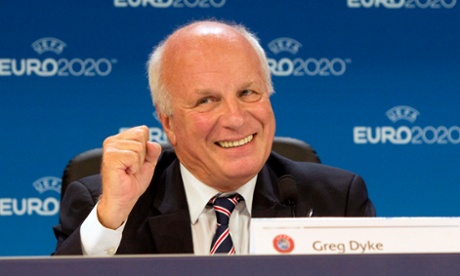
Such is the bloody mess left by the executive decapitation at Fifa it is almost impossible right now, even for those with their eyes fixed on the detail, to see an easy route out of the chaos. Some things, though, are clear enough. In confusing times it is often best simply to tune out the most distracting voices, just as elite football managers are said to shut out all distractions in the heat of battle, blind to anything that will not help them win. With this in mind the first thing that needs to happen, for the good of the game, is that Greg Dyke needs to stop talking. No, really Greg. That will do.
On Wednesday morning the FA chairman could be heard once again repeating with absolute, combative certainty his belief the 2022 World Cup bidding process should be reopened and Fifa itself reconstituted to a precise set of Dyke-approved rules. Never mind Dyke appears to be a little shaky on some of the details, objecting repeatedly on BBC radio that nobody (nobody!) in Blatter’s own organisation had told the president to resign, and thereby overlooking the fact the head of Dyke’s own federation had demanded exactly that last week.
The more urgent issue is that, at a moment of transformational chaos in football’s governing body, Dyke has no one within his own organisation to tell him to stop talking. Or at least to stop saying all the wrong things during an impasse that requires not squealed demands for a recount but diplomacy, tact and above all an understanding of how this looks to the rest of the world.
The war against Blatter may have been won for now. The much bigger challenge, indeed the whole point of the exercise, is to win the peace. Blatter’s exit will be irrelevant if Blatterism itself, the politics of self-interest and calculated division, is allowed to fester in the unscabbed wounds.
With this in mind what Dyke and many in Europe seem unwilling to accept is that Blatter was voted in as the Fifa president not because those who backed him are all corrupt, ill-informed, or motivated by anti-European bile (although some may be). But because many of Blatter’s supporters saw the incumbent as the lesser of two evils, a flawed but oleaginously ingratiating outreach candidate.
Post-Blatter there is a fear outside Uefa and North America of a Euro-centred power grab, a Carthaginian Peace where wrongs under Blatter are used as a moral imperative to take back and exclude – a moment of punitive opportunism for the old world.
Michel Platini is the favourite to win a re-run election. Platini may have backed Qatar as an arm of the Franco-Qatari entente cordiale but he is above all the head of Uefa, an organisation that centralises its wealth and which represents the most powerful interests in world football, the same European clubs and associations that hog the programme for the other 46 months between World Cups. Good luck, Africa, with that one.
The issue here boils down to timing and smart politics. Dyke may be right in the abstract. A World Cup in Qatar is an undesirable prospect for many reasons, not least because migrant workers will continue to die at an unprecedented rate as the infrastructure is built, just as migrant workers will continue to die all over the world while people are desperate to escape poverty and others willing to exploit them.
Football can make a powerful statement that this will not happen in its name but as a point of principle this will resonate only if it can do so with clean hands and with no hint of self-interest. The worst possible outcome now is to convey to the rest of the world that this is all about sour grapes over the award of a World Cup, rather than the objective facts of corruption and death. Europe must be seen to be fairer than fair, to set its own example of disinterested meritocracy.
For this reason calls to strip Qatar of its tournament should be muted until there is absolute, unarguable evidence of a corrupt vote, a case that makes itself. For now it is a moment to let events play themselves out. Maybe there is even something to be learnt here from Blatter’s astonishing success over 17 dictatorial years. Beyond the tawdry details here is a leader with the fine diplomatic sense to recognise a large portion of the footballing world felt overlooked and marginalised, and that by doing something he would be doing more than nothing.
Africa deserves better than Blatter (everyone deserves better than Blatter) but when Fifa members outside Europe look to the old world beyond the president there are plenty who see hypocrisy and entitlement. In Dyke they might see an FA chairman who has accepted not one but six watches during his own tenure, including the famous £16,000 job during the World Cup in Brazil (which he has since returned). They might see an English FA that couldn’t even make a decent fist of de facto bribery, offering up 24 Mulberry handbags to Fifa committee members’ wives during its own bid process and thereby allowing even Jack Warner to claim the moral high ground by returning his unwanted bag with the disdain of a man palming off a Christmas cracker prize.
In this context the principles Blatter preached, if not the practice – global reach, inclusion – have a great deal to commend them. This is a moment for tact and conciliation, for reaching out. What the English FA appears to be offering is a dunk in the gunge tank, Timmy Mallet leaping up on Radio 4 and battering the rest of the world over the head with his foam-rubber hammer of righteousness.
What comes next will be the key. Russia will host the 2018 World Cup whatever any investigations uncover about the process involved. Qatar looks more vulnerable. First because of the human cost of its construction, and second because of the basic absurdity of staging a tournament there at all.
And yet football will go on either side of Qatar, as will Fifa in whatever shape can be crafted. If Dyke really has to say something it should be to announce England has no interest at all in staging a 2022 World Cup, and the FA believes the tournament should stay in that region whatever the outcome. Abu Dhabi and Dubai have staged plenty of global sporting events. Failing that, give it to Malaysia or China. Give it to Ghana or Greenland. Give it to anyone who hasn’t had a World Cup, anywhere that feels under-represented, and do so with a smile. A united, uncorrupted future is what is at stake here, not four weeks of pageantry in June.
Beyond this the wider fixing of Fifa will be a matter of controlled, consensual change. Ideally independent accountants would end up logging every dollar in and every dollar out, with Fifa edged closer to the unlikely dream of an independent, utterly transparent charitable administrator. How close we get to this, with the looming fudge of a Euro-takeover, the threat of split and division, depends entirely on engagement, tact and trust. It is possible to reform Fifa and to make the world see sense on Qatar. But not simply – Greg, please – by shouting it down.