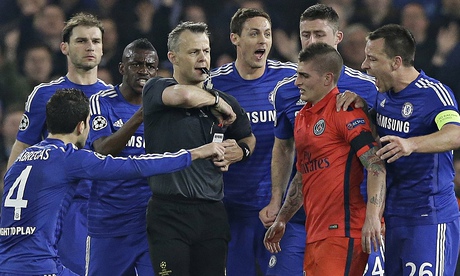
The Football Association chairman Greg Dyke has called an increase in incidents where players crowd the referee “pretty scary” and warned of the potentially toxic effects at grassroots and youth level.
As revealed by the Observer on Sunday, the number of clubs charged over incidents where three or more players have approached the referee in a confrontational manner has already almost tripled in the top five divisions on last season.
The number of times that a warning or reminder has been issued for players surrounding the match official has also already reached 29 this season, compared to 23 in 2013-14 and 14 in 2012-13.
“We have seen a pretty scary increase this season in the number of clubs charged with their players surrounding referees. As a result we have written to the clubs in the top five divisions reminding them of the rules and their responsibilities,” said Dyke.
Speaking a week after the furore that surrounded Chelsea’s Champions League last-16 tie with Paris Saint-Germain at Stamford Bridge, when Zlatan Ibramovic was sent off after Chelsea players swarmed around the referee, Dyke said professional clubs needed to lead by example.
“I believe it is particularly important for professional clubs to set an example so that this kind of conduct is not replicated at grassroots and youth level,” he said. “The whole game needs to ensure it is addressing this issue.”
There is believed to be particular concern about the possibility of the practice of aggressively swarming around the referee spreading through junior football at a time when other ills including simulation are taking wider hold in the grassroots game.
The FA, determined to take a strong stance on the issue by charging clubs on a consistent basis, could look into increasing the levels of fines that are imposed when they are found guilty of attempting to intimidate the referee.
Following the PSG match, the Chelsea defender John Terry admitted it “did not look good” if players surrounded the referee but argued that they had to match their opponents.
“Once they’re charging the ref, the only thing we can do is respond,” said the Chelsea captain. “You can’t, as a group of players, let them surround the ref, trying to get our players booked.”
The FA wrote to all clubs in the top five divisions in December to remind them of their responsibilities. The issue could also be raised at the quarterly stakeholders meetings that feature representatives from Professional Game Match Officials Limited, the Professional Footballers’ Association, the FA, the professional leagues and the League Managers Association.
It is understood that the issue was raised directly with players on the club visits that precede the season.
Yet the FA’s figures show that so far this year in the top five divisions there have been 16 incidents that resulted in a charge, 29 where a warning or reminder was issued and 15 where no further action was taken. That compares to six charges last season, 23 warnings and nine incidents requiring no further action.
While the FA can charge clubs when an incident in which three or more players crowd around the referee is included in their official match report, it is also open to individual officials to take action by issuing cautions on the field of play.
Chelsea were not charged by Uefa’s disciplinary committee following their Champions League exit because football’s European governing body does not have a specific rule prohibiting players crowing the referee in the same way as the FA does.