The Green party has insisted its policies are both practical and fair as it formally launched a manifesto targeting the twin priorities of ending economic austerity and highlighting the environmental crisis.
The party’s leader, Natalie Bennett, announcing the manifesto alongside its sole MP, Caroline Lucas, said voters could “transform British politics” by voting Green in sufficient numbers on 7 May.
“This is a new kind of politics, the end of politics as usual, the business as usual politics that accepts politics and society being run for the benefit of the few, not the many,” she said.
Key elements of the Greens’ plans were connected to social justice, she said. “No one in this, the world’s sixth richest economy, should fear not being able to put food on the table or not being able to keep a roof over their head. This is a politics that is founded in humanity.”
While Bennett and Lucas stressed what they see as the increasingly mainstream position of the Greens in a possible post-election coalition, the full, 84-page manifesto remains avowedly radical in many areas, with promises including £85bn of spending on home insulation and renewable energy, a significant increase in pensions and welfare benefits, re-nationalising the railways and a £10 per hour minimum wage by 2020.
Lucas stressed that the party would consider supporting Labour in parliament on a case-by-case basis after the election, but both she and Bennett remained vague as to how they might back renewed austerity measures.
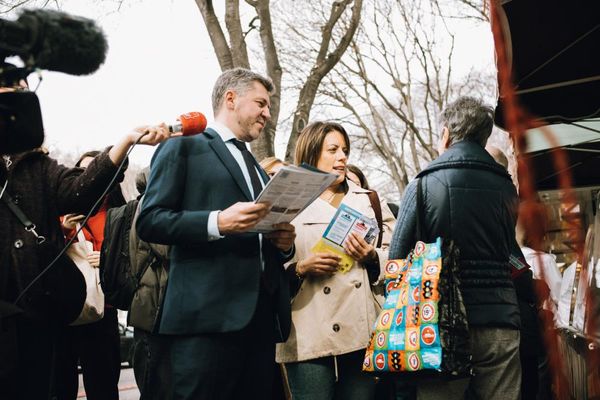
Introducing the plans at the Arcola theatre in east London – chosen as it runs a parallel fuel cell business and aims to become carbon neutral – Bennett said her party wanted to end “the disastrous policy of austerity”. This was, she said, “making the poor, the disadvantaged and the young pay for the greed and the fraud of the bankers”.
The Greens opposed the privatisation of public services, and wanted to return the rail network to government hands, so it could be “run for the benefit of passengers, not shareholders”, she said.
For too long, Bennett argued, the first past the post electoral system had given voters a choice of “the lesser of two evils” with Labour and the Conservatives. She said: “You have two barely separable parties jostling for the votes of a few swing voters in swing seats. That’s the kind of politics we have now. A kind of politics that has left so many people disappointed, even depressed.”
During this month’s seven-way party leaders’ TV debate, Bennett added, she had been the only person to even talk about climate change. The party was now fighting its first election with an MP – Lucas was elected to Brighton Pavilion in 2010 – and a “Green surge” had seen the party membership rise above those of the Lib Dems and Ukip.
Lucas spoke in greater detail about the party’s environmental pledges, saying such ideas were vital, and had been neglected amid austerity. “It’s not something that can be discarded when times are tough, like that extra cappuccino on the way to work,” she said.
A key element to this is a plan to give householders a £5,000 grant to insulate their properties, with an option of £15,000 more in subsidised loans, concentrating on the most deprived areas. This was not just fair, Lucas said – about 9,000 people a year died prematurely in Britain due to cold homes, Lucas said, many more than on the roads – but deeply practical, as they would permanently lower energy use and create 100,000 jobs.
The Greens would support any Labour government on a case-by-case basis, Lucas said, giving the party a good opportunity to push its priorities. But Lucas and Bennett refused to say specify whether Labour’s renewed commitment to austerity could bring problems. “It’s very difficult at this point in time, with a great deal of uncertainty, to talk through any negotiations on 8 May,” Bennett said.
The details of the manifesto contain several radical ideas, for example the proposal that all new homes should be built to the Passivhaus system, an exacting German-devised standard which aims to make properties hugely efficient in heating needs. On rented housing the Greens would introduce controlled rents and five-year tenancies.
Significant spending is aimed at pensions and welfare, with a planned new “citizens’ pension” of £310 a week for a couple and £180 for single people. On education, the compulsory school age would rise to seven, but with free, voluntary provision before then.
To pay for all this the party particularly aims to target more wealthy people, with a “Robin Hood tax” on financial transactions, and plans to employ 15,000 more HMRC to tackle tax avoidance. There would also be a wealth tax of 2% a year on those whose wealth is £3m or more. “The potential yield is uncertain,” the manifesto notes of this latter tax.
The final pages of the manifesto give a broad outline of proposed spending a revenue figures, which are likely to face considerable scrutiny. Asked how the party planned to pay for the more generous welfare and pensions provisions, Bennett referred the questioner to the tables in the manifesto: “It’s all set out there, going through the details at this point isn’t a very useful thing.”