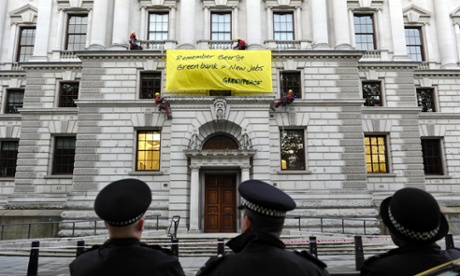
David Cameron likes to boast that his coalition government was the first in the world to create a green investment bank to accelerate investment in new energy infrastructure. Now the new Conservative government is a seller. A plan to start to move the Green Investment Bank (GIB) into private ownership will be announced on Thursday.
This policy will be pitched as a way to liberate the GIB to lend even more. Look, we will be told, our creation is so successful that it can make its own way in the world while staying true to the original ambitions.
A heavy dose of scepticism is required. First, the GIB has been up and running for only three years. It has lent only £2bn of the original £3.8bn earmarked by the Treasury. Current financial performance is acceptable – there was a tiny profit last year and the projected rate of return is 9% – but it’s very early to conclude that the organisation can prosper on a pure diet of private capital.
Second, the whole point of a publicly funded GIB is that it can lend at lower rates of return than the private-sector investors would accept. By taking the riskiest investment slices, it attracts other investors and thus gets new infrastructure built.
Would private sector owners be so happy to be high-risk lenders? It seems unlikely. Governments can’t tell privately owned banks where to lend. The GIB might end up chasing lower-risk projects, like onshore wind, where capital is in good supply already.
Third, the argument that the GIB is constrained by state-aid rules is weak. The organisation seems to win approval almost every time. Its current annual report, for example, boasts about expansion into community-scale hydro projects after the receipt of state-aid clearance.
Part-privatisation would be digested more easily if the yet-to-be-invested £1.8bn were still firmly committed to the GIB. Even that, though, is in doubt now that the hunt for private investors has started. Part of the sum may simply remain in Treasury coffers, where it could be described as another “saving.”
If so, it will be another jolt to investors’ confidence in an energy sector – green and otherwise – where investors are screaming for certainty in government policymaking.
Supermarket deals still distant
It’s a mighty stretch to say that the merger between Dutch group Ahold and Belgian counterpart Delhaize marks a revival in dealmaking in the supermarket sector. Yet warmer breezes managed to drift across from the continent – Morrisons and Sainsbury’s were two big risers in the FTSE 100 index.
Buyers may have had other reasons to like the UK supermarket duo, of course. Let’s hope so because the read-across, to use City jargon, from Ahold/Delhaize is surely precisely zero.
The €25bn (£17.8bn) merger is designed to combat Walmart in the US, where both companies have their main operations. The US food retailing market is still sufficiently fragmented to allow consolidation. The UK isn’t.
The discount invaders to the UK – Aldi and Lidl – would probably have to expand to at least three times their current size before regulators would tolerate a combination of two of the bigger players. Quite right, too: the old order is finally having to fight harder to retain loyalty, and we customers are enjoying the scrap.
Quindell questions at last
They are busy folk at the Financial Conduct Authority, but what took them so long to launch an investigation into Quindell, the insurance claims handler?
The company announced a full four weeks ago that there would be heavy rewrites to past figures. It said accountant PwC, brought in to take an independent look, deemed certain past accounting policies “not appropriate”. Indeed, the new boardroom regime at Quindell said itself that it viewed some practices as “at the aggressive end of acceptable practice”. Both statements should have caught the ears of the regulators at the time.
CVC eyes the finish line
If private equity house CVC really could make five times its money from its investment in Formula One by selling to the Qataris and/or a US tycoon, it sounds like a deal too good to refuse. Bernie Ecclestone’s creation has made exploratory tours of the public markets more than once over the years and found few takers for a hard-to-understand trophy asset. That exit would seem to be permanently closed. In CVC’s shoes, that’s a problem that can’t be ignored indefinitely.