How to produce more with less – greater yield with fewer negative environmental impacts - counts high among the complex challenges decision-makers will face this year in finalizing objectives and investment strategies to bring about a sustainable future for the planet and its people.
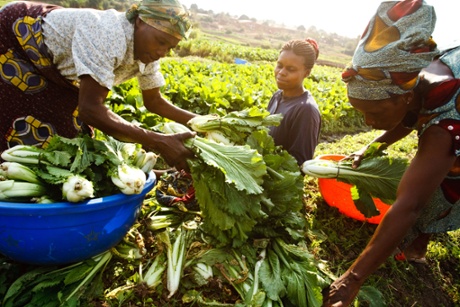
Agriculture utilizes natural resources - land, water, biodiversity, forests, fish, nutrients and energy - and environmental services, and transforms them into food, feed, fibre and fuel.
FAO estimates that food output needs to rise by 60 percent globally to feed a growing world population projected to top 9 billion by 2050. But that increase cannot come at the expense of further damage to the earth and its ecosystems. World governments, set to adopt the post-2015 development agenda in September, have been addressing this question since the beginning of the process more than two years ago.
From Green Revolution to sustainable food systems
Focusing on ways to intensify agricultural production is nothing new. In the final quarter of the 20th century, the Green Revolution boosted cereal yields in South Asia by more than 50 percent thanks to the use of high-yielding varieties, irrigation and high levels of chemical inputs. However, according to a recent FAO publication, ‘Building a common vision for sustainable food and agriculture’, those technologies largely ignored efficient use of resources: “The Green Revolution relied extensively on irrigation to raise yields and secure production, contributing to rapid depletion of water resources.”
Today, a third of farmland is degraded, up to 75 percent of crop genetic diversity has been lost and 22 percent of animal breeds are at risk. Almost 30 percent of fish stocks are overfished, and from 2000-10 some 13 million hectares of forests were converted into other land uses each year.
Agriculture produces more than enough food for all people on the planet, but around 800 million still live with chronic hunger. The inefficiency of modern food systems is highlighted by the loss or waste of a third of global food production.
“The global food system over the next 40 years will experience an unprecedented confluence of pressures,” predicts a 2011 UK government report, ‘The Future of Food and Farming’. The 2012 revision of the FAO report ‘World Agriculture Towards 2030/2050’ states that “significant parts of world population will reach per capita consumption levels that do not leave much scope for further increases”.
More with less
FAO has developed a number of agriculture approaches focused on producing more with less.
No magic seed exists to improve the environmental performance of agriculture for all landscapes in all regions, but the techniques have several elements in common: knowledge-sharing and capacity building, better harnessing ecosystem services, good governance and coherence across different agriculture sections, conservation and sustainable use.
One model, Save and Grow, developed by FAO in 2011, uses an ecosystem approach to intensify crop production that enhances both productivity and sustainability, builds resilience to climate change and reduces greenhouse gas emissions. Save and Grow promotes farming systems based on conservation agriculture practices, the use of good seed of high-yielding adapted varieties, integrated pest management, plant nutrition based on healthy soils, efficient water management, and the integration of crops, pastures, trees and livestock.
Other initiatives FAO and its partners have launched that integrate the three dimensions of sustainable development include:
· Sustainable forest management conservation and use of forests
· Code of conduct for responsible fisheries
· Climate smart agriculture
· Global soil partnership
· Sustainable land management
· Energy smart food for people and climate
· The ecosystem approach
· Conservation and sustainable use of biodiversity and genetic resources ()
· Sustainable food systems program
The importance of agriculture – the single largest employer in the world – has now been recognized by policymakers drafting a global framework to succeed the Millennium Development Goals at the beginning of 2016. A dedicated goal on food and agriculture, SDG2, reads: Ending hunger, achieving food security and improved nutrition, and promoting sustainable agriculture, and includes targets relating to biodiversity, access to land and resources, soil quality, resilience and climate change. Sustainable use of natural resources is also prominent among a number of other SDGs, including ecosystems, biodiversity and forests; fisheries and climate change.
But the transition to sustainable agriculture will also need a significant commitment of resources. On the way to final post-2015 negotiations on means of implementation, the Third International Conference on Financing for Development in Addis Ababa in July will provide an opportunity to assess the policies, institutions and investments needed to successfully promote sustainable agriculture. High on the agenda will be discussion on evaluating the environmental cost of production and better including natural resource and nutritional values into agricultural prices and value chains, and moving from investments that have low “sustainability” returns to higher ones.
Decisions taken in the next few months are destined to shape the planet’s future, answering the critical question of how to produce more with less.
Content on this page is paid for and provided by FAO, a sponsor of the Guardian Global Development Professionals Network.