
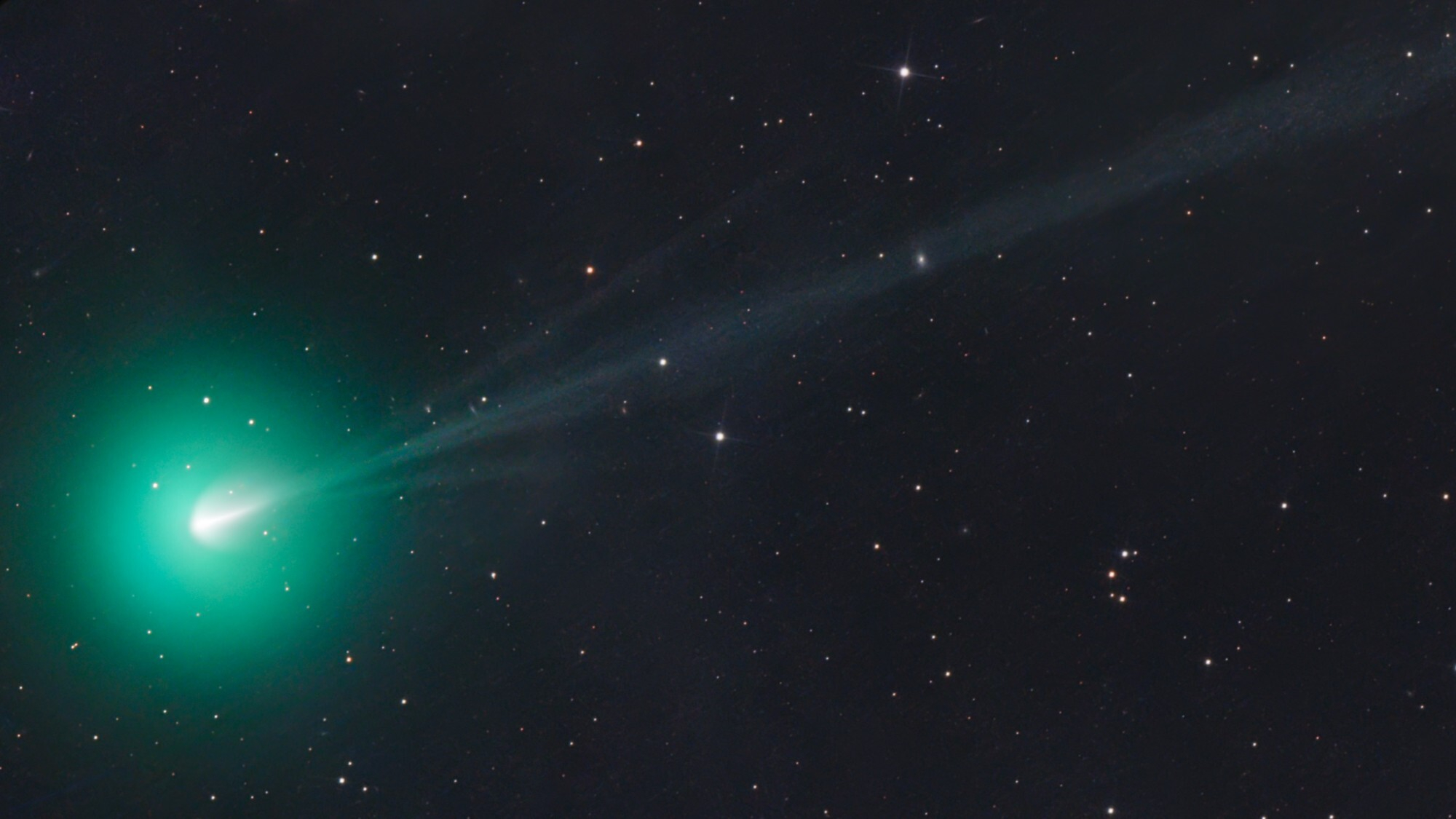
What a view. Astrophotographers in Namibia have captured a bright green comet soaring overhead in a spectacular new photograph.
What is it?
In this incredible new photograph is the comet 220P/McNaught.
Discovered by Australian astronomer Robert H. McNaught, the comet orbits our sun once every 5.5 years. Back in June, the comet reached perihelion, or the closest point in its orbit around the sun. Around that time, the comet experienced a large outburst, which brightened it about 8,000 times.
The comet brightened back up this August to about 600 times its normal brightness — and it was during this period when astrophotographers Gerald Rhemann and Michael Jäger captured it streaking across the night sky over Namibia.
To capture the moment, the pair used a 12-inch Astrograph telescope with a ZWO ASI 6200 MM Pro camera.
Why is it incredible?
It's not every day you see a comet in the night sky. Even if one is overhead, often they're too tricky or too far away to spot without a telescope, and even then it can be a challenge.
It's also incredible that the moment captured in the new image showcases the comet 220P/McNaught with such spectacular clarity and detail. It must have been something truly special to witness.
While spotting a comet like this might not happen every day, we can sometimes see the debris trailing behind a comet as its tail burns up in our atmosphere. These burnt comet bits are actually the "shooting stars" we see in the night sky during a meteor shower.
Right now, the Perseids meteor shower is on its annual parade across the night sky. This meteor shower is made up of debris shed by the comet Swift-Tuttle as it swoops by on its annual trip across the solar system. Under dark skies, skywatchers can see up to 100 shooting stars thanks to Swift-Tuttle.