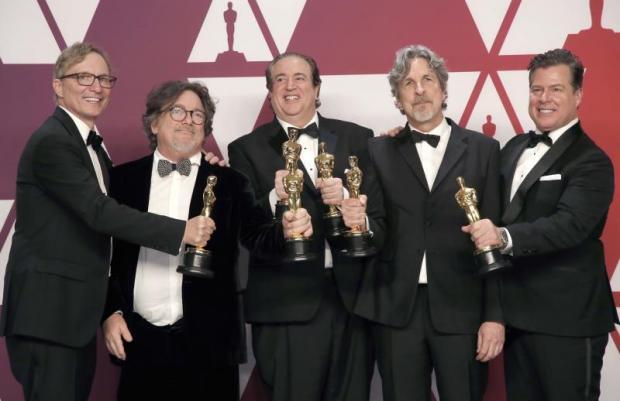
Green Book, about a white chauffeur and his black client in segregation-era America, won best picture at the Academy Awards, overcoming mixed critical notices and a series of awards-season setbacks. By backing Green Book voters slowed the ascendancy of Netflix, which had been pushing a competing nominee Roma.
The first hostless Academy Awards in 30 years took its lead from the Grammys, opening on Sunday with a rowdy rendition of We Will Rock You by Queen, the supergroup chronicled in the blockbuster best-picture nominee Bohemian Rhapsody.
"Welcome to the Oscars!" shouted Adam Lambert, who has taken over for Freddie Mercury as Queen's frontman in recent years, as a waterfall of sparks fell to the Dolby Theater stage.
Tina Fey, Amy Poehler and Maya Rudolph then took the stage and -- while explaining they were not the hosts -- gave a mini-performance that drew relaxed laughter from the audience and seemed to make the case that the three women should be hired to co-host next year, pronto. In a quick segue, they began presenting the Oscar for best supporting actress at the show's eight-minute mark. Last year, it took the show 18 minutes just to get through Jimmy Kimmel's monologue.
Regina King won the trophy for the lyrical art film If Beale Street Could Talk.
"I'm an example of what it looks like when support and love is poured into someone," King said, composing herself after breaking into tears.
Alfonso Cuarón won best director for his semi-autobiographical Roma, as expected, his second victory in the category in five years, having received an Oscar for Gravity in 2014. It was the fifth time in six years that a Mexican filmmaker has taken the prize. Cuarón collected the equivalent trophy for Roma at the Directors Guild Awards and the Golden Globes.
Olivia Colman, a first-time nominee, won best actress for playing a lonely and manipulative Queen Anne in The Favourite. Colman's victory was a humbling defeat for Glenn Close, a seven-time nominee who had been widely expected to clinch her first win this year for playing the title role in The Wife.
Rami Malek, a first-time Oscar nominee, won best actor for his toothsome portrayal of Freddie Mercury in the blockbuster Queen biopic Bohemian Rhapsody. Malek was the front-runner, having picked up trophies for the performance at precursor ceremonies like the Golden Globes and SAG Awards.
Spike Lee and his three fellow BlacKkKlansman writers won best adapted screenplay for their story about an African-American police officer who infiltrates the Ku Klux Klan with the help of a Jewish surrogate. It was Lee's first competitive Oscar. He started his speech with an expletive and praised his family before pivoting into anti-Trump politics by sounding a battle cry for the coming presidential election.
"Let's all mobilise," Lee shouted. "Make the moral choice between love versus hate. Let's do the right thing!"
Green Book won best original screenplay. It was written by Nick Vallelonga, Brian Currie and Peter Farrelly. Vallelonga, who wrote the book on which the film was based, thanked his parents. Farrelly thanked his cast, agents, publicists, production executives, family and the entire state of Rhode Island. Shallow, the duet between Lady Gaga and Bradley Cooper that serves as the centrepiece of A Star Is Born, won best song. The film came up short during much of the awards season, but Shallow proved irresistible to voters.
Two subsequent awards also found African-American women called to the stage. Ruth E. Carter won best costume design for her Afro-futuristic Black Panther attire. Carter, a three-time nominee (Amistad, Malcolm X), was the first African-American winner in the category. Hannah Beachler made history herself as the first African-American to win in the production design category, also for her work (with Jay Hart) on Black Panther.
"When you think it's impossible, just remember to say this," Beachler said, reading off her phone during an emotional speech. "I did my best, and my best is good enough."
The film also won for Ludwig Goransson's score.
Another early trophy went to Cuarón, who won the Oscar for cinematography for Roma, making him the first director to win for shooting his own film. Roma also won best foreign-language film.
Free Solo, about a daring rock climber, took the prize for documentary feature.
"Thank you National Geographic for believing in us, and for hiring women and people of colour," said one of its directors, Elizabeth Chai Vasarhelyi.
The Academy of Motion Picture Arts and Sciences had pressed the producers of this year's ceremony to dramatically reduce the running time. Last year, the Oscars stretched to almost four hours -- beyond the endurance of viewers, with ratings dropping to a record low. In one abandoned plan, the academy wanted to award four Oscars, including hair and make-up, during the commercial breaks, with the winning moments edited and aired later in the broadcast.
Perhaps as a protest, intentional or not, the three winners for hair and make-up, honoured for their work on Vice, took their time at the microphone. In an awkward and halting set of thank-yous, they fumbled with a piece of paper containing names and went way over their allotted 90-second time. Producers started the playoff music and ultimately cut sound to the microphone.
For much of the first half of the ceremony, the Oscars played out like the more populist and less prestigious Golden Globes -- veering in multiple directions as voters sprinkled their attention among a half-dozen pictures, with no film walking away with a commanding sweep.
Bohemian Rhapsody picked up Oscars for sound editing and sound mixing. John Ottman also won the Oscar for editing Bohemian Rhapsody. None of the winners thanked Bryan Singer, who was fired as the film's director because of erratic behaviour on the set and has been dogged by sexual misconduct allegations.
Green Book got on the board with a supporting actor victory by Mahershala Ali, who plays an erudite musician in the film who hires an unrefined white man as his chauffeur and bodyguard. It was Ali's second supporting actor win in two years. (He previously won in 2017 for his role in Moonlight.) Ali became the second African-American man to win two Oscars for acting, joining Denzel Washington
"I want to dedicate this to my grandmother, who has been in my ear my entire life telling me that if at first I don't succeed, try, try again," Ali said from the stage.
Spider-Man: Into The Spider-Verse won best animated feature for Sony Pictures, as expected. The win was a blow to Disney and its Pixar studio, which have dominated the category since its creation in 2001 and had two nominees this year, Incredibles 2 and Ralph Breaks The Internet.
Peter Ramsey, one of the three-credited Spider-Verse directors, spoke about the importance of inclusion in animated films.
"We see you, we're powerful," he said to fans who identified with the diverse characters in the film.
Pixar did not leave empty handed. The studio's Bao, conceived and directed by Domee Shi, won the Oscar for best animated short. Even the space-race thriller First Man picked up an award, for visual effects. © 2019 New York Times News Service
Best picture:
Green Book
Best actress:
Olivia Colman, The Favourite
Best actor:
Rami Malek, Bohemian Rhapsody
Best director:
Alfonso Cuaron, Roma
Best supporting actress:
Regina King, If Beale Street Could Talk
Best supporting actor:
Mahershala Ali, Green Book
Foreign language film:
Mexico's Roma
Original screenplay:
Green Book, Nick Vallelonga, Brian Currie and Peter Farrelly
Adapted screenplay:
BlacKkKlansman, Charlie Wachtel, David Rabinowitz, Kevin Willmott and Spike Lee
Original Song:
Shallow from A Star Is Born, music and lyrics by Lady Gaga, Mark Ronson, Anthony Rossomando and Andrew Wyatt
Cinematography:
Alfonso Cuaron, Roma
Best animated film:
Spider-Man: Into The Spider-Verse
Original Score:
Ludwig Goransson, Black Panther
Costume design:
Ruth Carter, Black Panther
Production design:
Black Panther
Sound Editing:
Bohemian Rhapsody
Sound Mixing:
Bohemian Rhapsody
Film Editing:
John Ottman, Bohemian Rhapsody
Animated short film:
Bao
Documentary short subject:
Period. End Of Sentence
Visual effects:
First Man
Live action short film:
Skin
Documentary feature:
Free Solo
Make-up and hairstyling:
Vice