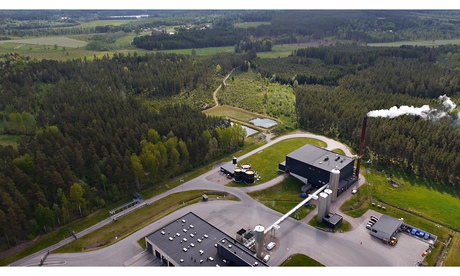
Every year, the green and leafy town of Vimmerby in southern Sweden hosts thousands of Astrid Lindgren fans paying tribute to the author’s popular Pippi Longstocking and other children’s characters. Lindgren’s birthplace is also one of the country’s most enterprising regions, where diverse industries dot the landscape.
One of the largest of these is Arla Foods, with its hi-tech Vimmerby plant, processing an average of 1.5m kg of milk daily. More than 13,500 farmers in Sweden, Denmark, Germany, Belgium, Luxembourg, the Netherlands and the UK own the Arla milk co-operative.
Dealing with dairy wastewater
In 2012, Arla planned to expand its Vimmerby production to meet a growing demand, but the resulting wastewater presented a problem. The municipality’s wastewater treatment facility was already running at full capacity. Expanding the facilities to meet Arla’s needs would take an estimated three to four years.
That is when the people at Arla Vimmerby contacted Grundfos.
“We sent them our requirements regarding the purity of the discharged water and they said ‘no problem’”, says Pär Bragsjö, Arla Foods’ facility manager. He adds that Grundfos was able to meet all of the plant’s demands, including a very tight deadline. A contract for the BioBooster decentralised wastewater system was signed in November 2012 and the plant was up and running by May 2013.
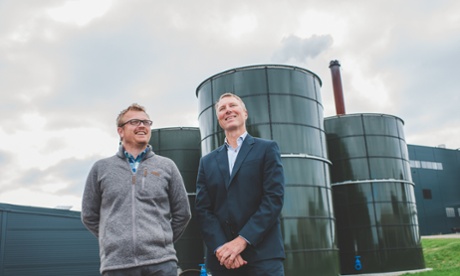
“It is performing even better than we had hoped for,” says Pär Bragsjö. “The cleanliness of the discharged water has been even better than expected and we can run much more water through than what was initially promised – 400 cubic metres per day instead of 320 cubic metres per day –and still maintain the water purity level. Dairy water is relatively difficult to clean, but we have achieved fantastic purification results. I can strongly recommend the Grundfos BioBooster – the plant technology is very advanced, but still easy to operate.”
Georg Stefansson, operator for Dalkia, which takes care of the Arla plant’s daily operational and maintenance needs, agrees. His job includes testing the discharged water to ensure that it meets strict environmental regulations.
“We take tests every day to check on the quality of the water and it is so clean after going through the BioBooster membranes that it can be discharged directly to the wetlands,” he says.
The natural approach
Such environmental advantages are a good match with Arla’s own Closer to Nature approach, with an overall target to reduce the company’s CO2 emissions by 34% from 2005 to 2020 and reduce the amount of water used by 20%.
“Closer to Nature means that we should always be considering the environment and our energy consumption,” says Bragsjö. “Grundfos BioBooster is a very good example of this with its low energy consumption and only natural methods, and no chemicals, for cleaning the water.” The sludge remains provide a good source of fertilizer for the local farmers.
In addition to these advantages, Pär Bragsjö mentions another important benefit. “One advantage of having our own decentralised treatment plant is the cost. It is almost half the price of treating water in the municipality’s treatment plant, so that justifies this installation.”
As for the municipality’s own wastewater treatment plant, Arla’s decentralised solution came as a welcome relief.
“Arla’s BioBooster is a good solution that I can see being used for other industries, not just dairies,” says manager Göran Nilsson. “I think that all industries should take care of their own wastewater.”
Arla’s Vimmerby plant produces milk powder in a modern facility that is EN16001-certified for energy efficiency. The Grundfos BioBooster treatment plant was built on the site to handle 400 cubic meters of wastewater daily, or almost 50% of the milk plant’s total wastewater flow.
The treated water matches or exceeds the local wastewater requirements when it comes to chemical oxygen demand, nitrogen and phosphorous, and it can be discharged into the local stream and surrounding wetlands. The capacity of the Arla’s BioBooster unit equals a wastewater treatment plant for 18,000 people.
The Grundfos BioBooster decentralised wastewater system is highly suited to customers in the food and beverage industries, hospitals and municipal wastewater treatment plants.
For more information, see our video, or contact biobooster@grundfos.com
Copy on this page is provided by Grundfos, sponsor of the water hub