And finally, a Greek spokesperson is saying that the Hollande, Merkel and Tspiras telephone call tonight was constructive.
But Tsipras has also insisted that the creditors’ plan cannot be the basis for an acceptable deal. So he’s sticking to his guns, and his own, 47-page proposal.
Tspiras says that the plan presented by creditors cannot be the basis for a deal according to a Greek official - repeating himself....
— Live Squawk (@livesquawk) June 4, 2015
We’ve had a lot of “constructive” calls since this crisis began, but yet no permanent solution has actually been built.
So let’s see what tomorrow brings. Another big day - with Tsipras due to address the Greek parliament on the crisis, from 6pm local time, or 4pm BST.
How will the Greek people react to the latest deadlock? Will the markets panic? See you on Friday morning to find out..... Until then, thanks and goodnight. GW
You never forget where you are in Athens. Beautiful acropolis overlooking our make shift edit suite pic.twitter.com/rn6KCryOTQ
— Emily Purser (@EmilyPurser) June 4, 2015
...otherwise we’ll catch in the morning.
Greek media say that Alexis Tsipras has ended his telephone call with Angela Merkel and Francois Hollande. Fingers crossed for some details soon....
#Greece: It's official. Gov says it will NOT accept "extreme positions"outlined in proposed reform plan by creditors.
— Helena Smith (@HelenaSmithGDN) June 4, 2015
Greek government blasts creditors
Greece’s leftist-led government has just issued one of its famous non-papers, saying there is no way it will accept the creditors’ proposed demands.
It was sent as Alexis Tsipras was holding a teleconference call with the German and French leaders, and declared:
“The proposal presented by the institutions in Brussels yesterday, Wednesday, contains extremist positions that cannot be accepted by the Greek government. They do not even correspond to the changes that have been accepted by the Brussels Group!” it said referring to negotiators.
“They haven’t taken a step back independently of the fact that over the past four months the two sides had converged on reforms which the Greek government included in its own proposal.”
Did creditors ultimately want a mutually beneficial solution, the government statement asked.
“If these proposals were accepted it would continue the tragic mistake of the [previous] government of Samaras/Venizelos which lead the country to the strategic impasse of austerity.”
Over in Athens, insiders are saying that an irate Christine Lagarde has not responded to Greece’s request to bundle debt repayments this month - and is unlikely to tonight.
Helena Smith reports from Athens
The IMF chief Christine Lagarde has not responded to the Bank of Greece and is not expected to tonight, we have just been told.
“She’s annoyed that we reassured her earlier and was taken by surprise,” our insider tells us. “The Bank, however still expects a positive reply only tomorrow.”
We’ve splashed tomorrow’s paper on the latest Greek developments:
Friday's Guardian front page: Greece steps towards the exit #tomorrowspaperstoday #bbcpapers pic.twitter.com/CVKIDNT2sa
— Nick Sutton (@suttonnick) June 4, 2015
Here’s a flavour:
Greece has moved closer to default and possible exit from the eurozone after telling the International Monetary Fund it would not be making a debt repayment of €300m (£219m) due on Friday.
A crisis that has been going on for more than five years entered a new phase when Athens surprised the IMF by saying it intended to bundle up four payments in June totalling €1.6bn and make them all at the end of the month.
The move came as the Greek government reacted angrily to what was seen as an ultimatum from its creditors – including the IMF – that demanded further austerity and unpopular reforms to VAT, pensions and wage bargaining as the price for €7.2bn in fresh financial help.
Although Greece’s financial position has become increasingly serious in recent months, Athens had the ability to make the €300m payment and the country’s prime minister, Alexis Tsipras, gave the IMF managing director, Christine Lagarde, an assurance earlier this week it would be made on time.
Asked about the repayment due on Friday, Lagarde told reporters: “The payment had been honoured and will be honoured,. I think his words were, ‘Do not worry,.’ I’m confident that will continue to be the case.”
Instead, the decision to delay payments appears to be a show of defiance by Athens against what it sees as unacceptably harsh terms being demanded by its creditors. This increases the chances of Greece defaulting on its debts, losing the support for its weak financial sector from the European Central Bank, and eventually being forced to leave the single currency.....
Greece makes the front page of tomorrow’s FT.....
Friday's FT: Greece to withhold €300m loan repayment in show of defiance #tomorrowspaperstoday #bbcpapers pic.twitter.com/rAQo9FtaqC
— Nick Sutton (@suttonnick) June 4, 2015
Athens sources are telling us that the Bank of Greece is still waiting for a response from the IMF to the news that it will be bundling this month’s payments.
“The Bank expects the reply to be positive as there is a precedent,” said one well-placed insider.
“We have enough for the payment but Tsipras wants to save up for salaries and pensions.”
Analysts this evening said the decision to miss the loan installment was also motivated by Tsipras’ determination to look as if he is playing tough. “It is aimed purely at internal consumption, not foreigners,” Christos Memis, chief executive of the news portal Protagon told me this evening
. “He is dramatising things deliberately to show Greeks he is putting up a robust defense. Come mid-June he will accept the deal. At some point he will get rid of the hardliners in his party and move to the centre left who voted him into office. That is the plan.”
But that’s a risky game.
The prime minister, who is expected to address Syriza’s steering board on Friday, is facing heavy pressure from hardliners to default. “Rupture [from the EU] has become the necessary solution,” the Left Platform, which represents the party’s militant wing, opined on its website.
It added:
“Developments on the level of negotiations have shown in the most emphatic way that the so-called “institutions” are aiming for an agreement of devastation for the Greek people and the country, immovable in the logic [of pursuing] the neo-liberal model of austerity.”
Hold on to your seats...... #Greek PM Tspiras, #German Chancellor Merkel and #French President Hollande due to hold a call in 17mins!!!
— RANsquawk (@RANsquawk) June 4, 2015
Greek media reckon the leaders of Greece, Germany and France could hold a conference call in 15 minutes time to discuss the situation.
#Greece PM #Tsipras, #Germany Chancellor Merkel & #France President Hollande 'll hold a teleconference at 23.30(GR), acc to local media #ec
— Manos Giakoumis (@ManosGiakoumis) June 4, 2015

Fears over Greece helped to send shares down on Wall Street.
Trading just ended for the day, with the main indices all losing ground. Here’s the damage:
- DOW JONES UNOFFICIALLY CLOSES DOWN 164.45 POINTS, OR 0.91 PERCENT, AT 17,911.82
- S&P 500 UNOFFICIALLY CLOSES DOWN 17.56 POINTS, OR 0.83 PERCENT, AT 2,096.51
- NASDAQ UNOFFICIALLY CLOSES DOWN 38.72 POINTS, OR 0.76 PERCENT, AT 5,060.51
Stocks ended lower today, pressured by Greek worries http://t.co/bb5P7BMgRh $DJIA fell more than 160 points. pic.twitter.com/PVzTgc2iVy
— MarketWatch (@MarketWatch) June 4, 2015
European stock markets had closed (in the red) before news of Athens’ plan broke; Friday could be a lively day in the City, depending how investors see the situation when they arrive at their desks.
Updated
btw, with bundling IMF payments, Greece follows the footsteps of Zambia. A coutry which eventually ended with debt restructuring.
— Carsten Brzeski (@carstenbrzeski) June 4, 2015
Rumblings in Brussels:
#EU off'l: Tsipras won't come to Brussels for talks tomorro; bundled payments to IMF not a good sign; It will be difficult frm here on ~RTRS
— Yannis Koutsomitis (@YanniKouts) June 4, 2015
If this is a political move by Tsipras, then it must be designed to pacify his Syriza party.
In particular, the party’s militant faction, which represents around a third of its total MPs and is known as the Left Platform. It says rupture with Europe is now the only option.
Over to Helena Smith in Athens.
The faction wants elections because it believes Syriza would win the polls hand down. Then, one member says:
“We would be in a position to decide what course the country should take.”
Analysts are describing Greece’s plight as “terrifying” - meaning the country’s future is “unforeseeable”.
“The country is in a mess and I don’t know how it is going to get out of it,” the political commentator Alexis Papachelas told SKAI News.
“What is terrifying is that creditors truly believe that what they have offered is very flexible, very tame.”
Just 20 hours ago, Alexis Tsipras was assuring reporters they needn’t worry about Friday’s IMF bill.
We’ve made bigger payments already, he breezily declared, after his talks with Jean-Claude Juncker in Brussels.
This makes the subsequent u-turn all the more surprising, and potentially incendiary.
As Mujtaba Rahman, head of European analysis at the Eurasia Group risk consultancy, put it to the FT:
“This move is almost unprecedented and based on Tsipras’s comments yesterday unexpected.
It unnecessarily raises the stakes and will further undermine the goodwill of Greece’s creditors.”
Updated
Some Greek media are reporting that Athens could have found the funds owed to the IMF, but chose not to transfer them to Washington.
Greece had the money to pay IMF tomorrow, @pitrofos4 reports. Decision not to pay is a political one, gives time to reach deal (if desired)
— Katerina Sokou (@KaterinaSokou) June 4, 2015
Updated
Greeks are digesting the news that they are only the second country after Zambia to bundle its IMF repayments.
#Zambia is trending in #Greece. (h/t @GreekAnalyst) cc: @IMFNews
— Peter Spiegel (@SpiegelPeter) June 4, 2015
SKAI News on its flagship news programme tonight is reporting that Christine Lagarde was taken aback by the Greek government’s request for consolidation of its debt repayment.
Why? Because Athens had guaranteed only yesterday that the payment would be made in full, reports Helena Smith in Athens.
“Addressing reporters earlier today, Mrs Lagarde said she did not believe Greece would make such a move because she had been told by officials at the finance ministry than Athens would make the loan installment,” the channel’s Washington-based correspondent Katerina Soko said.
Updated
Greece’s request comes on a day when many in the the governing Syriza party have railed against the country’s creditors.
As we reported earlier, deputy social security minister, Dimitris Stratoulis said lenders were pushing a “a disgraceful and dishonourable agreement” on the Greek people.
And that was relatively mild. Alexis Mitropoulos, a deputy parliament speaker and senior official within Syriza told Mega TV that Jean-Claude Juncker had presented a “most vulgar, most murderous, toughest plan.” when he met Alexis Tsipras last night.
Updated
Larry Elliott: Greece's financial situation is desperate
Greece’s long-running debt crisis has entered a “new and dangerous phase” tonight, says economics editor Larry Elliott:
Athens said it would be bundling together four debt payments due to the IMF into one and would settle up on 30 June.
The move is allowed under IMF rules, but the Washington-based Fund was taken by surprise by the decision, which came just hours after its managing director, Christine Lagarde, said she expected Greece to pay the €300m due on 5 June.
Countries are only supposed to bundle up their debts if they face administrative problems from making multiple payments, but Greece’s decision not to pay on time provides an insight into the country’s desperate financial position.
Here’s the full story:
In Athens media reports are suggesting that Tsipras will now meet EU president Jean-Claude Juncker on Saturday, says my colleague Helena in Athens.
If the Greek leader is to call for early elections, he will likely do so on Monday.
But elections would necessarily have to be held in early July - thereby missing the deadline to repay the IMF debts at the end of the month.
If Greece can’t or won’t pay tomorrow, can we be confident it will repay the IMF at the end of June?
It all depends on whether Athens can reach a deal with its lenders in time. There are 7.2bn euros of bailout funds waiting to be unfrozen, if an agreement is reached before the bailout programme expires at the end of this month.
But talks between prime minister Tsipras and EC president Juncker last night failed to reach a deal; pensions, labour market reforms and VAT rates are all sticking points (as regular readers know well).
Without compromise, the bailout funds won’t be unlocked in time
Not clear if #Greece decision to bundle #IMF payments is due to internal party pressure or due to divergence with creditors. Or both.
— Open Europe (@OpenEurope) June 4, 2015
Although countries are allowed to bundle their IMF repayments together, this is the first time in decades that it’s actually happened.
According to the IMF, Zambia did it in the 1980s, meaning Greece is joining a fairly exclusive club.
Greek government sources are confirming that Friday’s loan installment will not be paid, Helena Smith reports from Athens.
Greek officials say that the IMF informed them late last night that the country would be able to “bundle up” all four of the 1.6bn euro worth of loan instalments it owes the Washington-based body and pay the sum at the end of the month.
According to an EU official, EU's Juncker is not to hold talks with Greek representatives tomorrow (@RANsquawk)
— Open Europe (@OpenEurope) June 4, 2015
EU official says Juncker and #Greece PM Tsipras no longer meeting tomorrow - likely owing to the country bundling its payments for end-June
— RANsquawk (@RANsquawk) June 4, 2015
Updated
Few hrs ago Greek econ minister told me he was certain it wld pay tomo’s IMF repayment. Now we learn they’ll delay payment til end of month
— Ed Conway (@EdConwaySky) June 4, 2015
IMF: Greece will bundle payments
Here’s a statement from the IMF. Chief Spokesman Gerry Rice said:
The Greek authorities have informed the Fund today that they plan to bundle the country’s four June payments into one, which is now due on June 30.
Under an Executive Board decision adopted in the late 1970s, country members can ask to bundle together multiple principal payments falling due in a calendar month (payments of interest cannot be included in the bundle). The decision was intended to address the administrative difficulty of making multiple payments in a short period.
Updated
Last time #Greece had to make IMF payment (750m€, May12), the order was publicly confirmed the day before. Nothing today. 300m€ due tomorrow
— Maxime Sbaihi (@MxSba) June 4, 2015
Greece to bundle all IMF payments together at end of June?
A growing number of reports suggest that Greece will not after all make tomorrow’s €300m payment to the International Monetary Fund, but will in fact bundle up all the June payments with a view to handing over €1.6bn at the end of the month:
Greece to miss EUR 300m IMF loan repayment, bundle EUR 1.6bn payment at end of June http://t.co/DF88Ra8a7T
— Live Squawk (@livesquawk) June 4, 2015
#Greece has asked to pay all 4 of this month's tranches to #IMF (total of €1.6 bln) together at end of June, according to multiple reports
— MacroPolis (@MacroPolis_gr) June 4, 2015
But Lagarde said no bundling https://t.co/Gf0HouZ8tN
— zerohedge (@zerohedge) June 4, 2015
IMF chief Lagarde 'confident' Greece will make key payment on Friday http://t.co/COwf5VNS2B
— Agence France-Presse (@AFP) June 4, 2015
Updated
Markets rattled by Greek uncertainty
Bonds were falling, the euro rising and markets tumbling, as the Greek crisis rumbles on, writes Nick Fletcher. The first two saw a slight reversal as the day progressed, helped by some better than expected US jobless claims ahead of Friday’s non-farm payroll numbers. But shares remained in negative territory, with the closing scores showing:
- The FTSE 100 finished down 91.22 or 1.31% at 6859.24
- Germany’s Dax dropped 0.69% to 11,340.60
- France’s Cac closed 0.93% lower at 4987.13
- Italy’s FTSE MIB fell 1.15% to 23,336.50
- Spain’s Ibex ended down 1.08% at 11,146.1
- The Athens market lost 1.32% to 827.12
On Wall Street, the Dow Jones Industrial Average is currently 110 points or 0.6% lower.
Updated
@yanisvaroufakis could have done this interview with @EdConwaySky word for word the day after his appointment as Fin Min
— econhedge (@econhedge) June 4, 2015
Here’s Yanis Varoufakis’s interview with Ed Conway of Sky News, in which he declines to say when Greece might run out of cash to pay the IMF:
'It would be impertinent for you to ask me' when Greece can't make IMF/ECB payments, @yanisvaroufakis tells Sky https://t.co/t8DkuCiMvK
— Danny Kemp (@dannyctkemp) June 4, 2015
Full marks for impertinence, Ed!
Updated
Euclid Tsakalotos, the economist who leads the Greek negotiating team has expressed his ‘shock’ over the proposals creditors presented last night. More on Channel 4 News tonight, from 7pm.
Exclusive: Greek economy minister Euclid Tsakalotos tells me he is "shocked" by ultimatum issued last night. 7pm pic.twitter.com/AzPqTN5qwI
— Paul Mason (@paulmasonnews) June 4, 2015
Creditors proposals leak
It’s raining leaks! The five-page list of proposals which Greece’s creditors have drawn up has just gone public.
It is broken down into eight key areas. Here are some key points:
1) Fiscal: Primary surpluses of 1% of GDP in 2015, 2% in 2016, 3% in 2017 and 3.5% of GDP in 2018. That’s a little tougher than the Greek proposal.
2) Social measures: Creditors would launch a social welfare review, leading to the gradual rollout of a guaranteed basic income.
3) VAT reforms: Making 23% the standard rate, eliminating various exemptions, and only allowing food, medicine and hotels to be on a 11% rate. That’s tougher than the Greek proposal.
4) Pension reforms: tightening early retirement rules to save 1% of GDP. That’s implies a more rapid overhaul than the Greek proposal.
5) Labour markets: Creditors say recent reforms would not be reversed. Greece wants to reverse them....
You can see the full list here, on To Vima.
Here’s the detailed list of Prior Actions Greece would have to take, too.
And compared to the Greek proposal.... it’s shorter, more taxing, and crosses some of Athen’s famous ‘red lines’ on pensions, labour reforms and VAT.
Creditors unlikely to accept all of this - but a serious & detailed document. Two sides no longer miles apart. https://t.co/tZmKsPFWKN
— Duncan Weldon (@DuncanWeldon) June 4, 2015
There has been a change of plan in Athens, it now emerges.
Our correspondent Helena Smith says the Greek prime minister’s decision to address parliament tomorrow is being seen as a direct response to calls for national unity by the main opposition leader Antonis Samaras today.
Tomorrow night’s parliamentary debate – the second since the radical left Syriza party assumed power – will be addressed only by party leaders.
Tsipras, who has been busy conferring with core ministers in his office since his return from Brussels, is also likely to address his party on Friday morning.
We will know more about the state of play – and whether the embattled leader is prepared to take on creditors – later tonight when the anti-austerity government is expected to make the order for the transfer of €300m to the IMF.
Updated
Credit Agricole’s Fred Ducrozet is also fairly impressed by the primary surplus targets which Greece is proposing:
Greece offers higher-than-expected primary surplus targets... in order not to cross red lines, including pension cuts and VAT?
— Frederik Ducrozet (@fwred) June 4, 2015
Yanis Varoufakis has called for Angela Merkel to come to Greece and give a “Speech of Hope”:
On September 6, 1946 US Secretary of State James F. Byrnes traveled to Stuttgart to deliver his historic “Speech of Hope.” Byrnes’ address marked America’s post-war change of heart vis-à-vis Germany and gave a fallen nation a chance to imagine recovery, growth, and a return to normalcy. Seven decades later, it is my country, Greece, that needs such a chance.....
And what it needs, Varoufakis says, is a dose of optimism and solidarity from the most powerful leader in Europe:
What should such a declaration include? Just as Byrnes’ address was short on detail but long on symbolism, a “Speech of Hope” for Greece does not have to be technical.
It should simply mark a sea change, a break with the past five years of adding new loans on top of already unsustainable debt, conditional on further doses of punitive austerity.
More here: A Speech of Hope for Greece
Updated
Some financial experts and eurocrisis commentators are quite impressed with the 47-page reform plan which Greece has drawn up (see previous post).
Dan Davies, senior research advisor at Frontline Analysts, says it’s much more credible than the list which Yanis Varoufakis famously sent to Brussels, including a plan to wire up tourists as secret tax inspectors:
As I said yesterday; this deadline isn't hard (Greece can make the payment) so don't necessarily expect a deal before the w/e
— Dan Davies (@dsquareddigest) June 4, 2015
Having said that, I'm very happy at the level of goodwill and the technical quality of the latest Greek proposal
— Dan Davies (@dsquareddigest) June 4, 2015
Compared to the YV cigarette packet effort in March, it's like night and day https://t.co/Q8R8VepsL4
— Dan Davies (@dsquareddigest) June 4, 2015
Numbers in Greek proposal don't add up but I consider it a serious proposal, almost a pleasant surprise showing that Tsipras wants an agrmnt
— Yannis Koutsomitis (@YanniKouts) June 4, 2015
Greek proposal leaks
The 47-page proposal which Alexis Tsipras presented lenders with last night has now leaked, thanks to Enikos.gr.
At first glance, it confirms that Greece and her creditors still disagree about primary surplus targets. But not by that much.
Here’s Greece’s proposals:
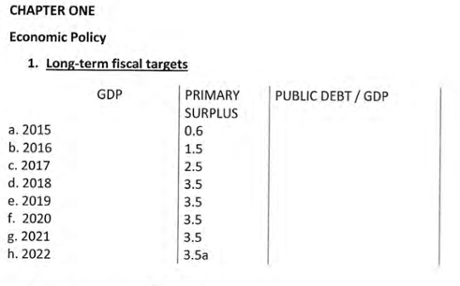
And here’s the IMF/ECB/EC’s targets:
- 2015: 1% of GDP
- 2016: 2% of GDP
- 2017: 3% of GDP
-
2018: 3.5% of GDP
The Greek document also outlines how it would gradually raise the pension age, by progressively raising the early retirement age to 62. That would push the average retirement age up from 56.3 in 2016, to 64.4 in 2040..... Creditors are likely to favour swifter action.
The long document also includes a swathe of privatisation targets, with these conditions:
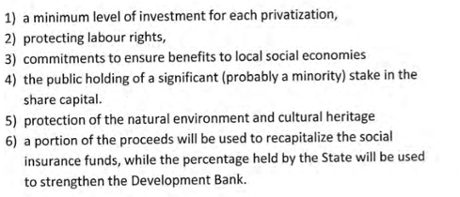
And there are tax changes, including a luxury tax and higher rates on planes, helicopters, speedboats and swimming pools.
The document also includes a pledge to repeal recent legislation that undermined collective bargaining. New labour market rules will be brought in, that are compatible with best practice in Europe and protect workers’ rights.
And the minimum wage will be raised, as Syriza pledged before the election, but in a gradual way - returning to 2010 levels by the end og 2016.
It also ends with a section on debt relief, explaining how Greece’s creditors would agree to further restructuring and reduction.
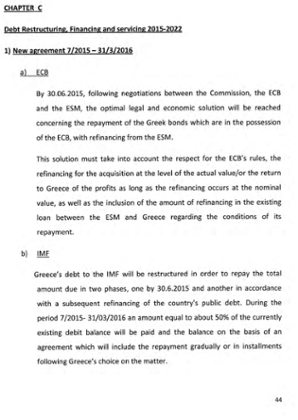
You can read the full report here.
And German newspaper Der Tagesspiegel has a good take:
Tsipras’ Traum (Tsipras’ dream)
Updated
The Greek government has also slapped down a rumour on social media that Alexis Tsipras might seek a vote of confidence tomorrow, so don’t get excited if you read that on Twitter......
It’s official:
Tomorrow at 6pm, I will inform Parliament regarding the progress of the negotiation. #vouli #Greece pic.twitter.com/no3nnoHJ2e
— Alexis Tsipras (@tsipras_eu) June 4, 2015
There will be drama in the Greek parliament tomorrow afternoon -- we’re hearing that Alexis Tsipras will address MPs on the crisis, from 6pm local time (4pm BST).
Greek Prime Minister Alexis Tsipras to address Parliament at 6 p.m. Friday on course of negotiations with lenders #Greece
— MacroPolis (@MacroPolis_gr) June 4, 2015
I don’t know how he’ll manage to do that and also visit Jean-Claude Juncker in Brussels on Friday, as was expected.....
Greece’s finance minister has denied that creditors slapped Alexis Tsipras with a ‘take it or leave it’ offer -- that’s not how civilised nations work, guys.
Interviewed by Sky News, he also argued that Greece has most of a month to reach an agreement.....
Breaking: Greek finance minister @yanisvaroufakis tells @skynews: “Objectively speaking we have until June 30th” to come up with a deal
— Ed Conway (@EdConwaySky) June 4, 2015
Been speaking to @yanisvaroufakis this morning - he says "we have until the 30th June" to make a deal #Greece pic.twitter.com/aO8k2fsA0q
— Emily Purser (@EmilyPurser) June 4, 2015
Varoufakis told @SkyNews that the deal on the table is not an ultimatum - "civilised nations do not issue ultimatums" #greece
— Emily Purser (@EmilyPurser) June 4, 2015
Varoufakis was elusive about whether they will pay tmrw. "Lots of processes are in progress" he said #greece
— Emily Purser (@EmilyPurser) June 4, 2015
And unsurprisingly he reiterated that at some point wages and pensions will take priority - he seemed to know when that point wld be #Greece
— Emily Purser (@EmilyPurser) June 4, 2015
Updated
Over in Athens opposition MPs are also saying that they are hearing a cabinet meeting will take place later today so that prime minister Alexis Tsipras can “sound out” his party.
“I think Tsipras is now facing his toughest choice. Is he going to take a deal or leave a deal?” Anna Asimakopoulos, a shadow finance minister with the main opposition New Democracy party, has just told the Guardian.
“Even the deal he has put on the table is really stretching it for people in his party, while the deal lenders have put on the table is impossible for him to defend.
“What he is clearly doing now is sounding out his own people - if there is any possibility he can get the deal [proposed by creditors] through, he will stretch it out. If not, his only other option is elections.”
Fresh polls, she argued, would take at least 27 days to prepare for.
“First the government would have to disassemble, then constitutionally we would need another 21 days until elections are held.”
These posters everywhere in Athens - translates "YOLO - we deserve more" pic.twitter.com/4IossSiYJa
— Paul Mason (@paulmasonnews) June 4, 2015
Sleep deflation: Juncker just said he had two hours sleep. He said this morning he'd had three
— Danny Kemp (@dannyctkemp) June 4, 2015
EC president Jean-Claude Juncker has been fielding calls from Angela Merkel, as he tries to play peacemaker between Greece and its more hard-line creditors....
JUNCKER: WE MADE SOME PROGRESS LAST NIGHT WITH GREECE, NOT SUFFICIENT
— MineForNothing (@minefornothing) June 4, 2015
Juncker says he 'just had the German Chancellor on the phone', will speak to Hollande later
— Danny Kemp (@dannyctkemp) June 4, 2015
Eurogroup president Jeroen Dijsselbloem has just weighed in, telling Reuters in Amsterdam that there are still “quite large” differences between the two sides.
Last night’s meeting, which he attended, was “successful in narrowing down the remaining issues”, Dijsselbloem added.
He expects Greece to present alternative options within days.
Updated
Just to clarify the point about VAT....
Lenders want the Greek government to lift the current exemptions on VAT (where the top rate is 23%). This includes, food, medicines and electricity, says Helena, for which VAT currently stands at just 6%.
Reuters: Creditors offer €10.9bn of aid....
Reuters is also reporting that creditors are demanding VAT hikes and pension cuts.
They’ve also heard that the IMF/ECB/EC proposal forces Athens to continue with pension reforms, which will hit the poorest pensioners, and press on with privatisations.
In return, funds totalling €10.9bn would be unlocked to tide Greece through the summer:
- GREECE’S EU/IMF CREDITORS ASK ATHENS FOR VAT HIKES WORTH 1 PCT OF GDP, PENSION CUTS WORTH 1 PCT OF GDP - SOURCES
- EU/IMF DEMAND ATHENS NOT ROLL BACK PENSION REFORM OR MAKE UNILATERAL MOVES ON LABOUR ISSUES, CROSSING GREEK PM’S RED LINES- SOURCES
- EU/IMF ASK GREECE TO SAVE 800 MLN EUROS BY SCRAPPING LOW-INCOME PENSIONERS’ BENEFIT THROUGH 2016 - SOURCES
- EU/IMF ASK ATHENS TO COMMIT TO PRIVATISING GRID OPERATOR ADMIE, HELLENIC PETROLEUM, HELLENIKON, MAJOR PORTS, OTE, TRAINOSE -SOURCES
- IF DEAL IS ACCEPTED, EU/IMF PLAN AIMS TO UNLOCK 10.9 BLN EUROS FROM EFSF TO COVER GREEK NEEDS OVER JULY-AUGUST - SOURCES
Here's what the Greek cabinet will discuss
We are hearing that the following will be the focus of the emergency Greek cabinet meeting expected to take place later today:
VAT rates being increased to 11% and 23% in bid to raise internal revenue of €1.8bn in 2015. Both would have a crippling effect on energy bills, restaurants and pharmacies.
Cuts in social security system amounting to 1% of GDP this year alone which would hugely effect pensions - a red line for the leftists
Primary surplus targets of: 1% in 2015; rising to 3% in 2017 and 3.5% in 2018
Updated
Greek PM planning emergency cabinet meeting
Our correspondent Helena Smith is hearing that prime minister Alexis Tsipras is preparing to hold an “emergency” cabinet meeting to discuss the latest developments - possibly as early as this afternoon.
Media with close ties to the governing far left Syriza are reporting that Greece is as close as it has ever come to rupture.
“On the verge of rift,” the government-friendly Syntakton newspaper proclaimed on its front page saying the “problematic proposal” made by creditors was “impossible to sign.”

The well-informed portal, Newsit, argues that Greece’s lenders must offer Athens some concessions:
“If lenders don’t make a u-turn and retreat to softer positions, rupture is at this moment appearing as the most likely scenario, even if the government will try right up until the end to secure a ‘mutually beneficial solution,’”
Newsit adds:
“The prime minister and his close associates are returning to Athens with their luggage much heavier because of the lenders’ proposal, and with all scenarios on a political level now open.”
Elections, it is said, could take place on the last Sunday of June (28th) or the first Sunday of July.
A meeting of political party leaders might also be called in the coming days.
Former PM Samaras criticises creditors' demands
Over in Athens news of the measures now being demanded by creditors has been received with the force of a lead balloon, with government MPs and the opposition leader voicing deep concerns.
Our correspondent Helena Smith reports:
It is not only the government that has reacted with thinly veiled-violence to the five-page draft agreement revealed by European president jean Claude Juncker last night.
The former prime minister Antonis Samaras, whose ‘pro-bailout’ centre right New Democracy party was ousted from power in January, has also called the proposed plan a disaster, describing the measures put forward by lenders as far more onerous than any his own government had been asked to apply.
Reacting to the latest twist in Greece’s stand-off with creditors, the main opposition leader derided the anti-austerity coalition’s negotiating tactics.
“The proposed measures, as government ministers themselves accept, are much harsher than the measures of Hardouvelis,” Samaras said referring to his own former finance minister, Gikas Hardouvelis.
“The total cost [of Greece under Tsipras] is quite clearly huge, not only in VAT, electricity, the private domaine, etc but primarily in credibility. The deceit and lies are over.”

Several leading Syriza cadres today suggested that the only way out would be through fresh elections - or putting the deal to public vote via a referendum.
Describing the lenders’ draft agreement as “most brazen and provocative,” the deputy social security minister, Dimitris Stratoulis, insisted this morning that though debt-stricken and insolvent, Greece still had “alternatives solutions.”
Stratoulis argued:
“If they don’t back down, the country won’t be lost, it has alternatives solutions and democratic ways out that the people could have a place in ... there are alternatives that would cost less that our signing a disgraceful and dishonourable agreement.”
But Samaras said fresh elections would be catastrophic for the crisis-plagued country. He said:
“This nonsense about elections has to end because elections today would happen under very harsh and unfavourable conditions for Greeks. Let alone that they would bring us to an even worse point than the one we find ourselves in today.
And anyway what would Syriza be looking for, to get a mandate from the people to take us to the drachma? Unless that, from the start, was their real aim.”
The former prime minister, whose party is lagging far behind Syriza in the polls, reiterrated that national consensus was the only way forward for a nation that has repeatedly said it does not want to exit the euro.
Samaras concluded:
“The only way out that has remained for Mr Tsipras is to settle on the big national agreement that we have suggested. It is the only road for the country,”
Updated

To no-one’s surprise, the Bank of England has voted to leave UK interest rates at their current record low of 0.5%.
That means borrowing costs have been unchanged since March 2009, before the eurozone crisis even began.
Over in Greece, government MPs are feeling bruised after seeing Tsipras effectively given an ultimatum by creditors in Brussels.
Paul Mason of Channel 4 News reports:
They came, they saw, they had – as one Syriza MP put it to me last night – “their balls handed to them”.
@BTabrum @paulmasonnews Veni Vedi Vasectomy?
— Lorcan Roche Kelly (@LorcanRK) June 4, 2015
Mason argues that the creditor’s offer isn’t “all bad”.
A 1 per cent budget surplus target for this year, in a shrinking economy, looks optimistic – but it is lower than the 3-4 per cent the previous government had been asked for.
A two-tier VAT rise will raise money from the poorest off; but VAT has to rise in a country like Greece where assets are held offshore, and where getting businesses to pay corporation tax is a strategic problem, and does not balance the books short term.
The hardest details for Greece came when its lenders demanded pension payments to be cut by 1 per cent of GDP. However the deal on offer is reported to say that if Greece does not want to hit pensioners it must hit somebody else, to the same extent.
But the big problem is that it doesn’t include any pledges of debt relief, which makes it very hard to persuade Syriza MPs to support it....
The full piece is worth a read:
Greece debt crisis: the unsustainable ultimatum
Our Athens correspondent, Helena Smith, is hearing that the IMF has let it be known that it “does not mind” if Greece effectively misses its €305m debt repayment deadline tomorrow and “bundles up” loan instalments for the end of the month.
That of course when its current bailout programme ends.
The Financial Times has also confirmed that a new meeting between Greece and her creditors will take place tomorrow, after yesterday’s gathering made only limited progress.
Peter Spiegel writes:
EU leaders have long hoped Mr Tsipras would personally take over negotiations after months of little progress with mid-level officials from the Greek finance ministry.
People briefed on the talks expressed optimism that an outline of a deal could still be reached by the end of the week.
“Tsipras wants to wrap it up himself,” said one senior official.
Tsipras to resume creditor talks Friday http://t.co/tkQGaKFUXt
— FT Brussels (@ftbrussels) June 4, 2015
Updated
EC confirms Tsipras and Juncker will meet again soon
The European Commission is briefing reporters in Brussels now.
Spokesman Margaritis Schinas says that last night’s meeting between Tsipras and Juncker was constructive, and confirms they will meet again soon.
However, he won’t confirm that they’re meeting tomorrow:
EU's @MargSchinas won't confirm Friday meeting for Juncker-Tsipras, says further meeting 'in coming days'
— Danny Kemp (@dannyctkemp) June 4, 2015
'Rumourology' joins paperology in @EU_Commission-speak, via @MargSchinas
— Danny Kemp (@dannyctkemp) June 4, 2015
Don't know where,don't know when, but I know we'll meet again, some sunny day #Tsipras #Juncker https://t.co/0WOYhsoOrC
— Nick Malkoutzis (@NickMalkoutzis) June 4, 2015
Greek insiders have told us that Juncker and Tsipras will indeed meet tomorrow, as Kathimerini reported earlier.

We’re seeing more quotes from Yanis Varoufakis on the Reuters terminal:
- GREEK FINANCE MINISTER VAROUFAKIS SAYS THERE IS NO REASON WHATSOEVER TO HOLD SNAP ELECTIONS
- GREEK FINANCE MINISTER, ASKED ABOUT JUNE 5 IMF PAYMENT, SAYS GREEK STATE ALWAYS AIMS AT REPAYING ITS OBLIGATIONS
- GREEK FINANCE MINISTER VAROUFAKIS SAYS FIRMLY OPPOSED TO ELECTRICITY UTILITY PPC’S PRIVATISATION
Last night, Alexis Tsipras told reporters in Brussels not to worry about tomorrow’s €305m payment due to the IMF, arguing that Greece had handled bigger payments in the past.
And this tweet may explain his confidence:
IKA, #Greece's largest social security fund, to decide today to transfer cash reserves of €200 mln to BoG account (via @capitalgr) #imf #ec
— Manos Giakoumis (@ManosGiakoumis) June 4, 2015
Amid the uncertainty, Greece’s unemployment crisis remains a bleeding wound. The jobless rate was unchanged at 25.6% in March, according to new figures from Elstat.
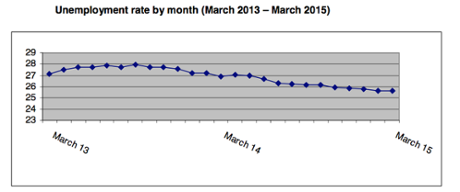
Elstat reports that the number of Greeks in work actually fell by 16,092 persons compared with February 2015. The unemployment total also fell, by 4,283.
How can that be? Because 16,751 persons declared themselves inactive - dropping out of the labour market forever.
There are now 3,518,858 people employed in Greece, 1,211,507 unemployed, and 3,368,392 classed as inactive.
Finance minister Yanous Varoufakis has told reporters that the Greek government is aiming for a “comprehensive” deal by the end of the month, and also resisting pressure to raise sales tax rates.
Greek FinMin Varoufakis tells reporters there is "no chance" of #Greece moving bulk of its goods & services to top VAT rate of 23% #euro
— MacroPolis (@MacroPolis_gr) June 4, 2015
#Greece FinMin Varoufakis says govt aims for a comprehensive agreement w the creditors until June 30 and no snap elections ~@parapolitika901
— Yannis Koutsomitis (@YanniKouts) June 4, 2015
Moscovici: Next few days are vital

The next few days are absolutely essential, Pierre Moscovici adds, if Greece and creditors are to agree a cash-for-reforms deal in time:
- EU’S MOSCOVICI SAYS NEXT HOURS, DAYS ARE ABSOLUTELY ESSENTIAL IN GREEK TALKS, “I AM OPTIMISTIC, BUT THERE IS STILL A WAY TO GO”
Updated
EU Economic and Monetary Affairs Commissioner Pierre Moscovici remains convinced that a Greek agreement will be reached in time.
Speaking in Brussels this morning, Moscovici says:
“My deep conviction is that we will find a deal on Greece.”
Discussions are fruitful, he says, and good progress is being made.
German 10-year Bund yield flirting with 1% today. Largest sell-off since euro creation. This one will go down in history. And it's not over.
— Maxime Sbaihi (@MxSba) June 4, 2015
Stocks slide as bond yields jump
There are some wild moves in the financial markets this morning, and Greece is only partly to blame.
Eurozone bond prices are falling across the board. That follows yesterday’s ECB press conference, where Mario Draghi predicted that volatility was here to stay.
That has prompted traders to pile out of bonds, pushing prices down and driving up yields (the interest rate paid to bondholders).
German 10-year bonds are now yielding 0.98% -- a sharp jump. That’s highest since last September, meaning any trader who piled into Bunds this year is sitting on a loss.
EU bond yields, wonder when was the last time we saw this! pic.twitter.com/JHSfWLfMb0
— Nour E. Al-Hammoury (@NourHammoury) June 4, 2015
After an early fall, the euro has now jumped to $1.134. That’s weighing on European stocks, pushing down the German, French, Spanish and Italian markets. The UK is dropping too:
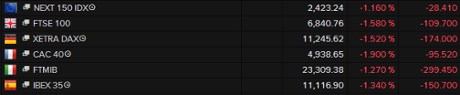
Connor Campbell, financial analyst at Spread EX, says Greek developments will push the markets around today:
The Greek PM, for now, is holding firm to the idea that any deal must be based on a proposal coming from, not going to, Greece, with a counter offer from the country expected to land at creditors’ feet at some point before the end of the week.
Reports that Tsipras and Juncker will meet again on Friday means things will be left incredibly close to, and maybe actually beyond, the IMF repayment wire [on Friday].
Yet one questions if any change in attitude, be it from either side, can occur in such a small space of time; if a deal couldn’t be found on Wednesday, a shift in tone by Friday seems unlikely. Nevertheless, the Eurozone indices are continuing their rollercoaster ride this week, slipping to losses after seeing hope-filled gains yesterday afternoon.
Lots of chatter about Greece this morning:
Tsipras close to accepting troika's fiscal targets - but not the pension & VAT measures to achieve them.
— Marcus Walker (@MMQWalker) June 4, 2015
After more than four months of negotiations, Eurozone and Greece now at least seem to agree that they disagree. Celebrate the progress...
— Carsten Brzeski (@carstenbrzeski) June 4, 2015
The Greek proposal for a deal was 46 pages long. The proposal from the European creditors was five pages long #Greece
— Ed Conway (@EdConwaySky) June 4, 2015
Greece’s stock market fell sharply at the start of trading in Athens, pushing the ATG index down over 3%.
Athens Stock Exchange General Index falls as much as 3.3% this morning, now down 2.7% #Greece pic.twitter.com/PJz6IMSH5S
— Richard Bravo (@richbravo2) June 4, 2015
Yesterday it jumped 4%, on hopes of a breakthrough in Brussels.
Hugo Dixon, Editor-at-Large at Reuters News, reckons there are four ways this crisis will play out:
Four scenarios now for Greece: 1. Tsipras agrees deal with creditors, can't sell to Syriza hardliners, calls snap elections and wins. Good
— Hugo Dixon (@Hugodixon) June 4, 2015
2 Tsipras agrees deal with creditors, keeps Syriza hard lines on board, fails to implement properly and crisis returns in a few months. Poor
— Hugo Dixon (@Hugodixon) June 4, 2015
3 Tsipras can't do deal, defaults, and after capital controls imposed hands over to national salvation government which sues for peace. Bad
— Hugo Dixon (@Hugodixon) June 4, 2015
4 Tsipras can't do deal, defaults, keeps power (maybe after new elections) and continues confrontation. Terrible.
— Hugo Dixon (@Hugodixon) June 4, 2015
Dow Jones: Tsipras will make a counter-offer
It’s all go this morning!
Dow Jones newswires is reporting that the Athens government is planning to make a new counter-offer, having ‘converged’ with its creditors on some issues last night.
That may explain why Alexis Tsipras will meet with Juncker on Friday.
#Greece, creditors, converge on some measures, Greek PM Tsipras to make counter offer- Officials (Dow Jones)
— Efthimia Efthimiou (@EfiEfthimiou) June 4, 2015
That convergence probably applies to the primary surplus targets (creditors are offering less onerous surpluses, starting at 1% this year, rising to 2%, then 3%, then 3.5% in 2017)
Greek jitters are hitting the euro this morning too, flags up Ipek Ozkardeskaya, market analyst at London Capital Group.
The single currency has dropped by 0.3% against the US dollar to $1.1232, from $1.1274 (a two-week high).
#EURUSD down to 1.1232 as #Tsipras rejects proposals, saying 'realistic proposals' are those of the #Greek government :)
— Ipek Ozkardeskaya (@IpekOzkardeskay) June 4, 2015
Here’s the official line from Alexis Tsipras this morning for English readers:
Our proposal continues to be the only realistic and constructive proposal. The discussions will continue. #Greece pic.twitter.com/VnxYbqxK9j
— Alexis Tsipras (@tsipras_eu) June 4, 2015
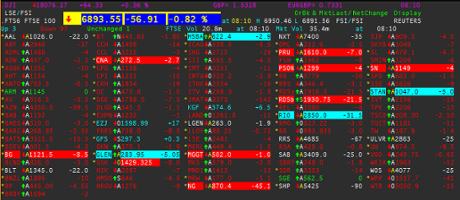
European stock markets have fallen at the start of trading, as traders react to last night’s inconclusive Greek meeting.
In London, the FTSE 100 swiftly shed 56 points to 6894, down 0.8%, with almost every share in the red:
Every blue-chip share on France’s CAC index is down, too:
All 40 in the CAC trading in the red. Sacre bleu!
— RANsquawk (@RANsquawk) June 4, 2015
Kathimerini: Tsipras and Juncker to meet on Friday
Greece’s Kathimerini newspaper is reporting that Alexis Tsipras will meet Jean-Claude Juncker again on Friday, in another attempt to break the deadlock.
Tsipras due to meet Juncker & Dijsselbloem again on Friday after last night's inconclusive talks in Brussels, reports @Elbarbie #Greece
— Nick Malkoutzis (@NickMalkoutzis) June 4, 2015
Greek minister: Juncker's proposal is beneath expectations
Greece’s Deputy Shipping Minister has warned this morning that the government will not ‘surrender’ to its creditors.
Thodoris Dritsas told Greek TV that:
“What appears to have been discussed and to have been proposed by Mr. Juncker during his meeting with the Greek prime minister is beneath (our) expectations in every way.”
“If reports are confirmed, obviously we cannot accept them.”
The Agenda: No deal in Brussels.....
Good morning.
Greece’s future remains as confused as ever, after Wednesday night’s crunch meeting in Brussels between prime minister Alexis Tsipras and EC president Jean-Claude Juncker broke up without a deal.
After speaking for more than four hours, Tsipras emerged after midnight to announce that Greece couldn’t accept some of the proposals put together by its creditors.
Instead, he argued, any deal to unlock bailout funds must be based on his own side’s offer.
As he put it:
“The realistic proposals on the table are the proposals of the Greek government.”
And Tsipras has just tweeted that discussions will continue....
Η πρόταση μας παραμένει η μόνη ρεαλιστική & εποικοδομητική πρόταση.Οι συζητήσεις θα συνεχιστούνhttp://t.co/GqE61SOxzF pic.twitter.com/jdB2IgcfAA
— PrimeMinisterGR (@PrimeministerGR) June 4, 2015
The meeting wasn’t a disaster - according to Tsipras, the two sides are “very close” to agreeing new fiscal targets, after the creditors proposed lower primary surplus goals.
But there appears to be less consensus on pension reforms and VAT reform, with Greece refusing to roll over and accept a five-page list of proposals created by the International Monetary Fund, the European Central Bank and the European Commission.
#grexit juncker, dijsselbloem, wieser gave tsipras 5-page draft for SLA by june 14. greeks happier with prim surplus http://t.co/0BJW70q7xv
— Ian Traynor (@traynorbrussels) June 4, 2015
#Greece Tsipras: there wr proposals we agree with & others we can't accept (VAThike in electricity, scrap povbenefit https://t.co/cO0LdeKRv1
— Keep Talking Greece (@keeptalkingGR) June 3, 2015
If you missed the action, it’s all in Wednesday’s liveblog:
What happens now?
According to the EC, both sides will hold more “intense work” in an attempt to reach a joint position soon. It said:
It was a good constructive meeting. Progress was made in understanding each other’s positions on the basis of various proposals. It was agreed they will meet again. Intense work will continue.
But the failure to make a breakthrough last night is still disappointing, with a €305m payment to the IMF due tomorrow, and just 26 days until Greece’s bailout programme expires.
I’ll be tracking all the action and reaction through the day, along with other events across the world economy and the financial markets. That will include the Bank of England’s interest rate decision at noon UK time (we’re braced for a dramatic ‘no change)....