Closing summary: Greek technical talks to begin on Wednesday

And that, I think, is that for this evening. A quick recap.
Technical teams will start to consider Greece’s reform plans on Wednesday, after eurozone ministers lost patience with the slow progress since its bailout extension was agreed in February.
Eurogroup president Jeroen Dijsselbloem warned that the last two weeks have been “a complete waste of time”, as he declared that work begins in Brussels the day after tomorrow.
Some officials will also be working to Athens, despite Greek efforts to stop its creditors sending inspectors back to the country.
Dijsselblom told a news conference that:
We agreed today that there is no further time to lose.
Discussions between the Greek government and the institutions will start on Wednesday in Brussels... in parallel, technical teams from the institutions will be welcomed in Athens.
At presser @J_Dijsselbloem confirms "technical teams" from bailout monitoring institutions to head to #Athens as of Wed. #Greece #Eurogroup
— Peter Spiegel (@SpiegelPeter) March 9, 2015
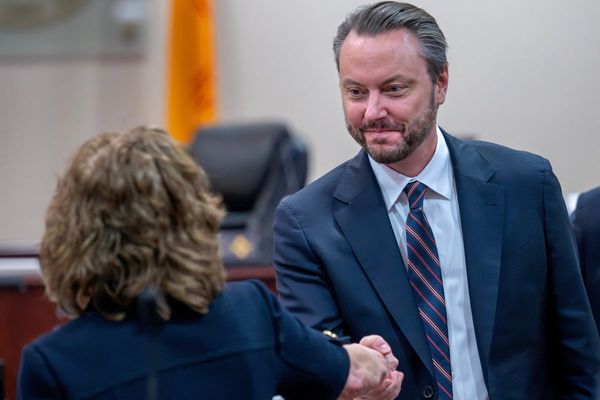
Dijsselbloem was speaking after a surprisingly quick eurogroup meeting today, in which Greece was urged to press on with its reform programme. Here are some photos from the event.
Greece will not receive any aid money will not be released until there is a firm plan, and signs that it is being implemented, added Dijssselbloem.
#Eurogroup @J_Dijsselbloem 'there can be no talk of disbursement' without agreement and implementation #Greece
— Ian Traynor (@traynorbrussels) March 9, 2015
Greek finance minister Yanis Varoufakis has just told reporters that the meeting went well; he’s very pleased that technical talks over reforms would begin on Wednesday.
He denied that Greece had frittered away valuable time.
“There has been no time wasted, not by the Greek government....We were very speedy.”
Varoufakis also insisted that the Troika’s grip on Greece was broken for ever.
“The idea of troika visits, comprising cabals of technocrats from the three institutions in lockstep walking into our ministries and trying to implement a programme which has failed ... that is a thing of the past”
(I’ve taken the quotes from Reuters)
Varoufakis also heavily criticised some in the media, over reports that he’d threatened a Greek referendum if creditors don’t accept his plans. Pure press misinformation, he declared.
Varoufakis, minister, academic, editor-in-chief of all media
— tania (@tanjatania) March 9, 2015
The Athens government has also said that today’s meeting was a success, and hinted that more reforms are coming.
Boom! “@graemewearden: If other eurozone ministers miss the Troika so much we can send it to them - @yanisvaroufakis http://t.co/BNpP8U9JLH”
— Nicola Theron (@nicolatheron) March 9, 2015
We’ll be back tomorrow. Goodnight and thanks (as ever) GW
Updated
I’m afraid I didn’t really catch the last question, but I think it was whether Varoufakis had held discussions with his Portuguese counterpart.
Varoufakis insisted he had not; the pair were on opposite side of the eurogroup table.
And that’s the end of the press conference
Updated
Just to clarify... when asked about Greece’s cash position (twice), Yanis Varoufakis replied that the liquidity position of Greece will be guaranteed by the Greek government in conjunction with its international lenders.
Mario Draghi doesn’t need any advice from me.... our job is to start the work to create the confidence that the ECB wants to see. Every party will do what’s necessary to make this deal work, Varoufakis adds.
We are all very excited that we will start technical discussions in Brussels on Wednesday, Varoufakis says.
A second question on Greece’s funding position:
A @Bloomberg reporter says @yanisvaroufakis' failure to answer my Q on #Greece's cash position creates uncertainty. YV still doesn't answer.
— Peter Spiegel (@SpiegelPeter) March 9, 2015
Updated
#Varoufakis denies speculation of Deputy PM #Dragasakis taking over negotiations, says 2 in perfect cooperation #Greece
— Kathimerini English (@ekathimerini) March 9, 2015
Varoufakis also denies that Greece’s deputy prime minister will take the lead in negotiations with its creditors.
That’s another example of poor reporting by the media, he says.
Hang on, though, Yanis -- that story came from the lips of Ireland’s finance minister, Michael Noonan! (see earlier post)
Well, who told him, asks an unabashed Varoufakis, suggesting Noonan was another victim of media inaccuracy.
"Particularly poor journalistic standards" have been mentioned several times during Varoufakis presser. #Eurogroup
— Jarno Hartikainen (@JarnoHa) March 9, 2015
Whichever editor wrote the headline in Corriere della Sera should consider apologising, declares Varoufakis, returning to that referendum story.
It's always the editor's fault...
— Nikos Chrysoloras (@nchrysoloras) March 9, 2015
Again: reporters are cool, it's always the editor's fault.
— Nikos Chrysoloras (@nchrysoloras) March 9, 2015
#Varoufakis: I said if every single one of our proposals is rejected (which has NOT happened) then we go to a referendum. #eurogroup
— Omaira Gill (@OmairaGill) March 9, 2015
Varoufakis "There was clearly some misunderstanding between the press and Mr. Dijsselbloem and me" (would hate to be Yanis' Flack after this
— Lorcan Roche Kelly (@LorcanRK) March 9, 2015
The webfeed just crashed briefly during a question about Greece’s reform plans...but fortunately Kathimerini is on the case:
#Varoufakis: unilateral actions not in the cards, but #Greece can't possibly ask permission for every single move
— Kathimerini English (@ekathimerini) March 9, 2015
#Varoufakis: our list of reforms was meant to be incomplete #Greece
— Kathimerini English (@ekathimerini) March 9, 2015
Varoufakis: Talk of referendum was in response to 'hypothetical question' #Greece #Eurogroup pic.twitter.com/otdZITKiQH
— Derek Gatopoulos (@dgatopoulos) March 9, 2015
Varoufakis declines to answer a question about whether Greece is running short of cash.
Got a Q in to @yanisvaroufakis asking him for an update on govt's cash position & whether cash in agency accts accessed. He didn't answer.
— Peter Spiegel (@SpiegelPeter) March 9, 2015
Yanis Varoufakis is now laying into the media, for reporting that he had claimed Greece could hold a referendum if its creditors rejected its reform measures.
This is a reference to Sunday’s interview with Italy’s Corriere della Sera.
I was only responding to a hypothetical question, he insists, blaming “poor journalistic standards” for flamming up the story and claiming (wrongly) he was threatening that Greece’s eurozone membership was on the line.
I am aghast about the amount of effort some journalists put into this misinformation, he adds darkly. Some have sunk into “pure depths of journalistic depravity”.
Varoufakis: "No misunderstanding. ..Purely poor journalistic standards"
— Lorcan Roche Kelly (@LorcanRK) March 9, 2015
"@777mingus: #Varoufakis says Corriere della Sera #Grexit report "descended to pure journalistic depravity""
— MAIRHbachtse (@mbachtse) March 9, 2015
Some instant reaction:
#Varoufakis: will welcome members of "institutions" to GR, but idea of the 3 arriving together, imposing, like old troika is thing of past
— Kathimerini English (@ekathimerini) March 9, 2015
Now the Troika can actually continue to be called Troika, they only need to travel independently...
— Carsten Brzeski (@carstenbrzeski) March 9, 2015
Varoufakis must be programmed from his university lecturing days to speak in hour-long spurts.
— Lorcan Roche Kelly (@LorcanRK) March 9, 2015
Another reporter reminds Varoufakis that eurogroup chief Jeroen Dijsselbloem was adamant that the last two weeks have been a complete waste of time.
The fact that Dijsselbloem and I can disagree about this is part of Europe’s magic, he replies.
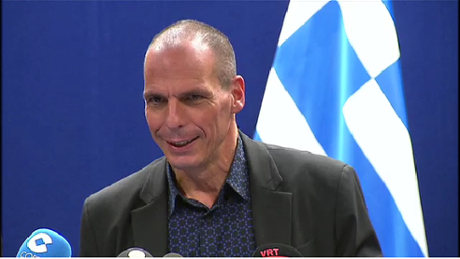
Varoufakis: The Troika is finished
What about the return of Troika officials to Athens, as Jeroen Dijsselbloem announced today?
Varoufakis is adamant that the Troika is dead. The days of officials from the three institutions (IMF, EU, ECB) “marching in lockstep”, imposing measures on Greece, are over.
But yes, officials from the institutions will be welcomed to Athens to help with its reform plans.
Varoufakis says there has been a ‘serious misunderstanding’ by some members of the press.
The list of seven reforms he sent to Brussels last week was never means to be a comprehensive list, as some reporters claimed. It was just a starting point.
Next we will have another batch of seven or eight reforms, he adds.
Varoufakis denies that the Greek government has frittered time away. No time has been wasted, he says.
Onto questions, and Yanis Varoufakis is asked whether he minds that several eurozone finance ministers insist on referring to ‘the Troika’ (rather than ‘the institutions’).
Smiling, Varoufakis says he is fairly relaxed that some ministers, perhaps through inertia, insist on using that old term.
If they miss the Troika so much we can sent it to them, but we are not having it again, he declares.
Updated
I am pleased that we can announce that, starting on Wednesday, our team will start work with officials from the institutions in Brussels, Varoufakis adds.
Varoufakis press conference begins.
Here comes Yanis Varoufakis.... He looks fairly cheerful.
Today’s meeting was an important step forwards in implementing the agreement of 20 February, he says.
It will also helps us consider the plan for beyond June (when the four-month extension expires).
Heads up: Greek finance minister Yanis Varoufakis is about to give a press conference about the eurogroup meeting.
Much smaller group waiting for @yanisvaroufakis presser than last few #eurogroup meetings pic.twitter.com/zfntCzxWIb
— Peter Spiegel (@SpiegelPeter) March 9, 2015
Back in Brussels, France’s finance minister Michel Sapin is telling a press conference that it’s important to stop mentioning ‘the troika’.
"It's imporant to make that effort" of not speoking abt the troika anymore, says Sapin.
— Gabriele Steinhauser (@gksteinhauser) March 9, 2015
Maybe he heard the anguished cries from Athens earlier.....
You have to admire the Greek government’s timing.
Just as eurogroup president Jeroen Dijsselboem was lamenting the “waste of time” Greece’s international creditors have witnessed in recent weeks, the Athens government was releasing a statement called:
“ERT (the state TV channel) is returning. Sacked employees will return to work.”
That’s because the Tsipras government has presented legislation to parliament reinstating the state-run organisation shut down overnight by the previous government in June 2013, Helena Smith explains.
That means the government has met one of its pre-election pledges, but doesn’t get Greece any closer to a deal with its creditors.
Eurozone finance ministers are now flooding out of the eurogroup meeting:
Belgian Finance Minister on result of the #Eurogroup meeting: #Greece has a lot of homework to do
— Amrita Paul (@AmritaPaul04) March 9, 2015
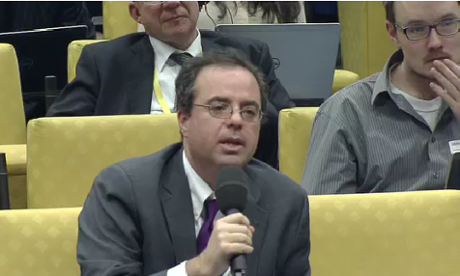
The last question goes to Peter Spiegel of the Financial Times, who hits the bullseye by asking a technical question about €500m that was returned to the European Financial Stability Fund (EFSF) last month (as part of a larger transfer of funds).
Is it correct that this money is actually fees paid by Greek banks, and not bonds which the EFSF is entitled to have reclaimed? Should it be returned?
Klaus Regling of the EFSF says that his officials have taken legal advice, and yes, this money relates to activities in 2010, before the first Greek bailout.
So “we will certainly not have any claim on that amount”, he adds.
Good news for Greece, I think!
Regling just made a sweet €555ml gift the Greek gov't.
— Yannis Koutsomitis (@YanniKouts) March 9, 2015
Klaus Regling says 500m in HFSF from fees paid in by Greek banks predated 2010 "before we started lending to Greece, we've no claim on that"
— Tony Connelly (@tconnellyRTE) March 9, 2015
Updated
Dijssebloem acknowledges some MS thought Commission too soft on France. Moscovici defensive, says Commission unanimous.
— Simon Nixon (@Simon_Nixon) March 9, 2015
Moscovici stresses that decision to grant #France another deficit target delay was taken unanimously by college of commissioners.
— Open Europe (@OpenEurope) March 9, 2015
Next question goes to Jeroen Dijsselbloem: Did you discuss your plan to run for a second term as eurogroup president with other ministers, such as Spain’s Luis De Guindos (rumoured to be planning his own bid)?
Dijsselbloem replies that his term runs until the summer, so it’s too early for a candidacy.
He was simply asked in an interview if he’d like to be president of the eurogroup again, and he answered that he would.
And no, he didn’t discuss it with anyone else.
As @J_Dijsselbloem asked about his candidacy for 2nd term as #Eurogroup chair, @pierremoscovici grins like a cheshire cat!
— Peter Spiegel (@SpiegelPeter) March 9, 2015
Updated
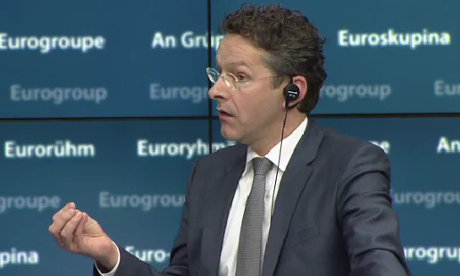
Mario Draghi was very clear about the important of Europe’s growth and stability pact at today’s meeting, Dijsselbloem says.
Should Greece be allowed to issue more short-term debt to get around its funding squeeze?
That’s up to the ECB, not me, Dijsselbloem ducks with aplomb.
Dijsselbloem reiterates that constructive talks must start now:
Dijsselbloem: Real talks haven't really started yet. Only thing I know is that they will start on Wednesday. #Greece
— Open Europe (@OpenEurope) March 9, 2015
Dijsselbloem: I'm open to an early disbursement but only with an agreement on whole program and progress on implementation.
— Simon Nixon (@Simon_Nixon) March 9, 2015
Dijsselbloem: We start making progress with Greece now
Onto questions.... What discussions took place with Greece over its reforms?
Jeroem Dijsselbloem confirms that the Greece government outlined some reforms in its letter last week, but that they weren’t the full proposals.
It is important that we reach an agreement about the whole package....about what we expect the Greek government to deliver over the next four months. he adds. We also need to see signs that reforms are being implemented.
Dijsselbloem says he’s be open to handing over Greece’s final aid payment in instalments, if there are signs of process. But:
There can be no talk about early disbursement if there is no agreement and no implementation.
No early disbursements if there is no agreement on the whole package or no implementation - says @J_Dijsselbloem #Eurogroup #Greece
— EfiKoutsokosta (@Efkouts) March 9, 2015
And he then lets rip over the lack of progress with Greece:
We have spent the last two weeks discussing who will meet who, where, and in what configuration. It’s been a complete waste of time...
And that’s why technical talks will start on Wednesday, Dijsselbloem concludes.
Mainly in Brussels, but some people will have to be on the ground in Athens - simply for efficiency reasons, to enable a constant exchange of information between Athens and Brussels.
Updated
Moscovici, the former French finance minister, embarks on a lengthy explanation about the importance of sticking to Europe’s deficit rules....
#Eurogroup @pierremoscovici protests a bit too much about france and stability pact credibility. sounds like he means his own credibility
— Ian Traynor (@traynorbrussels) March 9, 2015
At presser, @pierremoscovici talks about #Greece in French and about #France in English. Hmmm.
— Peter Spiegel (@SpiegelPeter) March 9, 2015
Commissioner Pierre Moscovici now has the microphone, and says that Cyprus must implement a foreclosure law to help banks act on bad debts.
It would be a great pity of Cyprus’s impressive progress over the last two years were slowed, Moscovici said.
Cyprus MPs have been refusing to approve the foreclosure law for several weeks, knocking its bailout plan off track.
Dijsselbloem adds that Greece has committed not to take unilateral actions, and not to roll back on reforms that have already been adopted.
Dijsselbloem: Technical teams will head to Athens
“Today we had a short discussion on Greece,” says Jeroen Dijsselbloem, on the process that should have started after our meeting two weeks ago.
We agreed there is no further time to lose. Technical talks will start on Wednesday, he confirms.
“Technical teams will be welcomed in Athens”, Dijsselbloem adds, to support this process.
So, despite what Greek officials have been saying tonight (see earlier), officials from Greece’s creditors will be working in the country’s capital.
#Eurogroup @J_Dijsselbloem troika types could go to athens on wednesday
— Ian Traynor (@traynorbrussels) March 9, 2015
At presser @J_Dijsselbloem confirms "technical teams" from bailout monitoring institutions to head to #Athens as of Wed. #Greece #Eurogroup
— Peter Spiegel (@SpiegelPeter) March 9, 2015
Updated
Austria and France need to make more progress to meet the Europe’s growth and stability pact, Dijsselbloem says. Particularly France, which has already been given a two-month extension to get in line.
Other countries have made encouraging progress, though.
Dijsselbloem starts by pointing out that fewer journalists have turned up than usual. Maybe they’re at another press conference, he jokes. (Is Yanis Varoufakis talking somewhere?!.....)
Today’s meeting tied up some loose ends from earlier meetings, looked at the Greek financial programme, and also considered the eurozone services industry, he says.
Updated
Eurogroup press conference begins
The press conference is starting now.
Eurogroup president Jeroen Dijsselbloem, European Commissioner Pierre Moscovici, and Klaus Regling, CEO of the European Financial Stability Facility, are here to entertain us.
Waiting for the #Eurogroup press briefing to start #Greece pic.twitter.com/7A99Wj30Bo
— Eleni Varvitsiotis (@Elbarbie) March 9, 2015
OK, the eurogroup press conference is about to start. It’s being streamed live here.
Greek officials are not hiding their frustration at the reappearance of the dreaded word “Troika” in statements made by several euro zone finance ministers today, reports Helena Smith.
The German finance minister Wolfgang Schauble, no less, used it four or five times - in what some are calling a deliberate act of spite.
One insider snapped:
“Why couldn’t he just say institutions? We agreed on February 20th that there was no more Troika.”
The Spanish finance minister, Luis de Guindos, who appears to be taking delicious delight in ramming home the message that Greece is heading, inexorably, towards a third international bailout programme (even if it will almost certainly not be called that) also spoke of the troika.
Athens’ Syriza-led government sees it as a huge victory that it has relegated the deeply unpopular triumvirate of creditors to the dustbin of history.
Speaking today European Commission spokesperson Margaritis Schinas, who is Greek himself, said negotiations between Greek authorities and technical teams, aimed at fleshing out reforms would take place in Brussels at the request of EU president Jean-Claude Juncker.
But he added that some discussions will also have to take place “in situ in Athens.”
An embarrassed Greek government appears unwilling to accept this. “All the discussions will be taking place in Brussels,” said one.
The FT’s Peter Spiegel tweeted about this earlier:
Possibility of sending "troika" officials to Athens Wednesday raised in #eurogroup meeting. Unclear if @yanisvaroufakis consented. #Greece
— Peter Spiegel (@SpiegelPeter) March 9, 2015
The Eurogroup meeting is over! Is that a record? It’s certainly the quickest meeting in recent weeks.
#Eurogroup just finished
— EfiKoutsokosta (@Efkouts) March 9, 2015
And there will be a press conference in just 15 minutes time...
Eurogroup press conference at 1855 CET. Whoop whoop!
— Gabriele Steinhauser (@gksteinhauser) March 9, 2015
Greek government: More reforms to come...

The Greek government has just released a statement describing today’s euro group as a “success”, because four key points were agreed.
Helena Smith, Athens correspondent, has the details:
- It launches the process by which the decision taken at the 20th February euro group will be enforced which is a positive step in that it marks a relaxation of the stance by the ECB towards Greece.
- Despite the misinformation of recent days the Greek proposals were accepted politically by the euro group.
- On Wednesday discussions between Greece and technical teams will begin but they will take place exclusively in Brussels and not in Athens. We remind you that the troika is a mechanism that belongs decisively to the past
- The institutions showed a willingness to resolve the financing problem with immediate effect.
A senior official in the Greek government adds that:
“The Greek government will continue enriching the list of reforms with additional proposals that it will elaborate on.
“The reforms will be part of a National Plan for Reconstruction and Growth.”
Updated
Greek insiders are also confirming that technical talks will start on Wednesday, in Brussels...
Technical discussions on #Greece will start on Wednesday in Brussels according to Greek sources
— Eleni Varvitsiotis (@Elbarbie) March 9, 2015
Greek government: Eurogroup meeting has gone well
The Greek government is roundly denying that anyone other than finance minister Yanis Varoufakis will lead negotiations with its creditors (as was rumoured earlier), Athens correspondent Helena Smith writes.
And Panos Kammenos, who heads the left-led coalition’s junior partner, the Independent Greeks party, has tried to put on a brave face on the eurogroup meeting..
He emerged from holding talks with prime minister Alexis Tsipras to tell reporters that:
“We have good news from Brussels...The finance minister communicated with the prime minister and told him that the agreement of February 20th is being upheld.”
So no sign of it being a flop in Athens. As they say one man’s defeat is another man’s victory!
Greek journalist Efi Efthimiou of CapitalGR confirms this:
#Greece govt sources say Eurogroup's outcome is "positive", Gr proposals were accepted (politicaly) by the Eurogroup (@capitalgr )
— Efthimia Efthimiou (@EfiEfthimiou) March 9, 2015
Another photo from inside the eurogroup; it’s Yanis Varoufakis speaking with Greek delegation members before the meeting began.

Updated
Another newsflash from Brussels -- technical talks between Greece and its creditors will begin on Wednesday:
* EU officials say Greece to open technical reform talks with EU, ECB, IMF experts in brussels on Wednesday - RTRS
— Fabrizio Goria (@FGoria) March 9, 2015
Short debate on #Greece at today's Eurogroup to allow Varoufakis to fly back pronto & gain time for his pressing homework #VaroufakisLetters
— wolf piccoli (@wolfpiccoli) March 9, 2015
Here’s Reuters’ story, confirming that eurozone ministers have already finished discussing Greece at today’s meeting (which only started around 90 minutes ago).
Euro zone finance ministers concluded their discussions on Greece on Monday and have said progress must be made now, an EU official said, adding that the ministers would not publish a joint statement on the issue.
“It’s over,” the official said of the Eurogroup discussions on Greece. Ministers said “we must move forward now,” the official said.
A Greek official confirmed the discussion was over.
If they were trying to set a record... #Greece MT @TradeDesk_Steve pic.twitter.com/m94cIlKK0q
— Derek Gatopoulos (@dgatopoulos) March 9, 2015
That was quick! The Greek section of today’s eurogroup meeting is over, according to Reuters:
- EUROGROUP DISCUSSION ON GREECE OVER, MINISTERS SAID IT IS TIME NOW TO MAKE PROGRESS - EU OFFICIAL
- THERE WILL BE NO JOINT EUROGROUP STATEMENT ON GREECE - EU OFFICIAL- EU OFFICIAL
That rather suggests that Greece has been given a clear message to crack on with its reform programme and not waste any more time (as Dijsselbloem put it earlier).
Photos: Inside the eurogroup
Some pictures from the eurogroup meeting have just arrived, showing ministers chatting - and in some cases even hugging - before getting down to work.


Greece may have got the message. A government official in Brussels has said that Athens is ready to submit more reform proposals for technical discussion.
There are also reports that three new measures are ready, designed to improve tax collection and fight evasion:
Eurocrisis expert Yannis Koutsomis has the details:
- Taxpayers to be able to submit additional declarations for previous years without penalties
- A bill to probe big corporations’ tax avoidance through intra-EU schemes
- Incentives for taxpayers to collect receipts; lotteries for receipts.
The third idea has worked in other countries such as Slovakia, where customers can collect VAT receipts and enter them for a prize draw.
Slovakia’s finance minister (or at least his media team) has tweeted that Greece face the “naked truth” over its bailout programme, and start technical talks with its creditors.
#Greece needs to face naked truth. The longer they speculate the worse for them and for us #eurozone. Tech talks need to start ASAP
— Peter Kažimír (@KazimirPeter) March 9, 2015
OK, all the eurozone ministers have arrived for this afternoon’s eurogroup.
The running theme as they arrived was that Greece needs to hurry up and deliver firm reforms, so this could be a testy meeting...
Eurogroup doorsteps wrap-up: Except for Moscovici, there seems to be widespread frustration at time being wasted. #Greece
— Open Europe (@OpenEurope) March 9, 2015
Back in Athens... government insiders are denying that the deputy prime minister will take the lead in negotiations with Greece’s creditors, as Ireland’s finance minister said a few minute ago.
Athens (govt sources) rejects that Dragasakis and not Varoufakis will lead negotiations with the "institutions" #Greece via @capitalgr
— Efthimia Efthimiou (@EfiEfthimiou) March 9, 2015
Greece’s Yanis Varoufakis has arrived at the meeting, but I haven’t seen any quotes from him:

Maybe he’s heeding Alexis Tsipras’s call for less talk and more action...
Updated
Spanish finance chief Luis de Guindos has echoed Wolfgang Schauble’s use of the T-Word.
He told reporters outside the eurogroup meeting that ministers must listen to Yanis Varoufakos, then to the Troika, than start working.
It’s almost as if they’re doing it deliberately...
A bit surprised at how many #eurozone finance mins using word "troika" on way into #eurogroup. Sign of their mounting frustration? #Greece
— Peter Spiegel (@SpiegelPeter) March 9, 2015
Slovakia’s finance minister has also urged Greece to produce firm proposals:
Slovakia's Kažimir: Too early to judge Greek proposals "We are waiting for the real numbers" #Greece #Eurogroup pic.twitter.com/d1O4qzek9Z
— Derek Gatopoulos (@dgatopoulos) March 9, 2015
Video: Dijsselbloem warns that time-wasting must stop
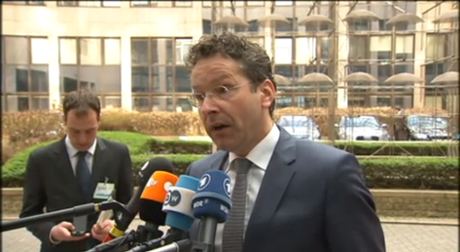
Eurogroup chief Jeroen Dijsselbloem warned several times that Greece must stop wasting time and start delivering , as he arrived at today’s Eurogroup meeting.
Here’s a video clip (he starts speaking English around 5 minute in).
Here’s the key quotes.
Q: Is there a risk that Greece can go bankrupt?
Dijsselbloem: We have said that we will support Greece further if they continue on the reform path. And I think that the talks about the programme and the reforms that are needed should restart very very quickly. We’re losing too much time.
Dijsselbloem then warned that discussions about Grexit are not very helpful; he’s very much against it, and so are the Greeks.
Q: How can Greece finance themself?
Dijsselbloem: That is up to the Greeks to secure... we stand ready to support them on the basis of further progress in the programme.
We seem to be losing time now - since the last eurogroup little has been done in terms of future talks, in terms of implementation. The key issue now is not to waste any more time.
Q: What do you think about the letter sent by Greece last week [see earlier post for details]?
Dijsselbloem: It was a welcome contribution to the process....I have sent it onto the institutions. It can be part of the talks between the institutions and the Greek government which have to start very, very soon.
We have lost over two weeks in which very little progress has been made. The real talks haven’t started yet, there has been no implementation. So we have to stop wasting time and really start the talks now, seriously.
Q: What kind of concrete measures do you expect from the Greek?
Dijsselbloem: I won’t go into the whole list and the reform programme. My key message is the talks have to start, rather today than tomorrow, and we shouldn’t waste so much time.
The extension is only for four months, and the time is ticking away...
Updated
Malta’s finance minister, Edward Scicluna, told reporters that the Greek reform programme “needs a lot of work” as he arrives at the eurogroup meeting.
Ireland’s finance minister, Michael Noonan, has told reporters that Greece’s deputy prime minister Yannis Dragasakis will lead negotiations with its creditors, rather than finance minister Yanis Varoufakis.
#Eurogroup irish finmin says real negs with troika to be run by greek deputy pm, not @yanisvaroufakis
— Ian Traynor (@traynorbrussels) March 9, 2015
Dragasakis has been present at earlier eurogroup meetings, and also chairs the government’s economic council, so he’s already heavily involved. Interesting that Noonan pointed this out, though.....
#Ireland FinMin Noonan w an xclusive: The Greek gov't has decided that negotations will be centered at Deputy PM's office. | Not Varoufakis?
— Yannis Koutsomitis (@YanniKouts) March 9, 2015
Did the eurogroup not get the message that Greece is no longer under the control of the Troika?
#Eurogroup schaeuble greece is now a matter for the troika. very explicit. he's said troika 3/4 times already
— Ian Traynor (@traynorbrussels) March 9, 2015
Schaeuble: Making repeated references to "Troika" #Greece #Eurogroup pic.twitter.com/TJ7sfssm4T
— Derek Gatopoulos (@dgatopoulos) March 9, 2015
It’s The Institutions, now, Wolfgang, don’t forget!
Updated
Here comes Wolfgang Schauble....
Wolfgang Schauble just arrived at #Eurogroup pic.twitter.com/meDMjXJEvJ
— Eleni Varvitsiotis (@Elbarbie) March 9, 2015
More quotes from Jeroen Dijsselbloem, urging Greece to up its game.
we have to stop wasting time, that's my message today, #Dijsselbloem says. #greece #eurogroup
— Elodie Lamer (@ElodieLamer) March 9, 2015
#Dijsselbloem: little has been done since the last #eurogroup, we have lost over two weeks, real talks have not begun yet
— Symela Touchtidou (@stouchtidou) March 9, 2015
Dijsselbloem: Greece hasn't done enough yet
Eurogroup chief Jeroen Dijsselbloem warned that Greece must stop wasting time and develop its reform package, as he arrives at the eurogroup meeting in Brussels.
Our Europe editor Ian Traynor is there, and reports:
#Eurogroup @J_Dijsselbloem 'little has been done on (greek) reform, further talks, implementation'
— Ian Traynor (@traynorbrussels) March 9, 2015
#Eurogroup @J_Dijsselbloem main msg today, stop wasting time, get real. clearly last week's tourists and taxdodgers was daft
— Ian Traynor (@traynorbrussels) March 9, 2015
Dijsselbloem also told reporters that officials from “troika institutions” will visit Athens soon; a reminder that Greece is still under the control of its creditors.
#Eurogroup @J_Dijsselbloem choosing to signal there will be (troika) technical talks in athens
— Ian Traynor (@traynorbrussels) March 9, 2015
Dijsselbloem mentions 'Troika institutions' and Athens in the same sentence. Ouch.
— Yannis Koutsomitis (@YanniKouts) March 9, 2015
Updated
Reporters in Brussels are poised for the arrival of Germany’s finance minister, who’s likely to take his usual tough stance with Greece:
Waiting for Schäuble. #Eurogroup pic.twitter.com/gRSlJPNYq0
— Gabriele Steinhauser (@gksteinhauser) March 9, 2015
And here’s a videoclip of Pierre Moscovici telling reporters that Greece must give more details of its reform plans today.
#Eurogroup meeting - EU Commissioner @pierremoscovici on #Greek reforms http://t.co/rY1hdCTs6i pic.twitter.com/AhbdySdx2B
— EU Council TV News (@EUCouncilTVNews) March 9, 2015
Updated
Dutch Deputy FinMin: "Greeks should move as fast as they can, they should speed up". Declines to comment on potential referendum. #Greece
— Open Europe (@OpenEurope) March 9, 2015
Dutch: Greece needs a proper reforms package
Eric Wiebes, the Dutch state secretary for finance, has just declared that Greece’s list of reforms isn’t sufficient.
Arriving at the eurogroup meeting in Brussels, Wiebes told reporters that a full package must be agreed and signed off by creditors by the end of enc
#Eurogroup greeks need to get a move on. need a proper reform package by end of april rubberstamped by troika - wiebes, dutch official
— Ian Traynor (@traynorbrussels) March 9, 2015
European commissioner Pierre Moscovici has declared that Greece must provide more specifics about its reform plans at today’s meeting, as the trickle of quotes from Brussels begins.
Moscovici: First reform list was accepted by institutions, we need to go more into detail. But that won't necessarily be today. #Greece
— Open Europe (@OpenEurope) March 9, 2015
Moscovici: It is 'essential' that the Greek gov't works with the 'Institutions' on the technical level. #Greece #Eurogroup
— Yannis Koutsomitis (@YanniKouts) March 9, 2015
Lunchtime summary
A quick recap.
Eurozone finance ministers are due in Brussels shortly for a eurogroup meeting, with Greece’s bailout programme top of the agenda.
German finance ministry sources have already predicted that today’s meeting won’t deliver a concrete result to unlock any aid payments for Greece.
The meeting is overshadowed by the Greek finance minister’s claim that a referendum could be held, or even fresh elections, if the country’s creditors reject its reform proposals.
Angela Merkel has warned of difficult times ahead over Greece, on a trip to Japan.
The uncertainty has hit the Greek stock market, where bank shares are now down over 7%.
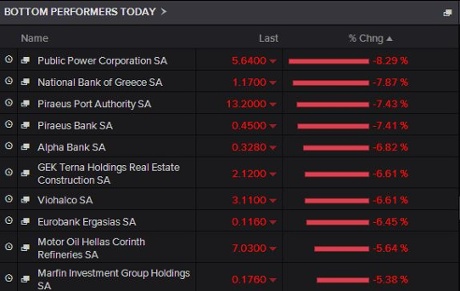
Greek bonds have fallen in value too, as Grexit fears continue to loom -- even though City chiefs fear that the markets are too complacent.
But other eurozone bonds are rising in value, as the European Central Bank’s new QE stimulus programme begins.
German Bunds rally as #ECB said to begin buying German Government bonds under QE plan. 10yr yields drop to 0.36%. pic.twitter.com/lxUlqSe7J1
— Holger Zschaepitz (@Schuldensuehner) March 9, 2015
Reminder: The Greek reform plan
Eurogroup chief Jeroen Dijsselbloem warned yesterday that Greece’s latest reform plan is “far from complete”. So what is it?
The programme which Greece sent to Brussels last week [online here] consists of seven key points.
1) Creating an Office for Fiscal Responsibility, to monitor government policy
2) Improving budget preparation
3) Hiring ‘casual onlookers’ to fight tax evasion -- citizens and tourists wired up with recording kit to find evidence of firms dodging VAT.
4) Tackling Greece’s unpaid tax problem, by offering a discount to those in arrears and writing off some of the ‘unrecoverable’ debts.
5) Offering new licences to online gambling sites, replacing the current system which doesn’t raise any revenue
6) Reforms to force government agencies to share information better, rather than bombarding citizens with requests.
7) New allowances for food and rent for poorest Greek families, and reconnecting power supplies to those who have been disconnected for not paying their bills.
Item 3 was roundly criticised when the list leaked last Friday, but what about the rest?
Items 1 and 2 sound decent -- Britain’s own Office for Budget Responsibility has worked well since being introduced in 2010.
Targeting unpaid taxes makes sense, but it’s not clear that Item 4 has enough teeth to force debtors to comply. It proposes that anyone who joins the process and then fails to comply is simply put back into the normal tax collection policy.
Item 5 breezily declares that new online gambling licences could raise more than €500m per year, based on “fairly plausible assumptions” -- something that eurozone ministers may be sceptical of.
And the measures in Item 7 could help tackle Greece’s humanitarian crisis, so are very welcome. However, they cost €200m. The letter explains that it will be paid by €60m in government efficiency savings and €140m from a new public tendering system. The eurogroup might not believe these savings are credible.
As Frontline Analysts’ Dan Davies put it in his excellent analysis:
These are classic examples of projected “waste and inefficiency” savings, which tend to be taken only at a substantial discount in any program negotiations — it’s not that it isn’t possible to sweat the paperclips budget, or to improve competitive tendering, it’s just that delivery on this sort of program is never taken for granted.
I don’t think the Eurogroup will treat these measures as fiscally neutral, which means that more funding from spending cuts or tax rises will need to come from somewhere else.
OK, my first-cut analysis of the Greek proposals is up on medium. https://t.co/QLZETOaBqt . I feel bad about being so negative, but WCYD?
— Dan Davies (@dsquareddigest) March 6, 2015
The European Commission has just announced that Greece’s prime minister, Alexis Tsipras, will meet with Jean-Claude Juncker on Friday.
President @JunckerEU will meet PM @atsipras in Brussels on Friday 13.3 at 9.00am.
— Margaritis Schinas (@MargSchinas) March 9, 2015
Merkel: We have a difficult path over Greece

German chancellor Angela Merkel has warned that Europe faces a “very difficult path” over Greece.
Speaking in Japan, Merkel sounded cautious when asked whether she could rule out the possibility that Greece might leave the eurozone.
I’ve taken the quotes from Reuters.
Merkel told a press conference that:
“I have said time and time again, and I can say it again here, our political goal is to keep Greece in the euro zone. We have been working on this for many years.
“But it’s also true that there are two sides to this coin -- on the one hand solidarity from European partners, and on the other the readiness to implement reforms and other commitments at home.
On this, we clearly have a very difficult path ahead of us.”

The FT’s Peter Spiegel has published a letter sent by eurogroup chief Jeroen Dijsselbloem to the Greek government on Friday.
In it, Dijsselbloem thanks Yanis Varoufakis for the seven reforms he outlined in his own letter last week, before cautioning that more work is needed.
Here’s a flavour:
Dear Yanis,
I thank you for your letter, dated 5 March 2015, and for the attached document outlining in some detail seven of the reforms planned by the Greek government.
This document will be helpful in the process of specifying the first list of reform measures you submitted earlier on 23 February, which needs to be agreed with the institutions by the end of April, in line with the Eurogroup statement of 20 February. The proposals described in your letter will thus need to be further discussed with the institutions. Let me also clarify that in the course of the current review the institutions will have to take a broad view covering all policy areas and I count on your cooperation in this regard....
Dijsselbloem adds that officials from Greece’s creditors will conduct ‘technical work’ in Greece in the coming weeks.
.@J_Dijsselbloem letter to @yanisvaroufakis: "troika" (sorry, "institutions") returning to Athens? Leaked letter here http://t.co/8lwBzZxajE
— Peter Spiegel (@SpiegelPeter) March 9, 2015

Greek government bonds are weakening this morning, showing that traders see the debt as riskier.
The yield (or interest rate) on Greek 10-year sovereign debt has risen to 9.96%, from 9.5% on Friday night.
Three-year bond yields have risen more sharply:
* Greek 3-year government bond yields rise 112 bps to 15.436 percent - RTRS
— Fabrizio Goria (@FGoria) March 9, 2015
The European Central Bank has confirmed that its new QE programme kicked off this morning:
ECB and Eurosystem national central banks have, as previously announced, started purchases under the Public Sector Purchase Programme.
— ECB (@ecb) March 9, 2015
Leisurely start RT @FerroTV BUNDESBANK SAYS IT WAS ACTIVE IN MARKET FROM 9:25 AM CET
— Mike Bird (@Birdyword) March 9, 2015
Heads up. Eurozone ministers will arrive for today’s meeting in Brussels around 2.45pm local time, or 1.45pm GMT.
Doorstep #Eurogroup at around 14.45.
— Jeroen Dijsselbloem (@J_Dijsselbloem) March 9, 2015
Many of the City’s biggest names are worried that markets underestimate the risk that Greece might leave the eurozone.
That’s according to a new poll from the Financial Times. Here’s a flavour:
“Neither the eurozone, nor perhaps even the EU itself could survive a stampede out the door,” said Xavier Rolet, chief executive of the London Stock Exchange.
Tidjane Thiam, chief executive of insurer Prudential, said: “Financial markets seem remarkably relaxed about a potential Grexit; they believe that either it will not happen, or it will not matter. That belief deserves to be challenged.”
Grexit would “accelerate a dismantling of euroland”, warned Robert Swannell, chief executive of Marks and Spencer. It would be a “signpost for others to follow in times of distress”, echoed Sir Roger Carr, chairman of BAE Systems...
Here’s the full piece (£):
Top City financiers warn investors over Grexit chaos
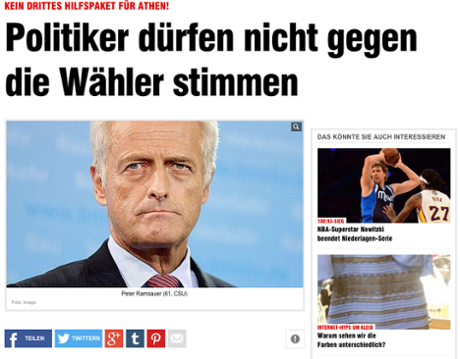
One of the German MPs who voted against Greece’s bailout extension has argued that the country would be better off quitting the eurozone.
Writing in the Bild tabloid today, CSU MP Peter Ramsauer argued:
“By leaving the euro zone, as finance minister Schäuble has suggested, the country could make itself competitive again from a currency perspective with a new drachma.
“This would provide Greece with a great opportunity to renew itself economically and administratively, making itself fit again to return to the eurozone from a position of strength.”
A new opinion poll shows that over two-thirds of Greeks want their leaders to reach a “fair compromise” with its creditors.
The number who favour a tough fight that risks Greece leaving the eurozone has fallen a little:
#Greece poll [Marc]: 69,6% for 'fair compromise' w Eurozone (+1.9% vs prev), 27,4% for 'confrontation even if it wd lead to Grexit' (-2.2%)
— Yannis Koutsomitis (@YanniKouts) March 9, 2015
Among Syriza voters, 57,8% for 'fair compromise', 38,9% for 'confrontation'. #Greece
— Yannis Koutsomitis (@YanniKouts) March 9, 2015
Updated
Meanwhile, alternate economy minister Dimitris Mardas has insisted this morning that Greece’s state revenues were not in such a parlous position as many imagined.
Over to Helena Smith again:
Insisting that a solution would be found “despite the low expectations,” Mardas took commentators aback this morning saying: “the picture that we have of revenues is better than expected.”
Greece’s tax collecting apparatus has come to a grinding halt since the year began with revenues dropping by a precipitous 22 %, according to officials.
Speaking of today’s euro group he added enigmatically: “let’s get to the point where we are up against the wall and after we’ll see [what we do]. “
“There are alternative solutions,” he told Mega TV. “A solution will be found despite the low expectations.”
And Mardas also played down the idea that Greeks could head back to the polls soon.
“Scenarios”, he said referring to the idea of a referendum floated by Varoufakis over the weekend, “won’t happen.”
Greek opposition calls for finance minister Varoufakis to be replaced

Over in Athens, opposition to government policies - and members - is escalating ahead of today’s eurogroup meeting of euro area finance ministers.
Our correspondent Helena Smith reports:
Describing Greece’s finance minister as “dangerous,” the main opposition party’s parliamentary spokesman Kyriakos Mitsotakis called this morning for Yanis Varoufakis to be replaced.
In a clear ratcheting up of the pressure on the leftist-led government, Mitsotakis said the finance minister’s tendency to shoot from the mouth was not the way to conduct “proud negotiation.”
The conservative New Democracy MP told Mega TV:
“With what Mr Varoufakis is doing, he is dangerous for the country and the best thing that the prime minister can do is replace him as soon as possible.”
“Every time he opens his mouth he creates problems for the negotiating position of the country. Mr Varoufakis has managed to do something unique which is to get all of Europe [to support] Mr Schäuble,” he said referring to the German finance minister.
“With endless interviews you do not conduct proud negotiation.”
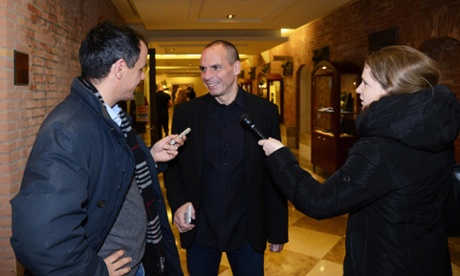
Athens, Mitsotakis said, had become isolated within the family of eurozone nations.
He also criticised the “unclear and ridiculous reforms” which Varoufakis proposed last week [including sending members of the public undercover to help spot tax evasion].
“Greece is desperately isolated, it is alone. [Varoufakis’] proposals range between being unclear to ridiculous, provoking laughter when we talk about wiring up tourists to clamp down on tax evasion.
And all the while the country is being driven to recession and revenues are tragically behind.”
The Greek finance minister had to go because he was “unstoppable and impetuous,” Mitsotakis insisted, adding:
“He doesn’t know what he is talking about.”
Quite an attack on the economics professor, who we should hear from later today in Brussels....
Updated
Greece’s bank shares are falling sharply in early trading in Athens, as the threat of a referendum hits confidence.
The main Athens index has fallen by 3.5%, with bank shares among the big fallers. Piraeus Bank has shed 6.5%, and National Bank of Greece is down 6.3%.
#Greece gives the Eurozone party pooper: FTSE Greek banking index starts 5.5% lower to the week. pic.twitter.com/g1jZkPJ154
— Holger Zschaepitz (@Schuldensuehner) March 9, 2015
QE begins!
Bloomberg is reporting that the ECB has made its first purchase of eurozone government debt, under its new quantitative easing programme.
And they’ve started by snaffling up some German bunds, according to traders.
Jawohl! *ECB SAID TO BEGIN BUYING GERMAN GOVERNMENT BONDS IN QE PLAN
— Frederik Ducrozet (@fwred) March 9, 2015
Eurozone bond have been rallying this morning, as the markets anticipated the arrival of the ECB as a willing buyer.
This has pushed yields (which move inversely to prices) down to new record lows.
#Eurozone bonds rally on QE day: Germany's 10yr bund yields drop to 0.38, 10yr BTP's to 1.3%, Spain's 10yr to 1.28%. pic.twitter.com/4BT8YyGh8V
— Holger Zschaepitz (@Schuldensuehner) March 9, 2015
Europe’s stock markets have all fallen in early trading:
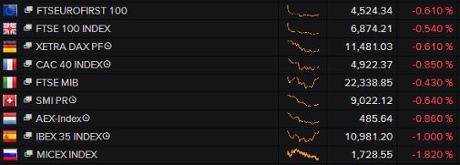
Investors are calculating that America’s monetary policy may soon start to tighten, after the US unemployment rate hit a new six-year low late on Friday.
Kit Juckes of Société Générale says:
Unless data deteriorate, the rate rises start in June.
One of Britain’s best-performing fund managers has weighed in on the eurozone crisis, arguing that the single currency isn’t viable.
Neil Woodford told the BBC that the eurozone was “fundamentally flawed”, and “probably” not viable in the long term.
“In a very simple sense pretending that Greece was Germany is a fundamental error.
Having the same interest rate, the same monetary policy for two economies that are so different seemed to me to be a fundamentally flawed assumption right at the start of the project.
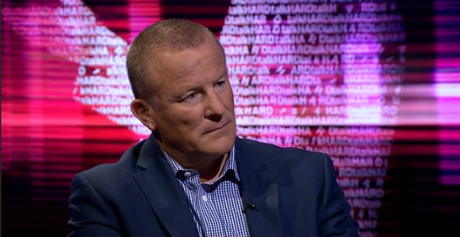
He concedes that political leaders are committed to keeping the eurozone together, but... “ultimately, economics has a habit of overruling politics”.
Woodford made the comments in a lengthy interview, in which he also discusses the state of the world economy, Britain’s EU membership, and the whole business of investment.
Here’s the full interview (the Greek section starts18 minutes in).
The agenda for this afternoon’s eurogroup meeting, which starts at 2.30pm GMT, is online here.
Eurogroup, 09/03/2015
Here’s the section on Greece:
The Eurogroup will discuss the next steps following the decision to extend the financial assistance to Greece by up to four months beyond its original expiry date of 28 February 2015. The political agreement on the extension was taken by the Eurogroup on 24 February and later approved by a number of national parliaments in the euro area and by the European Financial Stability Facility (EFSF), which provides the assistance. The formal decision on the extension was taken on 27 February.
Ministers will also consider Cyprus’s bailout programme, which is stalling because MPs won’t pass a law to help banks repossess properties.
The Eurogroup will be given an update on the ongoing 6th review of the macroeconomic adjustment programme in Cyprus. One of the requirements of the programme is the implementation of the an effective foreclosure framework, which would allow banks to manage their bad loans and improve lending to the real economy.
Speaking of Germany.... its economy may not be quite as vibrant as we thought.
New data shows that German exports fell by 2.1% month-on-month in January. That’s the biggest fall since last August and worse than economist expected, suggesting the weak euro isn’t helping as much as we thought.
Weaker-than-expected German exports, down 2.1% MoM. Well, at least the infamous German trade surplus narrowed, to EUR16bn.
— Frederik Ducrozet (@fwred) March 9, 2015
The prospect of a Greek referendum might make the European Central Bank wary of offering more emergency support to its banking sector.
As Dan Davies of Frontline Analysts put it:
if Syriza are floating the idea of exit referendums, they kind of lose the right to complain about anyone else threatening bank liquidity
— Dan Davies (@dsquareddigest) March 9, 2015
Germany: Greece hasn't got time for a referendum
Yanis Varoufakis’s suggestion that Greece could hold a referendum over its reform plans has been slapped down by Germany’s deputy finance minister.
Steffen Kampeter warned this morning that any referendum would simply slow down Greece’s reform drive. He also predicted little progress at today eurogroup meeting.
Reuters has full details:
Germany’s deputy finance minister said on Monday that he did not expect concrete dedcisions on Greece to be taken at a meeting of euro zone finance ministers later in the day because they are still waiting for more financial details on Greek reform plans.
“I don’t expect any substantial decisions by the Eurogroup this evening,” Steffen Kampeter told German radio in an interview.
Kampeter also rebuffed suggestions by Finance Minister Yanis Varoufakis that Greece could call a referendum or early elections if its euro zone partners reject the latest reform proposals from Athens, saying this would only lead to a delay in the implementation of the economic measures Greece needed.
#Germany DepFinMin does not expect concrete Eurogroup decision on #Greece; Referendum wd only lead to a delay in reform implementation ~RTRS
— Yannis Koutsomitis (@YanniKouts) March 9, 2015
Updated
The agenda: Eurozone ministers meet to discuss Greece again

Good morning, and welcome to our rolling coverage of the world economy, the financial markets, the eurozone and business.
Greece’s financial woes are top of the agenda again today, as Eurozone finance ministers head to Brussels for another crunch meeting. [starting at 3.30pm local time].
It’s the first eurogroup meeting since the Greek government was given a four-month extension to its bailout programme.
Ministers will be discussing a new reform plan which Athens sent last week [online on the FT’s site], which made headlines because it included an innovative proposal to send out civilians carrying recording kit as undercover tax evasion inspectors. Brussels insiders say the idea didn’t go down terribly well...
More importantly, the plan also proposed talks on a third bailout (dubbed a “contract for recovery and growth).
Greece’s government has raised the stakes ahead of the meeting by suggesting they could hold a referendum, or fresh elections, if their reform plans are rejected.
Finance chief Yanis Varoufakis told Italy’s Il Corriere della Sera that:
“We are not attached to our posts. If needed, if we encounter implacability, we will resort to the Greek people either through elections or a referendum.”
The finance ministry has now insisted that any referendum would be on the reform plans, not eurozone membership. But it does suggest we could see further political upheaval in Greece in the coming months.
Full story: Greece threatens new elections if eurozone rejects planned reforms
It’s also a historical day in the eurozone crisis, as the European Central Bank begins its massive QE bond-buying programme. They’ve picked a good day for it, looking at the weather in Frankfurt:
A fine morning to start #QE? pic.twitter.com/3RrT1IC37O
— Angela Cullen (@cullenang) March 9, 2015
Over in the financial markets, European shares are expected to drop this morning, tracking a late sell-off on Wall Street last Friday.
That was triggered by an unexpectedly strong American jobs report, which bolstered predictions that the Federal Reserve might raise interest rates as early as June.
Here’s the early calls, from CMC Markets:
-
FTSE100 is expected to open 28 points lower at 6,883
-
DAX is expected to open 47 points lower at 11,503
-
CAC40 is expected to open 21 points lower at 4,943
I’ll be tracking all the main events through the day...