And finally... you know the crisis has reached a tipping point when this happens:
Keep calm & reform #Greece @yanisvaroufakis http://t.co/wL8reqmRqo pic.twitter.com/dBhYRAjddd
— Guy Verhofstadt (@GuyVerhofstadt) June 9, 2015
Yanis managed to maintain his calm...
@GuyVerhofstadt This is precisely what we ask for: An opportunity to reform deeply. Which cannot be done under even greater austerity...
— Yanis Varoufakis (@yanisvaroufakis) June 9, 2015
...others may have struggled:
FFS, is this what it's really come to? https://t.co/ZGrbSVoWUq
— Mehreen (@MehreenKhn) June 9, 2015
So let’s all take a deep breath and come back tomorrow, when Alexis Tsipras will try (once again) to achieve a political breakthrough in Brussels with Merkel and Hollande. But possibly not Jean-Claude Juncker, who doesn’t sound especially calm right now.
Cheers, and thanks for reading and commenting. GW
Even the most sensationalist hack would struggle to get excited about Wall Street tonight. The Dow Jones index fell a mere 0.01%, while the broader S&P 500 gained a single point.
Dow ends lower by 3 points, according to early data. http://t.co/niE7wmOjeE pic.twitter.com/BmKnqm7c9m
— MarketWatch (@MarketWatch) June 9, 2015
Greece’s predicament clearly isn’t worrying New York.
Volker Kauder, caucus leader of Chancellor Angela Merkel’s bloc in parliament, has also shown impatience with Greece’s strategy tonight.
Kauder said:
“It’s not possible that the borrower decides under what conditions the lender kindly gives his money,”
“We want Greece to stay in the euro, but whether this is achievable depends entirely on Greece.”
That’s via Bloomberg. More here:
New Greek Budget Plan Falls Short of Last Week’s Pledge

Mood seemed to really darken today in #Greece talks. @JunckerEU told college Athens "has lost the @EU_Commission" http://t.co/jnhpEOx3fz
— Peter Spiegel (@SpiegelPeter) June 9, 2015
Juncker is not happy with Greece....
Greece may have burned its bridges with Jean-Claude Juncker too!
As we flagged up earlier, Juncker has been cool about meeting Alexis Tsipras at Wednesday’s summit. And AFP has learned that the EC president has been telling colleagues that it’s not worth the effort.
Juncker told fellow European commissioners on Tuesday that a new Tsipras meeting would be a “waste of time” and that it would be “better to meet with the Latin Americans”, an EU source said.
Juncker told commission meeting Tsipras tmrw 'waste of time', wd be 'better off meeting Latin Americans' - sources https://t.co/h0aLd5GxA9
— Danny Kemp (@dannyctkemp) June 9, 2015
Updated
Was it just another day in the Greek crisis -- with Athens submitting proposals, creditors saying more work is needed, and the roundabout spinning again?
Perhaps not. The FT’s Peter Spiegel reports tonight that the cautious optimism in Brussels is being replaced by “fear and suspicion”.
That’s despite Greece proposing more taxing budget surplus targets - moving halfway towards its old bailout targets.
So is Greece misplaying its hand? Over to Peter......
Gone this time were the private reassurances that a deal would ultimately be concluded, allowing the Greek government to receive an infusion of euros before its bailout expires at the end of the month.
Instead, officials from various institutions involved in the talks now worry that Greece’s hard-left government is dangerously miscalculating. Athens, they believe, is intentionally prolonging the negotiations to the last minute in a belief that its creditors will eventually “blink” and agree to grant wholesale debt relief and new bailout cash with few strings attached.
“They do not want a deal with us; they just want debt relief,” a senior official with one of Athens’ bailout monitors said after reviewing Greece’s latest offer.
“I don’t think they will move. I think they’re waiting for us to blink, and we won’t,” the official added. “They don’t understand we’re not back in 2012 where the Europeans were willing to just throw money at the problem.”
Full story: ‘Paperology’ continues, but mood darkens in Greece talks
Some Greek MPs are pushing Alexis Tsipras to hold firm:
22 SYRIZA MPs ask Greek PM Tsipras for collective bargaining to be restored & min wage raised. Lenders have asked for no rollback #Greece
— MacroPolis (@MacroPolis_gr) June 9, 2015
Correction! London’s stock market actually fell to a three-month low tonight:
Fortunately my colleague Nick Fletcher knows the score:
Leading shares hit a near three month low, on continuing worries about Greece, rising bond yields and talk of a US rate rise.
In a broad based sell-off the FTSE 100 fell 36.24 points to 6753.80, its lowest level since 13 March. European markets were also lower, with Germany’s Dax down 0.7% and France’s Cac falling 0.19%.
On Wall Street, the Dow Jones Industrial Average was up around 25 points by the time London closed, as better than expected job openings figures added to Friday’s non-farm payroll numbers to ease concerns about weakness in the US economy.
But gains were limited, since a strong economy inevitably suggests to investors a probable rise in interest rates this year....
More here:
Updated
#FTSE 100 biggest risers: Royal Mail (+2.30%), Mondi (+1.97%), Intu Properties (+1.49%)
— LondonStockExchange (@LSEplc) June 9, 2015
#FTSE 100 biggest fallers: Pearson (-2.38%), Anglo American (-2.00%), Astrazeneca (-2.00%)
— LondonStockExchange (@LSEplc) June 9, 2015
Updated
It was a day to forget on the Frankfurt stock market, where the Dax lost another 0.55% (the white line on this chart).
#Germany's Dax drops to 11k on Bund rout. 10yr yields continue to rise towards 1%. pic.twitter.com/e3hq1foebR
— Holger Zschaepitz (@Schuldensuehner) June 9, 2015
Money also flooded out of German government debt as the QE factor faded, pushing yields on 10-year bunds up to nearly 1% (the yellow line above)
Is the EU Commission president still fuming, after hearing his efforts savaged in the Athens parliament on Friday?
According to officials cited in the Greek media, he may well be, writes Helena Smith.
Athens has still not heard whether Jean-Claude Juncker will be present when Alexis Tsipras holds talks on the sidelines of Wednesday’s EU-Latin American and Carribean summit with his French and German counterparts.
Still, the Greek leader appears to be preparing the ground for a solution - among his own rank and file.
Speaking to Syriza’s political secretariat - the party’s steering board - he said every last MP had to support the government’s proposal because it outlined “a viable solution” to the country’s economic woes.

Valdis Dombrovskis, the EC vice-president with responsibility for the euro, believes a Greek deal can be reached in the coming days.
He told a press conference in Brussels that a staff-level accord could be close, if primary surplus targets are ‘specific measures’ are agreed.
But Dombrovskis, who has been fairly firm with Greece in recent months, also warned that the “tactical manoeuvring” must stop.
- EU’S DOMBROVSKIS SAYS: IMPORTANT IN COMING DAYS TO AGREE ON PRIMARY SURPLUS TARGETS AND SPECIFIC MEASURES FOR GREECE
- EU’S DOMBROVSKIS SAYS: IS IMPORTANT FOR GREECE TO SAY WHAT MEASURES THEY DON’T LIKE AND WHAT THEY ARE READY TO DO
- EU’S DOMBROVSKIS SAYS: REACHING AGREEMENT IN COMING DAYS IS POSSIBLE
- EU’S DOMBROVSKIS SAYS: NEEDS LESS TACTICAL MANOEUVRING AND MORE WORK ON SUBSTANCE
EU's @VDombrovskis says Greek debt deal possible 'in coming days', @AFP alerting ex-Strasbourg
— Danny Kemp (@dannyctkemp) June 9, 2015
Updated
Analyst: Greece will be forced into a deal
Wolfango Piccoli of Teneo Intelligence reckons Greece will be forced into a “take it or leave it” deal by its creditors in time for the next Eurogroup meeting, on 18 June.
By that stage, Tsipras would have to swallow pension reforms, as the only alternative will be capital controls.
Wolf adds:
In this sense, rumours that the revised Greek proposal constitutes no substantial improvement are not particularly surprising.
Wolf has also summarised the latest Greek negotiating position, based on today’s leaks:
- Primary surplus: Greece wants the targets (1% in 2015 and 2% in 2016) lowered (to 0.75% in 2015, 1.75% in 2016, and 2.5% in 2017) but this remains unlikely as it would open up again the question of debt sustainability. Moreover, the proposed measures are deemed by the creditor as not sufficient to meet to targets indicated by Athens. While creditors might show some flexibility on the target for 2015, they are likely to be less forthcoming regarding 2016-18.
- VAT: Athens may be willing to give up exemptions for the Aegean islands (worth about €300m), increasing their offer to around €1.3bn. Ultimately, Athens will likely have to accept the Troika proposal of revenues of around €1.5-1.8bn, as long as electricity is excluded from the top rate.
- Pensions: This remains the major sticking point. Athens offered to scrap early retirement incentives and to increase health contributions of pensions but wants to keep the EKAS benefit for low-income pensioners. The question is whether the Government will commit to cumulative savings target by end 2016 of 1% of GDP.
- OECD toolkit on product market deregulation: The IMF insists on passing the reforms not yet implemented by the previous government (over-the-counter drugs, milk, advertising). If Athens delivers, it may get some flexibility on pensions. But SYRIZA once railed against the OECD recommendations, and resistance from vested interests is strong.
- Privatisation: Creditors insist on privatizations in the energy sector with the sale of ADMIE (the independent power transmission operator), PPC (or at least a small part of it), and ELPE (Hellenic Petroleum) – all of which are under the supervision of Energy/Environment Minister Panagiotis Lafazanis, the leader of SYRIZA’s leftist platform.
Tsipras urges Syriza to stand by him
Newsflashes from Athens - Alexis Tsipras has met with top members of his Syriza party, and urged them to support him at this critical time.
Tsipras, who looked quite relaxed arriving at the meeting (is that a new jacket?) also told MPs that he is not planning to call fresh elections:

That’s via a government official, speaking to Reuters:
- 09-Jun-2015 15:15:53 - GREEK PM TSIPRAS TELLS HIS PARTY’S POLITICAL COMMITTEE NEGOTIATIONS WITH LENDERS ARE AT MOST CRUCIAL STAGE, CALLS ON PARTY TO SUPPORT HIM - GOVERNMENT OFFICIAL
- 09-Jun-2015 15:16:16 - GREEK PM TSIPRAS TELLS HIS PARTY’S POLITICAL COMMITTEE HE IS NOT CONSIDERING EARLY ELECTIONS
As regular readers know, a section of Syriza are adamant that Tsipras should not compromise, and should instead seek a ‘rupture’ from its creditors.
Updated
Summary: Greek proposals in, but talks continue

It must be time for a recap.
Greece has submitted fresh proposals to its creditors in an attempt to secure fresh bailout funding before its current programme expires in three weeks time.
But talks are continuing in Brussels this afternoon, after EU officials warned this new list still doesn’t go far enough.
Three pages of new fiscal plans were delivered to Brussels officials this morning, including higher budget surplus targets.
#Greece officials believe they've moved half the distance on surplus targets and want creditors to do the same. 0.75% in 2015, 1.75% in 2016
— Peter Spiegel (@SpiegelPeter) June 9, 2015
Greece has also outlined plans to cut its debt burden, partly by getting Europe’s bailout fund to buy Greek bonds held by the ECB which mature in July and August.
“Two complimentary texts of proposals were handed over to the commissioner Pierre Moscovici, with the aim of closing the fiscal gap with alternative proposals and coming up with a possible plan of sustainability for the Greek debt.”
Officially, the EC says it is considering the plan with “diligence and care”. But behind the scenes, officials didn’t take long to dismiss this latest proposal.
Reuters explains:
“What has been submitted is not sufficient to move the process forward,” said one EU official. Another said it was “not sufficient and not acceptable to member states”.
Talks between the two sides are expected to continue today. And Greece has a great incentive to make progress:
Insiders saying Alexis Tsipras will present his government’s updated proposal to Angela Merkel and Francois Hollande tomorrow, when he meets the two leaders on the sidelines of the EU/ Latin America summit.
RTRS reports that #Greece & creditors aiming for a baseline agreement today so that Tsipras can seal deal w/ German & French leaders on Wed
— Holger Zschaepitz (@Schuldensuehner) June 9, 2015
There’s a lot of speculation that Greece could be given a new bailout extension, to March 2016. The WSJ says creditors proposed this last week.
And Athens insiders say it would give time to agree a third bailout early next year. One told our Helena Smith :
“That would be the time that the government would have to come to a big agreement.”
But that would require billions of fresh funding - perhaps by repurposing €10.9bn of bank recapitalisation funds.
And Tsipras is sticking to his ‘red lines’. He criticised lenders for demanding more austerity to be poured on Greece’s poorest, in an interview with Italy’s Corriere Della Sera.
And the PM also claimed that the eurozone could collapse if Greece were forced out, raising the stakes ahead of Wednesday’s meeting. He said:
It would be the beginning of the end of the eurozone.
If the European political leadership cannot handle a problem like that of Greece, which accounts for 2% of its economy, what would the reaction of the markets be to countries facing much larger problems, such as Spain or Italy which has two trillion of public debt?
Italy’s finance minister has rejected this idea, though, telling CNBC that the eurozone is stronger than it was before.
And Germany’s Wolfgang Schäuble has said Athens needs to do more:
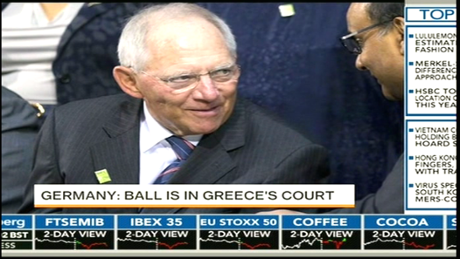
Schäuble says he still disagrees with Yanis Varoufakis, having met his Greek counterpart on Monday
And he also has denied falling out with Angela Merkel over her handling of the Greek crisis, insisting:
“You shouldn’t waste much time on these rumours.”
Not that Greece has much time to waste on anything right now....
Naftemporiki: "Time is Running Out" #Greece MT @naftemporikigr pic.twitter.com/wvJZAACeSq
— Derek Gatopoulos (@dgatopoulos) June 9, 2015
Updated
Some afternoon reading.
Andrew Farlow, research fellow in economics at Oriel College, Oxford, has outlined how Greece’s unsustainably debts have been created by the flawed structure of the eurozone, which encouraged the flow of cheap credit from German and French banks to the periphery.
Here’s a flavour:
At first, the German people welcomed the artificial upside of the euro, and passed the systemic risk consequences on to countries like Greece. Now, as the prospects for Greece worsen and the euro becomes more depressed, Germany’s exports receive a boost, and Germans become even less sympathetic. Meanwhile, all those panic-driven flows of capital flooding back into Germany have pushed ten-year German bond rates from about 3% in early 2011 to nearly zero today, easing Germany’s own budget problems. No wonder its politicians have been disinclined to spell out the optimal loss-mitigation strategy for Germany and the eurozone.
The stark reality is that Greece’s creditors must choose between two unpalatable scenarios. One is that Greece will leave the euro and default on its euro-denominated debt, its creditors will not get repaid anyway, and costly speculative pressures will mount on Portugal, Spain and Italy, while Greece itself will become more unstable politically and economically. The alternative is that Greece will stay, and its creditors will have to allow some further write-down on Greek debt. The latter scenario is surely the less painful.
Reforms in Greece need to go hand in hand with debt write-downs – not because of any special virtues of Greece, but because the logic of the euro makes it the only sane way out. Those who led the country into its mess are largely discredited within Greece. It has made huge progress in shifting its primary fiscal balance (i.e. before interest) and its structural fiscal deficit towards surplus. Further reforms now need growth, and this will only happen if economic bygones are treated as bygones.

Italy’s finance minister, Pier Carlo Padoan, has rejected Alexis Tsipras’s claim today that the eurozone would eventually collapse if Greece left.
Speaking on CNBC a moment ago, Padoan said the EU system was much stronger than before.
He’s still confident that a Greek deal will come in time, he adds.
Updated
Schäuble has also denied reports of a rift with Angela Merkel over Greece.
Don’t waste your time with such rumours, he insists.
Last week, German media claimed that the two politicians were divided over Greece, with Merkel determined to avoid Grexit and Schäuble arguing that stretching the rules for Athens would simply be too dangerous.
Bloomberg reported this morning that the split was widening as the Greece crisis goes down to the wire.
Updated
Schäuble: I still don't agree with Yanis
Over in Berlin, Germany’s finance minister Wolfgang Schäuble is telling reporters that he still disagrees with his Greek counterpart, Yanis Varoufakis, on some issues despite yesterday’s meeting.
Via Reuters:
- GERMAN FIN MIN SCHAEUBLE SAYS AFTER TALKS WITH GREECE’S VAROUFAKIS ON MONDAY WE STILL HAVE DIFFERING VIEWS
I guess we shouldn’t be surprised that the Marxist economist and the centre-right politician don’t quite see the world the same way.
In other news, the earth still appears to be revolving around the sun... https://t.co/3UqJAYx4x5
— Peter Spiegel (@SpiegelPeter) June 9, 2015
Schauble is speaking alongside Alex Stubb, Finland’s finance minister (and ex-PM).
Stubb is taking a firm line too, warning that Greece needs to do its share to resolve the crisis before Europe runs out of patience:
- FINNISH FINANCE MINISTER STUBB SAYS IN LAST FEW YEARS WE HAVE DONE EVERYTHING IN OUR POWER TO KEEP GREECE IN EURO ZONE, WE WILL CONTINUE TO DO THAT BUT IT IS A TWO-WAY STREET
FIN fin-min Stubb, beside DE counterpart Schaeuble: ''I am sure there are a few finance ministers whose patience is running out'' #Greece
— Jeff Black (@Jeffrey_Black) June 9, 2015
#Likeminded - Der finnische Finanzminister @alexstubb zu Gast bei Freunden. pic.twitter.com/SCCAyKJXL5
— BMF (@BMF_Bund) June 9, 2015
Dow Jones newswires have some firm details of Greece’s new proposal.
It confirms that Athens has promised tougher budget targets - but still not as stretching as the creditors want.
Greece is now offering to run a primary surplus (excluding debt payments) of 0.75% this year. Up from 0.6% before, but below the creditors 1% goal.
Next year’s target has been raised from 1% to 1.75%, halfway to the creditors’ aim for 2.5%. (corrected)
Then in 2017, Greece is offering 2.5%, up from its earlier offer of 2%. Creditors want 3% though.
#Greece's latest proposal sees higher surplus targets than previous proposed: Prim surplus at 0.75% in 2015, 1.75% in '16, 2.5% in '17 (DJ)
— Holger Zschaepitz (@Schuldensuehner) June 9, 2015
Updated
We shouldn’t blame Greece entirely for the moves in the markets today.
Mining stocks were hit by weak Chinese inflation data released overnight, and there are also worries that the US Federal Reserve is likely to raise interest rates in September.
Greece’s stock market is defying the selloff; The Athens ATG index is up 2% today.
European markets hit lowest levels since February
Fears over Greece have pushed Europe’s stock markets lower through the morning.
All the main indices are in the red, with the Stoxx Europe 600 hitting its lowest level since 20 February (later that night, Greece’s four-month bailout extension was agreed).

The German DAX has now dropped around 11% since hitting its record high in April, as the enthusiasm created by the European Central Bank’s stimulus programme fades.
David Madden, market analyst at IG, pins some of the blame on Greece.
The London market is somewhat sheltered from the uncertainty in the eurozone, but whenever there is a decline in continental Europe the British market isn’t far behind.
The value that was added to eurozone stock markets on the back of QE is quickly being eroded due to Greece, and with the payback deadline looming dealers are doing their utmost to get out.
Updated
Greece’s short-term debt is under pressure this morning, pushing the yield (or interest rate) on two-year bonds up from 24.9% to 25.1%.
That suggests the debt is seen as even riskier.
New Greek reform proposal in cash-for-reform talks not sufficient, EU Officials say. 2y ylds continue to rise. (RTRS) pic.twitter.com/tyJGEEHOtG
— Holger Zschaepitz (@Schuldensuehner) June 9, 2015
Reuters is now also reporting that Greece hasn’t gone far enough for Europe’s liking:
- 12:22:08 - NEW GREEK REFORM PROPOSAL IN CASH-FOR-REFORM TALKS IS NOT SUFFICIENT -- EU OFFICIALS
Greek officials insist that their team in Brussels have narrowed the gap over fiscal targets and reforms with creditors.
That convergence follows the arrival of minister of state Nikos Pappas, prime minister Alexis Tsipras’ closest ally, in Brussels on Monday, leading to today’s new proposals.
Helena Smith reports from Athens:
After the flare-up of tensions following what many perceived as Tsipras’ incendiary speech before parliament on Friday, Pappas flew to Brussels on Monday to smooth ruffled feathers. Accompanied by Euclid Tsakalotos, the Oxford-educated economist coordinating negotiations and George Chouliarakis, the Manchester University academic heading the Greek government’s negotiating team, the three (moderates) held talks with EU economic and monetary affairs commissioner, Pierre Moscovici.
The contours of the proposal released today are believed to have been hotly debated at the meeting. The major discrepancy over just how big the fiscal gap will be in 2015-2106 appears to have been closed.
Until now Athens has forecast that indebtedness will stand at around €2bn; lenders at the EU, ECB and IMF reckon it will be more than twice that amount at around €4.5bn.
But sources are reporting convergence between the two sides over revenue projections that would close the gap.
However...the issue of VAT (which lenders want to increase to 23%) is still a huge bone of contention, as it could hurt tourism.

The tourist industry – the lifeblood of the Greek economy at this difficult time – is up in arms. The measure has been tired and tested and deemed a huge failure. When imposed back in 2011, tax evasion shot up, more than 100,000 enterprises were forced to close and unemployment skyrocketed.
“It would be a catastrophe for the one sector that is doing well,” Greece’s tourism chief Andreas Andreadis told me.
“They say tourism must pay its share but all across Europe VAT rates are so much lower,” he said adding that the country would lose its competitive edge in the one area that is now so vital to keeping it afloat.
Updated

The Greek government has just issued one of its famous non-papers confirming that it has indeed delivered an updated version of its proposals, in an attempt to “close the gap” with creditors.
Here’s the statement (via Helena Smith):
“The Greek government after the expression of opposition to the proposal [made by] the institutions by all the Greek parties is continuing negotiations on a political level on the basis of the proposal that it has given them.
“Two complimentary texts of proposals were handed over to the commissioner Pierre Moscovici, with the aim of closing the fiscal gap with alternative proposals and coming up with a possible plan of sustainability for the Greek debt.”
“The Greek government will continue this exchange of views with the institutions on a political level and awaits with interest their formal response.”
Another Brussels insider has rubbished Greece’s latest proposal, to German TV journalist Stefan Leifert.
New Greec reform proposal in Brussels. Someone who knows the paper: "We are appalled. Unsure, if this is a basis for further negotiations."
— Stefan Leifert (@StefanLeifert) June 9, 2015
EC: We're studying Greece's new proposals carefully
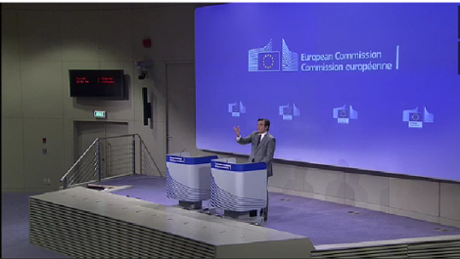
Over in Brussels, European Commission spokesman Margaritis Schinas has been fielding a lot of questions from the press pack about the Greek bailout talks.
Schinas confirms that Greece has indeed submitted new proposals. They are now being circulated among the institutions, he says, and being assessed “with diligence and care.”
He’s reluctant to commit much more, though, at this stage.
Is the Commission now looking at a new programme for Greece, as well as the current bailout (which expires on 30 June)?
The Commission continue to work on the framework of the Eurogroup statement of 20 February, Schinas replies, suggesting they are still only working on the current deal.
What meeting will take place today?
Contacts should obviously continue at both political and technical level, says Schinas But he cannot confirm any other meeting.
And might Jean-Claude Juncker meet Alexis Tsipras tomorrow, when leaders gather for the EU summit?
Before we get into tomorrow, let’s get into today, pleads Schinas. We need to assess these new proposals first.
Will Juncker meet Tsipras Weds? 'We have to complete this assessment and in the light of this assesment we can then discuss tomorrow'
— Danny Kemp (@dannyctkemp) June 9, 2015
Journalists in Athens are being briefed that two documents have indeed been drawn up, and handed to European Commissioner Pierre Moscovici.
One covers fiscal issues. The second outlines Greece’s plan for achieve debt sustainability. And together they’re Greece’s latest attempt to reach a compromise.
Greek gov source: 2 extra dox w proposals given to @pierremoscovici Mon to bridge fiscal gap and define viable plan for debt sustainability
— NikiKitsantonis (@NikiKitsantonis) June 9, 2015
I understand Greek proposal involves debt reschedule + fiscal framework - eg new fiscal architecture concessions. Ie not just ESM/ECB swap,
— Paul Mason (@paulmasonnews) June 9, 2015
We still don’t know exactly what’s in the two Greek proposals, but Bloomberg is reporting that one EU official has already claimed it doesn’t go far enough it.
Their Athens bureau chief, Nikos Chrysoloras, reports:
The Greek government submitted a three-page budget proposal to its creditors in Brussels in a bid to unlock bailout funds, two international officials with direct knowledge of the discussions said.
The document covered only fiscal targets, one of the people said. Greece gave its creditors a separate note, also three pages long, on how to address the country’s financing needs, in which the government asked to use funds from the European Stability Mechanism to repay about €6.7bn ($7.6bn) of bonds held by the European Central Bank that come due in July and August, the people said.
One of the officials said the revised Greek plan is a vague rehash of earlier proposals and is still not considered credible. The second official said the European Commission, the European Central Bank and the International Monetary Fund are assessing the plan, which was received this morning. Both asked not to be named, as they were not authorized to speak publicly on the matter....(more here)
"One of the officials said the revised Greek plan is a vague rehash of earlier proposals" http://t.co/VE8uACWPry
— Joseph Weisenthal (@TheStalwart) June 9, 2015

Austria’s finance minister, Hans Jörg Schelling, has warned Greece not to expect any slack from its lenders.
Schelling said (via Reuters):
“I believe that the institutions and creditors have made so many concessions to the Greeks that I cannot imagine that there can be further concessions.”
Updated
Eurozone growth confirmed at 0.4%
More data....and Eurostat has confirmed that the eurozone economy grew by 0.4% in the first three months of this year.
That’s faster than the UK (+0.3%) and the US (which contracted almost 0.2% quarter-on-quarter).
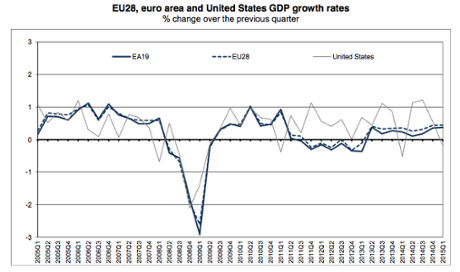
But Greece missed the recovery -- falling back into recession during the quarter.
Eurostat explains:
Among Member States for which data are available for the first quarter of 2015, the Czech Republic (+3.1%), Cyprus and Romania (both +1.6%) recorded the highest growth compared with the previous quarter, followed by Poland (+1.0%), Bulgaria and Spain (both +0.9%), Hungary, Slovenia and Slovakia (all +0.8%).
Decreases were registered in Lithuania (-0.6%), Estonia (-0.3%), Greece (-0.2%) and Finland (-0.1%).
Britain’s trade gap has hit the lowest level in 13 months.
The total trade deficit dipped to £1.2bn in April, from nearly £3.1bn in March. That suggests net trade could be a smaller drag on growth.
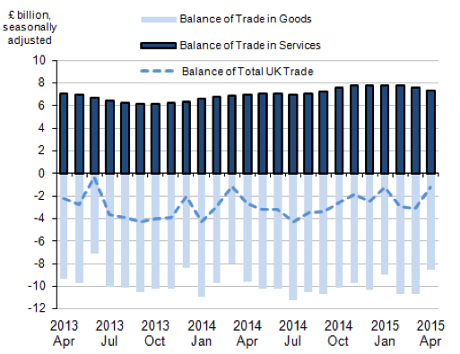
The figure included a 23% jump in exports to the US, due to higher sales of chemicals and machinery. But eurozone exports only rose by 0.6%; the strong pound may be holding back net trade.
A much better set of trade figures. Overall deficit narrows to £1.2bn in April from £3.2bn March. Bodes well for Q2 GDP.
— David Smith (@dsmitheconomics) June 9, 2015
Updated
EU official: Not a credible proposal
Reality check. An EU official has just told Bloomberg that this new proposal is a “vague rehash” of earlier Greek plans, and questioning how credible it is.
Kathimerini was reporting last night that Athens was proposing to raise VAT rates a little, but keep the 7% lowest rate. And it was prepared to offer a higher primary surplus target this year, nearer to the creditors’ 1% target.
But little change on pensions (something Alexis Tsipras dubbed “inconceivable” in this morning’s interview with Corriere Della Sera).
Updated
Make that a seven-page proposal -- broadly split between proposed measures, and plans to cover Greece’s funding problems over the coming months.
#Greece submitted a 7-page revised proposal, 3 pages on fiscal issues & 4 pages on covering funding gap (via @kathimerini_gr) #ec #ecb #imf
— Manos Giakoumis (@ManosGiakoumis) June 9, 2015
Quite a reduction from the 47-page list of measures which Athens submitted last week.
Greek stock market jumps
Shares are rallying in Athens on hopes of a breakthrough.
The ATG index has jumped almost 3%, even though we don’t know what’s in this new proposal, or whether it closes the gap with creditors.
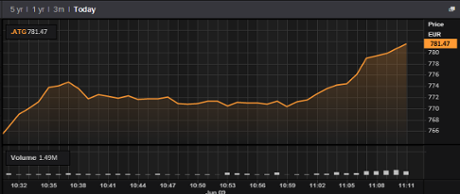
#Greece stock market rebounds 2.9% in the aftermath of submission of revised proposal to institutions. #economy #ec #ecb #imf #markets
— Manos Giakoumis (@ManosGiakoumis) June 9, 2015
Updated
Helena Smith: Greece could get bailout extension until March 2016

Over in Athens, there is much talk that a deal that would extend the country’s bailout programme until the autumn (at the very least) is now seriously being pondered (as the Wall Street Journal reported last night)
Our correspondent Helena Smith reports:
Insiders are saying the new name of the game is extension – possibly through to March 2016 when the International Monetary Fund’s participation in Greece’s bailout program officially expires, or certainly into the fall.
Both would allow the leftist government to properly prepare for what everyone is now calling the “big agreement” – a third bailout of between €40bn to €50bn that Athens undoubtedly needs to survive economically in the coming years.
The idea of an extension, first reported in this blog on May 21st, has been floated at the highest level of German policy making for some time now, according to Greek insiders.
Sources saying there simply isn’t enough time now to come to a credible agreement that will stick.
The only condition are reforms (or at least a persuasive promise of reforms) that would overhaul an economy on its deathbed.
“After the summer we don’t have any big [debt] payments until March 2016, which in effect would be crunch time,” said one well-placed source who requested anonymity simply because speculation is now running so high.
“That would be the time that the government would have to come to a big agreement.”
Almost everything at this moment rests in the hands of prime minister Alexis Tsipras and which way he wants to go.
An extension would buy him time – and give the radical left leader some wiggle room to deal with his Syriza party’s hard left faction. Even if a “short-term” deal is eventually clinched, as it is expected to be in the coming days, the anti-austerity government will face enormous difficulties.
The agreement will need to be approved by the governing party, passed by the 300-seat parliament, legislated and then implemented. “It would be impossible to enforce with the current cabinet,” Andreas Papadopoulos, a former spokesman with the small Democratic Left party, told state-run TV this morning. “Tsipras would need to change his cabinet make-up,” he said, insisting that disagreement on an ideological basis was so profound many of the reforms could never pass.
That might explain why the Greek finance minister Yanis Varoufakis also insisted in comments relayed this morning that any deal would have to be a permanent deal.
Varoufakis told the Athens News agency:
“The Greek government wants an agreement-solution. It wants this to be the last negotiation. The Greek people deserved it.”
Updated
Our Europe editor, Ian Traynor, confirms that the idea of swapping existing Greek debt held at the European Central Bank for new bailout loans isn’t new.
It all depends what Greece is offering in return...
#grexit ecb/esm debt swap old. depends what @atsipras is offering on greek side
— Ian Traynor (@traynorbrussels) June 9, 2015
Updated
Over to Reuters for details of this morning’s key development.
The European Commission has received a new proposal from Greece for reforms that could unlock new funding from the cash-strapped country and is now assessing it, an EU official said on Tuesday.
The proposal was originally due last Thursday. It is to bridge the remaining differences between Athens and its international creditors on issues like pension or Value Added Tax reform.
And Bloomberg has more details too.
#Greece: new proposal for creditors said to be 3-page long, only covering fiscal targets. Plus another 3 pages to roll #ECB bonds into ESM.
— Maxime Sbaihi (@MxSba) June 9, 2015
Greek media were reporting this morning that EU president Jean Claude Juncker had threatened not to see Tsipras if he was not sent an updated proposal from Greece pronto.
Perhaps that prompted today’s burst of activity...
It’s official! The European Commission has confirmed to Reuters that it has received a new proposal from Greece’s officials this morning.
They’re now assessing it....
Greece is also proposing that Europe’s main bailout fund, the European Stability Mechanism, would provide help it.
Today’s three-page plan apparently suggests the ESM buys the €6.7bn of Greek bonds held by the European Central Bank, which mature in July and August.
That idea has been circulating for a while -- the problem is that it’s effectively a new injection of bailout funds for Greece.
In layman's terms, this is called "a bailout" RT @lemasabachthani: GREECE SAID TO ASK CREDITORS FOR ESM MONEY TO REPAY ECB
— Peter Spiegel (@SpiegelPeter) June 9, 2015
Greece: Three page proposals submitted
Crumbs: Greece has reportedly cut its 47-page list of reforms down to just three pages.
GREECE SAID TO SUBMIT REVISED 3-PAGE PROPOSAL TO CREDITORS
— Francine Lacqua (@flacqua) June 9, 2015
And Athens is also proposing that the European Central Bank would raise the limits on short-term borrowing, allowing Greece’s banks to buy more Greek debt.
That would help cover Greece’s looming debt repayments, and avert the risk of default....
*GREEK PROPOSAL SAID TO REQUEST INCREASE IN T-BILL CEILING
— Michael Hewson (@mhewson_CMC) June 9, 2015
AFP: Greece submits a new reform plan
Greece’s negotiators have handed a new proposal to its creditors this morning, according to the AFP newswire.
Greece submits new reform plan to creditors, European source tells @AFP, via @CSpillmann
— Danny Kemp (@dannyctkemp) June 9, 2015
A sign that Greece is following through on yesterday’s pledge to compromise? Stay tuned....
Could the Greek crisis be resolved at year’s Bilderberg conference?
No, probably not. But Greece is sandwiched between ‘Globalisation’ and ‘Iran’ on his year’s agenda at the world’s most exclusive gathering of the powerful.
And that means the heads of the world’s largest banks can hear what Jeroen Dijsselbloem, head of the eurogroup, and ECB policymaker Benoît Coeuré think about the crisis.
Bilderberg is notoriously secretive, but fortunately some top journalists are there -- including the editors-in-chief of Bloomberg and the Economist, and Martin Wolf of the Financial Times. Tweet early, tweet often, please!
Here’s Bilderberg-watcher Charlie Skelton’s preview:
Updated
European stock markets have nudged a one-month low at the start of trading.
The FTSEurofirst 300, which tracks the biggest companies across the region, dipped 0.4% in early deals.
The German DAX is down almost 0.5%, pushing the index further into correction territory (down more than 10% from its recent peak).
And the euro has dropped by 0.2%, back under $1.13 at $1.1266.
Greece continuing to be ‘front and central’ for markets, says Marc Ostwald of ADM Investor Services.
But there are other factors, as Tony Cross of Trustnet Direct explains:
A weaker than expected inflation reading from China has added another layer of uncertainty into matters, coming on top of yesterday’s unexpectedly large fall in imports.
Tsipras: Deal is close, if creditors can compromise...
Alexis Tsipras has also argued that a deal between Greece and her creditors could be close.
However, that would require the IMF, ECB and EC to relax their demands on pension reforms, and other proposals which would push Greece deeper into recession.
Tsipras told Corriere Della Sera that:
“I think we’re very close to an agreement on the primary surplus for the next few years.... There just needs to be a positive attitude on alternative proposals to cuts to pensions or the imposition of recessionary measures.”
And he also pledged to discuss recent progress with Angela Merkel and Francois Hollande at the EU-Latin America summit on Wednesday.
Last night, finance minister Yanis Varoufakis claimed that an agreement could be reached in one all-night session, if all sides were serious about getting a deal. We’re ready if you are, guys.....
Our Greek readers may have had a disturbed night, after the country was rattled by a magnitude 5.2 earthquake around 4am. No reports of injuries, fortunately.
Please no. The last thing we need now is an #earthquake"@guardian: magnitude 5.2 tremor felt in #Athens http://t.co/m1RqnqWtPI"
— Omaira Gill (@OmairaGill) June 9, 2015
Tsipras: Greek failure would be 'beginning of the end' for the eurozone

If Greece fails, it will be the beginning of the end of the eurozone.
That’s the stark warning from Alexis Tsipras this morning, as Greece’s prime minister battles to reach an agreement with his creditors in time.
In an interview with Italy’s Corriere Della Sera, Tsipras rubbished the suggestion that a Grexit would be easily manageable.
Instead, he argued, it would trigger the unravelling of the whole European project.
Asked if the failure of Greece would also be the failure of the euro, Tsipras replied:
I think it’s obvious.
It would be the beginning of the end of the eurozone. If the European political leadership cannot handle a problem like that of Greece, which accounts for 2% of its economy, what would the reaction of the markets be to countries facing much larger problems, such as Spain or Italy which has two trillion of public debt?
Tsipras writing in Corriere says #Grexit would be beginning of the end for Euro Zone
— Anna Edwards (@annaedwardsnews) June 9, 2015
Several European politicians have argued that a Grexit would be relatively containable. Europe has more tools to calm the crisis than in 2012, and a default wouldn’t hit Euro banks hard as few hold Greek debt.
But Tsipras says a Greek failure would trigger a domino effect:
If Greece fails markets will go now to look for the next. If the negotiation fails, the cost to European taxpayers will be huge.
And he also defended Greece’s refusal to compromise on issues such as pensions:
After five years of austerity it is inconceivable that we are required to abolish the lowest pensions and subsidies that affect the poorest citizens.
Here’s the full interview (in Italian).
#Grexit e crollo #Europa sono interconnesse. #Tsipras al @Corriereit minaccia i creditori. @andrea_nicastro pic.twitter.com/nrAjNb39qw
— Andrea Nicastro (@andrea_nicastro) June 9, 2015
Updated
The Agenda: "Creditors propose extension to March 2016"
Good morning, and welcome to our rolling coverage of the Greek bailout, and other events across the world economy, the financial markets, the eurozone and business.
It will be another day of negotiations and speculation, as Greece now has just 22 days before its bailout extension expires.
Last night, the Wall Street Journal reported that creditors have proposed a nine-month extension to the current programme, propelling the can down the road to March 2016.
The WSJ’s Gabriele Steinhauser says:
The proposal, first presented last week, is part of European officials’ efforts to prod the government in Athens to agree to painful concessions in exchange for rescue funds.
But continued disagreements over the economic overhauls and austerity measures demanded by Greece’s lenders risk undermining the plan, people familiar with the plans say.
How would Greece survive until March 2016? Well, lenders would release almost €11bn of funds currently sitting in Greece’s bank rescue facility, as well as €7.2bn of bailout loans.
Using the bank recap funds isn’t a fresh idea (the FT reported it up last week), but the idea of a nine-month extension is a new development.
Extension by Feb, by Jun - then rumored by Sep, now by Mar. A bumpy & lengthy road ahead with drops of hope. #Greece #economy #ec #ecb #imf
— Manos Giakoumis (@ManosGiakoumis) June 8, 2015
Steinhauser says the plan was discussed last Wednesday when Alexis Tsipras and Jean-Claude Juncker, the president of the European Commission, met in Brussels.
“What we offered would mean that Greece is fully financed until March 2016,” one of the people said.
But to get the deal, Greece would have to cross its red lines on pensions, VAT rates and labour market reforms. Tsipras continues to rule this out, of course, so the deadlock remains...
WSJ: Greece, Creditors Discuss Extending Bailout in Bid to Break Deadlock
Latest source comments suggest the latest proposal on the table for Greece involves a bailout programme extension until Mar'16
— RANsquawk (@RANsquawk) June 9, 2015
Greek officials will be sitting down with creditors in Brussels today, in another attempt to make progress before Wednesday’s EU-Latin American summit. That will give Alexis Tsipras another chance to bend Angela Merkel’s ear about the crisis.
World leaders are looking increasingly jittery about the crisis -- with Barack Obama urging Greece to take “tough choice” yesterday. The pressure to make progress is intense.
Also coming up today....
Global banking giant HSBC is announcing a major restructuring plan today. We’ve already learned that it will cut 25,000 jobs worldwide, including thousands in Britain.
More details should emerge through the day, which may shed new light on whether it might move its HQ out of the UK.
Here’s Jill Treanor’s first take:
And on the data side:
- 9.30am BST: the latest UK trade data is released (for April).
- 10am: The third estimate of eurozone growth in the first quarter, which will probably confirm GDP rose by 0.4% in January-March.
I’ll be tracking all the main events through the day.....
Updated