European markets recover from US-inspired slide
An unexpectedly weak US manufacturing figure for New York sent a mini-shock through markets on an otherwise relatively quiet day. But shares soon recovered their poise, as investors awaited the week’s key vote on the Greece bailout in the German parliament, as well as a possible vote of confidence by Syriza which could lead to new elections as early as next month. The final scores showed:
- The FTSE 100 finished virtually unchanged, down 0.44 points or 0.01% at 6550.30
- Germany’s Dax dropped 0.41% to 10,940.33
- France’s Cac closed up 0.57% at 4984.83
- Italy’s FTSE MIB added 0.69% to 23,407.99
- Spain’s Ibex ended 0.19% better at 10,900.3
- As previously reported, the Athens marked edged up 1.04% at 680.94
On Wall Street the Dow Jones Industrial Average is currently up 39 points or 0.23%.
On that note, it’s time to close up for the day. Thanks for all your comments, and we’ll be back tomorrow.
A survey in Germany seems to show people are not overly thrilled with the agreement with Greece:
Merkel's bailout battle: German chancellor faces party rebellion over #Greece. https://t.co/IRNwwycoXZ pic.twitter.com/9I0TiVyCRa
— Holger Zschaepitz (@Schuldensuehner) August 17, 2015
Strong Greek furniture sales in Q2 support view that rise in GDP reflected panic spending ahead of capital controls pic.twitter.com/jk5FnYjAiy
— Capital Economics (@CapEconEurope) August 17, 2015
Greece’s stock market has ended the day higher although banking shares are still under the cosh.
The Athens index is up 1.04% at 680.94, but the banking index has dropped 8.67% as concerns about recapitalisation continue. Piraeus Bank is down 13.61% while Eurobank Ergasias has fallen 12.12%.
Here’s our report on the latest comments from Yanis Varoufakis, who has once more attacked the bailout proposals:
Greece’s former finance minister Yanis Varoufakis has accused European leaders of allowing oligarchs to maintain their stranglehold on Greek society while punishing ordinary people in a line-by-line critique of the country’s €86bn (£61bn) bailout deal.
Varoufakis said the Greek parliament had pushed through an agreement with international creditors that would allow oligarchs, who dominate sections of the economy, to generate huge profits and continue to avoid paying taxes.
The outspoken economist published an annotated version of the deal memorandum on his website on Monday, arguing throughout the 62-page document that most of the measures imposed on Greece would make the country’s dire economic situation worse.
The full story is here:
Some talk about a possible Greek election date:
Just exiting Villa Maximou, Athens. Seems to be some truth in the rumor that elections will be held on sept 20th #Greece
— Andreas Petzold (@andreaspetzold) August 17, 2015
Back with the US and some strong housing figures.
US housebuilder sentiment rose to its highest level in nearly a decade, according to the National Association of Home Builders. Its market index rose from 60 in July to 61, in line with expectations and the highest since a matching reading in November 2005. The association’s chief executive David Crowe said:
Today’s report is consistent with our forecast for a gradual strengthening of the single-family housing sector in 2015. Job and economic gains should keep the market moving forward at a modest pace throughout the rest of the year.
The better news has helped markets recover some of their poise after falling back sharply in the wake of poor New York manufacturing figures.
The Dow Jones Industrial Average is now down just 2 points, the FTSE 100 is 7 points lower and Germany’s Dax has dropped 79 points.
Here are the reported terms of the ESM financing assistance for Greece, as revealed by Bild’s Dirk Hoeren:
Confidential: #ESM proposal for Financial Assistance FacilityAgreement #FFA. Which fees #Greece has to pay for loans pic.twitter.com/KsV3EBjYTf
— Dirk Hoeren (@DirkHoeren) August 17, 2015
ESM Document On Greek Loan Facility Proposal: - 32.5 Year Maximum Weighted Average Maturity For Loan Facility
— Live Squawk (@livesquawk) August 17, 2015
ESM Document: 10 Bps Margin Charged To Greece For Loans Disbursed - EUR86 Bln Loan Facility Over 3-Years
— Live Squawk (@livesquawk) August 17, 2015
Updated
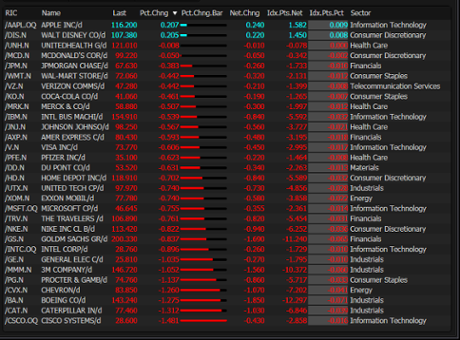
Here are the falls on the Dow:
Updated
Wall Street has opened sharply lower, predictably.
With oil still around six-year lows and the poor New York state manufacturing figures pointing to a slowdown, the Dow Jones Industrial Average has dropped 123 points or 0.7% in early trading. The US Federal Reserve is widely expected to begin raising interest rates this year, perhaps as soon as the September meeting, but such a move would cause concern if the world’s biggest economy is starting to splutter.
Best not to pay too much attention to this US data, reckons Rob Carnell at ING (although it being a quiet August day, markets already have of course):
The latest Empire manufacturing survey is a good reminder of why we don’t pay much attention to regional activity surveys – to be charitable, they are a bit choppy. In this case, the Empire survey fell from a moderate reading of 3.86, to -14.92. And you have to go right back to 2009 and the heart of the financial crisis to find anything this bad.
For what it is worth, and in our opinion, it is not a lot, the new orders and shipments series utterly collapsed this month. Inventories, which had been heading down, fell further, as did the average workweek (in complete contrast to the last labour market report). Interestingly, despite this apparently dismal; backdrop, although the index of employees fell slightly, it remained positive. Odder still, the outlook for six-months’ time improved to 33.64 from 27.04, with new orders and shipments then expected to be strong or picking up. We doubt there is much merit in these expectations either.
There will be a bunch of other regional activity surveys out in the coming weeks. Even when they all point in the same direction, this need not give the correct steer for the national ISM survey, or for the strength of national manufacturing. But this is a quiet week, so markets may give this more attention than it deserves.
US Empire State manufacturing index hits lowest since 2009
Oh dear. A key survey of the US manufacturing sector has just hit its lowest level since the great recession, and markets aren’t happy.
The Empire State index, which tracks factory activity in the New York area, slumped to -14.92, from +4.75 in July.
That’s the weakest reading since November 2009, with manufacturers reporting a slump in new orders and deteriorating economic conditions.
Oof - worst reading for Empire State index since April 2009 http://t.co/VBM4bk8prj pic.twitter.com/hmmmIZYlne
— MarketWatch Economy (@MKTWeconomics) August 17, 2015
The reading has hit European stock markets, as it raises new concerns over the strength of the US recovery at a time when the Fed is (maybe) close to raising interest rates.
The FTSE 100 is now down 35 points, or 0.5%, at 6530, and the German DAX is also dropping into the red....
Big #DAX selloff pic.twitter.com/ysvWzNjf8U
— IGSquawk (@IGSquawk) August 17, 2015

Back in Greece, health minister Panagiotis Kouroumblis has predicted that autumn elections could be needed, Reuters reports.
Kouroumblis told Skai TV that it would give the government the authority needed to implement the plan:
“Elections are not the best choice ... but for the economy to pick up there must be political stability.
To implement such a serious programme with painful measures, you cannot do that without a popular mandate.”
Greek journalist Nick Malkoutzis agrees that a confidence vote could quickly lead to elections (as explained earlier):
Tsipras mulling confidence vote soon, maybe in knowledge that he'll lose & have to call snap elections https://t.co/o9kLA3K1su #Greece
— Nick Malkoutzis (@NickMalkoutzis) August 17, 2015
Angela Merkel is now attending a Christian Democrats party board meeting today; another chance to shore up support ahead of Wednesday’s Greek bailout vote.

Merkel’s grand coalition has 504 out of the 631 seats in the Bundestag. Thus, she can cope even if 120 MPs do defy her, as Bild reckons today.
CDU/CSU MPs will take their lead from Wolfgang Schauble as much as Merkel herself, argues Carsten Nickel of Teneo Intelligence.
He writes:
What counts in the Bundestag (much more than the IMF), meanwhile, is the endorsement of Germany’s most popular politician, Finance Minister Wolfgang Schaeuble, who single-handedly guarantees support from a number of sceptics within CDU/CSU.
His support voiced in Greece-sceptic tabloid Bild am Sonntag is the cornerstone for yet another unsurprising result this Wednesday.

German finance ministry insists again that the involvement of the IMF in the third Greek bailout remains 'indispensable'#Greece
— Gavin Hewitt (@BBCGavinHewitt) August 17, 2015
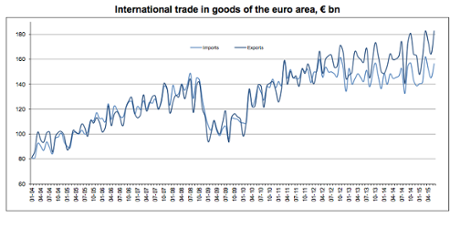
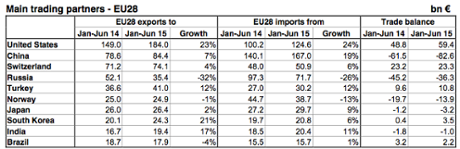
Finally, some economic data. And the latest survey of eurozone trade suggests that the weaker euro is helping exporters.
The eurozone’s trade surplus jumped to €26.4bn in June, according to Eurostat, up from €16.0bn a year earlier.
Exports were 12% higher than in June 2014, at €182.7, while imports rose just 7% year-on-year to €156.4bn.
Imports have been lagging exports since the eurozone debt crisis began, as demand waned in the face of austerity and recession.
Updated
Merkel ally: IMF must join Greek bailout
One of Angela Merkel’s close allies, Michael Fuchs, says he hasn’t decided whether he’ll support the Greek bailout in Wednesday’s vote.
The crucial issue, Fuchs told Bloomberg TV, is whether the International Monetary Fund will definitely be involved in the deal:
.@flacqua M Fuchs says his vote on Greece is 100% down to IMF involvement in the deal - needs to be sure to vote PRO
— Manus Cranny (@ManusCranny) August 17, 2015
The IMF won’t make that decision until October, though, so German MPs may have to trust their chancellor when she says the Fund will come on side.
Greece’s third bailout has cleared one hurdle this morning by being approved by the Lithuanian cabinet, according to the Baltic News Service.
#Lithuania's cabinet approves Greek bailout deal
— BNS Lithuania (@BNSLithuania) August 17, 2015
Angela Merkel could suffer the biggest rebellion of her career as chancellor, when the Bundestag votes on the Greek bailout deal.
German tabloid Bild reckons that 120 CDU/CSU MPs could oppose the plan, twice as many as broke ranks at an earlier vote in July.
That explains why Merkel took part in last night’s TV interview, to short up support ahead of Wednesday’s vote.
German MPs rebelling against Merkel and third Greek bailout could more than double and exceed 120 this Wedn (Bild) https://t.co/BgSh79qd7W
— Pieter Cleppe (@pietercleppe) August 17, 2015
Another Syriza rebel, former finance minister Yanis Varoufakis, has been hard at work critiquing the bailout deal.
Spoiler alert: he’s not a fan. Over 55 pages (plus appendices), the economics professor outlines why he fought against such a deal. Varoufakis fears it will merely further fuel Greece’s “six year old debt-deflationary cycle”, with impossible growth targets and unachievable measures:
Greece’s Third MoU (Memorandum of Understading) annotated by @yanisvaroufakis http://t.co/vVQ9XbnAWy
— Yanis Varoufakis (@yanisvaroufakis) August 17, 2015
Updated
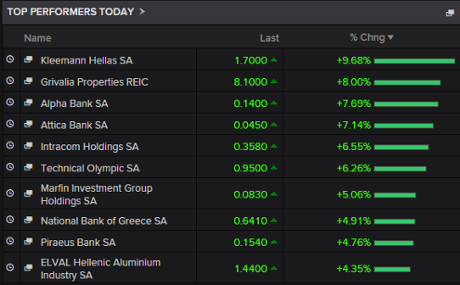
Greek bank stocks are rallying this morning, on relief that eurozone finance ministers agreed to the bailout deal on Friday night.
The ATG index is up by 1.5% in early trading in Athens, with financial shares gaining 5%.
Two Syriza MPs who rebelled last week have warned that the party cannot rally around the bailout deal.
Thanasis Petrakos told the Mega TV channel that:
We do not intend to overthrow the government, but rather get it off the bailout course.
And Stathis Leoutsakos took a similar line on Skai TV, warning that:
“The bailout cannot be the programme of Syriza, it falls outside its values, these are incompatible notions.”
If their allies take a similar view, Greece could be heading into early elections this autumn.

A glance at last Friday’s vote on the bailout deal shows that Alexis Tsipras is far from certain to win a confidence vote.
Although 222 MPs (out of 300) backed the plan, almost half of those came from opposition parties such as the right-wing New Democracy, centrist To Potami and left-wing Pasok.
Just 118 government MPs voted in favour. Tsipras’s Syriza party holds 149 seats, while its coalition partner ANEL holds 13.
Yesterday, Pasok announced it would not support the government in a confidence vote, echoing New Democracy’s position.
Pasok said:
“The government has signed the third and most onerous bailout. All the negative consequences for the country and its citizens bear the signatures of Mr Tsipras and [ANEL leader] Mr Kammenos.
We have no confidence in the Tsipras-Kammenos government and of course will not give it if we are asked.”
Greece’s energy minister also hinted this morning that the country could “go to elections soon”, in as little as three or four weeks.
And if that happens, Alexis Tsipras would be pushing for an outright majority, Panos Skourletis told Skai TV:
“Based on my feeling of how things stand... I think such a goal is attainable,”
(thanks to Reuters for the quotes)
Updated
Greek energy minister: confidence vote needed.

A Greek government minister has dropped a clear hint that prime minister Alexis Tsipras will call a confidence vote in the coming days.
Energy minister Panos Skourletis predicted this morning that the rebellion among government MPs over the third bailout will force Tsipras to test his authority in parliament.
Skourletis told Skai TV that:
I consider it self-evident after the deep wound in Syriza’s parliamentary group for there to be such a move [a confidence vote].
Tsipras had to rely on opposition parties to get support for the bailout plan in a vote last Friday; 32 Syriza MPs voted against it, and another 11 abstained.
A confidence vote could trigger early elections this autumn, giving Tsipras the opportunity to reshape his party and win a new mandate. But it would also obstruct efforts to agree the debt relief measures demanded by both Athens and the IMF....
Updated
Introduction: Markets fret about Greece and China
Good morning, and welcome to our rolling coverage of the world economy, the financial markets, the eurozone and business.
We’ll be fighting off the August lull today, I fear, as policymakers and traders take a summer breather after a fairly turbulent 2015.
On the agenda.....
1) Greece. European national parliaments will be asked to approve the country’s third bailout this week, after it was signed off by finance ministers on Friday night.
Wednesday’s vote in the Bundestag could be critical, given German concern over this latest loan.
Angela Merkel (back from her hols) has already tried to stem dissent, telling a TV interview last night that she has no doubt that the IMF will play a role.
But for that to happen, debt relief will be needed - something that will play badly with many of Merkel’s own MPs.
Our Europe editor, Ian Traynor, senses trouble ahead....
#greece #germany must be bad when merkel takes to evening tv to make her case
— Ian Traynor (@traynorbrussels) August 17, 2015
2) China. Investors are edgy after last week’s shock yuan devaluations, which sent ripples through global markets.
Michael Hewson of CMC Markets explains:
The events in China were a timely reminder to investors that all may not be well with the world’s second largest economy, as the authorities attempt to reinvigorate a flagging economy, at a time when economic data in some of its key export markets are also showing signs of flagging.
Currency markets in particular will be looking for signs of further weakness in the Chinese currency given the comments by the Chinese central bank at the weekend, which warned markets to expect further two way volatility in the coming weeks. While Chinese authorities aren’t likely to openly admit they want a slightly weaker currency, last week’s actions saw the die cast and it seems improbable that the yuan won’t slowly weaken in the coming weeks, and in the process exercise further downward pressure on global inflation.
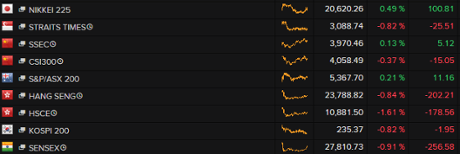
Some Asian markets have dipped overnight, as they await Beijing’s next move:
European markets are expected to rally a little, though, partly on relief that Greece has secured its third bailout - even though implementing the tough measures demanded by creditors will be tough.
Here’s IG’s opening calls:
-
FTSE 100: 6586 +36 points
-
German DAX: 11057, +72
-
French CAC: 4985 +29,
-
Spanish IBEX: 10951, +72
-
Italian FTSE MIB: 23407, +159
I’ll be tracking all the action (such as there is) through the day....
Updated