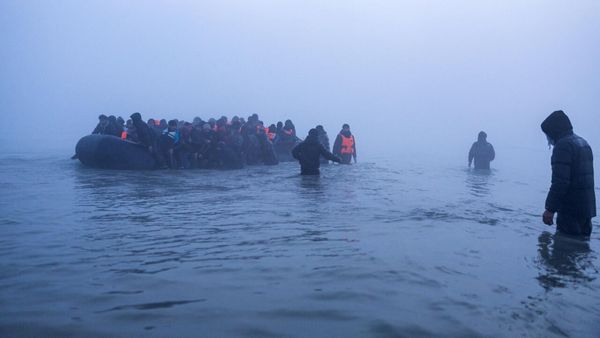
On the northern coast of Lesbos, on the shore outside a famous local hotel, the footfall is usually limited to tourists. But this morning, there is an unusual interloper. It’s the president of the local village, Thanassis Andreotis, who stands on the back of his white pick-up and tugs the remains of a huge inflatable dinghy up from the beach below. Every morning now, refugees use dinghies like this one to get from the Turkish shore – six miles away in the distance – to the Greek islands. And Andreotis sees it as his human duty to pick up the debris.
“It’s way, way, way more than last year,” says Andreotis, a retired policeman. “Last year I’d be doing this once a week. Now it’s once a day.”
There have long been refugees trying their luck in these waters. But this year, amid the world’s biggest wave of mass-migration since the second world war, the numbers arriving on this isolated shoreline have reached record levels. Arrivals to the Greek archipelago are already 50% higher than for the whole of 2014 – and have even now out-paced Italy. Lesbos, hitherto known as an exquisite tourist destination, has become the frontline – the Greek Lampedusa.
It could not have happened at a worse time. The Greek economy is close to collapse, with the European Central Bank threatening on Wednesday to withdraw its support for Greek banks by the end of the week.
Not that Andreotis blames the refugees. “They’re hunted by their government and they’re running everywhere from horrible things,” he says, hauling the last bits of dinghy up from the beach. And he says that lots of local people – some of whom are themselves descendants of migrants who left Turkey in 1922 – agree with him. When he recently went into the centre of town with a megaphone and called for donations for the migrants, “within 10 minutes there were four cars of supplies”.
With the central government unable to properly provide for many of its citizens, let alone migrants, this is how the humanitarian vacuum has often been filled.
Western reporting has centred on how the wave of migrants, sharing beaches with wealthy holidaymakers, have incensed foreigners and residents alike. There is certainly an awkward juxtaposition: further round this Lesbos beach, tourists sunbathe metres from an Angry Birds arm-band left on the beach by an infant migrant.
But there is also another story – one of locals, tourists and expats doing their best in tough circumstances to provide as warm a welcome as possible for a less fortunate kind of expatriate.

One of the first welcomes is provided by a British couple, Eric and Philippa Kempson, who live just metres from the closest beaches to Turkey. An eccentric long-haired artist who doesn’t own a mobile, Eric Kempson is an unexpected connoisseur of Aegean smuggling networks. Originally from Windsor, he’s lived here on the north coast of Lesbos for 16 years, earning his living by carving boutique wooden jewellery and sculptures.
But over the past few months Kempson has developed a new specialism. He’s learned to spot the migrant dinghies from the moment they leave Turkey at dawn. Early each morning, he and his wife rush up and down the Greek shoreline, handing out water, dry clothes and food to the most vulnerable arrivals.
“Usually there are two black boats that come out, mainly Afghans, Pakistanis, mostly men,” says Kempson. “About an hour later, we normally get three grey boats full of Syrians, and those are the ones we usually focus on because they’re full of women and children.”
It has been an upsetting experience, he says. “When you see two-week-old children, people with cut feet, and people who haven’t eaten for days – you can’t do anything. I hadn’t cried in 20 years, and I am a hard bastard. But I’ve cried so much in the last four months.”
In logistical terms, the Greek government cannot cope either. The EU now wants to establish so-called quarantine zones for migrants on the Greek islands – but the government here already lacks the capacity to house the current wave of arrivals.
So in the south of the island, local activists have taken things into their own hands, turning an old scout camp into a makeshift, volunteer-run migrant reception centre called the Village of Altogether.

Driving migrants here from the beaches is a legal grey area. Under Greek law, you could be accused of the crime of people-smuggling. “But on the other hand,” says a defiant Efi Latsoudis, one of the camp’s founders, “we cannot stay watching hundreds of people with their children – walking, lying in the streets – and let them die there under the sun. It’s impossible. That’s also a crime, to let someone die in the street.”
In the north of the island, in the village of Molyvos, others have followed suit. An Australian who’s lived here for four decades, Melinda McRostie, has turned a slip of land behind her well-known quayside restaurant into a makeshift migrant campsite. As soon as Kempson sends her the day’s headcount, her kitchen team at The Captain’s Table get to work preparing food for the island’s newest guests, largely using food and supplies donated by tourists and locals.
“It’s obvious that it’s not something that’s going to stop,” says McRostie, of the wave of arrivals that have landed on Lesbos in recent weeks. “So the only obvious thing to do is to do something about it.”
McRostie can fit up to 180 people on the land behind her restaurant. This day, there are just 51 Afghanis and a single Pakistani here, sleeping off their exhaustion under the shade of a tarpaulin. Each of them lost all their remaining belongings earlier in the morning, after their boat started sinking a kilometre from Greece. Only quick work by the Hellenic coastguard saved their lives.
“Suddenly there was water coming on the boat, and the engine stopped,” remembers Tawfiq Amini, a former mechanic for the US army in Afghanistan, who fled home after the Taliban threatened him for working with foreigners. “Everyone was shouting, the women were screaming. Everyone threw their bags in the water because we thought the boat was too heavy.”

Doing her best for people like Amini every day, McRostie finds it emotionally tough. “I’ve stopped remembering names,” she says, carrying two trays of sandwiches from her storeroom to the camp. “I’ve stopped asking stories. It’s just too hard.”
But there are some on Lesbos who never wanted to listen in the first place. “Get them away from here,” shouts another local restauranteur, pointing at the makeshift camp that backs on to his property. He’s worried it will put off customers.
The same day, a vicious rumour circulates via social media that Muslim migrants have defecated in churches, and defiled their icons. It turns out to be a lie, but the takeaway is clear: there are those on the island’s far right who want to stir up resentment of migrants. Golden Dawn, Greece’s far-right party, is certainly quick to seize its chance. “We will do everything we can to protect the Greek homeland against immigrants,” the party says in response to the defecation story.
The abuse has sometimes got personal. Kempson says he receives threats because of his activism. During a conversation with the Guardian, an anonymous caller rings his house phone and breathes silently on the other end of the line. “No matter where you are in the world, you’ll get these threats,” he says. “You’ll have people with black hearts who hate human beings.”
Andreotis says it’s a challenge to keep people united. “There are people who think this will impact tourism,” he says, the dinghy now safely squeezed into his pick-up. “But by and large we’ve managed to make sure that people don’t think there’s anything to be afraid of.”
One thing that does worry people is the risk of prosecution should they help a migrant. In order to apply for papers to leave for the mainland, migrants need to get to the island’s capital, Mytilene, 40 miles to the south.
But if they land on the island without being rescued by coastguards, they can’t legally be driven there. Due to the law that equates assisting migrants with the act of people-smuggling, public buses won’t let them board, and locals have been threatened with €100 (£71) fines if they give anyone a lift. Two have even been arrested.
Kempson has been explicitly warned by the police against driving anyone into town, and has also stopped helping people on the beaches themselves, lest he be accused of smuggling. The result is that most migrants, in order to embark on the next stage of their journey to mainland Europe, have to walk 40 miles in the heat.
In the main bus stop at the edge of Molyvos, a group of Syrian Kurds who fled the advance of Islamic State 10 days ago are bracing themselves for the trek. They’re weighing up whether to walk – or to plea for local officials to make an exception. “Us men can walk it, but not the women and children,” says a 40-year-old, who calls himself Abu Azab. “There’s two pregnant women with us. Did we really risk death at sea for this?”
But even in the face of censure, many locals are doing their best to help under the radar – and even in full view. A few days ago, 41 drivers organised a convoy from Molyvos to Mytilene, each car carrying migrants in full violation of the law. The police did not dare arrest anyone.

Tourists are also at it in their hire cars. Miel Lammens, a Belgian lab technician on holiday in Lesbos for the second time, has driven three groups of migrants southwards, under his own steam. He drops them a short way from built-up areas, to avoid being detected. “In the beginning I was worried – I thought, should I do this or not?” Lammens says. “But when you pass them and see the women and children, you think, yes, I should. I must do something. It costs me nothing.”
Lammens also scoffs at the idea that migrants have ruined anyone’s holidays. “The island has not changed because there are refugees,” he says. “Tourists can still lie on the beach without any problem. I haven’t seen any refugees begging. There’s no problem. If you go to Rome, people are begging for money. But here you don’t have that. I have no idea why you’d cancel your vacation.”
There are even some who have devoted their holidays to helping the migrants. One couple flew in specifically to assist the Kempsons in their daily mission. Sabine Fischer, a German nurse, hadn’t heard of the refugee influx before arriving on the island for a holiday but decided to help once she saw the situation. So every morning for a fortnight, she has helped McRostie prepare food and talk to the migrants. “Somehow it just developed,” says Fischer. “They needed someone to help in the morning. I think: I’m here, I don’t have to do any work, I can help.”
And McRostie hopes more people follow in Fischer’s wake – not necessarily to help at the camp, but simply to maintain the local economy. “Greece already has one crisis, and now we’re having another one,” says McRostie. “We need tourists to support us.”