European markets close higher
Hopes of a breakthrough in Greece’s drawn-out talks with its creditors followed news of a restructuring of its negotiating team and sent European shares higher, writes Nick Fletcher.
With finance minister Yanis Varoufakis supposedly sidelined, and reports in Germany’s Bild that a new set of - more conciliatory - reforms will be presented this week, investors were prepared to look on the positive side. It was not only shares that benefited; Greek bonds were also on the rise.
But aside from Greece, there were still uncertainties, notably around the UK election and the prospects for US interest rates when the Federal Reserve meets this week. The final scores showed:
- The FTSE 100 finished at a new record close of 7103.98, up 33.28 points or 0.47%
- Germany’s Dax added 1.93% to 12,039.16
- France’s Cac closed up 1.3% at 5268.91
- Italy’s FTSE MIB finished 1.62% ahead at 23,806.27
- Spain’s Ibex ended 1.17% better at 11,640.2
- The Athens market jumped 4.37% to 794.84
But ahead of the Fed, the Dow Jones Industrial Average has lost its early gains and is currently down 11 points or 0.07%.
On that note, it’s time to close up for the evening. Thanks for all your comments, and we’ll be back tomorrow.
Now for some slightly negative news from Greece, with the government’s call for money from regional institutions not being universally agreed:
Greece's municipalities union says will not transfer money
— Steve Collins (@TradeDesk_Steve) April 27, 2015
Updated
Analyst: Varoufakis's influence is being cut
Felix Herrmann, a market strategist at DZ Bank, agrees that the Greek reshuffle has calmed nerves in the markets:
“The Eurogroup meeting in Riga showed Varoufakis was more or less isolated and it seems that Tsipras has understood that.
“The market is a bit relieved...(that) his influence has decreased.”
(although, as we flagged up earlier, this isn’t the first time Yanis has been sidelined)
More here:
Greece reshuffles negotiating team after Riga debacle http://t.co/tiCnNxKoNr @Reuters ...sidelines Varoufakis by promoting him to supervisor
— Katerina Sokou (@KaterinaSokou) April 27, 2015
Updated
The rally in Greek bonds is picking up pace too, clawing back losses after Friday’s Eurogroup debacle.
Greek 2-year yield down nearly 300 bps to 23%.
— Jamie McGeever (@ReutersJamie) April 27, 2015
That’s still a very high bond yield, reflecting a high risk of default; just less than earlier.
News that Greece is rebooting its negotiating team sparked a new wave optimism across stock markets this afternoon.
Jasper Lawler of CMC Markets explains:
European markets appear to be dusting themselves off from the sharp declines seen in the middle of the month with large gains to start the week. Stalled Greek bailout negotiations have left stocks below record highs but there was a bit more optimism on Monday with Athens seemingly having sidelined its trouble-making finance minister, Yanis Varoufakis.
If the Syriza-led government of Alexis Tsipras want to progress in negotiations and avoid default, it’s probably the right move to put its finance minister on the proverbial chopping block. After three months of attempting to reach a better deal for Greece and roll back austerity, Mr Varoufakis has only succeeded in frustrating creditors.
German markets led the way as the German Dax jumped over 1.5% with Volkswagen one of the best performers after it Chairman Ferdinand Piech stepped down.
More expressions of surprise that the Greek move to reshape its negotiating team has had such a strong reaction in the markets:
Surprised #Greece reshuffle prompted large mrkt shift. Varoufakis already side-lined in Feb, e.g when Tsipras dealt directly w/ Dijsselbloem
— Open Europe (@OpenEurope) April 27, 2015
Indeed: Varoufakis first sidelined at 2nd Eurogroup meeting in Feb. He's been more figurehead than negotiator since https://t.co/VQysF11SGp
— Ed Conway (@EdConwaySky) April 27, 2015
Greece's short-term borrowing rates drop after bailout team reshuffle #Greece pic.twitter.com/axKVE6N3YS
— Derek Gatopoulos (@dgatopoulos) April 27, 2015
Eurozone crisis experts are surprised to see the rally in Greek bonds, and European shares generally:
Odd that markets are rallying now that Varoufakis has had his wings clipped. Tsipras was always calling the shots in negotiations.
— Megan Greene (@economistmeg) April 27, 2015
If you really think that in matters of substance it was down to one person you have barely scratched the surface #Greece
— Yiannis Mouzakis (@YiannisMouzakis) April 27, 2015
Lunchtime summary: Greek reshuffle cheers markets
Greece has attempted to breath new life into its stalling talks with its creditors, by shaking up its negotiating team.
Alexis Tsipras’s government is creating a new “political negotiation team”, under junior foreign minister Euclid Tsakalotos, a 55-year-old economics professor.
The move may take embattled finance minister Yanis Varoufakis out of the firing line, after eurozone ministers were “highly critical” of recent progress (and lack there of) at last Friday’s meeting in Riga.
Today's reshuffling of the #Greece negotiating team further sidelines Varoufakis. New coordinator Tsakalotos is the one to watch now.
— Maxime Sbaihi (@MxSba) April 27, 2015
Nektaria Stamouli of the Wall Street Journal explains:
Greece’s alternate foreign minister, Euclid Tsakalotos, will head a new policy negotiating team, a senior government official said, while the finance ministry’s chief economist will lead talks in Brussels with the heads of the country’s international creditors — a formation known as the Brussels Group.
Both people are seen as close allies of Greek Prime Minister Alexis Tsipras.
Financial markets have welcomed the news. European stock markets are now positive, and Greek bond yields have fallen; showing a lower danger of default.
- GREEK 2-YEAR GOVT BOND YIELDS FALL OVER 100 BPS TO DAY’S LOW OF 24.87% - TRADEWEB
Massive drops in Greek sovereign debt yields as Varoufakis gets wings clipped http://t.co/32E21Xtvtr pic.twitter.com/5Z6yZhaCqm
— Bloomberg Markets (@markets) April 27, 2015
Markets like the news that Varoufakis is getting reined in. http://t.co/3UDQxSPqzj Bond yields diving pic.twitter.com/MRedzkRcBB
— Joseph Weisenthal (@TheStalwart) April 27, 2015
There’s also a rumour, published by Germany’s Bild, that Greece could bow to pressure and not drop plans to raise the Greek minimum wage back towards pre-crisis levels.
The reshuffle came a day after Varoufakis caused a stir by tweeting a quote from Franklin D Roosevelt:
“FDR, 1936: ‘they are unanimous in their hate for me; and I welcome their hatred’. A quotation close to my heart (& reality) these days,”....
Last night, the Financial Times reported that Varoufakis could be sidelined after being criticised by fellow finance ministers in Riga on Friday. So fierce was the session that Varoufakis ducked dinner with the rest of the Eurogroup on Friday night.
And 18 other eurozone finance ministers just breathed a big sigh of relief. https://t.co/L61Op7mIie
— Gabriele Steinhauser (@gksteinhauser) April 27, 2015
Opposition politicians have called for Varoufakis to resign today, blaming his intransigence for the lack of progress towards a reform plan that would persuade lenders to advance some cash soon.
Dora Bakoyanni of the opposition New Democracy party urged Varoufakis to fall on his sword:
He has to resign today to make things easier for Mr Tsipras and to liberate him so that it doesn’t seem that he is being sacked on the orders of people abroad.”
But government insiders say that Tsipras still has confidence in his finance minister.
Greece remains under pressure to hurry up and produce credible reforms. A Gemran finance ministry spokesman said the constant delays were “frustrating”, while Italy’s economy minister says the eurozone wants “a rapid accord” that keeps Greece in the euro.
Tsipras is also due to speak about the crisis late tonight.
Tonite at 23:30 #Athens time, live @atsipras intvw w/@Star_gr. @enikos_en to provide simultaneous Enlgish translation http://t.co/ryVXqAT6gA
— Peter Spiegel (@SpiegelPeter) April 27, 2015
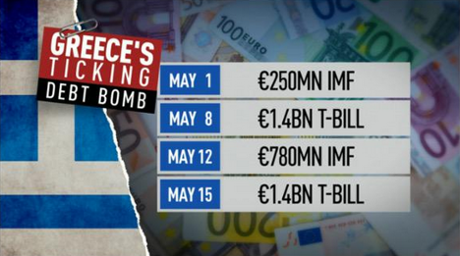
Greece faces a string of repayments in the next few weeks, including wages and pensions and almost €1bn to the IMF. Analysts at UBS have warned that this could trigger a rapid exit from the eurozone, or a slower one....
Updated
UBS: The fast Grexit, and the slow....
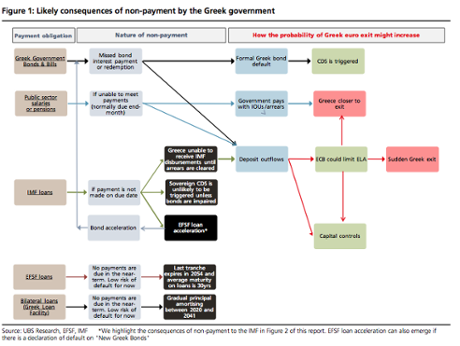
Analysts at UBS have outlined two methods by which Greece could leave the eurozone:
(1) The fast route:
A rapid deposit withdrawal from the banking system, if the Eurosystem refused to finance it through expansion of the ELA facility. The government would then need to refinance (and probably recapitalise) the banking system by creating a new currency to do so. However, this could probably be slowed with the imposition of capital controls limiting deposit withdrawal.
(2) The slow(er) route:
The government, running out of funds, could substitute IOUs for euros in some of its payments. Starting with payments to suppliers (including for pharmaceuticals, as in 2011), and then - in theory - progressing on to public sector salaries and pensions over time. As current Greek debt obligations are not valued at their face value by the bond market, nor would these notes be, meaning that their purchasing power would likely be lower than that of the euro. In this way, the parallel currency would already be devalued.
The more of these notes that were issued, the greater the need would be for the banking system to clear payments in them. The need would also increase for businesses and citizens to use them to pay taxes. As this continued, it would be likely that more euros would leak out of the Greek banking system and the economy would rely on the new currency to a greater extent.
Nominally, Greece could (in theory, and just conceivably) remain in the euro under these circumstances, but there would come a point in this process at which it had in a practical sense already left.
They’ve also produced a chart, showing the consequences of Greece missing various payments:
The word in Athens is that the reshuffled Greek negotiating team will meet tonight, at 6.30pm local time or 4.30pm BST.
The new #Greece negotiating team is convening at 6.30 pm, according to local media #politics #economy
— Manos Giakoumis (@ManosGiakoumis) April 27, 2015
Life has been continuing as normal in Athens today, despite growing public concerns over the negotiations with creditors.

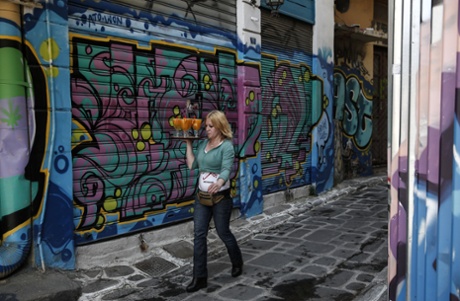
Over the weekend, a survey by Alco showed that 50% of the public want a compromise even if creditors reject the Greek government demands, while 36% felt the government should opt for a “rupture” if it is spurned.
Germany: Greek delays are frustrating
Over in Berlin, the German government gave Greece the hurry-up this morning.
Finance ministry spokesman Martin Jaeger told reporters that the lack of a credible reform plan is Athens’ fault:
“Our goal is to keep Greece in the euro. That’s what we are working for intensively. But we have to make it clear once more that the ball is in Greece’s court.”
“We’re waiting for proposals and have been waiting for weeks. It’s frustrating but we are patient.” (quotes via Reuters)
Updated
With or without Yanis at the wheel, it will be hard for Greece’s government to agree a reform programme that is acceptable to both its lenders and its own left-wing MPs.
#Greece Τsakalotos taking the lead & #Varoufakis getting sidelined might soothe creditors, but doesn't necessarily soothe #Syriza's stance.
— The Greek Analyst (@GreekAnalyst) April 27, 2015
Bild: Greece is revising its reform list
Germany’s Bild tabloid is reporting that Greece is planning to present a new list of reforms to creditors on Wednesday.
It includes abandoning plans to raise the minimum wage.
You can see the story on Bild’s website (scroll down to find their news ticker).
Bild kicking off the rumor mill. Says Greece has revised reform list, ready to suspend minimum-wage plans.
— Jonathan Ferro (@FerroTV) April 27, 2015
Combined with the shake-up off the Greek negotiating team (see 11am), and perhaps the wheels are moving again?....
Getting there, slowly but surely: - reschuffling of Greek negotiation team - revised reform list, including minimum wage (Bild)
— Frederik Ducrozet (@fwred) April 27, 2015
Italy’s economy minister, Pier Carlo Padoan, has denied that the eurozone is now secretly planning for life without Greece.
Padoan told reporters in Rome:
“As far as I’m aware, there is no Plan B on Greece...The aim is to get a rapid accord with Athens.”
On Friday, though, the FT reported that Slovenia’s representative told the Eurogroup that if bailout talks did not progress more quickly the eurozone should prepare a “Plan B” to deal with a Greek default.
Reuters has also been told that Yanis Varoufakis still enjoys the support of PM Tsipras (as flagged earlier)
But despite these signals, Greek negotiating team is being shaken up - giving more responsibility to Euclid Tsakalotos, the government’s chief economics spokesman.
Via Reuters:
Tsipras, in a meeting on Sunday with senior aides and ministers including the deputy prime minister and economy minister, expressed support for Varoufakis and agreed the finance minister will supervise a new group to lead “political talks” with lenders.
However, deputy Foreign Minister Euclid Tsakalotos will be tasked with coordinating the group, the official said, suggesting the Oxford-educated economist and professor would have a more active role in talks with the EU and IMF.
“Support for Finance Minister Yanis Varoufakis, who has been targeted by international media reports, was confirmed during the meeting,” the government official said. “The finance minister always acts in line with collective decisions and the government’s leadership.”
#Greece | Varoufakis confidant Nikos Theocarakis replaced in Brussels Group with Nikos Houliarakis. A sign of Varoufakis retreat.
— Yannis Koutsomitis (@YanniKouts) April 27, 2015
New Greek negotiating team announced
Reports are coming in that Greece’s negotiating team is being shaken up:
New political negotiation group for #Greece under the supervision of the greek finmin @yanisvaroufakis
— EfiKoutsokosta (@Efkouts) April 27, 2015
Greek gov't says FinMin Varoufakis to form "political negotiation team" that will be led by Alt Foreign Minister Euclid Tsakalotos #Greece
— Nick Malkoutzis (@NickMalkoutzis) April 27, 2015
Despite govt officials backing @yanisvaroufakis, others are being introduced/upgraded in talks process #Greece
— Stelios Bouras (@SteliosBouras1) April 27, 2015
Updated
#Greek govt officials spreading the message that @yanisvaroufakis has the full backing of govt
— Stelios Bouras (@SteliosBouras1) April 27, 2015
<football manager analogy here> https://t.co/XgR4nr75Dd
— Katie Martin (@katie_martin_FX) April 27, 2015
Greek opposition call for Varoufakis to quit

Over in Athens calls are growing for the Greek finance minister’s head, after he came away from last Friday’s eurogroup with criticism ringing in his ears, and no signs of progress with creditors.
Government insiders, though, say Yanis Varoufakis still enjoys the support of PM Alexis Tsipras.
Athens correspondent Helena Smith reports:
It has not taken long for the morning TV shows to host politicians calling for Yanis Varoufakis to go. First amongst them this morning was Dora Bakoyannis, the former foreign minister widely seen as the leader-in-waiting at New Democracy, the main opposition party.
Bakoyannis told Skai TV that:
“He has to resign today to make things easier for Mr Tsipras and to liberate him so that it doesn’t seem that he is being sacked on the orders of people abroad.”
Accusing the academic-turned-politician of untrammeled “narcissism” she said the finance minister had not only become an impediment in negotiations with creditors but was endangering the country and the future of all Greeks.
Bakoyannis claimed:
“I am not at all sure that Mr Varoufakis has not adopted the logic of the drachma....Mr Varoufakis is an impediment for Greece.”
Bakoyannis added it was unforgiveable that the outspoken Greek finance minister had elected not to attend Friday’s euro group dinner “but go off with friends instead of trying to negotiate when the country is dependent on these people for loans.”
Varoufakis’ removal would enable Tsipras to take what is bound to be the unpopular step of compromising with lenders.
Bakoyannis also argued that Varoufakis wouldn’t suffer if he quit political life:
“Mr Varoufakis will be alright, he will be able to go on and lecture in universities but does he think of ordinary Greeks who do not have such possibilities?”.
Despite the uproar, the official line remains that the Greek prime minister is standing by his friend. “If he is let go it will be only once a deal is achieved,” confided one insider.
“Varoufakis may not be to everyone’s taste in Syriza,” he said of the governing leftwing party, “but he has managed to internationalise the Greek problem. A lot of good cop, bad cop is being played. After Tsipras’ positive meeting with Merkel last week, it was only to be expected they [euro zone finance ministers] would round on Varoufakis.”
Updated
Updated
Japan downgraded to A by Fitch
Breaking away from Greece for a moment; Japan has just been hit with a credit rating downgrade.
Fitch cut Japan’s rating by one notch, from A+ to A; the sixth-highest credit rating available. It blamed the cut on Tokyo’s failure to agree “sufficient structural fiscal measures” in its most recent budget, to make up for delaying a sales tax rise.
Fitch is concerned that Japanese growth has been weaker than expected, given its huge national debt:
Japan’s main sovereign credit and rating weakness is the high and rising level of government debt. Fitch projects the gross general government (GG) debt to GDP ratio to rise to 244% of GDP by end-2015, by far the highest ratio of any rated sovereign.
More here: Fitch Downgrades Japan to ‘A’; Outlook Stable
Jeroen Dijsselbloem has also confirmed that he spoke with Greek PM Tsipras after Friday’s Eurogroup dramas in Riga.
Asked by De Volkskrant whether Yanis Varoufakis was the right man to handle the negotiations, Dijsselbloem replied that the issues go beyond Varoufakis’s remit:
Yes, it is about the budget and the financial sector but also on privatization, labor market and pensions. So much more than the portfolio of the Minister of Finance.....
Thus is it “obvious” that Dijsselbloem should speak with the man at the top, Tsipras.
In @marcpeeperkorn intvw, @J_Dijsselbloem confirms he called @atsipras after Friday's #eurogroup bust-up in #Riga: http://t.co/fRbmSd9gBR
— Peter Spiegel (@SpiegelPeter) April 27, 2015
Is Yanis Varougakis being painted as the fall guy by eurozone members who have lost patience with Greece?
Alastair Winter, chief economist at investment bank Daniel Stewart’s, suspects so. He writes:
It appears that Mr Varoufakis, a renowned exponent of game theory, may have mistaken the game that the Northerners are playing. Encouraged by Messrs Juncker, Draghi, Moscovici and Ms Lagarde, he is playing the game to avoid Grexit. In his post-meeting interviews he said “Any mention of a plan B is profoundly anti-European, My immediate response was to say there is no such plan B, there cannot be such a plan B.”
However, the Northerners’ game seems more like avoiding getting the blame for Grexit even if they cannot yet agree a Plan B (because of opposition from those encouraging Mr Varoufakis). The Greeks are still holding out for the last €7.2bn tranche from the second bail-out, no more supervision by the lenders and release from most if not all current budgetary and structural reform targets. Once that is out the way, they then will want to talk about a third bail-out.
The current stand-off probably means the first crunch date is May 12th when a €0.75bn repayment is due to the IMF. Things would move quickly after a default but the exact sequence is unclear. Assuming the Northerners refuse to blink, drachmas would soon be needed to pay suppliers, salaries and pensions. This in turn would necessitate nationalising the banks and introducing exchange controls. Mr Draghi’s nightmare will have come true: EMU would be seen not to be irreversible after all. Then it will be Mr Juncker’s turn: will Greece be able to stay in the EU?
Wonder if circumventing Varoufakis just another instalment in Northerners trying to escape blame for Grexit while Greece trying to avoid it?
— Alastair Winter (@AlastairWinter) April 27, 2015
Good news for readers whose grasp of Greek is as poor as mine; Enikos will translating Alexis Tsipras’s interview tonight into English (from 9.30pm UK time, I think)
@graemewearden Simultaneous translation into English for Alexis #Tsipras first live interview -http://t.co/0PrAT10q83
— enikos_en (@enikos_en) April 27, 2015

Eurogroup chief Jeroen Dijsselbloem has told Dutch newspaper De Volkskrant that Greece will not require a “great” new bailout when its existing programme expires.
Asked about rumours that a €30bn-€50bn loan will be needed, Dijsselbloem indicated that any third bailout would be smaller than the existing €130bn deal that expires in June.
Dijsselbloem said:
I’m not going to speculate on the extent, but the amounts are of an entirely different order than the current help.
Dijsselbloem statement is interesting. No 3rd major program for #Greece could mean two things: i) Greece gets dumped ii) debt rescheduling
— Yannis Koutsomitis (@YanniKouts) April 27, 2015

I forgot to mention this earlier, but Alexis Tsipras is giving a live TV interview late tonight, to discuss the debt crisis.
The Enikos newspaper explains:
Mr. Tsipras will answer questions from leading journalist Nikos Chatzinikolaou and an invited audience on all the critical issues facing Greece and the negotiations with its lenders.
It starts at 11.30pm Greek time, or 9.30pm if you’re in the UK.
Greek bonds are weakening this morning, pushing up yields further into the danger zone.
The yields on Greece’s two-year bond has jumped to 26.8%, up from 26% on Friday night, showing a higher risk of default.
And that means the spread between Greek bonds and the rest of the eurozone has widened further:
Peripheral spreads widen as markets prepare for Greek endgame. #Grexit pic.twitter.com/bnCq2fzmWa
— Holger Zschaepitz (@Schuldensuehner) April 27, 2015
Yanis Varoufakis is making headlines today, but not in the way he’d like:
Everything going well then pic.twitter.com/qA5uzhI7Wc
— Mike Bird (@Birdyword) April 27, 2015
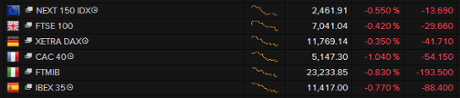
Greek worries are pushing Europe’s stock markets down in early trading, with France’s CAC index losing 1%:
Koji Fukaya, CEO of FPG Securities, explains that investors see the Greek crisis heading towards a climax:
Proposals from Greece do not include important issues such as pension cuts and labour market reforms and are not something the creditors will be able to stomach.”
Lots of chatter about Greece this morning:
#EU hopes to sideline #Greece finance minister and deal directly with PM. Little progress made on bailout, some big repayments due in weeks
— Robin Bew (@RobinBew) April 27, 2015
Greece to find ways to assemble enough cash to pay pensioners and employees, after euro ministers say no more aid until bailout terms met
— Richard Edney DipPFS (@RichEdney) April 27, 2015
#Greece | Brussels Group to hold conference call later today in a revived effort to bridge gap in Greek bailout talks.
— Yannis Koutsomitis (@YanniKouts) April 27, 2015

A German government spokesman has confirmed reports that chancellor Merkel spoke with the Greek prime minister by phone yesterday.
Although Berlin won’t say what was discussed, the fact the call took place at all suggests that Alexis Tsipras is taking a more hands-on role.
One Greek official has briefed that the two leaders:
“expressed their common will for a steady communication throughout the course of negotiations in order to have a mutually beneficial solution soon”
Merkel and Tsipras also held a face-to-face meeting in Brussels last Thursday; it was said to be constructive, unlike the finance ministers’ meeting that followed it.....
FT: Isolated Yanis Varoufakis could be bypassed

The Financial Times is also reporting that Yanis Varoufakis is being sidelined, after last Friday’s “highly critical” eurogroup meeting:
Here’s a flavour:
Greece’s dire financial position is forcing eurozone authorities to look beyond Mr Varoufakis to Alexis Tsipras, prime minister, much like in February when Jeroen Dijsselbloem, the Dutch finance minister who chairs the eurogroup, brokered an extension of the current bailout programme.
According to two eurozone officials, Mr Dijsselbloem phoned Mr Tsipras from Riga in an effort to mend fences after Friday’s feisty eurogroup meeting, where Mr Varoufakis was rounded on by his eurozone colleagues.
In a sign that Mr Varoufakis’s combative approach is prompting concern in Greece as well, a senior Athens official said the Riga meeting was likely to lead to him being sidelined as Mr Tsipras and his deputy Yannis Dragasakis take a more hands-on role.
Amid the acrimony, differences over a new list of reforms that is to be agreed by Athens were barely discussed at the meeting, putting off indefinitely a deal to unlock access to the funds left from Greece’s €172bn bailout.
“All the ministers told [Mr Varoufakis]: this cannot go on,” said Luis de Guindos, Spain’s finance minister....
Full story: Eurozone officials seek to bypass Varoufakis to spur Greek talks
Varoufakis wasn’t completely ostracised over the weekend, though. Czech finance minister Andrej Babis insisted on sharing a ‘selfie’ with him on Saturday.

Updated
Introduction: Greek crisis grinds on
Good morning, and welcome to our rolling coverage of events around the world economy, the financial markets, the eurozone and business.
It looks like another week dominated by Greece’s debt crisis.
The dust is settling after Friday’s dramatic Eurogroup meeting in Riga, where divisions between Athens and its creditors burst into the public eye.
And with eurozone ministers refusing to hand over any money without seeing a list of credible reforms, talk of a Greek default is growing louder by the day.
It emerged over the weekend that Yanis Varoufakis ducked out of Friday night’s official dinner, following the bruising eurogroup meeting where he was heavily criticised by the rest of the eurogroup.
“He is completely isolated,” a senior euro zone official told Reuters on condition of anonymity.
“He didn’t even come to the dinner to represent his country,” the official said of the event where ministers, serenaded by a Latvian choir, ate salmon and sea bass.
Varoufakis hit back on Twitter last night:
FDR, 1936: "They are unanimous in their hate for me; and I welcome their hatred." A quotation close to my heart (& reality) these days
— Yanis Varoufakis (@yanisvaroufakis) April 26, 2015
Roosevelt is a fine role model. But Varoufakis’s tweeting has fuelled speculation that he is being sidelined as the Greek crisis steadily escalates.
As IG’s Chris Weston puts it:
Greece has moved somewhat closer to a technical default after the weekend’s antics, although it seems the majority of Europe’s finance ministers have had about as much as they can take of the Greek finance minister Yanis Varoufakis and will look to deal directly with top dog Alexis Tsipras from here on in.
And the latest opinion polling shows the public are getting edgy; 72% of Greece’s want to see a deal struck with creditors, while only 23% favour a clash.
Technical officials representing both sides should hold a conference call today, in the hope of getting closer to the comprehensive list of reforms sought by the Institutions who funded Greece’s bailout.
So we’ll be watching out for developments there, along with other news through the day....