Closing summary: Greece nears euro exit as bailout talks break up

So, another crunch meeting fails to deliver a breakthough.
But this wasn’t any old failed eurogroup meeting. This might be remembered as a classic.
We had Germany producing a half-baked scheme to boot Greece out for five years, Finland’s new government on the edge of meltdown, and Italy preparing to raise the stakes on Sunday by telling Germany that enough is enough.
Meanwhile, Greece’s economy is in freefall, its banks are on the edge, and its political class are reeling after Alexis Tsipras offered billions of euros in fresh austerity to get a deal.
From Brussels, our Europe editor Ian Traynor sums up the situation after another frustrating, and sometimes bizarre, day:
Greece’s final attempt to avoid being kicked out of the euro by securing a new three-year bailout worth up to €80bn ran into a wall of resistance from the eurozone’s fiscal hawks on Saturday.
Finland rejected any more funding for the country and Germany called for Greece to be turfed out of the currency bloc for at least five years.
The last chance talks between the 19 eurozone finance ministers in Brussels ran into the early hours of the morning as they struggled to draft a policy paper for national leaders at yet another emergency summit on Sunday that was billed as the decisive meeting.
With Greece on the edge of financial and social implosion, eurozone finance ministers met to decide on the country’s fate and on what to do about its debt crisis, after experts from the troika of creditors said that new fiscal rigour proposals from Athens were good enough to form “the basis for negotiations”.
But the German finance minister, Wolfgang Schäuble, dismissed that view, supported by a number of northern and eastern European states.
A German finance ministry paper said:
“These proposals cannot build the basis for a completely new, three-year [bailout] programme, as requested by Greece.”
It called for Greece to be expelled from the eurozone for a minimum of five years and demanded that the Greek government transfer €50bn of state assets to an outside agency for sell-off.
Timo Soini, the nationalist True Finns leader, meanwhile, threatened to bring down the government in Helsinki if Alex Stubb, the finance minister, agreed to a new bailout for Greece. Stubb apparently came to the crunch meeting on a new bailout without a mandate to agree one.....
Here’s Ian’s full story:
Tomorrow’s leaders’ summit could be explosive, given we’re expecting Matteo Renzi to urge Angela Merkel to show some leadership and end the crisis.
And with eurogroup president Dijsselbloem warning that the situation is “very difficult”, there’s no guarantee of a breakthrough when ministers resume talks. But a good night’s sleep might help.
So in that spirit, I’m going to end this liveblog until the morning. (unless anything sensational happens). Thanks, as ever, for reading and helping. Goodnight! GW
see you tomorrow #Greece #ohnoooo pic.twitter.com/oL2NVGNQqS
— Patricio Arana (@PAranaAFP) July 11, 2015
Updated
The message from Greece tonight - don’t blame us, we’re doing our best:
Greek gov source on Eurogroup: It's clear that certain countries, for reasons unrelated to reforms+program, don't want there to be agreement
— NikiKitsantonis (@NikiKitsantonis) July 11, 2015
European solidarity, eh?
"Even if #Tsakalotos chopped down his arm, #Schaeuble would say it's not enough". Words of a European official for today's #Eurogroup
— Nikos Sverkos (@NikosSverkos) July 11, 2015
If eurozone finance ministers cannot reach a deal on Sunday morning, they will pass the hot potato onto the 28 leaders of EU countries in the afternoon:
Another crack tomorrow at 11am, and if they can't do it, then it gets booted upstairs to the leaders. And that is when the fun really begins
— Duncan Robinson (@duncanrobinson) July 11, 2015
Full #EUCO still on for 6pm CET tomorrow, says EU source - for now.
— Tom Nuttall (@tom_nuttall) July 11, 2015
Updated
The FT’s Duncan Robinson confirms that the eurogroup is far from a deal.
Despite the public optimism, officials from both camps are frustrated. "Not very" close to agreement seems to be the summary. #eurogroup
— Duncan Robinson (@duncanrobinson) July 11, 2015
Spain’s Luis de Guindos spoke to the media before hotfooting it into the darkness.
I asked Spain's FINMIN De Guindos if he's optimist: We're going to try till the end (Meeting) Could have been better, but also worse #Greece
— María Tejero Martín (@Maria_Tejero) July 11, 2015
Updated
I missed Christine Lagarde’s departure, but a replay shows that the IMF chief only gave a wave to the cameras.
Updated
The Greek fin min @tsakalotos leaving the #EU building Lex after a hard day. Photo credits @ArisoikoPhoto pic.twitter.com/IzfXmEPwQ4
— Efi Koutsokosta (@Efkouts) July 11, 2015
Here comes Euclid Tsakalotos.....and there goes Euclid Tsakalotos!
Greece’s finance minister exited the building at a marching pace, mobile phone glued to his ear, deep in conversation. Not a word for the press, alas.
Here’s a video clip of Pierre Moscovici’s comments tonight:
#Eurogroup Doorstep European Commissioner @pierremoscovici I always keep my hope #Greece http://t.co/CPqacZODFZ pic.twitter.com/3dvNujme73
— EU Council TV News (@EUCouncilTVNews) July 11, 2015
Some ministers are walking past the media and refusing to speak, including Ireland’s Michael Noonan. I guess they’ve got nothing encouraging to say.
Mario Draghi just got into a car without comment.
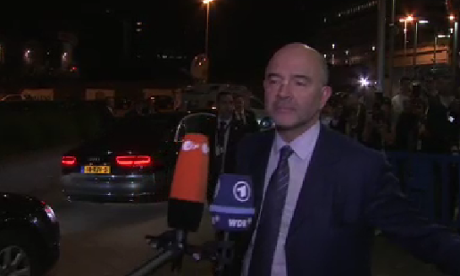
Here comes Pierre Moscovici....and actually he (for once) doesn’t look too upbeat.
He tells reporters (in French) that there is always hope.
#Moscovici: "I always keep hope". Doesn't sound so optimistic. #Eurogroup
— Eric Maurice (@er1cmau) July 11, 2015
#Eurogpoup there's always tommorow, there's always hope, says Pier Moscovici, leaving Eurozone Finance Ministers' 9-hour meeting
— Georgios Fellidis (@Georg1os) July 11, 2015
Michel Sapin’s optimism is unquenchable!
French finance minister asked if he is still optimistic as he leaves. "Always!" #Greece
— Emily Purser (@EmilyPurser) July 11, 2015
Finland’s Alex Stubb told reporters that tonight’s meeting made ‘good progress’
RTRS - EUROGROUP "MAKING GOOD PROGRESS" ON GREECE -FINLAND'S STUBB
— Eric Burroughs (@ericbeebo) July 11, 2015
This is the same Alex Stubb who apparently can’t back a third bailout?
Dijsselbloem: It is still very difficult
Jerosn Dijsselbloem, head of the eurogroup, is speaking now at the exit.
He confirms that the meeting is adjourned until 11am tomorrow morning.
We have had an in-depth discussion of the Greek proposals. The issue of credibility and trust was discussed, and also of course the financial issues involved.
It is still very difficult, but work is still in progress.
#eurogroup now very badly split. getting nasty. could be rowdy summit sunday. renzi to round on merkel, enough humiliation. and hollande?
— Ian Traynor (@traynorbrussels) July 11, 2015
Eurozone meeting ends without agreement
It does NOT look good, I’m afraid.
"Is it a yes or a no," the Slovakian finmin @KazimirPeter is asked as he leaves. "No is the better answer," he replies #Greece
— Ed Conway (@EdConwaySky) July 11, 2015
Eurozone ministers are being collared as they leave the meeting - here’s a live feed.
Ian adds that there won’t be a press conference tonight. No statement either. We’re basically in limbo until the morning.
Eurogroup breaks up with no joint statement. To continue at noon Greek time on Sunday #Greece #Eurogroup
— Kathimerini English (@ekathimerini) July 11, 2015
Ian confirms that the eurogroup is breaking up, to resume in the morning
#eurogroup over at midnight. till 11 tomorrow. no statement agreed for summit. yet
— Ian Traynor (@traynorbrussels) July 11, 2015
Eurogroup ministers are going to resume talks in 11 hours time:
#Eurogroup tomorrow at 11 in the morning.
— Efi Koutsokosta (@Efkouts) July 11, 2015
The prime minister of Malta has tweeted that the eurogroup meeting failed to reach an agreement (as had become clear in recent hours)
Briefed about inconclusive #Eurogroup meeting. It will be a long day -JM
— Joseph Muscat (@JosephMuscat_JM) July 11, 2015
Muscat, like other EU leaders, will be attending Sunday’s emergency summit on Greece. But is that to discuss Grexit, or to hammer out political agreement on a third bailout?
The Eurogroup meeting is over! Until the morning......
End of #Eurogroup session. To be continued tomorrow.
— Alexander Stubb (@alexstubb) July 11, 2015
The 9th hour of Eurogroup meeting starting soon. Works on final statement not finished untill 2-3 am... pic.twitter.com/QJSjMBLDnX
— Stefan Leifert (@StefanLeifert) July 11, 2015
The Finns really have put a spanner in the works, by the sound of it:
EG drafting session with two options. One with the finns, one without. Last word to the leaders, tomorrow (source with a tie) @la_stampa
— Marco Zatterin (@straneuropa) July 11, 2015
So the source isn’t Euclid, anyway.
Hopes of an early finish are being trampled into the carpet. The Brussels press pack are heading that the eurogroup may run for another three hours.
How are things going at Eurogroup? "No way near the end", apparently.
— Duncan Robinson (@duncanrobinson) July 11, 2015
Final Eurogroup statement not expected until 2-3am - source.
— Tom Nuttall (@tom_nuttall) July 11, 2015
Here’s something to chew on. A eurozone bailout, as Jennifer flagged up earlier, only needs 85% support if the situation is an emergency.
But some country’s have rather more muscle than others, reflecting their financial contribution to bailout funds. Many of the smaller countries only have a tiny share of the vote.
Finland and Slokavia may have hard-talking finance ministers, but when the chips are actually down, it’s France, Italy, and of course Germany who actually have veto power, while Spain just needs a few allies. The Netherlands, Belgium, Portugal, and Austria also have enough power to influence a really tight vote.
Thanks to an obscure legal clause, ESM can agree a bailout with 85% of votes, not unanimity. These are voting rights: pic.twitter.com/Yfqp8T60Jn
— Ed Conway (@EdConwaySky) July 11, 2015
It's 23.00 in Brussels. Eurogroup meeting started 8 hours ago. As far as I know, very little improvement. Very little optimism.
— Pablo Rodríguez (@Suanzes) July 11, 2015
So much for finishing at 10pm Brussels time.....
#eurogroup still working on the common statement.
— Keep Talking Greece (@keeptalkingGR) July 11, 2015

Italy to tell Germany: enough is enough.
Tomorrow, Italy is reportedly going to demand that Germany hammers out an agreement with Greece, our datablog editor, Alberto Nardelli, hears tonight.
Italian prime minister Matteo Renzi has had enough, Alberto understands. It’s time to stop humiliating Greece, and end this crisis.
Tomorrow, at the summit of eurozone leaders, Renzi will insist that chancellor Angela Merkel finds an agreement, for the good of the European Union.
Hearing Italy to tell Germany: "enough is enough" - we need to stop humiliating Greece, and find a deal and common ground for good of EU
— Alberto Nardelli (@AlbertoNardelli) July 11, 2015
This crisis just gets more, and more, and more serious. And compelling.
Updated
Greek capital controls could last two more months - minister
Back in Greece, economy minister George Stathakis has warned that the country could face some capital controls all though the summer.
Reuters has the details:
Stathakis told Greece’s Mega TV that the banks could reopen as soon as next week, if an agreement with creditors is reached this weekend, but other restrictions on withdrawals and currency exports would remain in place for most.
“That will stay in play for two months or some months,” he said.
Here's Germany's plan for temporary Grexit
This appears to be the German finance ministry’s paper, which suggests Greece could be offered a ‘temporary’ exit from the eurozone.
Here's the Schäuble Grexit plan everybody is talking about - via @sven_giegold pic.twitter.com/zYwTeyx4Q5
— Mathieu von Rohr (@mathieuvonrohr) July 11, 2015
As you can see, it argues that this would allow Greece to restructure its debts, and also get humanitarian support.
Finnish TV is reporting that the Helsinki government will not support a new Greek aid package.
It is confirmed: Finnish gov't won't accept a new bailout package to #Greece. #Eurogroup
— Jarno Hartikainen (@JarnoHa) July 11, 2015
So, it’s over?
Not necessarily. There’s an emergency procedure which allows financial assistance to be granted from the ESM with just 85% support, in a real emergency:
True Finns can't stop #greece bailout, ESM emergency voting procedure allows decisions to pass with 85% majority. pic.twitter.com/ctkznCeoKw
— Jennifer Rankin (@JenniferMerode) July 11, 2015
That may not help get an agreement through the eurogroup tonight, though.....
Sounds like a statement is being drawn up tonight....but it’s not a decisive Yes or No to a Greek deal. It sounds more like an Ummmmm....:
Sources: #eurogroup working on a statement: #Greece to implement next week some measures and than #Eurogroup will reconvene for final deal
— Giovanna Pancheri (@giopank) July 11, 2015
sources: #greece agreed to the statement, but some ministers have problems to accept it (Finalnd) and so they will pass it to the leaders
— Giovanna Pancheri (@giopank) July 11, 2015
The Eurogroup meeting is buzzing with talk that the Finnish government might collapse, if it backs a third Greek bailout.
My colleagues Ian and Jennifer have the latest:
#greece #eurogroup said here that finland's alex stubb's hands tied, soini will bring down govt if finland agrees to any more gk funding
— Ian Traynor (@traynorbrussels) July 11, 2015
(that’s Timo Soini, leader of the True Finns)
Talk of the #Eurogroup is that True Finns threatening to pull out of coalition if gov supports 3rd bailout for #Greece
— Jennifer Rankin (@JenniferMerode) July 11, 2015
A quick recap....
Eurozone ministers have been discussing Greece’s bailout request for hours, with no signs of an major breakthrough.
The meeting may end soon, though, after around six hours which began with smiles, and frowns.
#Eurogroup meeting could be done within the next half an hour or so according to those within the meetings. #Greece
— Jack Parrock (@jackeparrock) July 11, 2015
EU sources say that creditors are demanding tougher measures, on top of the €13bn plan of tax rises, pension reforms and spending cuts already offered.
Several countries have already questioned whether Greece has done enough, and warned that trust in the Greek government has been badly hit by the last few weeks’ events.
Germany has reportedly drawn up a paper suggesting Greece could temporarily exit the eurozone, to general disbelief:
I mean, it's almost as if it was a deliberate entry into the "worst plan ever" competition.
— Duncan Weldon (@DuncanWeldon) July 11, 2015
"Our currency union is irrevocable - except during a crisis when countries might devalue. We'll just assume the markets will ignore that"
— Duncan Weldon (@DuncanWeldon) July 11, 2015
And Finland’s government is rumoured to be taking a very hard line, with reports suggesting its coalition could break up over Greece.
It could all be bargaining tactics, though, ahead of tomorrow’s leaders summits
The (ex-True) Finns knew very well that 3rd bailout was on the cards when they joined coalition. Suspect there's more to this story.
— Tom Nuttall (@tom_nuttall) July 11, 2015
Economists have warned that Greece needs a deal urgently, so that its banking sector can be replenished with desperately needed liquidity.
And in Athens, a senior government minister has suggested that Syriza MPs who can’t support the austerity plan should quit.
Updated
Life has been carrying on in Athens tonight, as the eurogroup meeting rolls on:


Finland says NO to #Greece. Fin could be the #Eurogroup country that blocks an agreement source to #yle
— Daniel Olin (@DanielOlin) July 11, 2015
Finland taking tough line over Grexit - reports
The Greek crisis is putting serious strain on Finland’s new government.
Maria Stenroos, EU correspondent for state broadcaster Yle, reports that the Finnish delegation is taking an even tougher line than Germany.
Source for Yle: Stubb's mandate from Finnish parliament is very narrow. In practise means #Grexit. #eurogroup
— maria stenroos (@mariastenroos) July 11, 2015
Finnish government near to collapse this morning. True Finns saying NO for #Greece or leaving government.
— maria stenroos (@mariastenroos) July 11, 2015
(The right-wing, euro-sceptic True Finns are coalition partners in the new government, which was formed in May)
This is getting a lot of play on Finnish TV tonight. But would Helsinki really outflank Berlin on this?
Jarno Hartikainen of business newspaper Kauppalehti reckons not:
Okay, already 3 big Finnish news outlets (MTV3, HS, YLE) reporting same thing: Finland wants #Greece out of eurozone.
— Jarno Hartikainen (@JarnoHa) July 11, 2015
I wld still advise ppl to b cautious abt news FIN wanting #Greece out. Hard to believe they would play harder than DE, will follow Schäuble
— Jarno Hartikainen (@JarnoHa) July 11, 2015
The BBC’s Chris Morris has more details on the measures that Greece is being pushed for tonight (as Ian reported earlier)
EU official says #Greece needs to do more on product and labour market reform. And needs to pass more laws this wk to show they're serious.
— Chris Morris (@BBCChrisMorris) July 11, 2015
A week of nail-biting votes in Athens, as well as crunch meetings in Brussels? Oh great.
Could ministers come back in the morning for another crack at the problem?
More EuGroup Tomorrow? "Well, its nine o' clock. We could take a break and start again in the morning". (sad source) @la_stampa #greece
— Marco Zatterin (@straneuropa) July 11, 2015
Apparently, tonight’s dinner isn’t going too well:
Sources: ministers' dinner just started, but around the table everyone is very silent. #Eurogroup #Greece
— Giovanna Pancheri (@giopank) July 11, 2015
Given the sheer number of eurogroup meetings in recent weeks, ministers must have exhausted their reserves of small talk.
“Been anywhere nice recently?”
“Brussels, Brussels, Brussels, Brussels, oh yes Luxembourg..... and Brussels.”
Updated
Rumour watch: the eurogroup meeting might finish in just over an hour’s time:
#Eurogroup sources say meeting should be over by 10pm Brussels time (famous last words) Two more meetings expected next week.
— Bojan Pancevski (@bopanc) July 11, 2015
(there’s a scheduled Eurogroup meeting on Monday, but a second meeting would be unscheduled)
So much for kicking out the Troika....
#greece #eurogroup if gks hated troika before,it can only get worse.germans demanding guaranteed outside vetting of tsipras reforms - source
— Ian Traynor (@traynorbrussels) July 11, 2015
Creditors drawing up extra demands on Greece
Greece’s creditors are drafting a response to Athen’s bailout proposal - outlining what extra measures are needed, reports our Europe editor:
#greece #eurogroup while session in pause €zone/troika drafting written response to greek proposals, what more greeks need to offer-sources
— Ian Traynor (@traynorbrussels) July 11, 2015
Ian also hears that eurozone ministers may fail to reach an agreement tonight - kicking the can upstairs to the euro leaders meeting tomorrow.
#greece #eurogroup session in pause. nowhere near agreement. unlikely tonight. could be passed to sunday summit - sources
— Ian Traynor (@traynorbrussels) July 11, 2015
Channel 4’s Paul Mason has a handy summary of the state of play this evening:
Upsum Eurogroup so far: Greece asked for more austerity; German Grexit plan non-starter; @tsakalotos can’t sign without words on debt (1/2)
— Paul Mason (@paulmasonnews) July 11, 2015
(2/3) in other words the exact same situation as for 6 months. But Germans now openly pushing for Grexit, IMF for debt relief, EU paralysed
— Paul Mason (@paulmasonnews) July 11, 2015
(3/3) Unless Syriza gives *legitimacy* to its own overthrow, pro-Merkel parties in Greece cannot rule it. This last always forgotten by MSM
— Paul Mason (@paulmasonnews) July 11, 2015
Now here’s a tasty rumour:
F.A.S. reports Merkel was not aware of French help to Greeks in drafting proposals; "angry call" from chancellery to Elysée when news broke
— Mathieu von Rohr (@mathieuvonrohr) July 11, 2015
We’ve been told that French officials provided “invaluable” help in drawing up the current Greek proposals. Can’t imagine why Berlin would be cross.....
More head-shaking in Brussels:
#greece #eurogroup with their 5year timeout paper, germans seem to be losing it #silly
— Ian Traynor (@traynorbrussels) July 11, 2015

Wolfango Piccoli, analyst at Teneo Intelligence, reckons that Alexis Tsipras has four options following the mini-rebellion at last night’s vote over his reform plan:
- He could resign and trigger snap polls after reaching a deal with his lenders. This would leave Greece in limbo for around 3-4 weeks, a development that would raise significant concerns among the lenders and complicate meeting the relevant targets (milestones) attached to the likely sub-tranches of a new bailout.
- He could decide to tackle decisively the situation by breaking with the dissenters and replacing those MPs who voted “No” or abstained, including the two ministers and the parliament speaker. This could be achieved by enforcing SYRIZA’s internal rule forcing (on paper) MPs to give up their seats after leaving the parliamentary group.
- He could seek to enlarge the governing coalition by including one or more of the opposition parties, notably POTAMI and Pasok. The creation of a wider coalition would reassure the lenders but it is, in our view, the least likely of the available options.
- Finally, he could decide to move cautiously (as he has done in the past) by replacing only the two MPs who voted “No”, meaning that an unstable balance would prevail in the short-term, at least.
But whatever Tsipras chooses, there’s a high chance of another general election this year, Wolf adds.
Greek minister: Syriza rebels should resign
Over in Athens, economy minister Giorgos Stathakis has said he’s confident the government will be able to get parliamentary approval for its reform plans.
And he also warned that any Syriza MP who disagrees should resign their seat.
Stathakis told Mega TV that:
“If a lawmaker of a leftist party disagrees with the policies of the government...they should follow the rules and if they strongly disagree resign their seat.
Stathakis added that “if it were me, I would resign”.
(that’s via Reuters)
Last night, 17 Syriza MPs either opposed the plan, abstained or were absent during the vote. That included energy minister, and influential Syriza member, Panagiotis Lafazanis.
EconomyMin Stathakis on MegaTV: Reshuffle soon, dissenters should resign, GR needs 73bn euros in financing #Greece pic.twitter.com/amjqyFDrqr
— Derek Gatopoulos (@dgatopoulos) July 11, 2015
Updated
Greece’s former finance minister, Yanis Varoufakis, may feel vindicated by the news of a German government paper proposing a temporary Grexit.
He’s written an opinion piece in today’s Guardian, claiming Schäuble wanted to drive Greece out to “put the fear of God” into the French.
And he’s just tweeted:
Worthwhile reading this http://t.co/deEzjKX8K7 in conjunction with my Guardian piece http://t.co/bxulEXIGYW
— Yanis Varoufakis (@yanisvaroufakis) July 11, 2015
Eurozone finance ministers are pausing to refuel after three hours of talks, Cyprus government spokesman Nikos Christodoulides flags up.
#Eurogroup...brake for dinner, #Greece
— NikosChristodoulides (@Christodulides) July 11, 2015
Talks could go well into the night, we hear....
Although there is growing optimism in Athens, there is also fear for the future after weeks of unsettling drama, as Helena Smith reports:
I just chatted with Vicky Pryce, the prominent economist. She says she has been taken aback not only by the yearning for normality she has encountered since arriving in Athens but the sheer level of anxiety she has also seen.
“Everyone wants the banks to reopen so that some normality can return and businesses can re-open,” she told me.
“People are really very, very, fearful, a lot have been telling me they have been having panic attacks because of the anxiety that this situation has produced. No one wants to even go to the beach [in the southern suburbs]. When I asked why, I was told they are all at home guarding their money!”
There were mass withdrawals of savings by Greeks fearing the collapse of the banking system, before capital controls were imposed nearly two weeks ago.
Pryce, who has openly opposed the tough austerity measures being asked of Athens, said it was now crucial that an agreement was reached with the country’s creditors.
“It’s going to be very painful but we are where we are and right now so very much hangs on signing it,” she said.
“If Greece gets this bailout it will not only bring liquidity into the system but open the possibility of the country entering the quantitative easing scheme [set up] by the European Central Bank which would then allow rates to come down in the capital markets.
That would be terribly, terribly important in helping to turn things around.”
Updated
German finmin internal paper raised idea of five-year 'temporary Grexit' , but wasn't raised at Eurogroup, source tells AFP
— Danny Kemp (@dannyctkemp) July 11, 2015
Schäuble´s idea of a "Temporary Grexit" not yet discussed at Eurogroup meeting. But paper exists and circulates. #Greece
— Stefan Leifert (@StefanLeifert) July 11, 2015
Maybe Wolfgang’s just waiting for the right moment to drop it into the conversation....
Reuters: Greece told to offer more
More leaks, as ministers take a break after three hour of talks.
Reuters says that Euro zone finance ministers told Euclid Tsakalotos that Athens must offer deeper reforms to persuade them to open talks on a third bailout.
Two sources said there was consensus among the other 18 ministers around the table that the leftist government in Athens must take further steps to convince them it would honour any new debts.
That fits with the noises coming out of Germany, that Athens can’t simply propose measures ‘left undone’ from its second bailout to qualify for a third aid package.
The Telegraph’s Mehreen Khan points out another reason that temporary Grexit is somewhat bonkers:
"Time out" from euro is ridiculous even for Schaeuble. Would nail monetary union as currency peg - ERM 2.0
— Mehreen (@MehreenKhn) July 11, 2015
Ie, it reduces the eurozone to a mere fixed exchange rate system, not an expression (however flawed) of European solidarity.
Updated
Sky News’s economics editor, Ed Conway, agrees that ‘temporary’ Grexit is a non-starter:
Of course, there’s no such thing as “temporary” Grexit, just as UK’s “temporary” ERM exit in 1992 became very permanent indeed
— Ed Conway (@EdConwaySky) July 11, 2015
But it might reassure German voters and MPs:
Amid the #Greece tweetstorm, don’t forget the politics. Schaeuble saying stuff like this goes down brilliantly back home in his constituency
— Ed Conway (@EdConwaySky) July 11, 2015
Greek officials have denied that Germany has suggested they clear off for five years, reports Euronews’s Efi Koutsokosta.
Greek gov officials reject FAZ report on #Schauble proposal about limited #Grexit as not true. #Eurogroup #Greece
— Efi Koutsokosta (@Efkouts) July 11, 2015
FAS: Germany proposing temporary Grexit
Germany’s Frankfurter Allgemeine Sonntagszeitung newspaper is reporting that the German finance ministry has proposed two options for Greece - including a temporary ‘timeout’ from the eurozone!
Under the first course, Greece would improve its existing proposals, and also transfer some €50bn of property assets to sell off to pay debts (not clear which assets they have in mind. Islands? The Parthenon perhaps?)
The second option would see Greece leaves the monetary union for at least five years and restructures its debt. It would remain as the EU Member and receives further “growth-enhancing, humanitarian and technical assistance”.
Here’s the story:
Schäuble bringt „Grexit“ auf Zeit ins Gespräch
The finance ministry are declining to comment:
German finance ministry declines to comment on FAS report
— Reuters India (@ReutersIndia) July 11, 2015
I suppose they could be serious (assuming FAS are right). But it’s riddled with problems.
For starters, if Greece shifts to a depreciated Drachma it’ll find it even harder to service its existing euro debts. What happens to the banking sector once the emergency liquidity is removed, and the euro deposits locked inside.
And once you’re left the eurozone, even ‘temporarily’, can you really be certain you’ll be allowed back in?
Updated

Over in Athens our correspondent Helena Smith reports that despite the obstacles Greece and its creditors have to overcome, there is optimism that a deal can be reached. And it is beginning to show.
The age-old adage that psychology is everything in economics was evident for all to see on the streets of Athens today. A deal may be as far away as ever, but prime minister Alexis Tsipras’ abrupt decision to embrace reforms he once vehemently opposed has raised optimism.
Taverna owners, shop keepers and families enjoying the summer sun in Athens’ old town of Plaka, this afternoon, spoke of relief that the drama of recent weeks might, finally, be coming to an end.
“Everyone is praying for this uncertainty to end,” said Georgia Poulidou who owns a local gift shop.
“Everyone just looks a lot happier and I am not talking about tourists. Let’s hope Germany doesn’t make it too difficult.”
The improved psychology was also reflected in business with firms reporting an increase in turnover on hopes of a financial lifeline being thrown to Greece. “Since yesterday Greeks have started eating again,” said Michalis Alexiou an employee in a catering firm in the northern suburb of Maroussi.
“It’s incredible, people are suddenly no longer afraid to spend. Everyone is hoping for a solution,” he told me.
Analysts said despite the political tumult Tsipras was bound to face, almost six months after assuming power, he had “crossed the rubicon” by agreeing to take on the cost of reforms and hardliners in the ranks of his own Syriza party.
“He is going to confront a lot of problems with former comrades, some of the more extremist elements in Syriza’s ranks,” said Aristides Hatzis, professor of economics and law at Athens University.
“I see a reshuffle very soon and many of those who refused to endorse the proposed reforms in the parliament will probably resign.”
Across the room, Italy’s Pier Carlo Padoan (left) and France’s Michel Sapin (right) discussed matters with commissioner Pierre Moscovici....

While Slovakia’s Peter Kazimir caught up with Portugal’s Maria Luis Albuquerque:

epa04842344 S Photograph: Olivier Hoslet/EPA
And Christine Lagarde gave Euclid Tsakalotos quite a look:....


Photos: Inside the eurogroup
This is Euclid Tsakalotos’s second eurogroup meeting as Greece’s finance minister, and he got a friendly welcome from, among others, France’s Michel Sapin:

He’s next to Spain’s Luis de Guindos (taking his seat here), who hopes to be elected as the eurogroup’s new president on Monday.

The current incumbent, Jeroen Dijsselbloem has been giving the thumbs-up:....

But also looking rather gloomy as he spoke with Finland’s Alex Stubb (centre)

IMF chief Christine Lagarde is in the room too:

And has been comparing notes with Klaus Regling, who runs the European Financial Stability Facility (EFSF)

While Germany’s Wolfgang Schäuble looked like a man expecting “extraordinarily difficult negotiations” today:

My colleague Jennifer Rankin in Brussels has rounded up events so far today:
Here’s the video of Germany’s Wolfgang Schäuble’s caustic remarks on Greece as he arrived at the Eurogroup meeting (in German):
Updated
Away from Brussels and back to some of the people most affected by the current crisis. From Thessaloniki:
Vassilis, 48, is exactly the kind of Greek who will be most affected by whatever is or isn’t agreed in Brussels tonight. Today he sells Thessaloniki’s version of the Big Issue on one of the city’s main streets – the result of losing his job as a truck driver three years ago, and ending up homeless.
The deal as it currently stands would bring Vassilis more pain: a huge rise in VAT on food. But perhaps surprisingly, he is in favour of it passing. “I didn’t vote in the referendum,” he says. “But with difficulty and with pain, I would have voted yes.”
A hike in food prices will hurt Vassilis as much as it’ll hurt everyone. But that’s why it’s needed, he claims: the government doesn’t have too many alternative means of levying tax. “Only the restaurants and cafes are making money,” reckons Vassilis. “With 50 euros, people will buy food not clothes, and so [the government] doesn’t have any other way of making money.” Apart from slashing public sector salaries, he adds. “But they won’t do that.”
Resignation to more austerity extends even to ‘no’ voters, people who only a week ago rejected more cuts and debts. “For the people who don’t have money, the VAT will be an issue,” says Giorgios Voutas, a 56-year-old no-voter who sells rice, nuts and spices in a market in central Thessaloniki. “But what I’m guessing is that the increase will be absorbed by us sellers – and we’ll try to make the money back by finding new wholesalers, or reducing the packaging.”
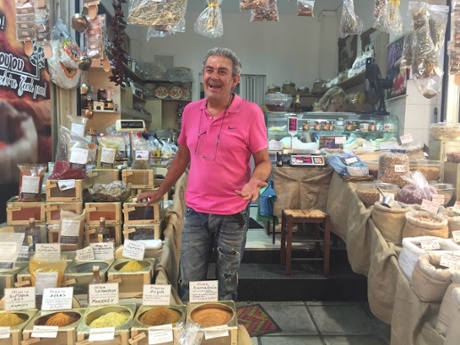
As a no-voter, does he feel betrayed by Alexis Tsipras? The prime minister has agreed to more austerity, despite a mandate for the opposite from the electorate. “No way,” says Voutas, arguing Tsipras tried his best against an intransigent Europe. “The Europeans aren’t capable of surprising us with something good.”
But austerity doesn’t really make any sense, Voutas adds. “Would these European countries like their money back?” he asks. “In order to find the money to pay them we need investment and economic development – but when will we see all this?”
Here is the Associated Press take on the German finance minister’s tough comments as he arrived for the Eurogroup meeting:
Wolfgang Schäuble, Germany’s finance minister, warned that that Saturday’s meeting of the eurozone’s 19 finance ministers over Greece’s bailout request was going to be tough.
Schaeuble, who has taken a hard line on Greece over recent months, says the Greek government will have to do a lot more than just say it wants to reform if it’s going to get the three-year bailout it requested for earlier this week.
“We will definitely not be able to rely on promises,” he said when arriving at the talks in Brussels.
Schaeuble put the blame for the current crisis firmly on the shoulders of the radical left Syriza government that was elected in January. The “hopeful” situation regarding Greece at the end of last year has been “destroyed by the last months,” he said.
Schaeuble said Saturday’s discussions would be “extraordinarily difficult.”
Updated
Finance ministers point to progress, but trust is a problem
So the tone from finance ministers going into the meeting was that the Greeks have made some progress with their latest proposals, but can they be trusted to implement what they have promised?
Given that the Greek government called its referendum and advised voting against the proposals which were then on the table, only to put forward broadly similar plans a few days later, you can understand the scepticism.
It almost seemed that if Alexis Tsipras received a euro for every time the word “trust” was mentioned, Greece’s financial problems would be over immediately.
Germany’s Wolfgang Schäuble of course put it most bluntly, saying trust had been destroyed “in an incredible manner.”
But there were plenty of officials trying to keep an open mind, clearly aware that pushing Greece over the brink would be an irreversible step.
There were even suggestions that the thorny issue of debt relief was up for discussion, even if reaching an agreement would seem rather unlikely.
Still, with the institutions (the EU, ECB and IMF) sounding cautiously positive about the Greek proposals, albeit with some reservations, there is at least the basis for discussion.
Updated
And they’re off.
#Eurogroup in session.
— Alexander Stubb (@alexstubb) July 11, 2015
(Just when we thought Finland’s finance minister was being uncommunicative)
Spain’s Luis de Guindos said he hoped Greece would not leave the eurozone:
Spanish FinMin Luis de Guindos: Everyone wants #Greece to stay in €, but we need to discuss institutions' assessment of Greek proposals.
— Open Europe (@OpenEurope) July 11, 2015
Spain's de Guindos: Credibility is very low, so we will we see. And I hope Grexit will not take place.
— Mathieu von Rohr (@mathieuvonrohr) July 11, 2015
Guindos: Greek proposal just a list of prior actions. New Memorandum will have to be prepared if negotiations go ahead. #Greece
— Open Europe (@OpenEurope) July 11, 2015
Not ready to accept calculations that are not believable -Schäuble
And here is German finance minister Wolfgang Schäuble:
#greece @schaeuble 'extraordinarily difficult negotiations' lie ahead
— Ian Traynor (@traynorbrussels) July 11, 2015
Schäuble: We are not ready to accept calculations that are not believable
— Mathieu von Rohr (@mathieuvonrohr) July 11, 2015
German FinMin Schäuble: Greek Financing Gaps Now Go Beyond Anything Talked About in Past. (DJ)
— Holger Zschaepitz (@Schuldensuehner) July 11, 2015
SCHAEUBLE: KNOW FROM TREATIES THAT DEBT RELIEF IS NOT POSSIBLE
— zerohedge (@zerohedge) July 11, 2015
In a broadside at the Greeks he said we cannot only rely on promises. Trust has been destroyed over the past months in an incredible manner.

Updated
Pierre Gramegna, finance minister of Luxembourg which currently holds the EU presidency, said he was “in a lighter heart than two days ago.”
We have proposals on the table, which are comprehensive.
What can Greece do about the lack of trust?
It is important to find out about the concrete steps [which will be taken] and how they are prepared to translate that into legislative initiatives which can be voted for in parliament. Draft bills, the prospect of a vote will build confidence.
On debt:
We are prepared to discuss debt restructuring today, whether we all agree is another matter.

Updated
He said the Greek proposals were enough for a second bailout programme but not a third.
Slovakia’s Peter Kazimir sees debt sustainability as “a huge problem’.
Slovak FinMin Kazimir: I see huge problem w/ debt sustainability analysis. We'll see what institutions will bring to table. #Greece
— Open Europe (@OpenEurope) July 11, 2015
It will be difficult, can Greeks be trusted, says Dijsselbloem
It’s going to be a difficult meeting, says Eurogroup president Jeroen Dijsselbloem.
We are not there yet, there is still some criticisms of the proposals, on the fiscal front and the reforms.
But there is the issue of trust. Can the Greek government be trusted to do what they are proposing.
How can they prove trust?
They’ll have to listen to the institutions and show their commitment to implementing [the proposals]

Updated
And speaking of France.
French finance minister Michel Sapin said there were two positive signs, that the Greek government had shown courage and determination in presenting its proposals to parliament, and secondly that the institutions see them as a good basis for discussions.
#greece #eurogroup france's sapin sees plenty of positives, tsipras brave to put his plan to parlt
— Ian Traynor (@traynorbrussels) July 11, 2015
#greece #eurogroup france wants a 'global and durable' deal - sapin
— Ian Traynor (@traynorbrussels) July 11, 2015
Sapin: Eurogroup needs to show that, if trust is there, we're capable of offering support. #Greece
— Open Europe (@OpenEurope) July 11, 2015
He added that the topic of debt was not taboo: “We have the right to talk about debt.”
#greece #eurogroup no tabus on debt rescheduling, but haircuts are a red line for some - sapin
— Ian Traynor (@traynorbrussels) July 11, 2015

Updated
Meanwhile the conciliatory tone by France, which helped with the Greek proposals, continues. Reuters reports:
A bailout package for Greece needs to include a reduction in the country’s debt burden, French Economy Minister Emmanuel Macron told German daily Die Welt in an interview published on Saturday.
The German government has resisted a restructuring of Greece’s debts... but Macron insisted the burden must be eased.
“It is necessary to reduce the debt burden so that the Greek economy does not go under,” he told Die Welt.
Outlining the path to solving the Greek problem, Macron said structural reforms needed to be deepened, adding: “More competition doesn’t mean saving more!”
Investment was also essential to supporting growth in Greece, said.
“Not to try everything possible to keep Greece in the euro zone would be to accept a step backwards in Europe,” Macron said.
Italian finance minister Pier Carlo Padoan said:
The purpose of the meeting is to kick off negotiations on [an] ESM [bailout].
We are all here with open minds.
It is the beginning of negotiations, not about striking a deal tonight.
Malta’s finance minister Edward Scicluna said the Greek issue has to be solved today, but he summed up the mood:
There are some who are very sceptical, some less so.
This doesn’t sound particularly helpful:
New agreement with #Greece "will be worse than the previous one", says Spain's PM Mariano Rajoy #Grecia
— María Tejero Martín (@Maria_Tejero) July 11, 2015
It’s hard to call how things will go at the Eurogroup meeting, with much talk from the arriving officials of progress being made, but also many calls for the Greek government to actually implement whatever may be agreed.
It's becoming clear the main issue today are not the Greek proposals themselves but lack of trust in the Greek government. #Eurogroup
— Mathieu von Rohr (@mathieuvonrohr) July 11, 2015
Alexander Stubb, the Finnish finance minister who has taken to tweeting developments, has not been so forthcoming today:
Stubb. No doorstep. Fishy.
— Yannis Koutsomitis (@YanniKouts) July 11, 2015
No doorstep declaration from Finnish Finance Minister Stubb, who's usually quite talkative. #Greece
— Open Europe (@OpenEurope) July 11, 2015
Updated
More from Noonan’s comments, courtesy of Open Europe:
Irish FinMin Noonan: Number of issues I need more information about. Greek proposal silent on banks. #Greece
— Open Europe (@OpenEurope) July 11, 2015
Noonan: Sustainability of programme depends a lot on whether programme is sufficient to cause Greek economy to grow. #Greece
— Open Europe (@OpenEurope) July 11, 2015
Noonan: I think extra measures probably needed there. More supply-side initiatives needed which effectively means a lot of reforms. #Greece
— Open Europe (@OpenEurope) July 11, 2015
Noonan explains any Irish liability under new ESM programme for #Greece "wouldn't have immediate budget effect".
— Open Europe (@OpenEurope) July 11, 2015
Noonan: It would have been better if what's happening now had happened in February. A lot of damage done in the meantime. #Greece
— Open Europe (@OpenEurope) July 11, 2015
Irish finance minister Michael Noonan said Greece must get on with implementing agreed proposals:
It is hard to deliver if your parliamentary majority diminishes.
While they have a majority I believe they should move to carry out the legislative changes.
[Presumably a reference to those Greek MPs who did not support the proposals in the earlier vote]

Updated
EU commissioner Valdis Dombrovskis sounds more positive:
We are clearly making progress. The Greek government proposal is pretty much along the lines of what the institutions proposal was before the referendum.
There is a willingness on the Greek side to reach an agreement.
[But] there are still many issues and many concerns of the member states to be addressed.
Today we are discussing giving a mandate to [the EU, ECB and IMF] to start negotiations about an ESM programme.
Greek plan is weaker than it should be - Dutch finance minister
Dutch finance minister Eric Wiebes is taking a fairly tough line:
The Greeks have clearly made a step forward.
At the same time the institutions have been critical.. the plan is weaker in some areas than it should be.
Their suggestion is we can only start negotiations when these conditions are filled in.
Many governments including my own [are worried about] implementation.
We are discussing a proposal that was rejected [in the referendum].
Clearly there has to be a step made towards restoring trust.
What if there is no agreement tonight?
That is up to the Greek government.

Updated
More from Schelling:
Austrian FinMin Schelling answers "yes and no" if there is progress. "Details are missing".
— Mathieu von Rohr (@mathieuvonrohr) July 11, 2015
Austrian FinMin Schelling: "Which guarantees can Greece give they are actually going to implement what they propose?"
— Mathieu von Rohr (@mathieuvonrohr) July 11, 2015
Austrian FinMin Schelling says 72 billion program needed
— Mathieu von Rohr (@mathieuvonrohr) July 11, 2015
Austrian FinMin Schelling says Greek parliament should legislate on prior actions within 14 days. #eurogroup
— Mathieu von Rohr (@mathieuvonrohr) July 11, 2015
And again, the emphasis on implementation, this time from Austria’s Schelling (almost as if the finance ministers do not trust the Greeks to do what they say.)
#Austria FinMin Schelling: It is certainly a positive surprise from #Greece. Missing are guarantees from the Greeks that they will implement
— Yannis Koutsomitis (@YanniKouts) July 11, 2015
Wonderful graffiti in the background for Eurogroup arrivals pic.twitter.com/W3shZui6h5
— Danny Kemp (@dannyctkemp) July 11, 2015
(and in the foreground Austrian finance minister Hans Jörg Schelling).
French FinMin Sapin to meet #Greece's counterpart Tsakalotos before #Eurogroup, BBG reports citing Figaro.
— Holger Zschaepitz (@Schuldensuehner) July 11, 2015
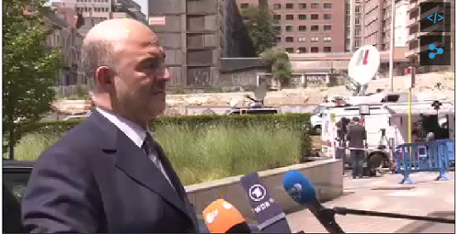
Here’s a video of EU economics commissioner Pierre Moscovici arriving for the Eurogroup meeting (in French):
EU Economics Commissioner Pierre Moscovici said the Greek government had made a significant gesture but it needed to implement reforms:
EU Economics Commissioner @pierremoscovici: Important day for Eurozone and Europe. Greek gov't has made important gestures. #Greece
— Open Europe (@OpenEurope) July 11, 2015
Moscovici doorstep: Institutions believe new Greek proposal can be basis for negotiations, implementation will be key. #Greece
— Open Europe (@OpenEurope) July 11, 2015
Updated
IMF managing director Christine Lagarde said, “We are here to make a lot more progress.”

Updated
And the finance ministers are starting to arrive. Here is Greece’s Euclid Tsakalotos, keeping his own counsel:

Updated
If you haven’t yet seen the piece on Alexis Tsipras and Syriza from our economics editor Larry Elliott, it’s well worth a read (spoiler: he says untold damage has been caused to the Greek economy for no purpose whatsoever):
Cabinet reshuffle for Tsipras next week?
The lack of support from some members of his partly for Alexis Tsipras’ proposals in last night’s vote could have repercussions, according to Niki Kitsantonis of Greek newspaper Kathimerini:
After crisis mtg at 5am following Syriza defections, @tsipras_eu expected to reshuffle cabinet nxt week. Rumblings of elex in fall
— NikiKitsantonis (@NikiKitsantonis) July 11, 2015
Updated
And the chances of a deal seem to be getting worse by the minute:
50-50 chance of Greek bailout deal, sources say ahead of #Eurogroup. (dpa)
— Holger Zschaepitz (@Schuldensuehner) July 11, 2015
In Thessaloniki, many Greeks appear resigned to further austerity even though theyi voted against that very thing in last Sunday’s referendum. Patrick Kingsley reports:
Clara Sklavounou, a toy-shop owner in central Thessaloniki, might have reason to feel let down. Sklavounou voted no in last week’s referendum – “no to austerity”, she says – and yet a week later her parliament has agreed to a deal that many feel is just as austere as what she said no to.
“But I don’t feel betrayed,” says Sklavounou, reiterating her backing for Alexis Tsipras. “He tried to find a viable solution but he couldn’t do anything else, and I hope he stays in government to try to do some of what he set out to do.”
Outside her shop there stands a life-size Playmobil pirate. Inside, though, the big, pricier brands like Playmobil and Lego aren’t shifting. And despite the sales of up to 80% in this shopping district, the footfall in her shop is less than half of what she’d expect for the sales season. The new deal, if it becomes the basis of a new bailout, will make matters worse – raising corporation tax, and making her pay it in advance.
“But what else can we do?” says Sklavanou. “I said no to austerity – not no to the EU.”
This sense of resignation is mirrored by shoppers at AB Vasilopoulos, a well-known supermarket chain down the road. Customers here face a price-hike for food if the deal goes ahead, with VAT on food set to rise to 23%. At the moment, says 50-year-old Fotini Toli as she leaves with a clutch of groceries, “I’m only buying the things that I need to buy, and nothing extra. I don’t know what will happen now.”
But like Sklavounou, Toli is resigned to further austerity. “We have to choose between the bad and the worse,” she says. “And so we have to prefer the bad.”

Hold the optimism.
Reuters is reporting two sources saying they are not so sure a deal will be done.
With the officials in the Euro Working Group meeting ahead of the gathering of finance ministers, a Reuters source who said late on Friday he was almost sure an agreement would be reached appeared to have had second thoughts:
The high figures for financing needs over the next three years may be too high and too sudden.
The second source told Reuters he put the chances of reaching an agreement which would allow talks to begin at 60-40.
Our Europe editor Ian Traynor says if a deal is to be done, there needs to be a lot of negotiation, and Alexis Tsipras may end up with tougher demands from the troika (the EU, IMF and ECB) than his predecessors:
#greece 3-page troika paper backs tsipras plan, with ifs and buts...http://t.co/flRjFRqGZR
— Ian Traynor (@traynorbrussels) July 11, 2015
#greece troika insists on right to co-author tsipras reform bills before they go to parliament #hmm http://t.co/flRjFRqGZR
— Ian Traynor (@traynorbrussels) July 11, 2015
#greece if this flies, @atsipras may end up with tougher troika than predecessors. the price of mistrust
— Ian Traynor (@traynorbrussels) July 11, 2015
#greece caveats in troika paper such that if eurogroup's gonna nail this, it will have to be a long night, a very big negotiation
— Ian Traynor (@traynorbrussels) July 11, 2015
Sky’s Ed Conway confirms that the proposals appear to be the basis for talks:
EU sources say Greek proposals approved in Parl last night are a basis for negotiating a new programme. But won't be easy...
— Ed Conway (@EdConwaySky) July 11, 2015
But he adds:
EU source: Will be tough meeting. Much scepticism among member states. Mistrust & lack of confidence in Greeks after so many wasted months
— Ed Conway (@EdConwaySky) July 11, 2015
Yanis Varoufakis, the former Greek finance minister, continues to make waves. In a piece for the Guardian he has attacked eurozone policies towards Greece and said German finance minister Wolfgang Schäuble wanted the country out of the eurozone:
Schäuble is convinced that as things stand, he needs a Grexit to clear the air, one way or another...
Based on months of negotiation, my conviction is that the German finance minister wants Greece to be pushed out of the single currency to put the fear of God into the French and have them accept his model of a disciplinarian eurozone.
The full piece is here:
And here’s one interesting reaction:
If Varoufakis thinks (rightly, imo) that Schauble wants Grexit, why did he think Greece could use the threat of Grexit to get concessions?
— Keith Frankish (@keithfrankish) July 11, 2015
Which has prompted a response from the man himself:
@keithfrankish I did not. In fact I steadfastly refused to bluff, threaten or strategise. http://t.co/CAHwnx4HoH
— Yanis Varoufakis (@yanisvaroufakis) July 11, 2015
Merkel and Schäuble split on Greece, says Bild
Here’s the Bild story (in German).
The key part suggests German chancellor Angela Merkel wants an agreement but finance minister Schäuble “believes Athen’s plans are insufficient and is against further talks.”
This is not the first time, of course, that talk of a rift between Merkel and Schäuble has emerged.

Updated
The outcome of the day’s Eurogroup meeting is completely open, according to a German finance ministry spokesman.
According to Reuters, Frank Paul Weber refused to comment on a story in Germany’s Bild that finance minister Wolfgang Schäuble thought the Greek proposals were inadequate and he opposed further talks. Weber said:
The minister this afternoon will discuss with his eurozone colleagues the assessment of the institutions. The result of the discussion is completely open.
Greece may need up to €84bn - reports
There is growing talk that Greece will need more that the €53bn package it is asking for:|
#Eurogroup Working Group meeting underway ahead of Eurogroup due at 3pm (CET). #Greece 3rd aid package seen at €78-84 bln (via @amna_news)
— Manos Giakoumis (@ManosGiakoumis) July 11, 2015
And the Wall Street Journal has reported:
Greece will need €74 billion ($82.55 billion) in fresh funding, the three institutions overseeing the eurozone bailout program said in their assessment of the country’s request for a new aid package, according to three European officials.
The €74 billion could include €16 billion from the International Monetary Fund, should the Washington-based institution decide to participate in the new aid program, the officials said. A fourth official said some funding could come from Greece raising money on debt markets.
Updated
Not everyone in Greece is overjoyed about the new proposals, of course, especially given that Sunday’s referendum - was it really less than a week ago - had rejected something very similar. Here’s some pictures from yesterday’s rallies as parliament voted:


Greek proposals well received but more steps needed - report
German newspaper Frankfurter Allgemeine is also reporting that the Greek proposals have been well received by the institutions, and are a basis for discussion but further steps may be needed (full story here in German).
The EU, IMF and ECB are “cautiously positive”, says the report but they want any new bailout programme to contain “structural benchmarks, milestones and quantitative benchmarks” for the future
And the reforms are not enough to meet primary budget surplus targets given the “significant deterioration in macroeconomic and financial conditions.”
.@FAZ_Politik got #Troika's #Greece proposals response:good basis, bt more measures needed for gap created by #Syriza http://t.co/NTvcur3qwo
— Bojan Pancevski (@bopanc) July 11, 2015
Updated
The Eurogroup has now listed the press conference following the meeting for 22.00 Brussels time (21.00 BST).
That seems to indicate a long meeting. A good sign?
As a reminder, here’s what is in the latest Greek proposals, and how they differ from what has gone before:
And on Sunday there is a meeting of eurozone leaders and a separate gathering of the whole European Union.
If there is an agreement today to start loan talks, Sunday’s summit could well be cancelled although leaders may still want to hear more from Alexis Tsipras about his proposals in the wake of the turbulent events of the last few days.
However if there is no sign of a possible deal, then the summit is likely to be dedicated to coping with Greece’s removal from the single currency. Here is the formal agenda for Sunday’s get-together:
Following up the special Euro Summit on Greece on 7 July, EU leaders will meet again on Sunday 12 July to take stock of the situation and set out the political guidelines for the next steps.
On 7 July, leaders from the euro area member states discussed the situation in Greece following the referendum held on 5 July. President Donald Tusk confirmed that the euro area authorities were ready to do all that is necessary to ensure financial stability in the euro area.
What next?
This is the way the day ahead is looking.
Advisers to the finance ministers were due to begin a meeting of the Euro Working Group at 8.00 GMT (9.00 BST) to discuss the Greek proposals.
They will pass on their views to the ministers before the Eurogroup meets at 13.00 GMT (14.00 BST). A reminder of the agenda of the Eurogroup:
The Eurogroup will discuss the recent request by the Greek authorities for financial assistance from the European Stability Mechanism (ESM) and their new proposals for a reform agenda.
The European Commission, the European Central Bank (ECB), and the International Monetary Fund (IMF) will present their assessment of risk to financial stability in the euro area, Greece’s financing needs and the sustainability of its public debt.
Based on this assessment ministers will exchange views on whether there is a sufficient basis to start formal negotiations on a new financial assistance programme for Greece.
ESM financial assistance programmes are negotiated by the Commission, in liaison with the ECB, on the basis of a mandate by the Eurogroup. When possible, active participation of the IMF is sought.
The Eurogroup has confirmed it has received the initial assessment by the institutions - the EU, IMF and ECB - via the spokesman for Eurogroup president Jeroen Dijsselbloem.
Assessment of institutions under Article 13 of the ESM Treaty and initial review of the Greek proposals received bij #Eurogroup, meeting 3pm
— Michel Reijns (@MichelReijns) July 11, 2015
More details on the reasons for optimism.
The European Commission, the European Central Bank and the International Monetary Fund have said the Greek proposals are a basis for negotiation, Reuters is reporting.
An unnamed EU official is quoted by the agency as saying:
The three institutions have made a first joint assessment of the Greek reform proposals submitted Thursday night. Under certain conditions, they jointly see the proposals as a basis for negotiating an ESM [bailout fund] programme. This assessment was sent to the Eurogroup president last night.
Updated
Introduction: Eurogroup meets amid signs of optimism
Good morning and welcome to what is one of the most crucial weekends since the eurozone crisis began more than five years ago.
Finance ministers from the 19 members of the single currency will meet in Brussels later to discuss whether the latest set of Greek proposals are enough to start negotiations on a desperately needed third bailout for the beleaguered country.
If they cannot agree, that could be the beginning of the end for Greece as a member of the eurozone, with a summit of EU leaders on Sunday likely to discuss the impact of such a move and how they can deal with the fallout. In that case the European Central Bank would be unlikely to offer any more assistance to Greek banks - which are still shut at the moment - and the country could be plunged into further chaos.
Greek prime minister Alexis Tsipras has proposed €13bn of austerity cuts in return for €53bn over three years, a plan which effectively amounts to a U-turn after last week’s No vote in the hastily called referendum rejected a pretty similar deal.
But late last night Tsipras managed to get the backing of the Greek parliament for his proposals, albeit not without some dissent.

After a tense debate 251 MPs out of 300 voted to give Tsipras, and finance minister Euclid Tsakalotos, the go-ahead to negotiate with the Eurogroup of finance ministers.
But two MPs from the governing Syriza party voted no, eight abstained and seven were absent, which could prove a problem for the getting any agreed measures through law at a later stage. Some in the eurozone, notably in Germany, doubt whether they can trust the Greek government to live up to its promises.
Even so, Tsipras claimed the backing of parliament gave his a strong mandate to complete negotiations with the country’s creditors towards a viable solution.
Here is our report by Ian Traynor and Graeme Wearden of the night’s drama:
And there are some signs that the measures may be enough to restart talks, with EU officials saying today there was a basis for negotiations.
Updated