
Closing summary: Finally, a deal
It’s all over in Brussels, and Eurozone leaders are heading home after what appears to be the longest summit in EU history.
So after more than 26 hours, we’re going to wrap this liveblog up and launch a new one.
Here’s the state of play:
Greece and the rest of the eurozone have finally reached an agreement that could lead to a third bailout and keep the country in the eurozone.
Greek PM Alexis Tsipras conceded to a further swathe of austerity measures and economic reforms after more than 16 hours of negotiations in Brussels. He has agreed to immediately pass laws to further reform the tax and pension system, liberalise the labour market, and open up closed professions. Sunday trading laws will be relaxed, and even milk producers and bakers will be deregulated.
The Financial Times has dubbed it:
the most intrusive economic supervision programme ever mounted in the EU.
Greece was forced to accept these measures after Germany piled intense pressure, as a price for a new deal. EU officials told us that Tsipras was subjected to “mental waterboarding” in closed-door meetings with Angela Merkel, Donald Tusk and Francois Hollande.
The plan must now be approved by the Athens parliament by Wednesday, and then voted through various national parliaments. If agreement is reached, talks can then begin towards a a new three-year bailout worth up to €86bn (£61bn), accompanied by further monitoring by Greece’s creditors.
The deal appears to end Greece’s five-month battle with its creditors, which has gripped the eurozone, dominated the political agenda and alarmed the markets.
Emerging from the summit, Tsipras admitted it had been tough - but insisted he had won concessions on debt relief (sometime in the future) as well as the medium-term funding plan.
He also managed to persuade the eurozone that a new investment fund, that will manage and sell off €50bn Greek assets, would be based in Athens not Luxembourg.
But generally, Tsipras appears to have finally capitulated in the face of threats that Greece would be ejected from the eurozone.
Two separate people who saw Tsipras last night described him as a "beaten dog" http://t.co/aFBx7nPWpZ pic.twitter.com/NtQGjPahIP
— Joseph Weisenthal (@TheStalwart) July 13, 2015
Attention now turns to Athens, where Tsipras will arrive home to swirling speculation of cabinet reshuffles, unity governments and even fresh elections.
To catch up with the action, visit our new liveblog here:
Updated
Stock markets around Europe have welcomed the tentative deal reached in Brussels this morning.
The eurozone’s blue-chip Euro STOXX 50 index hit a two-week high in morning trading and is currently up around 2%. Banking stocks in particular are benefiting from the relief rally and the eurozone banking index is up 2.7%.
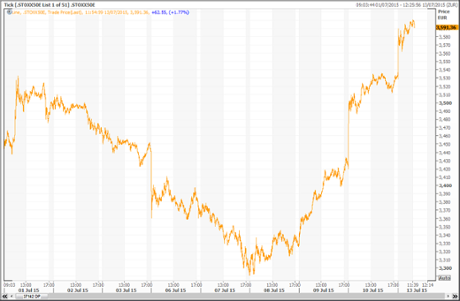
Individual country bourses are also higher:
- Germany’s DAX is up 1.7%
- France’s CAC 40 is up 2.2%
- UK’s FTSE 100 is up 0.7%
On bond markets, the yields on those bonds seen as most vulnerable to a Greek exit from the euro fell back on relief the crisis could be nearing resolution. The yields on the 10-years bonds of Italy, Spain and Portugal all fell back.
On foreign exchange markets, the euro initially rallied against other major currencies before easing back as traders looked beyond intitial positive headlines out of Brussels and considered the hurdles still to come this week. The single currency is now down around 0.7% against the dollar at $1.108 and 1.2% against the pound at 71.120 pence.
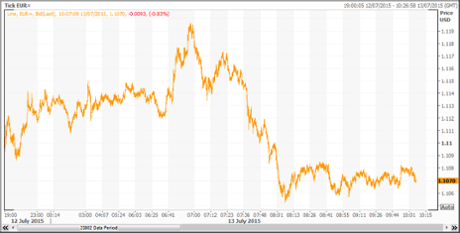
Analysts warn there are plenty of potential stumbling blocks ahead this week to unsettle markets.
Ruben Segura-Cayuel, Europe economist at Bank of America Merrill Lynch comments:
“We argued last week that likely Grexit would be avoided this weekend. And at this time ... it looks like it will be avoided, but the days ahead are full of opportunities for it to materialise. We remain in the path of Grexit and everything needs to go perfect to avoid it. We likely need a cabinet reshuffle in Greece. Then the Greek government needs to pass seven packages before Wednesday just to open the door to start negotiations for a new programme. It also needs to propose more reforms in several fronts. After all this happens, then talks about a new (third) package can start, assuming other national parliaments agree to do so...
We still think there is room for a positive resolution, but even the best case scenario is a deal with many conditions and very gradual disbursements, which will have substantial implementation risks because of no ownership.”

Italy’s prime minister Matteo Renzi told at a press conference in Brussels that there were moments during the marathon talks when he would have bet that negotiations would fail.
“But today instead we have taken a decisive stop forward.”
“At many moments, a deal could not be taken for granted. We should not toast triumphantly about it, nor should we diminish it,” he said, adding that there was still much work left to be done.
He denied that Germany “alone” was in charge of Europe. While he acknowledged that the Germans had a “different approach”, he said it was one he respected because it represented the will of a democratically elected government and that the overnight talks has been a “real discussion”.
Renzi also acknowledged that he supported keeping the fund that will hold Greek assets in Athens, not Luxembourg, saying that such a move would have been “a humiliation”.
[going into the talks, the Italian PM declared that he would tell Germany that “enough is enough”]
And he added that Italy’s moment of crisis - despite still having high debt levels - was behind it.
“Italy is part of the solution and not the problem.”
Updated
Just read the body language:


Updated
Alexis Tsipras has even agreed to consider reversing some of the measures his government has taken this year:
this section of Eurosummit statement is especially humiliating for Syriza pic.twitter.com/yjxEuTTki3
— econhedge (@econhedge) July 13, 2015
Does that mean that the Athens cleaning ladies, who were famously rehired after protesting their dismissals, will be laid off again?
The new measures Greece must now implement
The final Euro Summit statement confirms that Greece has agreed to immediately implement sweeping measures, after a bruising battle in Brussels:
This includes pension reforms, liberalising its economy (from Sunday opening hours to opening up closed professions), privatising its energy transmission network, reforming its labour market practices (including new rules on industrial action, and collective dismissals), and action on non-performing loans:
That is on top of the austerity its MPs agreed on Friday:
Here are the key points:
- carry out ambitious pension reforms and specify policies to fully compensate for the fiscal impact of the Constitutional Court ruling on the 2012 pension reform and to implement the zero deficit clause or mutually agreeable alternative measures by October 2015;
- adopt more ambitious product market reforms with a clear timetable for implementation of all OECD toolkit I recommendations, including Sunday trade, sales periods, pharmacy ownership, milk and bakeries, except over-the-counter pharmaceutical products, which will be implemented in a next step, as well as for the opening of macro-critical closed professions (e.g. ferry transportation). On the follow-up of the OECD toolkit-II, manufacturing needs to be included in the prior action;
- on energy markets, proceed with the privatisation of the electricity transmission network operator (ADMIE), unless replacement measures can be found that have equivalent effect on competition, as agreed by the Institutions;
- on labour markets, undertake rigorous reviews and modernisation of collective bargaining, industrial action and, in line with the relevant EU directive and best practice, collective dismissals, along the timetable and the approach agreed with the Institutions. On the basis of these reviews, labour market policies should be aligned with international and European best practices, and should not involve a return to past policy settings which are not compatible with the goals of promoting sustainable and inclusive growth;
- adopt the necessary steps to strengthen the financial sector, including decisive action on non-performing loans and measures to strengthen governance of the HFSF and the banks, in particular by eliminating any possibility for political interference especially in appointment processes.
And on top of that, Greece will also establish a new fund to sell off valuable assets to help repay its new bailout, and refinance its banks.
Or as the statement put it:
- develop a significantly scaled up privatisation programme with improved governance; valuable Greek assets will be transferred to an independent fund that will monetize the assets through privatisations and other means. The monetization of the assets will be one source to make the scheduled repayment of the new loan of ESM and generate over the life of the new loan a targeted total of €50bn of which €25bn will be used for the repayment of recapitalization of banks and other assets and 50% of every remaining euro (i.e. 50% of €25bn) will be used for decreasing the debt to GDP ratio and the remaining 50% will be used for investments.
Updated
The official statement has just been released:
NOW ONLINE: #EUROSUMMIT STATEMENT (PDF) http://t.co/dfwTY1uCxr #GREECE
— EU Council Press (@EUCouncilPress) July 13, 2015
Analyst: It's Merkel 1, Tsipras 0
Demetrios Efstathiou of ICBC Standard Bank says that Greece has been comprehensively routed by Germany in Brussels this weekend:
- Tsipras had to concede on almost every point.
- Merkel comes out as a winner, and should be able to get the deal though the German parliament.
- Germany’s extremely tough position would serve as a warning to other Eurozone nations. There are arguments that she even pushed too far.
- Varoufakis may have gambled, Tsipras and Syriza may have lost, but Greece may be the ultimate winner - Greece has a golden opportunity to implement in record time the drastic reforms that it desperately needed and which successive governments have been unwilling to commit to.
- The formation of a national unity or special purpose government to pass the reforms in the tight time-frame is now required. Elections would have to follow at a later stage.
- The debate will now move on to the reaction of the Greek people. There is no easy answer. Only time will tell. The way I see it is that the Greek people will be relieved to see their banks reopen, their pensions and savings to be still denominated in euros, and the tourist season not destroyed. They should also be celebrating the implementation of structural reforms, but I doubt that.
- Greece must now push through parliament, by Wednesday, July 15th, a series of legislations that include the streamlining of the VAT system, and pension measures.
#Tsipras gov't has to pass 4 bills by Wed & another 2 by July 22, which is probably more than its legislated since Jan election win #Greece
— Nick Malkoutzis (@NickMalkoutzis) July 13, 2015
The FT’s Peter Spiegel is tweeting key points from the deal:
Just got leaked version of final #Greece agreement. Here's the language on then new €50bn fund. pic.twitter.com/H0g4ib1G5W
— Peter Spiegel (@SpiegelPeter) July 13, 2015
Here's amt of #Greece bridge financing still to be decided by #eurogroup: €7bn by Mon, €5bn by Aug. pic.twitter.com/foIPvqD8yw
— Peter Spiegel (@SpiegelPeter) July 13, 2015
Remember debt relief? We'll get to that later. Much later. #Greece pic.twitter.com/2J0egaLCRI
— Peter Spiegel (@SpiegelPeter) July 13, 2015
Alexis Tsipras appears to have failed to prevent the IMF being involved in Greece, as part of this new bailout.
IMF, still there in 2016 pic.twitter.com/heXVP8V2lm
— Pablo Rodríguez (@Suanzes) July 13, 2015
Updated
The ball, it appears, is still in the Greek court:
#EuroSummit statement: "The risks of not concluding swiftly the negotiations remain fully with Greece."
— Jennifer Rankin (@JenniferMerode) July 13, 2015
Eurozone finance minister are due to convene again in a few hours, after their emergency meeting on Saturday night, and Sunday morning.
On the agenda: finding bridge financing to tide Greece through the summer while this third bailout is agreed.
#Greece needs €7bn by 20 July and €5bn by mid August...main issue for #eurogroup meeting starting... in 4 hrs or so.
— Jennifer Rankin (@JenniferMerode) July 13, 2015
Striking how confident EU leaders are sounding about ratification in #Greece and national parliaments.
— Jennifer Rankin (@JenniferMerode) July 13, 2015
But even if Greek banks are able to reopen, there’s little hope of capital controls being lifted until a third bailout has actually been agree.
The political agreement reached in Brussels means the European Central Bank shouldn’t take the dramatic step of terminating the emergency liquidity provided to Greek banks.
It could even provide more, allowing Greek banks to reopen after two weeks.
ECB told that if gives extra €2bn of ELA, banks re-open tmrw - not as normal, €60 withdrawal limit to stay, but to provide other services
— Robert Peston (@Peston) July 13, 2015
Updated
Today’s bailout deal comes just eight days after the Greek people comprehensively rejected its creditors’ original demands.
Analyst Marc Ostwald of ADM Investor Services reckons the measures in this bailout package are “infinitesimally worse” than the ones turned down in last Sunday’s referendum:
Indeed what is on the table as a deal highlights that:
a) there is no long-term future for the Eurozone;
b) the desire on the part of Eurozone creditor nations to completely destroy the Greek economy - it can certainly be asserted that this is indeed a worse deal than the 1919 Treaty of Versailles.
In terms of a near-term timeline, he says:
- a) Tsipras will have to form a new government of national unity as soon as he gets back to Athens
- b) By Wednesday 15th, Greece will have to pass laws including simplifying VAT rates, and applying VAT on a wider basis, cutbacks on pensions, and making its statistics agency independent.
- c) Once these have been passed, ESM bail-out parliamentary process can commence, and this will require parliaments in Finland, Germany, Austria, Netherlands, Slovakia and Estonia to approve starting ESM talks
- d) The Greek parliament will then have to rush through further laws to attain brige financing to pay the ECB on July 20th.
Updated
The full details of the Greek agreement hasn’t been released yet (but it may leak soon).
But the draft statement in Brussels last night demanded that Greece must immediately take these steps:
- Streamlining VAT
- Broadening the tax base
- Sustainability of pension system
- Adopt a code of civil procedure
- Safeguarding of legal independence for Greece ELSTAT — the statistic office
- Full implementation of automatic spending cuts
- Meet bank recovery and resolution directive
So the next few days in Athens will be very intense, as MPs are asked to approve new measures on top of the austerity agreed to on Friday night.
Nigel Farage, the leader of Britain’s eurosceptic UKIP party, has said the Greek parliament should reject the agreement:
“If I were a Greek politician I would vote against this deal. If I were a Greek ‘no’ voter I would be protesting in the streets. Mr Tsipras’s position is now at stake.”
“This conditional deal shows that national democracy and membership of the eurozone are incompatible.”
(quotes via AP)
Last night, tens of thousands of social media users had similar thoughts, as they flocked to the #thisisacoup hashtag.

Here’s the full statement which a bleary-eyed Donald Tusk delivered this morning.
Good morning. Today, we had only one objective: to reach an agreement. After 17 hours of negotiations, we have finally reached it. One can say that we have ‘agreekment’. Leaders have agreed in principle that they are ready to start negotiations on an ESM programme, which in other words means continued support for Greece.
There are strict conditions to be met. The approval of several national parliaments, including the Greek parliament, is now needed for negotiations on an ESM programme to formally begin.
Nevertheless, the decision gives Greece a chance to get back on track with the support of European partners. It also avoids the social, economic and political consequences that a negative outcome would have brought. I welcome the progress and the constructive position of Greece that helps to bring back trust among euro zone partners.
Following national procedures, the Eurogroup will work with the Institutions to swiftly take forward the negotiations. Finance ministers will also as a matter of urgency discuss how to help Greece meet her financial needs in the short term, so-called bridge-financing.
I would like to thank the President of the Commission Jean-Claude Juncker and the Eurogroup President Jeroen Dijsselbloem for their dedication and involvement in this progress. Without your work, today’s agreement wouldn’t be possible. Thank you.
Malta’s finance minister tweets:
Deal on Greece is one small but very significant step forward for Greece and the Eurozone.
— Prof Edward Scicluna (@edward_scicluna) July 13, 2015
French president Francois Hollande has confirmed that the Greek agreement will include an eventual re-profiling of Greek debt by extending the maturities.
This was a landmark summit, he adds, and we were afraid we might not have kept Greece with us.
Hollande: At one point we feared that eurozone would lose one of its members, Greece
— Kathimerini English (@ekathimerini) July 13, 2015
Alexis Tsipras is heading away from Brussels, and straight into a political battle in Athens:
While the other eurozone leaders can go off for a snooze if they like, #Tsipras has to return to #Greece and pass 6 (?) reform bills by Wed
— Nick Malkoutzis (@NickMalkoutzis) July 13, 2015
tsipras prize for understatement: says implementation will be tough.
— Alison Smale (@asmalenyt) July 13, 2015
Alexis Tsipras also pledged to implement radical reforms to ensure the Greek oligarchy finally makes a fair contribution.
Tsipras: We fought hard abroad, we must now fight at home against vested interests #greece
— Kathimerini English (@ekathimerini) July 13, 2015
His key message is that he has battled hard for Greece, getting commitments on debt restructuring:
Tsipras referring to two 'wins' that weren't on table pre-referendum: debt relief reference and mid-term funding
— Ruadhán Mac Cormaic (@RuadhanIT) July 13, 2015
Tsipras: "The measures are recessionary, but we hope that putting Grexit to bed, means inward investment can begin to flow, negating them."
— Alex Andreou (@sturdyAlex) July 13, 2015
Tsipras defends bailout agreement
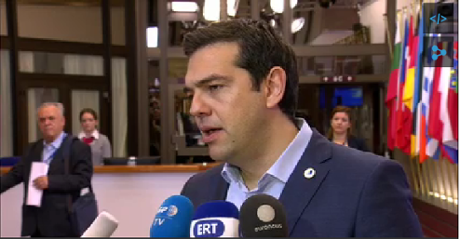
Alexis Tsipras has just spoken to the press, after a long night.
He defends the deal, saying he faces difficult decisions and tough dilemmas.
But this agreement will allow us to stand on our feet again.
He points out that he managed to persuade leaders not to place the new €50bn recapitalision fund in Luxembourgh (it will remain in Athens)
He tells reporters that he has also won medium-term funding for Greece, and eventual debt relief.
#Tsipras "Deal is difficult but we avoided transfer of assets abroad, plan for liquidity asphyxiation. Won mid-term funding & debt relief"
— MacroPolis (@MacroPolis_gr) July 13, 2015
And then Tsipras, accompanied by finance minister Euclid Tsakalotos and his negotiating team, exit the summit after a remarkable night - and embraces the French president en route.
On his way to his car, @atsipras gets a hug from @fhollande pic.twitter.com/2wRBUWDN5F
— Peter Spiegel (@SpiegelPeter) July 13, 2015
You can watch the action in Brussels here:
Relations between Berlin and Athens have deteriorated badly this year, but Angela Merkel also suggests that they can be restored.
Merkel: I think that trust can be regained #greece
— Kathimerini English (@ekathimerini) July 13, 2015
Merkel-"eurogroup is ready to grant longer grace period and longer loan maturities" a concession in favour of the Greeks (not a lot of these
— Richard Edgar (@ITVRichard) July 13, 2015
Interesting that Merkel finds no German phrase for the concept of "grace period;" uses the English.
— Melissa Eddy (@meddybln) July 13, 2015
What about debt relief?
Chancellor Merkel says that the eurogroup is ready to consider extending the maturity on Greek loans, but a “nominal haircut” is out of the question.
Listening to Merkel, it seems Greece has what it needed as minimum on debt relief: promise of discussions on restructuring (if not haircut)
— Ruadhán Mac Cormaic (@RuadhanIT) July 13, 2015
Updated
Merkel: No need for Plan B
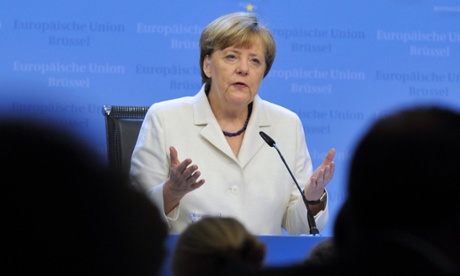
Angela Merkel is now giving a press conference too.
She tells reporters that there is no need for Plan B now.
So the threat of Grexit is off the table, even though a new bailout hasn’t been agreed yet (and that’s an important point).
Merkel says she can recommend “with full conviction” that the Bundestag should agree to open negotiations with Greece. But the Greek parliament must approve the entire conditions before the German parliament votes.
She confirms that a €50bn fund will be created, using Greek assets.
It will be a long and difficult road, she adds.
Updated
How does Brussels feel about being accused of launching a coup against Greece?
I said before the referendum that the situation would be worse after the referendum, Juncker replies, and it is.
This is a compromise, there are no winners and losers...
“It is a typical European arrangement”
Dijsselbloem says that talks on bridge financing for Greece will begin immediately, to help cover its debt repayments this summer.
Q: How will Tsipras possibly get these measures through parliament, given they are at odds with what Syriza promised when it was elected?
Juncker says he’s convinced that the Greek parliament can approve all the measures agreed today.
Updated
A lot of work will still have to be done says @J_Dijsselbloem. Reminder that today is agreement to have further talks.
— Jennifer Rankin (@JenniferMerode) July 13, 2015
Bridge financing is for #eurogroup. Commission to submit proposals today #Greece
— Jennifer Rankin (@JenniferMerode) July 13, 2015
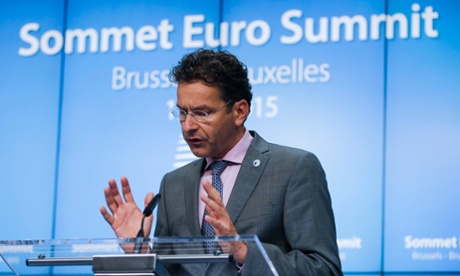
Eurogroup president Jeroen Dijsselbloem tells the press conference that €50bn of Greek assets will be transferred to a new fund.
That fund will contribute to the recapitalisation of Greek banks.
BUT! This fund will be based in Athens, not Luxembourg as originally planned.
Updated
Greek parl't will legislate on issues to bring back trust& #Greece assets to be transferred to fund,@J_Dijsselbloem pic.twitter.com/b8cWN36KF5
— Nathalie (@savaricas) July 13, 2015
Greek government must act immediately
Eurogroup president Jeroen Dijsselbloem says that the Greek parliament must immediately start passing legislation to implement the measures agreed in Brussels.
If Athens does that on Tuesday and Wednesday, then the Eurogroup can take a view on Wednesday, and then national parliaments can give their own approval for a third bailout.
Eurogroup call on wednesday says @J_Dijsselbloem, trigger for national parliaments to start process.
— Jennifer Rankin (@JenniferMerode) July 13, 2015
Then the firm negotiations can take place over a new bailout from the ESM (where the issue of debt sustainability can also be addressed)
Updated
There is no Grexit, says Commission president Jean-Claude Juncker.
Juncker "there is no Grexit"
— Richard Edgar (@ITVRichard) July 13, 2015
Tusk also welcomes Greece’s “constructive position”, which has helped restore trust.
Finance ministers will now start urgent talks on discussing bridge financing for Greece, says Tusk.
That’s because Greece must repay over €7bn to the ECB in July and August, before any bailout cash can be handed over.
And this deal includes “strict conditions”, Tusk warns.
Several national parliaments will need to give their approval, including the Greek parliament, says Tusk.
Strict conditions to be met are now needed for ESM prog to formally begin, says Tusk #GreeceCrisis
— Jennifer Rankin (@JenniferMerode) July 13, 2015
Tusk: We have an aGreekment
Today we had only one objective, to reach an agreement. And after 17 hours, we have it, says a tired looking EC president Tusk.
Some could say we have an aGreekment.
I think someone needs to go to bed!
The press conference is underway now. You can watch it here
Austria’s chancellor Walter Faymann has warned that it will be “very difficult” to implement this agreement, but it should be a positive result for Greek social cohesion.
IMF chief Christine Lagarde has said that the deal is a “good step to rebuild confidence”, according to Bloomberg TV.
#Euro jumps amid reports of deal at #EuroSummit. pic.twitter.com/zrB2qXcSQU /via @Schuldensuehner #Greece
— Yannis Koutsomitis (@YanniKouts) July 13, 2015
DEAL REACHED OVER THIRD GREEK BAILOUT
In the last few moments, eurozone leaders have agreed that negotiations should begin with Greece over a third bailout.
President Donald Tusk has tweeted the news himself:
EuroSummit has unanimously reached agreement. All ready to go for ESM programme for #Greece with serious reforms & financial support
— Donald Tusk (@eucopresident) July 13, 2015
We’ll get the details of the agreement soon, at a press conference in Brussels.
Updated
Malta’s prime minister has confirmed that EU leaders have hammered out an agreement on Greece.
Deal -JM #EuroSummit #Greece
— Joseph Muscat (@JosephMuscat_JM) July 13, 2015
So we may finally discover exactly what Alexis Tsipras has been forced to accept by Greece’s creditors.
- Has he managed to resist the IMF’s involvement in a third bailout?
- Has the eurozone dropped its demand that €50bn of Greek assets should be handed to an external fund?
- And will the final statement still include the controversial threat of a ‘time out’ from the eurozone?
Belgium’s prime minister Charles Michel has tweeted that a deal has been reached!
Agreement
— Charles Michel (@CharlesMichel) July 13, 2015
Deal in sight, finally?
Hold onto your hats, folks. There might just be a deal in Brussels, after probably the longest EU summit on record.
EU president Donald Tusk has just reconvened the EuroSummit with a “revised compromise proposal” on the table.
#greece there's a view abroad that it's a summit's longest single sitting, nudging 17hrs. we're truly blessed. or damned
— Ian Traynor (@traynorbrussels) July 13, 2015
Finland’s finance minister has woken up after a relaxing night’s sleep, to discover that the leaders’ meeting is still going on (frankly, I share his surprise. GW)
I wake up after a good to learn that #EUCO is still going on. Sympathies with all participants in and outside the room.
— Alexander Stubb (@alexstubb) July 13, 2015
Stubb is due back at the EC headquarters this afternoon, for yet another Eurogroup meeting. Surely the summit will be over by then?
I’ll shortly hand this blog back over to Graeme Wearden, who has had at least five minutes of sleep and will take you through the next who-knows-how-long of the summit.
As a parting post I’ll leave you with this - arguably the most notable achievement of the night.
Well, if nothing else has been achieved, at least they now hold the record for the longest summit ever. Well done, everyone! 🎉🎉🎉
— Jess Brammar (@jessbrammar) July 13, 2015
Updated
15 hours later, talks deliver ultimatum and more Greek resistance
If your head is spinning, either because you’ve just woken up to find the talks are still going, or because you have been up all night following the talks, here is an excellent rundown of where we are at.
Ian Traynor and Jennifer Rankin write:
A weekend of high tension that threatened to break Europe in two climaxed on Sunday at a summit of eurozone leaders in Brussels where the German chancellor, Angela Merkel, and the French president, François Hollande, presented Tsipras with an ultimatum.
The ultimatum - debated over more than 15 hours - entailed a series of draconian measures as the price of avoiding financial collapse and being ejected from the single currency bloc.
Tsipras acquiesced in most of the fiscal rigour demanded of him in four pages of summary instructions drafted by eurozone finance ministers.
But as Monday morning broke over Brussels, he was still resisting the creditors’ demands on two key points: on having the International Monetary Fund (IMF) involved in a proposed new three-year bailout, and on a controversial German demand for Greece to park €50bn (£36bn) in assets outside Greece, probably in Luxembourg, to serve as collateral for fresh loans and to provide privatisation proceeds to be used for debt servicing.
Fresh reports from the Guardian’s Ian Traynor on the continuing back and forth over the privatisation demands. Germany appears to be asking for more than others.
#greece #euco sources say several players dismissed 50bn figure, IMF spoke of 7bn, greeks of 17bn, yet germans insist on 50 or 'up to 50'
— Ian Traynor (@traynorbrussels) July 13, 2015
“Almost, almost” a deal
The Lithuanian President, Dalia Grybauskaitė, has now followed her Slovenian counterpart and left the summit.
CNBC is reporting its journalist asked if there was a deal.
“Almost, almost,” was the answer.
The Slovenian prime minister Miro Cerar has left the talks early, but will be represented in the Summit by Dutch PM Mark Rutte.
He tweets there is “one open issue left.” If earlier reports are correct that Tsipras has failed to have IMF supervision booted from the bailout offer, the last issue is likely to be the privatisation demand.
Leaving #EuroSummit early due to @jensstoltenberg visit in Sl. One open issue left. NL PM Rutte will represent SI. pic.twitter.com/ztv45YcaYc
— dr. Miro Cerar (@MiroCerar) July 13, 2015
Tsipras has failed in his attempt to have IMF supervision axed from any Greek plan, according to Olaf Gersemann, business editor of Die Welt & Welt am Sonntag, citing his own sources. This was one of two sticking points for Tsipras.
#Greece: #Tsipras fails to get rid of #IMF. Fund will remain involved, sources say. @welt @jandams @andretauber @MartinGreive
— Olaf Gersemann (@OlafGersemann) July 13, 2015
Updated
“Market reaction in the euro is surprisingly muted,” Steven Englander, global head of Group-of-10 currency strategy at Citigroup has told AFP.
“The absence of agreement and toughness of terms are eye-catching, but investors are waiting for the outcome more than trying to anticipate it.”
While we wait for any kind of movement in Brussels, a quick market update.
Asian markets rose Monday while the euro was marginally lower, AFP reports.
In Japanese trade the euro dipped but managed to stave off heavy losses as the talks continued in Brussels.
It eased to $1.1136 from $1.1149 in New York late Friday. In earlier electronic trading, the single currency fell as low as $1.1089. It was also at 136.40 yen compared with 136.58 yen in US trade.
Summary
For those just waking up, welcome. Yes it is a new day, but the talks are still going. Everyone in Brussels is envious of your rest.
The summit has just in the last half hour taken another intermission, this time for “final consultations” after an earlier sidelines discussion between Tsipras, Merkel, Hollande and Tusk emerged after four hours with a proposed compromise.
The earlier proposal on the table would force Greece to vote through sweeping changes by Wednesday night. Or, it would be offered a ‘temporary Grexit’; an opportunity to restructure its debts.
Few details were available about just what that compromise entails, but reports from Brussels say there were still two very large sticking points for Greece, namely that Greece wasn’t happy with the involvement of the IMF in the post 2016 package, and the demand for €50bn in asset sales, with proceeds held in another country, was far too high. Current understanding now is that the absolute maximum they could raise through privatisation is €17bn, and money should be kept in Athens.
The former acting director of the IMF’s European department was none too impressed with the first issue.
So Greece is against the involvement of the only institution that recognizes the country needs debt relief? The ways of the world.
— Alessandro Leipold (@ALeipold) July 13, 2015
Elsewhere, anger at the incredibly draconian demands being placed on Greece with this new bailout offer have sparked a social media campaign, #thisisacoup, against Germany and its finance minister Wolfgang Schäuble.
The campaign has been supported by many, including nobel laureate economist Paul Krugman, who lambasted the summit developments in his column at the New York Times.
Updated
Ian Traynor is suggesting an end is in sight. The summit has just taken another intermission, this time for “final consultations.”
#greece #euco seems about over. provided tsipras call to athens goes ok
— Ian Traynor (@traynorbrussels) July 13, 2015
#EuroSummit intermission for final consultations -JM
— Joseph Muscat (@JosephMuscat_JM) July 13, 2015
There are all kinds of reporting, but none so bad as waiting on the end of an 11 hour meeting, it seems.
Reality of covering #eurosummit which goes through the night pic.twitter.com/UD7SrhohoV
— Richard Quest (@richardquest) July 12, 2015
It's 05.00 in Brussels. Eurosummit started 11 hours ago. Eurogroup started 18 hours ago. My social life ended 2 months ago.
— Pablo Rodríguez (@Suanzes) July 13, 2015
Sleeping beauties #Eurogroup pic.twitter.com/C1SmIzzfx2
— Maria Aroni (@aronimar) July 13, 2015
Dawn. But no hope here at #EUCO pic.twitter.com/GMPNU97dve
— Bruno Waterfield (@BrunoBrussels) July 13, 2015
Despite Tusk’s claims of a compromise on the table, those two points mentioned earlier - IMF involvement in the Greece package and the privatisation fund - are increasingly looking like dealbreakers for Tsipras.
Greece wants the IMF to have a lesser role in the bailout package, and isn’t comfortable with the astronomical funds to be raised through privatisation and then held in Luxembourg. €17bn is the maximum it could raise, the Guardian’s Europe editor, Ian Traynor, reports.
Sources: Negotiation still tough, #Greece cannot accept IMF involvement in 3rd bail out and Trust fund up to 50 bln #EuroSummit
— Giovanna Pancheri (@giopank) July 13, 2015
#greece #euco greeks balking at €50bn or 'up to€50 bn' assets. say can't do more than 17bn. +legalism problem on stipulating IMF involvement
— Ian Traynor (@traynorbrussels) July 13, 2015
There are also many questioning the sense in a group of people, no matter their ranks or experience, making decisions like this at 5am after an all night meeting.
Asian markets calm enough, so what's the rush?
— Alessandro Leipold (@ALeipold) July 13, 2015
Updated
Like a dripping tap, we are getting a few more details on what happened in the four hour meeting between Tusk, Merkel, Hollande and Tsipras. Tusk emerged saying the summit would resume with a proposed compromise.
According to reporters on the ground in Brussels, there are two issues still to sort out, with some unconfirmed reports that they are IMF supervision after 2016 and the contentious €50bn privatisation fund.
If Tsipras has something to say at the end of tonight (if there is an end to tonight), this is where he'll say it pic.twitter.com/PHvC88kqYO
— Emily Purser (@EmilyPurser) July 13, 2015
Updated
Summit resumes with "compromise"
The summit has now properly resumed, with Tusk reportedly to propose a “compromise” after the private meeting.
#greece #euco tusk just regathering a stellar cast of leaders now with new bits of paper. he calls it a compromise
— Ian Traynor (@traynorbrussels) July 13, 2015
The Wall Street Journal begins this article with the Greek crisis in a nutshell.
A week ago, Greeks partied in the streets after voting to resoundingly reject terms of a new European bailout. On Sunday, those same streets were filled with a dazed and confused populace struggling to understand how they were now faced with swallowing a deal even tougher than the one they had just snubbed.
In the summer heat in central Athens, groups of people gathered around televisions at cafes showing Sunday’s live coverage of talks in Brussels, where top Greek officials were scrambling to negotiate a last-ditch rescue. Like Anna Christoforidi, many viewers struggled to understand the strange turnabout that could result in the screws being turned even tighter as a condition for Greece remaining in the eurozone.
Tsipras, Merkel, Hollande and Tusk have reportedly ended their private meeting and the summit has restarted. Whether this will change the 5am press conference, or is the reason for it, I’m sure we’ll find out soon. Perhaps an agreement?
Meeting btw @atsipras #Merkel #Hollande and @eucopresident finished. #EuroSummit starts again. #Greece
— Efi Koutsokosta (@Efkouts) July 13, 2015
A press conference at 5am local time, media are hearing.
The late hour of this meeting is not only being criticised by tired media. Leipold is the former acting head of the IMF’s European department.
Lots of reasons to diss IMF, but at least it managed crises for 70 years w/o such farce. Meetings at hours when people are still alert.
— Alessandro Leipold (@ALeipold) July 13, 2015
Updated
The New York Times has laid out some potential consequences of a Grexit with infographics. One looks at the debt of countries in similar positions and which could arguably demand more generosity if a precedent is set with Greece.
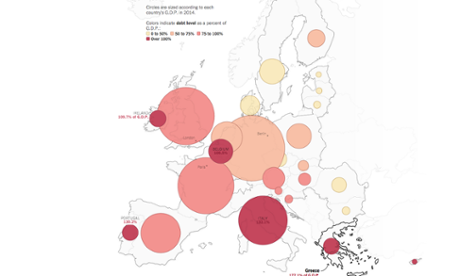
Irish economist David McWilliams has a novel idea for Greece’s economic recovery - adopting the yuan.
There’s no point for the Greeks in going back to the drachma if that will destroy its banking system.
Why not do what Ireland has done over the years and adopt some other country’s currency?
What’s in it for China? Everything!
Read the rest of McWilliams’ idea here, because at this stage in negotiations, why not.
Updated
The Financial Times world trade editor notes a rather well composed photograph of Greece’s finance minister, Euclid Tsakalotos at the negotiations.
Is this going to be the defining image of this deal? #Greece pic.twitter.com/jnq7II70pE
— Shawn Donnan (@sdonnan) July 13, 2015
Anger at the demands on Greece, gathered on social media under the hashtag #thisisacoup, is gaining traction.
Nobel laureate economist, Paul Krugman, has lambasted the summit developments in his column at the New York Times, and thrown his support behind #thisisacoup.
Suppose you consider Tsipras an incompetent twerp. Suppose you dearly want to see Syriza out of power. Suppose, even, that you welcome the prospect of pushing those annoying Greeks out of the euro.
Even if all of that is true, this Eurogroup list of demands is madness. The trending hashtag ThisIsACoup is exactly right. This goes beyond harsh into pure vindictiveness, complete destruction of national sovereignty, and no hope of relief. It is, presumably, meant to be an offer Greece can’t accept; but even so, it’s a grotesque betrayal of everything the European project was supposed to stand for.
Updated
Hello, Helen Davidson here, taking over from Graeme Wearden after a very long night of talks which are not yet over.
On the bright side for those following the drawn out negotiations, AFP’s Danny Kemp has heard another summit on Wednesday may be avoided if Greece accepts and passes a couple of things to get the ball rolling.
Thank God - no need Wednesday summit, Eurogroup could give mandate for start of negotiations if Greece parliament passes first steps- source
— Danny Kemp (@dannyctkemp) July 12, 2015
This summit is turning into an old school all-nighter:
The meeting between @atsipras #Merkel #Hollande and @eucopresident is over but still consultations go on.. #Greece
— Efi Koutsokosta (@Efkouts) July 12, 2015
"Will probably take some more hours." #EuroSummit
— Stefan Leifert (@StefanLeifert) July 12, 2015
So I’m going to hand over to my colleague Helen Davidson for the next few hours.... GW
Brussels diplomats are redrafting tonight’s decision for the fourth time, says AFP’s Danny Kemp. And that offer of a temporary Grexit has been quietly dropped.....
Eurozone Greece summit now on fifth draft, leaders have started discussing latest. 'Time-out' para was missing from last one - EU source
— Danny Kemp (@dannyctkemp) July 12, 2015
Updated
US financial analyst George Pearkes has an interesting take on the idea that KwF (the German investment bank chaired by Wolfgang Schauble) might take control of some Greek assets: (he argues it’s not a scandal)
For the #KfW and Privatisation Fund Debate Read this from @georgepearkes pic.twitter.com/nLj0dZTXVo
— Sony Kapoor (@SonyKapoor) July 12, 2015
Updated
EU sources are now briefing that Greece’s immediate funding crisis could be averted - if a bailout deal was in the pipeline.
EU source dangles funding bridge:'If an agreement, that means prospect of a program. If prospect of a program, financing can be dealt with'
— Danny Kemp (@dannyctkemp) July 12, 2015
#greece #euco gr needs 7bn short-term over next month. remember the 2010 efsm? EUcomm can raise 60bn using it. that's what they're mulling
— Ian Traynor (@traynorbrussels) July 12, 2015
Funny place, Brussels. One minute they’re threatening to kick Greece out for five years, the next they’re looking for innovative ways to keep them in.
Cyprus’s spokesman reports that the summit will remain on pause for another 40 minutes, at least.
#Eurozone Summit on #Greece...meeting will not reconvene before 2 a.m. at the earliest...
— NikosChristodoulides (@Christodulides) July 12, 2015
Tsipras making progress in the negotiations
Our Europe editor, Ian Traynor, is hearing that Alexis Tsipras is refusing to be beaten down, and is winning some concessions from creditors.
Tsipras may have sunk the idea that €50bn of Greek assets would be transferred to a Luxembourg fund (under the control of the German development bank KfW). It could be rather fewer assets, and it might not be Luxembourg either.
The Greek PM may even succeed in removing the threat of a temporary Grexit.
#greece #euco €50bn lux-parked assets dead. no chance of 50bn, maybe not lux, back to athens. better lingo for tsipras on debt relief
— Ian Traynor (@traynorbrussels) July 12, 2015
#greece #euco ecofin (including osborne) could fix bridging finance on tuesday - brussels sources. €group poss weds
— Ian Traynor (@traynorbrussels) July 12, 2015
#greece #euco final timeout threat probably deleted - brussels sources. imf role remains despite tsipras objections
— Ian Traynor (@traynorbrussels) July 12, 2015
Updated
Those EU sources are making encouraging noises about progress now being made at the Summit.
"We will not see #Grexit sentence in the #EuroSummit statement" - EU source
— Jarno Hartikainen (@JarnoHa) July 12, 2015
Many sources came to #EuroSummit to speak to journos suggesting that work is in progress and agreement at reach pic.twitter.com/XnKDH2xtPn
— Georgi Gotev (@GeorgiGotev) July 12, 2015
The Brussels press pack are still hard at work -- they just swamped an EU official who wandered over for a briefing.
This is how it looks like when "a source" comes to the press room: pic.twitter.com/pOIUOLJNgJ
— Stefan Leifert (@StefanLeifert) July 12, 2015
Right now, this does not feel like Angela Merkel’s finest hour in the eurozone crisis.
The stock of political capital that Germany has burned through this weekend is immense. Unclear how it will be replaced
— Alex White (@AlexWhite1812) July 12, 2015
The #thisisacoup protest is gathering pace:
Almost 100K tweets for #ThisIsACoup
— Francine Lacqua (@flacqua) July 12, 2015
Huge popularity of #thisisacoup suggests Germany and eurozone in general are at risk of losing blame game big time.
— Hugo Dixon (@Hugodixon) July 12, 2015
Now this is interesting...
#greece @atsipras raised four objections with merkel/hollande not including timeout nonsense as he's not worried about it
— Ian Traynor (@traynorbrussels) July 12, 2015
Rather than walking out, Alexis Tsipras is negotiating on four key points in tonight’s proposals, reports The Economist’s Tom Nuttall.
Tsipras seeking 4 changes to EG note: 1 No IMF involvement 2 Stronger statement on debt 3 Signal to ECB to maintain ELA 4 Scrap 50bn idea
— Tom Nuttall (@tom_nuttall) July 12, 2015
Incidentally, our readers flag up that the organisation which could take control of €50bn of “valuable Greek assets” is linked to none other than Wolfgang Schäuble himself:
The Institution for Growth was announced just two years ago, by Schäuble and Greek PM Antonis Samaras.
Update: KfW is the German development bank -- in 2012, we explained how it has had a huge impact in Germany. And in 2013, Berlin proposed that it provided loans to help companies in Southern European countries.
Updated
The scale of the demands being put on Greece tonight have alarmed German news magazine Spiegel. It has labelled them as a ‘deliberate humiliation’ of Greece, which Alexis Tsipras will struggle to get through parliament. Here’s the story
Spiegel Online calls the Eurogroup document the "catalogue of cruelties". #ThisIsACoup pic.twitter.com/vIC7UVC1fI”
— Nikos Xydakis (@nikoxy) July 12, 2015
The Latvian delegation reckon tonight’s summit might run for another three to five hours!
Internal polling in our delegation on summit end-time results in guess from 3 to 5 am. #lifer #EUCO #WorkOnSunday #RelaxingAfterPresidency
— Jānis Bērziņš (@BerzinsJ) July 12, 2015
Malta’s prime minister, Joseph Muscat, is playing the role of chief tweeter from the summit:
Second break for consultations. Some progress at #EuroSummit but still way to go -JM
— Joseph Muscat (@JosephMuscat_JM) July 12, 2015
Bild, the German tabloid, is reporting tonight that Alexis Tsipras is going to propose early elections this autumn.
It reckons that Tsipras is also pondering asking the Greek president to form a unity government, to drive his reform programme through parliament, given the scale of opposition in Syriza. With the centrist To Potami party refusing to join a coalition, Tsipras has little choice but to go to the polls.
More here: Premier Tsipras strebt Neuwahlen an
BILD: Tsipras seek to form national gov, call elections for Autumn http://t.co/8XaPk6RFNY (the google translate does German well enough)
— Lorcan Roche Kelly (@LorcanRK) July 12, 2015
Twitter users protest that #thisisacoup
Twitter users are using the hashtag #thisisacoup to show their anger about events in Brussels, and the demands being forced on Alexis Tsipras.
And right now, #thisisacoup is trending high across the social media network, just behind today’s tennis action. It’s tied in with another hashtag: #TsiprasLeaveEUSummit (he hasn’t, yet, anyway)

And here’s an example:
Economics Nobel laureate @JosephEStiglitz gives Germany both barrels. #ThisIsACoup http://t.co/MI84JEx6Ac pic.twitter.com/w7mRqaX4dM
— Diarmuid O'Flynn (@ballyhea14) July 12, 2015
Eurozone leaders have been making slow progress through the four-page draft statement, since beginning the summit almost seven hours ago.
The word on the floor is that they’re barely halfway, and that talks over the privatisations Greece must make have stalled. So leaders are turning to page 3.
EU official: "1st impasse" No agreement on Greek privatization so moving onto p3 of #eurogroup doc #eurosummit hoping to finish by 2nd break
— Tara Palmeri (@tarapalmeri) July 12, 2015
The statement about offering a short-term time-out is the final item of page 4. So it’s possible that it could yet be removed from the final text.
Neither Merkel, Hollande nor commission want temp Grexit. Unlikely it'll survive into final statement in meaningful form. #PredictionKlaxon
— Tom Nuttall (@tom_nuttall) July 12, 2015
France’s Libération asks the big question: What is Germany playing at?
A la une de @libe demain : «A quoi joue l'Allemagne ?» http://t.co/MP384GfmA9 pic.twitter.com/EkBVOYlqT3
— Libération (@libe) July 12, 2015
Monday’s edition of The Guardian is also leading on the Greece crisis.
Guardian front page, Monday 13 July 2015: Europe takes revenge on Tsipras pic.twitter.com/U7IrMB5Bwb
— The Guardian (@guardian) July 12, 2015
And here’s the story:
Greek crisis: surrender fiscal sovereignty in return for bailout, Merkel tells Tsipras
Once again, Greece is the front page story in the Financial Times:
FT UK: Greece's Eurozone future uncertain as Germany steps up the pressure #tomorrowspaperstoday #BBCPapers pic.twitter.com/1HoiXUNuZP
— Neil Henderson (@hendopolis) July 12, 2015
Greece is giving a firm Oxi to the two most controversial elements of the eurozone plan:
Greek official: €zone’s plan for privatizing €50B of greek assets is “on another planet” for @atsipras & temporary #Grexit "100 percent No.”
— Tara Palmeri (@tarapalmeri) July 12, 2015
Greek officials have just slammed the proposals on the table tonight, in a briefing with journalists.
But while they were highly critical of chancellor Angela Merkel’s actions, European Central Bank president Mario Draghi was credited with being “very supportive”.
But Draghi needs a political signal that a deal is possible, to avoid the ECB cutting support for Greece’s banks on Monday.
#Greece considers #Eurogroup draft as humiliating and disastrous (gov't sources).
— Dim Rapidis (@rapidis) July 12, 2015
#ECB #Draghi very supportive to #Greece. political signal needed for the ELA. Liquidity situation urgent over the coming days-Greek official
— Efi Koutsokosta (@Efkouts) July 12, 2015
MERKEL IS THE TOUGHEST ONE IN GREECE TALKS - OFFICIAL - MNI
— Fabrizio Goria (@FGoria) July 12, 2015
Summary: Tsipras's night of pain in Brussels

A quick recap, for anyone just tuning in.
Greece’s prime minister is under intense pressure tonight to accept even tougher economic reforms and austerity measures, or see his country pushed out of the eurozone.
Alexis Tsipas , the other 18 eurozone leaders, and the heads of the IMF, ECB and EU are locked in talks at the emergency summit to discuss Greece’s request for a third bailout.
The proposal on the table would force Greece to vote through sweeping changes by Wednesday night. Or, it would be offered a ‘temporary Grexit’; an opportunity to restructure its debts.
[In case no agreement could be reached, Greece should be offered swift negotiations on a time-out from the euro area, with possible debt restructuring].
The plan also suggests Greece surrenders €50bn of valuable assets to a euro-body, who would sell them off to pay down debt. Unless Athens cracks on with privatisations in a way it has never managed before.
We hear that Tsipras was put under the cosh in a meeting with Angela Merkel, Donald Tusk and Francois Hollande a couple of hours ago:
#greece merkel/holland session with tsipras said to resemble 'extensive mental waterboarding' - top official
— Ian Traynor (@traynorbrussels) July 12, 2015
#greece #euco tsipras' choice - a ward of the eurozone or on yr own, banking collapse, euro-less
— Ian Traynor (@traynorbrussels) July 12, 2015
The draft proposal, which comes from this morning’s eurozone finance ministers, forces Greece to take these seven steps straight away:
- Streamlining VAT
- Broadening the tax base
- Sustainability of pension system
- Adopt a code of civil procedure
- Safeguarding of legal independence for Greece ELSTAT — the statistic office
- Full implementation of automatic spending cuts
- Meet bank recovery and resolution directive
And also get the ball moving on another five points:
- Privatize electricity transmission grid
- Take decisive action on non-performing loans
- Ensure independence of privatization body TAIPED
- De-Politicize the Greek administration
- Return of officials from its creditors to Athens
Professor Karl Whelan argues that Germany is trying to force Greece out.
Other analysts, economists and commentators are also staggered by the scale of these demands -- given Greece effectively agreed to its creditors former demands last week.
Just got around to reading Eurogroup draft. Reminds me of when the Romans sowed Carthage with salt. #Greece
— Vincenzo Scarpetta (@LondonerVince) July 12, 2015
I always figured the Creditors wd slap Greece around before offering a deal. Didn't see them beating them over the head w/ a baseball bat.
— Owen Callan (@OwenCallan) July 12, 2015
Looking at recent developments it basically looks like Germany refuses to accept Greece's surrender.
— Paul Harris (@paulxharris) July 12, 2015
The developments have left Tsipras’s Syriza party reeling, with speculation of an imminent cabinet reshuffle, or even new elections.
And a group of anti-austerity protesters have gathered in Athens to urge the government not to cave in.
Tsipras himself said he believes a deal was possible tonight (but he didn’t suggest that it would be on the terms on offer)
There had been optimism early this afternoon, when Euro finance minister said they had made some progress at their own, sometimes acrimonious meeting.
Here’s how it looked:
Photos: Sunday's #eurogroup meeting on #Greece begins.... (hat-tip EPA) http://t.co/0DuQSQqEI6 pic.twitter.com/G10665a6PT
— Graeme Wearden (@graemewearden) July 12, 2015
Euclid @tsakalotos & Christine @Lagarde confer at today's #eurogroup on #Greece http://t.co/0DuQSQqEI6 (Photos: AP) pic.twitter.com/ymKVP4q0lv
— Graeme Wearden (@graemewearden) July 12, 2015
undefined
On the other side of the world, it’s Monday morning, and the financial markets are bursting into life.
The euro has promptly fallen, but it’s not a full-scale rout. It’s down around half a cent at $1.1114.
Syriza in shock over creditors' demands
Over in Athens there is mounting angst that if Greece is pushed too far, political turbulence will almost certainly erupt.
Our correspondent Helena Smith reports
While Greece’s fate was being debated in Brussels, in Athens the ruling radical left Syriza party was exhibiting signs of disintegration. Demands that the controversial reforms be approved by the Greek government and enacted into law by Wednesday were described as “utter blackmail” by leading party members and met with stunned disbelief.
Although sources close to prime minister Alexis Tsipras said the leader was now determined to do whatever was needed to keep Grexit at bay, political tumult also beckoned. Insiders conceded that a cabinet reshuffle – removing those ministers who had refused to vote the austerity package through parliament early Saturday – could come as early as Monday.
“What is sure is that we are going to have dramatic political developments,” said Nikos Bistis, a veteran politician from the centre left. “Basically Syriza is now split in two.”
By late Sunday it had become clear Tsipras’ u-turn, accepting measures he had once furiously spurned, had produced a tectonic split with potentially far-reaching consequences. In addition to suffering an unexpected loss of support with 17 MPs breaking ranks at the weekend – defections that strip his government of a working majority – 15 other lawmakers also indicated that they would not approve the agreement in its entirety when it was brought to the 300-seat House.
The MPs, who included two ministers, said they were radically opposed to endorsing an austerity programme that was not only ideologically at odds with their own beliefs but would exacerbate “the country’s agonising and tragic social economic problems.”
The resistance raises the spectre of Tsipras being forced to call fresh elections – a move described as potentially catastrophic for the country.
“Greece can bend up to a point,” said Aristides Hatzis, a prominent political commentator. “But after that there is no bending, only breaking. The breaking point may well come when Tsipras realises he has lost most of his parliamentary group.”
The embattled prime minister will also face substantial resistance from the parliament’s speaker Zoe Konstantopoulou in getting the policies fast-tracked through the House.
A Syriza hardliner, Kostantopoulou said at the weekend:
“the government is being blackmailed. The lenders are insisting on turning the “no” [of last week’s referendum] into “yes.” I could never vote for the contents of the agreement.”
While the leaders meet, Greece’s finance minister is talking to his German and French counterparts, reports Efi Koutsokosta of Euronews.
Greek fin min @tsakalotos holding discussions now w French minister #Sapin and the German #Schauble. #Greece #EuroSummit
— Efi Koutsokosta (@Efkouts) July 12, 2015
An opportunity for another dose of mental water-boarding?
Demonstrators are gathering in central Athens tonight to protest against fresh austerity measure being imposed on Greece:


Happening now, Athens #Greece. Protestors who still say "Oxi" or "No" to the deal on the table. Many favor #Grexit. pic.twitter.com/wsoGcdJ7tX
— M. Caruso-Cabrera (@MCaruso_Cabrera) July 12, 2015
Riot police have been deployed, but it all appears calm so far.

Official: Tsipras given "mental waterboarding" over reform plans
Alexis Tsipras was given a very rough ride in his meeting with Tusk, Merkel and Hollande, our Europe editor Ian Traynor reports.
Tsipras was told that Greece will either become an effective “ward” of the eurozone, by agreeing to immediately implement swift reforms this week.
Or, it leaves the euro area and watches its banks collapse.
One official dubbed it “extensive mental waterboarding”, in an attempt to make the Greek PM fall into line.
An unpleasant image, that highlights just how far we have now fallen from those European standards of solidarity and unity.
#greece merkel/holland session with tsipras said to resemble 'extensive mental waterboarding' - top official
— Ian Traynor (@traynorbrussels) July 12, 2015
#greece #euco tsipras' choice - a ward of the eurozone or on yr own, banking collapse, euro-less
— Ian Traynor (@traynorbrussels) July 12, 2015
And what on earth is Tsipras going to do? Capitulate, or walk away?
Teneo Intelligence's latest on #GREECE: Asked to surrender, the risk is that Tsipras walks out pic.twitter.com/utNEUZGRll
— wolf piccoli (@wolfpiccoli) July 12, 2015
By our reckoning, there are four eurozone members who believe Greece should stay in the euro at all costs, five more who’d like to avoid Grexit if possible, and nine who are open to the idea:
Economics professor Karl Whelan, of University College Dublin, believes the proposal for ‘temporary Grexit’ shows that Germany is determined to get Greece out of the eurozone.
He’s tweeted his thoughts:
1. The inclusion (in brackets so not agreed) of the temporary exit option shows that this is still the German position.
— Karl Whelan (@WhelanKarl) July 12, 2015
2. This document is going to heads of state. It is not credible that this is not the agreed German government position i.e just Schäuble's.
— Karl Whelan (@WhelanKarl) July 12, 2015
3. No haircuts inside euro but a "possible restructuring" if Grexit is a huge sweetener designed to boost support for Grexit in Greece.
— Karl Whelan (@WhelanKarl) July 12, 2015
4. The offer of restructuring outside the euro but not inside has got nothing to do with the provisions of the Treaty.
— Karl Whelan (@WhelanKarl) July 12, 2015
5. Germany has an effective veto on ESM loan agreements. German strategy appears to be to set conditions that won't be met and force Grexit.
— Karl Whelan (@WhelanKarl) July 12, 2015
The eurozone summit is restarting shortly, according to Cyprus government spokesperson Nikos Christodoulides.
The proposal that Greece hands over €50bn of state assets has gone down predictably badly:
An EU entity set up to seize "naughty" EZ state's assets. And rest of EZ not only didn't fight it, but demanded it! Game-set-match, Germany.
— Alex Andreou (@sturdyAlex) July 12, 2015
can't even say we're going to hell in a handbasket because the germans will probably seize it as part of the €50bn valued assets. #Greece
— Diane Shugart (@dianalizia) July 12, 2015
The leaked proposal also suggests Greece hands over €50bn of “valuable Greek assets” over to eurozone authorities to be sold off over time!
That would kick in if Greece cannot deliver “a significantly speeded up” privatisation programme.
It would be a remarkable loss of sovereignty, even for a country used to being overseen by officials from the IMF, ECB and EU for most of the last five years.
Proposal: Greece to be offered euro time-out if no deal
The four-page proposal on the table tonight is now circulating in Brussels.
It confirms that Greece could indeed by offered a ‘temporary’ exit from the eurozone if it doesn’t agree a deal with its creditors tonight.
[In case no agreement could be reached, Greece should be offered swift negotiations on a time-out from the euro area, with possible debt restructuring].
Sky’s Ed Conway has helpfully uploaded all four pages. Turn straight to the last section to see the reference to a time-out.
Here’s the full 4pg eurogroup document on #Greece, inc “time-out”, total amt needed (€82-6bn) & reform proposals pic.twitter.com/sKUpbykcBX
— Ed Conway (@EdConwaySky) July 12, 2015
The square brackets are important – that means that finance ministers couldn’t actually agree on this point, so have bumped it up to the leaders.
This must be one of the “big issues” that Jeroen Dijsselbloem, Eurogroup president, said was unresolved as he arrived at the summit.
If you’re just tuning in, this idea was proposed in a German finance ministry paper. Curiously, some ministers have said that Grexit wasn’t discussed at last night’s meeting … yet, there is the reference …
#greece y'day word at €group was schaeuble's paper neither presented nor discussed. €group's 4pages to summit today replicate it almost all
— Ian Traynor (@traynorbrussels) July 12, 2015
But as we mentioned earlier, François Hollande dismissed the idea of a temporary Grexit as he arrived at the Summit. And many observers are unimpressed (or aghast)
If a "time-out" Grexit clause is attached to ANY European document, Eurozone signs its death certificate: "death by time-out".
— Thomais Papaioannou (@ThomaisERT_RIK) July 12, 2015
So will he cave in, or will Angela Merkel?
The meeting taking place now, between Tsipras, Donald, Merkel and Hollande is really crucial...
Updated
Tsipras, Merkel, Hollande and Tusk hold meeting
As I type, Donald Tusk, Alexis Tsipras, Angela Merkel and Francois Hollande are holding a top-level meeting to discuss the proposals.
Διακοπή #EuroSummit -Τετραμερής συνάντηση @PrimeministerGR @atsipras - @fhollande - #Merkel - @eucopresident. #Greece pic.twitter.com/nn9JjzudUJ
— Ευρωπαϊκή Επιτροπή (@EEAthina) July 12, 2015
The Greek finance minister is also there, which means that Euclid is in a quadrilateral.....

Finnish finance chief Alex Stubb has explained that Greece has just 72 hours to agree to the demands of its creditors.
As he left the eurogroup, Stubb explained that ministers were demanding “far-reaching conditionality, on three counts:
Number one, it needs to implement laws by July 15. Number two, tough conditions on for instance labour reforms and pensions and VAT and taxes.
And then number three, quite tough measures also on for instance privatisation and privatisation funds.
And the most important thing, he added, is that the whole package has to be approved by both the Greek government and the Greek parliament.
Let’s see if EU leaders come to the same conclusion tonight....
Updated
Ouch. This, according to Politico’s Tara Palmeri, is what the Eurogroup has proposed that Greece signs up to and passes into law, by Wednesday.
Here's the list of reforms in the #Eurogroup draft that Greek government has to pass by Wednesday to get bailout pic.twitter.com/nEF8OmDBiA
— Tara Palmeri (@tarapalmeri) July 12, 2015
Updated
Developments in Brussels: Eurozone leaders are taking a break from their discussions, to consult with advisors (and in Malta’s case, to tweet about it)
#EuroSummit breaks for consultations. #Eurogroup document is most significant step so far. Need to focus on key points -JM
— Joseph Muscat (@JosephMuscat_JM) July 12, 2015
#Eurozone Summit...long break for consultations...#Greece
— NikosChristodoulides (@Christodulides) July 12, 2015
Rather alarmingly, Germany’s proposal of a temporary Grexit has also made its way into the eurogroup conclusions:
If no agreement Greece should be offered swift negotiations on a time out from the euro via @IdafeMartin pic.twitter.com/HYnsn3BZ8q
— Bruno Waterfield (@BrunoBrussels) July 12, 2015
The German finance ministry suggested this idea in a paper which leaked yesterday. The argument is that Greece can’t restructure its debts while a member of the eurozone.
But the idea is full of problems -- it completely sinks the idea that the eurozone is indivisible, and reduces it to a mere currency peg.
Also, it’s hard to go back once you’re out:
Temporary Grexit is like temporary divorce. Most if not all end up being permanent.
— Paul De Grauwe (@pdegrauwe) July 12, 2015
I’m sure Francois Hollande will repeat his opposition to the idea tonight:
Brussels reporters have got hold of the statement from the eurogroup, following today’s meeting of finance ministers.
And it shows that Greece needs fresh financing of up to €86bn over the next three years:
Greece financing needs according to the EG draft pic.twitter.com/8dlCaY8vrp
— Pablo Rodríguez (@Suanzes) July 12, 2015
The statement floats the possibility of restructuring Greece’s debt pile, but this wouldn’t be considered straight away. Full haircuts on the face value of Greek bonds isn’t an option.
The EG draft on the Greek debt: haircuts cannot be undertaken pic.twitter.com/5hxrJJdqGe
— Pablo Rodríguez (@Suanzes) July 12, 2015
Here’s a video clip of the leaders arriving at today’s summit on Greece:
Martin Schultz has also stated firmly that “Greece and its people must not be humiliated.’’
And under questioning from journalists, he also agreed that foreign lenders were being “strict with Greece.”
Our Athens correspondent Helena Smith explored that point in today’s Observer, writing:
After seeing my adopted country in freefall, after watching friends fret at the prospect of overnight impoverishment and weep at the indignity of bank closures and capital controls, it is impossible not to ask whether all – or any – of this was necessary. Did Greece need to get to this place? Did the economy need to die before our eyes for the government to declare that “honourable compromise” had been reached? In recent weeks, the spectre of chaos has haunted Greece. As Tsipras has pondered, primitive instincts have not been far away.
For truth, five years on, has arrived in the form of a €13bn package of savings – the key to further financial assistance – that is so severe, so bitter-sweet in the wake of the hardship that this “war” has already caused, it is unclear what will follow......
Leaders are hard at work discussing Greece now, accompanied by some rather twee miniature flower arrangements:
Discussions on #Greece now underway at #EuroSummit pic.twitter.com/06sT4pdZQf
— Preben Aamann (@PrebenEUspox) July 12, 2015
Updated
European parliament president, Martin Schulz, is giving a press conference now, underlining the importance of a deal.
We are now at a crossroads, he warns.
There must be a decision tonight, and I hope it will be a positive decision.
Asked is EU reputation at stake if Greek government collapses, @MartinSchulz said "yes" #EUCO
— Georgi Gotev (@GeorgiGotev) July 12, 2015
Updated
Photos: Hugs as euro summit begins
Alexis Tsipras and Jean-Claude Juncker shared a friendly hug, as the start of today’s eurozone leaders summit. A sign of genuine progress?

Tsipras also spoke with other leaders.
He didn’t win a hug from Angela Merkel, but the two did speak, with François Hollande alongside.


Belgian PM Charles Michel joined the group too:

Updated
Austria’s finance minister has laid out the position – the Greek parliament must decide on Monday that it supports everything that is agreed today. Otherwise, no bailout.
#greece austria's schelling - key point is gk parlt has to support everything tomorrow, then start legislating. if not, no bailout talks
— Ian Traynor (@traynorbrussels) July 12, 2015
Updated
The meeting has begun!
The #EuroSummit on #Greece has just started. pic.twitter.com/X115x0qc2l
— Donald Tusk (@eucopresident) July 12, 2015
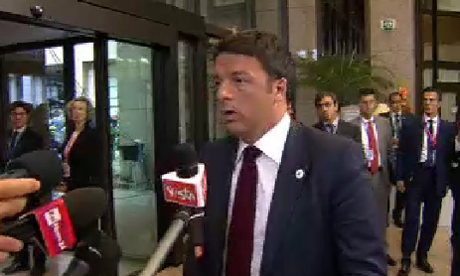
Now Matteo Renzi arrives, and tells the media that it is vital to reach a deal, both for Greece and Europe (which faces other challenges too).
Italian PM Renzi reiterates #Greece is important, but Europe also has other important issues to deal with (terrorism, Ukraine, etc.)
— Open Europe (@OpenEurope) July 12, 2015
Italian PM Renzi: Situation is very complicated. We're all committed to reaching a deal that is about #Greece but also about Europe.
— Open Europe (@OpenEurope) July 12, 2015
We have come a long way, but a couple of big issues are still open - says @J_Dijsselbloem @France24_en @savaricas
— Méabh (@Brusselsness) July 12, 2015
Dijsselbloem: We've come a long way
Jeroen Dijsselbloem, head of the Eurogroup, has been whisked from one meeting to the other.
Arriving at the summit, he says:
We have come a long way, solved a lot of issues, but some big issues still remain.
So we will brief the leaders and they can decide on those last issues, Dijsselbloem replies.
And then he vanishes into the Summit, closely followed by Mario Draghi - who gives the camera a winning smile but doesn’t stop to chat. Disappointing.

Updated
Eurogroup over, Euro summit start soon...
It’s official -- eurozone finance ministers have ended their meeting, passing the baton to the leaders at their summit.
And Finland’s Alexander Stubb has tweeted that progress has been made -- how much remains to be seen.
#Eurogroup over and out. Handover to #Eurosummit. Progress made.
— Alexander Stubb (@alexstubb) July 12, 2015
“Out”, you say, Alex?
Not sure about wisdom of 'over and OUT' as a sum of the #eurogroup https://t.co/ivQEdgiKfs
— Lorcan Roche Kelly (@LorcanRK) July 12, 2015
Tusk @eucopresident will start #EuroSummit on #Greece in a few minutes
— Preben Aamann (@PrebenEUspox) July 12, 2015
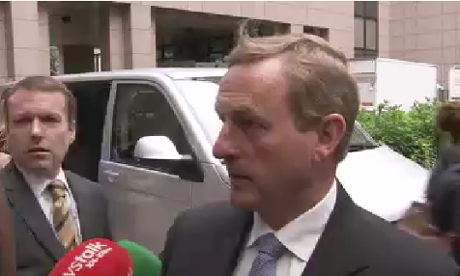
Ireland’s Enda Kenny says Greece needs to demonstrate their commitment to staying in the eurozone.
That means measures being taken in the Athens parliament this week, to show “intent and seriousness”.
We are quite willing to work towards a conclusion, so that talks can talk on a programme that can keep Greece in the eurozone, says Kenny, adding:
We don’t want to look back in 10 years time and think this could have been saved, but wasn’t.
Kenny has been Ireland’s leader since the early days of its bailout programme, which it exited 18 months ago, and that gives him insight into what Greece needs to do:
In Ireland’s case, trust was only built with the Troika through incremental analysis and payment when we had shown what we could do.
Updated
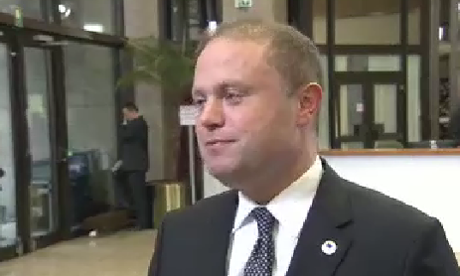
Malta’s prime minister, Joseph Muscat, says that leaders will be discussing “all options” at today’s summit, not simply Plan B (ie, Grexit).
His first preference is that Greece should stay in the eurozone, but not at any cost. The starting point should be the assessment of the institutions.
And Muscat adds that:
There needs to be a realisation that what was enough 10 days ago might not be enough today, because the situation in Greece has deteriorated.
Maltese PM Muscat: Fact that full European Council not convened shows that all options are on table, full #EUCO would have discussed Plan B
— Open Europe (@OpenEurope) July 12, 2015
Updated
Europe’s future is at stake tonight, says European parliament president Martin Schulz as he arrives at the summit.
Schulz: We must reach an agreement today and I believe we will, as the future of Europe is at stake #EuroSummit
— george mastropavlos (@g_mastropavlos) July 12, 2015
Juncker: I'll fight until the last millisecond
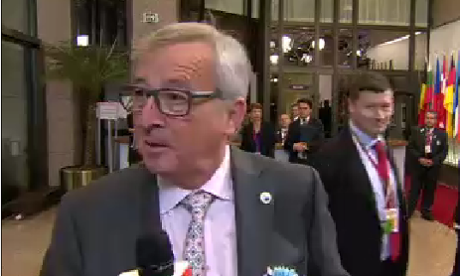
Now Jean-Claude Juncker, Commission president arrives. And he takes a question from the British press pack:
What is stopping a deal?
I’m entering the meeting now, Juncker replies (ie, ask me afterwards)
Are you hopeful?
I will fight until the very last millisecond for a deal, and I hope that we will have a deal.
Hollande: We'll do whatever it takes
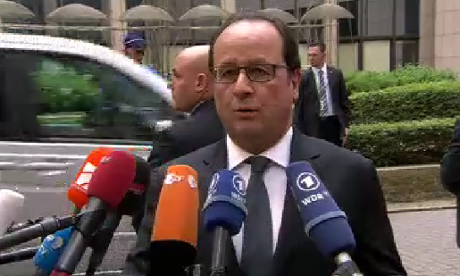
Next in line is the French president’s limo.
Francois Hollande brings an uncompromising message to the Summit, underlining that France is Greece’s ally at this vital moment.
We will do everything in its power to find an agreement tonight, he declares. This isn’t just about Greece, this is about Europe.
Hollande: France will do everything to find an agreement this eve, talks not just about Greece but Europe. #Greece
— Jennifer Rankin (@JenniferMerode) July 12, 2015
Hollande also appears to ridicule the ‘temporary Grexit’ idea suggested by the German finance ministry in a paper that leaked yesterday.
The situation is clear - you’re in, or you’re out.
Hollande: There is no Grexit on time. It's either Grexit or no Grexit.
— Mathieu von Rohr (@mathieuvonrohr) July 12, 2015
Updated
Merkel: Trust has been lost
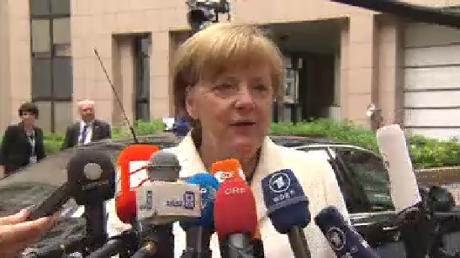
Chancellor Merkel tells reporters that the most important currency, trust, has been lost.
And she warns that the eurogroup are unlikely to give a unanimous recommendation at their own meeting earlier today. An agreement won’t come at any price.....
Merkel: the most important currency has gone missing. And that's Trust. There will be no agreement at any cost. #Greece #Grexit
— Nina Schick (@NinaDSchick) July 12, 2015
And then she vanishes inside, without taking further questions.
A flurry of activity as Angela Merkel’s motorcade rolls up....
Trust comes up again. Slovenian PM tells @ITVRichard he hopes it can be forgotten and trust can be rebuilt #Greece
— Emily Purser (@EmilyPurser) July 12, 2015
Slovenia’s prime minister says he’d rather avoid Grexit, but Athens must make firm commitments to get aid funds (reports Jennifer, who is tweeting from her second doorstep of the morning)
Slovenian PM Miro Cerar: we wd like Greeks to remain in eurozone, but must be pledges and obligations on Greek side to make a deal.
— Jennifer Rankin (@JenniferMerode) July 12, 2015
Dutch PM Mark Rutte has already perched on the hawkish territory, saying Greece won’t get any bailout cash unless they take “all measures” expected.
#EuroSummit @MinPres "The road to aid is only open if Greeks are willing to take all measures" http://t.co/abjAFIRvnu pic.twitter.com/LvmYopab4k
— EU Council TV News (@EUCouncilTVNews) July 12, 2015
Tsipras: We owe it to the people of Europe to compromise
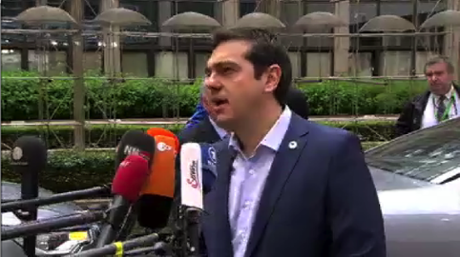
Alexis Tsipras has just arrived for tonight’s eurozone summit, and told reporters that an agreement could be within reach.
I am here ready for compromise, the Greek PM says.
We owe that to the people of Europe who want Europe united, and not divided.
We can reach an agreement tonight if all parties want it.
"We can reach an agreement tonight if all parties want it," says Alexis Tsipras on way in to #eurosummit #greece
— Jennifer Rankin (@JenniferMerode) July 12, 2015
.@Tsipras_EU has arrived in Brussels. Says: “I am ready for compromise. We can reach an agreement tonight if all parties want it.” #Greece
— Ed Conway (@EdConwaySky) July 12, 2015
You can watch all the arrivals here.
Updated
Green Party MEP Ska Keller is alarmed by the eurogroup’s latest demands on Greece:
#Eurogroup demands "rigorous reviews of collective bargaining". In clear words: cut rights of labor unions. Is This Europe?? #notinmyname
— Ska Keller (@SkaKeller) July 12, 2015
The #Eurogroup draft. Very tough stuff, and I'm told today's discussion is on tougher elements. http://t.co/chUlzbW7sv #Greece
— Eric Maurice (@er1cmau) July 12, 2015
Eurogroup wants more measures from Greece
Greece will have to do even more, on top of the €13bn of austerity measures agreed last week, if it wants to get its third bailout.
Reuters has now got hold of the draft statement from today’s meeting. And it confirms what was suspected - Greece must “broaden its tax base”, make further reforms to its sales tax and pension systems, and boost its privatisation programme, among other measures.
And that means that there’s no chance of an agreement today, as fresh legislation would be needed.
As Reuters explains:
“The Eurogroup... came to the conclusion that there is not yet the basis to start the negotiations on a new programme,” the draft statement, seen by Reuters, said.
To begin such talks, the ministers would first want Greece to improve its VAT and pension systems, broaden its tax base to boost revenues and strengthen the independence of ELSTAT, the Greek statistics agency.
So, we could be looking at another week of drama:
Eurogroup, possible scenario: Greece gets reforms through parliament by Wednesday and then gets a bridge for negotiations about ESM bailout.
— Stefan Leifert (@StefanLeifert) July 12, 2015
But can Alexis Tsipras persuade his MPs to accept such a package, given the small rebellion on Friday night over its initial offer?
How is that package outlined in Eurogroup draft seen by Reuters supposed to pass through #Greece's parliament?
— Damian Mac Con Uladh (@damomac) July 12, 2015
Rumours of white smoke soon from the Eurogroup.
#Eurogroup statement expected within 60 minutes #Greece
— Keep Talking Greece (@keeptalkingGR) July 12, 2015
Just as well, as eurozone leaders should be arriving soon for their summit (kick-off in 80 minutes).
Estonia’s PM has landed a little while ago.
Arrived in Brussels, some colleagues apparently already here. pic.twitter.com/nyzHcpjtMJ
— Taavi Rõivas (@TaaviRoivas) July 12, 2015
Updated
Here’s how those pictures of ministers chatting at the Eurogroup are made.
The other side of the mirror #Eurogroup #GreekCrisis http://t.co/SwW7EelELg pic.twitter.com/C498QsWRjF
— ArisOiko Photo (@ArisoikoPhoto) July 12, 2015
Updated
Renzi: Unthinkable to humiliate Greece any more
We broke the news in last night’s liveblog that Matteo Renzi, Italy’s prime minister, was going to tell Germany that the humiliation of Greece must stop.
And now it’s happened.
Renzi told Italian newspaper Il Messaggero that:
“Now common sense must prevail and an agreement must be reached. Italy does not want Greece to exit the euro and to Germany I say: enough is enough.
Now that Tsipras has made proposals in line with the European demands, we must absolutely sign a deal. Humiliating a European partner after Greece has given up on just about everything is unthinkable.”
Renzi is going to make similar comments to Chancellor Merkel tonight.
Updated
EU official: Grexit not on the agenda tonight
A eurozone official has told reporters that leaders will NOT be planning for Grexit tonight.
Instead, they are hoping going to make progress on Plan A – a new bailout deal for Greece.
Eurozone official says plan B (#Grexit) is not on table tonight at #eurozone summit #Greece @FT
— AnneSylvaineChassany (@ChassNews) July 12, 2015
Associate Press has more details:
The official, who spoke on condition of anonymity because he was not authorised to speak publicly, said eurozone leaders hope to issue a statement that would pave the way for the formal for the start of Greek bailout negotiations. The leaders are due to meet later.
That, the official added, would give the “green light” to the European Central Bank to turn up the emergency liquidity assistance it provides to Greek banks.
The usual proviso applies …
When "EU officials" appear in stories, it's important to study where on earth they come from: France, Germany, Finland, Commission?
— Simon Marks (@MarksSimon) July 12, 2015
Updated
Look who has arrived in Brussels – it’s the interim leader of Greece’s largest opposition party, New Democracy.
Evaggelos Meimarakis arrives at the #EPPSummit pic.twitter.com/2ObbP62KTG
— EPP (@EPP) July 12, 2015
Evangelos Meimarakis is meeting with fellow right-wing politicians at an event before the eurozone summit, so it’s all above board.
Updated
Leaked! Eurogroup draft statement pushing for more austerity
Reuters have got hold of the draft statement drawn up by eurozone officials last night.
It’s not the final agreement – more like the starting point for today’s meeting.
It shows that the eurozone has demanded even deeper measures from Athens, which Euclid Tsakalotos has apparently acceded to.
It includes getting Greece’s primary budget surplus up to a chunky 3.5% in 2018, rigorous labour market and pension reforms, a more solid privatisation programme with “improved governance” (does that mean external ‘assistance’?)
Here’s the list:
Eurogroup draft on demands for Greek reforms
And it says that “The Eurogroup thus welcomes the additional following commitments of the Greek authorities on the basis of a clear timetable”:
- fully comply with the medium-term primary surplus target of 3.5 percent of GDP by 2018, according to a yearly schedule to be agreed with the institutions;
- carry out ambitious pension reforms and specific policies to fully compensate for the fiscal impact of the Constitutional Court ruling on the 2012 pension reform and to implement the zero deficit clause;
- adopt more ambitious product market reforms with a clear timetable for implementation of all OECD toolkit I recommendations, including Sunday trade, sales periods, over-the-counter pharmaceutical products, pharmacy ownership, milk, bakeries. On the follow-up of the OECD toolkit II, manufacturing needs to be included in the prior action;
- on energy markets, the privatization of the electricity transmission network operator (ADMIE) must proceed, unless replacement measures can be found that have equivalent effect, as agreed by the institutions;
- on labor markets, undertake rigorous reviews of collective bargaining, industrial action and collective dismissals in line with the timetable and the approach suggested by the institutions. Any changes should be based on international and European best practices, and should not involve a return to past policy settings which are not compatible with the goals of promoting sustainable and inclusive growth;
- fully implement the relevant provisions of the Treaty on Stability, Coordination and Governance in the Economic and Monetary Union, in particular to make the Fiscal Council fully operational;
- adopt the necessary steps to strengthen the financial sector, including decisive action on non-performing loans, transposition of BRRD and measures to strengthen governance of the HFSF and the banks;
- develop a significantly scaled up privatization program with improved governance. A working group with the institutions shall provide proposals for better implementation mechanisms;
- amend or compensate for legislation adopted during 2015 which have not been agreed with the institutions and run counter to the program commitments;
- implement the key remaining elements from the December 2014 state of play of the fifth review of the second economic adjustment program.”
This is all in addition to the original plan, so tricky for Athens to commit to and achieve.
But Paul Mason, the Channel 4 journalist with close links to Syriza, reckons a deal is possible on these terms.
This draft seen by Reuters is the basis for a deal. A tough one but in the same ballpark as the old one -http://t.co/A03SZngkG3
— Paul Mason (@paulmasonnews) July 12, 2015
Updated
Readers who were in bed or out on the town last night will have missed the end of last night’s Eurogroup meeting, so here’s a video clip:
Updated
There’s a rumour that last night’s Eurogroup meeting turned nasty at one point, with Germany’s finance minister clashing with the head of the ECB:
"do you think I'm a fool?" - Schäuble reportedly had a row with Draghi yesterday https://t.co/zEYaV8MpNN
— Alberto Nardelli (@AlbertoNardelli) July 12, 2015
Updated
Greece may not have a guardian angel watching over it, but it got the next best thing this morning - a flyover by the International Space Station.
Captain Scott Kelly, who is spending a year on the ISS, tweeted a picture of Athens and his best wishes.
#Athens, #Greece, #GoodMorning from @Space_Station. Wishing you the best. #YearInSpace pic.twitter.com/zAMEz5JvlW
— Scott Kelly (@StationCDRKelly) July 12, 2015
Luxembourg’s warning to Germany that Grexit would trigger “deep conflict” in Europe has raised the stakes higher today.
But is that really Berlin’s plan? Bojan Pancevski of the Sunday Times reckons not.
But it will not go for #Grexit. A total #Greece submission and probably new government by end of week in the works https://t.co/BaXgQcHelI
— Bojan Pancevski (@bopanc) July 12, 2015
Political tensions are already rising in Germany, over the “five-year temporary Grexit” proposed in a finance ministry report. The Green Party has dismissed it as both unacceptable and unconstitutional, according to Euractiv.
German Green Party: "Schäuble's plans are "not only unacceptable, but also unconstitutional" https://t.co/DrXrh3snbv
— Edward Harrison (@edwardnh) July 12, 2015

Writing before this weekend’s meetings, Philip Shaw, economist at Investec, went over what the week ahead holds for the ECB, particularly when president Mario Draghi holds his press conference after Thursday’s monetary policy meeting.
Shaw believes a potential Grexit will turn out to be a real test of what Draghi means by “whatever it takes”.
The absence of a deal would, in our view, begin the path to Grexit. In that case, the press conference will probably be dominated by the ECB’s role in handling the situation. On the ECB’s specific role in a Grexit scenario, Mr Draghi said this week that if no deal is struck this weekend, the ECB will not extend emergency liquidity assistance (ELA) for Greek banks.
That could trigger a banking collapse as soon as Monday. On Thursday, questions will be asked on the ECB’s next steps on intervention, including any role in transitioning to a separate currency.
Perhaps more significant will be comments Mr Draghi will no doubt make on how ECB policy can limit Grexit contagion to financial markets and eurozone economies more generally. We should expect reassurances on the extent of the policy firewall in place, including the OMT program, the EFSF and QE. On the latter, Mr Draghi pointed out that if circumstances allow, the Governing Council would “reconsider the size, the timing, the design of the [QE] programme”.
Contagion seems limited so far – for example, alongside encouraging eurozone-wide indicators, peripheral bond yields have not blown out (Spanish and Italian 10-year sovereign bond yields are both at 2.2%). But a Grexit could make things worse, posing a true test of whether the ECB is willing to do “whatever it takes” to save the euro”
Updated
Luxembourg warns Germany: Grexit must be prevented

Jean Asselborn, the Luxembourg foreign minister, has declared that “Grexit has to be prevented, warning that:
“It would be fateful for Germany’s reputation in the EU and the world.
“Germany’s responsibility is great. It’s about not conjuring up the ghosts of the past,” Asselborn told Munich’s Sueddeutsche Zeitung.
And he warned that the crisis could send a schism through the heart of Europe.
“If Germany goes for Grexit, it will trigger a deep conflict with France. That would be a catastrophe for Europe.”
Updated
Europe's stock markets on track for Monday selloff
European stock markets are going to fall sharply when trading begins on Monday, unless there is serious progress today.
The German DAX, which jumped 319 points on Friday after Greece announced its proposals, is going to hand around 200 points back, according to the futures markets.
IG index Sunday markets pricing Dax -200 Ftse -61 Dow -120 - Which I'd eyeball and say is a 30% grexit chance if we were at 5% close of Fri
— Polemic Paine (@PolemicTMM) July 12, 2015
IG’s Chris Beauchamp explains:
Like a dysfunctional family, the cracks in European unity are coming to the surface, and not just between the Greeks and the rest.
If no deal is done by tonight, the market reaction will be severe, although should things look to be turning too unpleasant there is always the prospect that the ECB will step in with some emergency action to stabilise matters.
Updated
A few more photos from this morning’s meeting:


Updated
Today’s meeting of euro leaders could last a long time..... (reminder, it starts at 4pm Brussels time)
EU source: don’t read anything positive/negative into cancellation of EU Council. Simply that euro leaders will need a LONG time tonight
— Ed Conway (@EdConwaySky) July 12, 2015
Looks like Euclid Tsakalotos and Christine Lagarde had a good chat before the Eurogroup meeting began:


Updated
'How much?!' pic.twitter.com/XyxzJ4tgoy
— Danny Kemp (@dannyctkemp) July 12, 2015
Photos: Eurogroup gets underway
Photos from today’s eurogroup meeting are just arriving, so I’ll put the best in the blog now:


More to follow, with any luck....
Updated
So what happens now?
Newsnight’s Duncan Weldon reckons Greece is going to be presented with a very tough package of reforms in return for a three-year aid programme.
My *guess* now: Greece offered a much tougher deal than one already passed through Parliament with circa 24-48 hours to legislate on.
— Duncan Weldon (@DuncanWeldon) July 12, 2015
But AFP’s Danny Kemp points out that the two sides are far, far apart:
Words to make heart sink from Italy's Padoan: today is about establishing conditions to *start* negotiations, not closing a deal.
— Danny Kemp (@dannyctkemp) July 12, 2015
The eurogroup meeting of finance ministers has now begun.
Stubb: No one is blocking a deal
Finland’s finance minister, Alex Stubb, has also denied that some Eurogroup members (such as the Finns) are trying to thwart a bailout agreement:
Reuters has Stubb’s full comments as he arrive:
No one is blocking a deal, we are all constructively trying to find a solution in a very difficult situation. What we are saying is that the conditionality that has been presented by the Greeks are simply not enough at this stage.”
“We need to have clear commitments, clear conditionality and clear proof that those conditions will be implemented at the end of the day. I am still hopeful but I think we are very far away from the type of conditionality we need.”
Last night, the Finnish news channels were buzzing with reports that Finland wouldn’t support a Greek bailout, for fear that the eurosceptic True Finns party would revolt and bring down the two-month-old coalition government.
The Finnish prime minister has declared that the government is united on the issue.
Fi Sipilä: The whole government of Finland stands together. Not only True Finns #EuroSummit #Eurogroup
— maria stenroos (@mariastenroos) July 12, 2015
Updated
If trust is an issue with Greece, what is the point in demanding tougher and tougher measures that it will struggle to implement?
I’m paraphrasing, but that’s basically the message from Malta’s finance minister, Edward Scicluna, as he arrived at the eurogroup meeting:
Maltese Fin Min Scicluna: we've got enough heads & expertise to come up with good framework
— Open Europe (@OpenEurope) July 12, 2015
Scicluna: Will get more trust & be more convinced frm seeing Greece turning around rather than big package which will not be implemented
— Open Europe (@OpenEurope) July 12, 2015
Austria’s finance minister, Hans Jörg Schelling, denied that ministers considered Greece’s exit from the eurozone yesterday.
The problem, he adds, is getting commitments that Greece will actually implement the measures it is promising.
“We didn’t talk about Grexit. As I said yesterday, we have to made adjustments and guarantees for the implementation.
With the adjustments we have made a step forward but not with the guarantees.”
Extraordinary #Eurogroup: Doorstep #AT #Schelling We need implementation guarantees #Greece http://t.co/G14WIKFGjS pic.twitter.com/pCCtU5UjCg
— EU Council TV News (@EUCouncilTVNews) July 12, 2015
Dombrovskis: Agreement 'utterly unlikely' today
Vladis Dombrovskis, EC vice-president, suggests some progress could be made this morning - but an actual deal is far, far away.
He told reporters:
“Discussions were quite complicated so we hope for more progress today. I think it’s utterly unlikely the European Commission will get a mandate to start formal negotiations as regards a third programme or ESM programme today.
But I think the Eurogroup can prepare and provide input for discussions of the leaders later today.”
(thanks to Reuters for the quote)
Luxembourg’s finance minister, Pierre Gramegna, also sounded gloomy as he arrived:
It's a very difficult junction, says lux fin min Pierre Gramegna. Economic situation in #Greece gets worse every day.
— Jennifer Rankin (@JenniferMerode) July 12, 2015
Pierre Moscovici, the European Commissioner for Economic and Financial Affairs, insists that Greece can obtain a third bailout and remain in the euro.
But it must agree deep reforms, and implement them too.
Pierre Moscovici: If #Greece commits to implement and vote now for reforms, there is a basis for a (bailout) programme. There is a path.
— Jennifer Rankin (@JenniferMerode) July 12, 2015
What we want is a deeply reformed Greece inside the Eurozone, says @pierremoscovici
— Jennifer Rankin (@JenniferMerode) July 12, 2015
Updated
Greece’s new finance minister was brief and to the point as he arrived:
'Morning' is all we get from a chirpy Euclid Tsakalotos of Greece
— Danny Kemp (@dannyctkemp) July 12, 2015
Slovakia: Not possible to reach a deal today
Peter Kažimír, Slovakia’s finance minister, has ruled out a Greek deal today.
It’s just not possible, he says, citing the “breach of trust” between the eurozone and the Greek government.
Slovakia's fin min Peter Kazimir: "it's not possible to reach a deal today."
— Jennifer Rankin (@JenniferMerode) July 12, 2015
But he also suggests that “front-loading” Greece’s reform package could help rebuild trust. That means enforcing more austerity quickly:
Kazimir: frontloading reform [would help restore some trust].
— Open Europe (@OpenEurope) July 12, 2015
Slovakia’s Finance Minister Peter Kazimir says there won’t be a deal today. Nothing another weekend summit can’t solve, right?!?
— Matt O'Brien (@ObsoleteDogma) July 12, 2015
Updated

The weather in Brussels matches the mood - it’s grey, dreary and generally depressing.
From beneath his umbrella, Finland’s Alex Stubb told reporters that a few steps were taken last night, but much more needs to be done.
@alexstubb på väg in t #Eurogroup "If this was negotiation from 1 to 10, I think we’re still standing somewhere between 3 and 4" #Grekland
— Caroline Salzinger (@csalzinger) July 12, 2015
Updated
Italy blames lack of trust
My colleague Jennifer Rankin is back outside the Eurogroup meeting, as ministers arrive.
Pier Carlo Padoan, Italy’s finance minister, has blamed the ‘lack of trust’ with Greece, she reports.
He’d like to see Athens rebuilt it, by taking measures in the Greek parliament this week.
Italy's fin min Padoan: main obstacle to moving forward is lack of trust, wants to see Gk gov rebuild trust. #Greece
— Jennifer Rankin (@JenniferMerode) July 12, 2015
Tusk cancels EUCO summit
European Council president Donald Tusk has cancelled tonight’s meeting of all 28 EU heads of state and government.
That meeting was meant to be THE decisive event, where leaders could potentially have planned for Greece’s exit from the single currency.
However, eurozone leaders will still meet, from 3pm BST (5pm if you’re in Greece).
I have cancelled #EUCO today. #EuroSummit to start at 16h and last until we conclude talks on #Greece
— Donald Tusk (@eucopresident) July 12, 2015
It underlines just how bad yesterday’s Eurogroup meeting was.
#greece saturday was the ugliest, most depressing day in bxl for a v long time. sunday better or worse?
— Ian Traynor (@traynorbrussels) July 12, 2015
Updated
Introduction: Finance ministers resume talks over Greece

Good morning.
The eurozone is resuming its efforts to find a solution to the intractable Greek debt crisis, but hopes of a breakthrough today are already fading, fast.
Over in Brussels, finance ministers are gathering to restart the meeting which broke up late last night amid deadlock, with euro members pushing Greece to offer more concessions.
But the crisis runs deeper than that. Finland is refusing to back a third bailout, with eurosceptic coalition members threatening to bring the government down.
And Germany has drawn up a paper suggesting Greece should temporarily leave the eurozone. It doesn’t exactly dispel the idea that Berlin is pushing for Grexit.
Eurozone leaders are due to meet later today. Perhaps a political solution can be found to break the deadlock? But in truth, Europe looks more battered and divided than at any time in this debt crisis.
As our Europe editor, Ian Traynor, reported last night:
Saturday night’s talks were not to agree on a third bailout, but were negotiations on whether to launch more talks on Greece’s third rescue package in five years. The ministers faced formidable problems, said Schäuble, who argued debt relief for Greece, broadly seen as essential, was banned by the EU treaties: “Athens’s proposals are far from sufficient. The funding gaps are way beyond anything we’ve seen so far,” he said.
The hard line was echoed by Peter Kazimir, finance minister of Slovakia, who said that new austerity measures tabled by Athens were already past their sell-by date.
The eurozone has been united for five months in the negotiations with Tsipras, but with the stakes rising greatly in the last 10 days, major divisions have surfaced, with the French working tirelessly to save Greece and the hardliners now pushing Greece’s expulsion for the first time openly.
We’ll be tracking all the main events through the day.....
Updated











The Press Project has done some digging on the Luxembourg "Institution for Growth" to which the 4-page eurogroup paper demands that €50bn of Greek state property must be transferred. Guess what. This Luxembourg "institution" is wholly owned subsidiary of German KfW and the chairman of its board is a certain Wolfgang Schäuble.