Almost forgot. Here’s the other news story of the night:
Updated
That’s probably all for today. An earlier finish than in recent weeks, as the Greek crisis becomes a little calmer....but nowhere near a resolution, of course.
But for now, we’ll take the early cut.
Here’s our news story covering the day’s events:
Back tomorrow to see how German MPs react to a third Greek bailout. Goodnight! GW
Greece’s banks will stay closed until the close of play on Sunday, the finance ministry just announced.
That tees up the possibility of reopening on Monday, with limited services, if a bridge loan for Greece is signed and sealed on Friday (as seems likely).
#Greece MoF said bank holiday extended until Jul 19. #economy #ecb #ela #banking
— Manos Giakoumis (@ManosGiakoumis) July 16, 2015
A couple of late photos: Angela Merkel and Wolfgang Schäuble at a meeting with their party MPs this afternoon, ahead of tomorrow’s vote on whether to open talks on a third Greek bailout:

Merkel apparently told MPs it was “definitely right” to have examined all scenarios, including a potential short-term Grexit.

Updated
Over in Berlin, Wolfgang Schäuble has told German MPs that the International Monetary Fund won’t be involved in the first bailout payment to Greece.
He made the comments in a letter, ahead of Friday morning’s Bundestag debate on the Greek deal.
Over to Reuters:
That tranche is due to be paid in mid-August 2015, according to the letter, seen by Reuters, in which Schaeuble requested that parliament agree to open talks on a third Greek bailout.
The letter said the IMF would make its further involvement dependent on a successful conclusion of the first programme review in autumn 2015 and a confirmation of Greece’s debt sustainability.
The IMF cannot advance any more money while Greece is in arrears, and it has already made its views on debt sustainability very clear:
These quotes kind of sums up Greece really http://t.co/wTd1tiDSpA pic.twitter.com/oMEgVGaJOG
— Tony Tassell (@TonyTassell) July 16, 2015

As we flagged up yesterday, the UK government has succeeded in indemnifying itself against potential losses from Greece’s bridging loan.
Chancellor George Osborne declared:
“We have today secured a significant victory and strengthened the protections for the UK in the latest Greek bailout and any future bailouts of Eurozone countries.”
However.... that victory was only needed because the EU tore up an agreement that the EFSM fund would never again be used for eurozone bailouts, due to Greece’s urgent need for cash.
Osborne says UK contribution to Greek loan will be fully protected http://t.co/yMovagFS2t
— Reuters UK (@ReutersUK) July 16, 2015
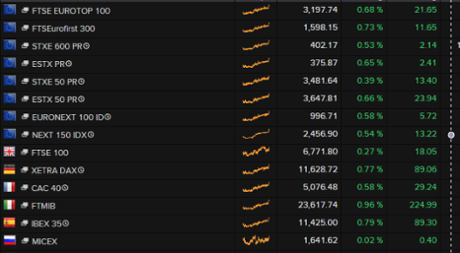
Euro markets hit six-week high on Greek relief
European stock markets ended the day strongly, as investors reacted to signs that the Greek crisis was easing, for now at least.
The main indices all finished higher, with European markets hitting their highest level since late May.
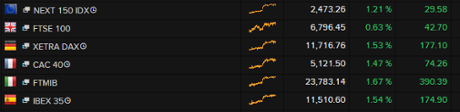
The €900m increase in Greece’s emergency liquidity levels raised hopes that Greece’s banks will reopen on Monday, although capital controls will stay in place.
Jasper Lawler of CMC Markets explains:
The ECB’s willingness to raise the ceiling on the ELA puts to bed the immediate risk of a banking collapse and paves the path towards the reopening of Greek banks and the eventual end to capital controls.
Mr Draghi saying that the need for debt relief in Greece is “uncontroversial” puts the ECB’s stance on the issue alongside the IMF. It increases the odds of a more substantial haircut than has been admitted by Eurozone finance ministers.
Last night’s vote in the Athens parliament to accept the bailout (through gritted teeth) was also cheered by traders, as it means a bridge loan is also imminent.

Over in Athens, Alexis Tsipras has been meeting with key aides this afternoon, plotting his next move.
A government minister says that a reshuffle won’t be announced on Thursday, though.
So the up-and-coming stars of Greek politics should stay by their phones (and those who rebelled last night needn’t rush to clear their desks)
Greek gov reshuffle won't be announced today. Courage to all colleagues there..#Greece #Agreekment https://t.co/HQ79bq4Ut0
— Efi Koutsokosta (@Efkouts) July 16, 2015
Hallo..... German tabloid Bild is reporting that senior social democrat Peer Steinbrück will vote against the Greek bailout package on Friday morning.
Thats big news: Ex-SPD-chancellor-candidate @peersteinbrueck will vote NO tomorrow in german parliament @BILD #grexit http://t.co/wN9DsyAMWz
— Paul Ronzheimer (@ronzheimer) July 16, 2015
Steinbrück ran against Merkel for the chancellorship in 2013, and was finance minister in her first coalition.
It appears that he believes Greece would be better off outside the eurozone:
Steinbrück no longer has skin in game politically and seems to genuinely believe #Grexit best scenario for Greece as will mean debt relief
— Pawel Swidlicki (@pswidlicki) July 16, 2015
Here’s some required reading before tomorrow’s vote in the Bundestag on the new Greek bailout package.
Jürgen Habermas, one of Germany’s leading intellectuals, has heavily criticised Angela Merkel for her handling of the Greek crisis.
Rather than acting in Europe’s best interests, he told the Guardian, Merkel gambled half a century of political capital to bring Alexis Tsipras into line.
As Haberas puts it:
“Forcing the Greek government to agree to an economically questionable, predominantly symbolic privatisation fund cannot be understood as anything other an act of punishment against a leftwing government.”
Greek banks may reopen on Monday

The ECB’s decision to pump another €900m of emergency liquidity into the Greek banking sector means banks could open next week, after a three-week hiatus.
One senior banker has told Reuters that:
“They will open on Monday.”
A ministerial decision on the bank holiday could come later today.
Snap Summary: Masterful Mario joins call for Greek debt relief

A vintage performance by the European Central Bank governor there.
Mario Draghi deftly set the agenda for the next few weeks, while also stoutly defended his role in the crisis and putting his critics - at home and aboard - in their place.
The top line news is that the ECB has accepted a request to provide an extra €900m to the Greek banking sector. That emergency liquidity will keep the cash machines churning out €60 per day for the next week.
It’s a relatively small rise, and it won’t allow the banking sector to fully reopen. But it’s a signal that Greece could be inching back to relative normality.
I did not expect the #ECB to raise ELA for #Greek banks already today. The decision shows willingness to support a fragile process #Greece
— Nick Kounis (@nickkounis) July 16, 2015
Most of the questions at today’s press conference focused on Greece. Draghi threw his considerable muscle behind calls for Greece to receive debt relief, echoing the IMF, the US Treasury, and Athens, of course.
But the beautiful thing about Draghi’s intervention, is that he made it sound like the most natural, obvious thing in the world:
“It’s uncontroversial that debt relief is necessary and I think that nobody has ever disputed that. The issue is what is the best form of debt relief within our framework, within our legal institutional framework.
I think we should focus on this point in the coming weeks.”
Not, I suspect, what Angela Merkel wanted to hear a day before she asks a restless Bundestag to vote on the package.
Draghi also calmly declared that he expects Greece to repay the ECB on Monday, suggesting that it will get a bridge loan (perhaps even today).
Criticism of the ECB’s actions were swept to the boundary, with Draghi insistent that the governing council has simply followed its mandate. The drip-drip-drip of criticism that he’s been “asphyxiating” the Greek banking sector may have hit home.
Criticism has been “quite unwarranted”, he declared, explaining that the ECB had steered a sensible course between fuelling a bank run and crashing the whole system.
Draghi dealt just as firmly with suggestions that he could be more skeptical of Alexis Tsipras’s government, and its ability to do its job. That is hardly the role of an independent central bank chief (indeed, Berlin has already got this role covered).
There was mixed news for Greeks who can’t access their banks. Capital controls are going to be around for a while, until the threat of a bank run has receded.
But on a happier note, Draghi hinted that Greece could soon share in the ECB’s QE programme, if it sticks with its latest bailout programme.
In the meantime, we’ll:
“continues to act on the assumption that Greece is and will ... remain a member of the euro area.”
And that won’t be shaken by any talk of ‘temporary Grexit’ from the likes of Wolfgang Schäuble.
In short, it was a picture of a central banker dutifully following his mandate, and quietly steering the eurozone through a mess that is not of his making.
Shorter Draghi; Thank God you've got me and not one of those other clowns. I will cut you though
— World First (@World_First) July 16, 2015
Another tantalising development.... Draghi hints that Greece could soon benefit from the ECB’s quantitative-easing scheme, if it delivers on what’s been demanded.
#ECB's Draghi: Greek QE eligibility depends on debt rating. Greek ECB repayment would leave room for QE purchases.
— Holger Zschaepitz (@Schuldensuehner) July 16, 2015
#Draghi: If SMP bonds re-payed on Monday, #Greece will become QE-eligible. BUT #ECB can't purchase without good implementation of program.
— Maxime Sbaihi (@MxSba) July 16, 2015
Draghi also gives Alexis Tsipras a nudge:
Draghi: There are questions about implementation: will and capacity, up to the Greek Government to dispel these doubts
— ECB (@ecb) July 16, 2015
How can the European Central Bank be so confident, given that prime minister Alexis Tsipras says he doesn’t believe in the bailout deal?
Draghi knocks this one out of the ground, in a manner that would have been applauded at the other ECB.
Do you really want us taking decisions based on political uncertainty? Or raising doubts about a government’s ability to implement its decisions? No, we follow our mandate.
Was the decision to give Greece more emergency liquidity unanimous?
Draghi claims that such decisions are never unanimous, as it takes a two-thirds majority to reject a request from a national bank.
Hmmmm me thinks it was not unanimous at all.
Decision not to object to BoG was approved, question of unanimity irrelevant, Draghi says. (*cough* Weidmann *cough*)
— Frederik Ducrozet (@fwred) July 16, 2015
Draghi says the ECB didn’t take a decision on the ELA haircut (which is applied to the assets provided on Greek banks when they get emergency liquidity).
Draghi’s confidence on getting repaid on Monday means he is certain that Greece will get its bridging loan in time.
What will happen if Greece defaults on the ECB on 20 July?
My information is that repayment will be met, and the IMF repayment too. So that is off the table, Draghi replies.
He’s getting positively insouciant now!
#Draghi: all my evidence leads me to say we will be repaid as well as the IMF, so that is off the table
— Open Europe (@OpenEurope) July 16, 2015
Draghi also reveals that the ECB will change the way that ELA changes are announced. Currently they are not, but leak out to journalists.
That’s going to stop, now that we’re dealing with a systemic, macroeconomic problem.
When will the Greek banks reopen and operate normally?
It would be good to reopen them soon, Draghi agrees. It’s a decision for the Greek government.
But we need to avoid a bank run, which would leave all the depositors being hit.
Capital controls have protected depositors, who are generally now all “small depositors”, says Draghi pointedly (a reference to the bank scamper in Greece this year)
What’s Draghi’s take on Wolfgang Schäuble’s idea that Greece could temporarily leave the eurozone?
I am not going to comment on politician’s statements. I only know our mandate, says Draghi, which is to work on the assumption that Greece is and will remain a member of the eurozone.
Is a €900m increase in ELA enough to help Greece? Will cash machine withdrawals remain at €60 per day?
Draghi rejects the suggestion that he’s being stingy with Greece - we have “completely and fully” satisfied the Bank of Greece’s request (although adjusted to one-week, so the ECB can see how the situation develops)
Draghi: "It's uncontroversial that debt relief is necessary.the issue is what's the best form of debt relief. I think we shld focus on this"
— James Mackintosh (@jmackin2) July 16, 2015
Draghi: Greece needs debt relief
Debt relief for Greece is “necessary”, Draghi continues. No-one has ever disputed that.
But the question is how we do that in our institutional framework.
(ie, do we do it through extending repayment dates, rather than up-front haircuts)
Mario Draghi says it’s uncontroversial debt relief is necessary in Greece. Yes from an economist’s perspective. Not a (German) politician’s
— Ed Conway (@EdConwaySky) July 16, 2015
What’s Draghi’s view of the Greek bailout deal?
Draghi points to the structural reforms in the package - they could help Greece become a thriving member of eurozone over time.
#Draghi mounted a pretty staunch defence of the ECB role in providing ELA to #Greece there.
— Ferdinando Giugliano (@FerdiGiugliano) July 16, 2015
Have you let Greece down?
Mario Drahghi says he finds such criticism quite “unwarranted”.
He embarks on a long explanation of how the ECB has propped up the Greek banking sector for months, as savers withdrew their savings this year.
We now have a total exposure of €130bn to Greece, that makes us the biggest depositor.
We had to adjust the collateral haircuts when the quality of the assets held by Greek banks deteriorated.
But we didn’t cut the ELA off altogether, as some people pushed for. That would have been against our mandate. We have always acted on the assumption that Greece was, and would remain, a member of the eurozone.
Draghi says those wanting to cut ELA (*cough Weidmann*) did not respect ECB mandate and wanted to decide who is or is not in euro
— Mehreen (@MehreenKhn) July 16, 2015
Updated
Greek emergency liquidity raised by €900m
Draghi confirms, extremely casually, that the ECB has raised Greece’s emergency liquidity limits by €900m.
That’s a small increase -- it won’t allow capital controls to be lifted.
But it should stop the cash machines running out in the next few days.
And has talk of temporary Grexit opened the Pandora’s Box?
It’s not up to us to decide who should be in the eurozone, Draghi replies. We work on the assumption that Greece is a member, and will continue to be.
Draghi: We have decided to raise Greek ELA
Onto questions....and the first one is about Greece (quite right too).
Will the short-term bridging loan be enough to restore emergency liquidity to the Greek banking sector?
ELA is provided to solvent banks with sufficient collateral, Draghi explains. We capped it once Greece exited its bailout programme without a deal. There were some who wanted us to terminate it - which would have crashed the banking sector.
Things have changed now- we have a series of news, with the approval of the bridge package,.
This restores the conditions to a raise in the ELA.
Is he saying that the ECB has turned the liquidity pumps on again?
Looks like it!
Draghi: Decision to raise ELA took today symmetrical to decision to freeze ELA
— ECB (@ecb) July 16, 2015
ECB raises ELA for Greek banks, Draghi casually mentions in press conference.
— Jamie McGeever (@ReutersJamie) July 16, 2015
Nothing about Greece yet...
Draghi is taking some time to explain that Loan dynamics continued to improve, but are still subdued -- such as the flow of loans to companies.
Draghi cites emerging markets as a threat to the eurozone economic outlook:
Draghi says the ongoing slowdown in EM economies weighs on outlook @ecb @CNBCWorld #ECB
— Louisa Bojesen (@louisabojesen) July 16, 2015
But he suggests other risks (oil, foreign exchange rates) are under control.
Draghi: Downside risks have been generally contained. #hawkishish
— Lorcan Roche Kelly (@LorcanRK) July 16, 2015
We would use “all instruments available” if we saw that an “unwarranted tightening of monetary policy” was taking place, says Draghi firmly.
That’s a warning shot at the markets:
Think that Draghi just said: forget about tapering, our bazooka remains loaded and we will use it until the very end. #ecb
— Carsten Brzeski (@carstenbrzeski) July 16, 2015
Draghi runs through his introductory statement following today’s meeting.
He confirms that the ECB left rates unchanged.
The ECB’s asset-purchase scheme is running smoothly, and will keep running until September 2016, or at least until inflation is back on target.
The evidence we’ve received since our last meeting in June has been broadly in line with our assessment of the economic situation.
It’s a ‘steady-as-she-goes’ performance so far.
Draghi: The ECB’s monetary policy stance remains accommodative.
— ECB (@ecb) July 16, 2015
Draghi: Market-based inflation expectations have, on balance, stabilised or recovered further since our meeting in early June.
— ECB (@ecb) July 16, 2015
ECB press conference begins
After some toe-tapping hold music, Mairo Draghi has arrived.

It’s nearly time for the main event of the afternoon - Mario Draghi’s press conference.
We’re hoping for a lot of questions about Greece - this is the first European Central Bank presser since capital controls were introduced.
What will it take for Draghi to pump more emergency liquidity into the Greek banking system?
What will happen if Greece €3.5bn repayment to the ECB on July 20?
What’s his take on last weekend’s Euro summit (where he apparently had a blazing row with the German finance minister?)
Plus the meat-and-drink of monetary policy: the state of the economy, the ECB’s stimulus packages, etc etc.
Despite last night’s vote, the Economist Intelligence Unit reckon this latest bailout deal is domed:
3 reasons Greek deal wont work: i) debt sustainability unaddressed; ii) GR cant implement, iii) neither side is taking political ownership
— Alex White (@AlexWhite1812) July 16, 2015
ECB leaves rates unchanged
Here comes the European Central Bank’s decisions....
And to no-one’s huge surprise, they have left interest rates across the eurozone unchanged.
That means the headline rate remains at a record low of 0.05%.
The deposit rate stays at -0.2%, meaning banks will still face negative interest rates for leaving cash at the ECB.
The marginal lending rate (charged to banks who borrow from the ECB) remains at 0.3%.
#ECB leaves rates unchanged http://t.co/hqOZBDSNfW
— ECB (@ecb) July 16, 2015
Here’s the Agence-France Presse report on the EU believing last night’s vote met the bailout conditions:
A Greek parliament vote satisfies the initial terms of a reforms-for-bailout deal between Greece and its EU creditors agreed at a 17-hour summit earlier this week, an EU spokeswoman said Thursday.
“The authorities have legally implemented the first set of four measures agreed at the eurosummit in a timely and overall satisfactory manner,” spokeswoman Annika Breidthardt told reporters.
Meanwhile, more concerns from Germany:
Economic Committee of Merkel's CDU party: third Greek ESM bailout "has been exposed as wishful thinking by the IMF" https://t.co/xRtXSRWZV4
— Pieter Cleppe (@pietercleppe) July 16, 2015
Greek risks remain elevated, says Moody's
Despite the Greek vote avoiding an immediate default, there are still considerable risks ahead, according to ratings agency Moody’s. It said Greece’s fiscal strength was “low” and the potential to reduce its debt burden was uncertain:
The Greek parliamentary vote averts an immediate disorderly default and potential exit from the euro area, but risks remains elevated given Greece’s weak institutions and substantial political scepticism on the bailout conditions.
The vote – following votes in other parliaments on Friday – should pave the way for the Greek government to receive much-needed liquidity to make its upcoming large external payment obligations for at least the next month.
Considerable uncertainty remains regarding the ability of Greece and its official creditors to reach a final agreement on a third programme to receive sustained funding, especially given the short time frame within which the program has to be negotiated.
Even if an agreement is found, judging by recent events and the deep economic problems and social divisions within society, it is highly uncertain whether the Greek authorities have the capacity to achieve agreed objectives and to abide by its creditor’s conditions.
We assess Greece’s Fiscal Strength as `low’, because of the country’s high debt burden, which stood at around 177% of GDP at the end of 2014, one of the highest debt burdens in the universe of Moody’s-rated countries. Moreover, the potential to meaningfully improve the debt trend over the next 3-5 years is highly uncertain given that the large-scale reforms that could spur growth are currently hampered by ongoing political uncertainty.
Against the backdrop of considerable decline in economic activity in the last six months, and even with a support programme in place, we expect non-performing loan ratio to increase to 40-45% up from 35% of all outstanding loans in December 2014. Given that current provisioning levels are weak, higher provisioning charges are likely to raise further solvency issues for banks.
Greek elections in September?
Greece’s interior minister Nikos Voutsis has said elections could come in September or October.
Speaking on Kokkino radio station, he said that elections are highly likely. The station reports:
“If it’s not September it will be on October and it will be a product of an overall insight-not just of the Syriza government- on the broader developments” he said.
Asked what would be the main question for the next election, the minister of Interior said it would be a mandate to apply our program.
A decision on a reshuffle would be made before 22 July, he added.
#SYRIZA Nikos Voutsis: Elections September or October #Grelections #ThisIsACoup http://t.co/49RktxWCvm pic.twitter.com/EQj6bIzzm8
— Στο Κόκκινο 105,5 (@stokokkino1055) July 16, 2015
Updated
The European Commission says it takes the Greek vote as a positive signal, and believes a compromise on a bridging loan for Greece is within reach.
It added that short term funds could be disbursed rapidly, reports Reuters.
Updated
The Eurogroup call has finished and more news is expected later today, according to its spokesman:
Call #Eurogroup has finished. More on the outcome early afternoon #Greece
— Michel Reijns (@MichelReijns) July 16, 2015
Despite concerns from EU ministers about Greece’s ability to implement the proposed reforms - Finland’s Alexander Stubb for one - the EU reportedly believes that the vote last night satisfies the bailout terms:
#BREAKING Greek parliament vote satisfies bailout deal terms: EU official
— Agence France-Presse (@AFP) July 16, 2015
European Commission-Institutions Assess Greece Has Legally Implemented 4 Key Measures Agreed At Summit. (DJ)
— Holger Zschaepitz (@Schuldensuehner) July 16, 2015
Updated
Austrian finance minister Hans Jörg Schelling has said he has heard from sources at the European Central Bank that the emergency liquidity assistance for Greece will be extended, Reuters is reporting.
Schelling also said he expects an agreement on a bridging loan for Greece to be reached by late afternoon tomorrow.
And here’s the ECB (central bank) and ECB (cricket) confusion, as tweeted by the ECB’s head of media:
A typical morning on the @ecb mentions thread. (Not sure anyone every tweets monetary policy to @ECB_cricket) pic.twitter.com/cWXoEuXzLJ
— Michael Steen (@michaelsteen) July 16, 2015
That leaves the German and Austrian parliaments to vote tomorrow.
Meanwhile the European Stability Mechanism council will have a conference call tomorrow to decide whether to begin negotiations about a third Greek bailout:
ESM governing council will have teleconf tomorrow at 4pm BXL time to make formal decision to start negotiations. #Greece
— Jarno Hartikainen (@JarnoHa) July 16, 2015
Finland approves Greek bailout talks
Finland has given its approval to start negotiations for a new bailout programme for Greece and for talks on bridging finance.
The Grand Committee, which acts on behalf of the country’s MPs, voted in favour of the request for talks (a day earlier than we had expected.)
Finance minister Alexander Stubb said Finland would not accept a haircut on Greek debt, but was open to other options.
He also said he was concerned about Greece implementing the reforms, given prime minister Alexis Tsipras said last night he did not believe in them.
#Finland parliament approuves #greekment . FinMin refusing possibility of haircut but open to discuss other options. https://t.co/M0eHFfmttZ
— José Miguel Sardo (@jmsardo) July 16, 2015
Stubb: Today we have mandate from FI parliament for bridge financing and begin of negotiations of 3rd bailout. #Greece
— Jarno Hartikainen (@JarnoHa) July 16, 2015
Stubb: Finland won't accept haircut. Some other form of debt restructuring might be discussed. #Greece
— Jarno Hartikainen (@JarnoHa) July 16, 2015
Stubb: Though hard to see much space for further debt relief since already maturities very long and interest rates low. #Greece
— Jarno Hartikainen (@JarnoHa) July 16, 2015
Stubb: I'm a bit worried after Greek PM last night said he doesn't believe in this programme. #Greece
— Jarno Hartikainen (@JarnoHa) July 16, 2015
Stubb: Clear that in order to conclude ESM prog talks Greek gov't must fully commit to its implementation. We have to be able to trust them.
— Jarno Hartikainen (@JarnoHa) July 16, 2015
Updated
New Forsa/Stern poll of German voters: - 55%: Merkel right to try keep #Greece in; - 31%: #Grexit should've been forced; - 14%: undecided.
— Open Europe (@OpenEurope) July 16, 2015
Secondly, film of violence that broke out at last night’s protests:
Meanwhile here are a couple of videos from last night.
First the Greek parliament passing the bailout deal:
Bridging loan agreed in principle - Bloomberg
The €7bn bridging loan for Greece has been agreed in principle and could be announced tomorrow, Bloomberg is reporting:
Euro Area said to agree in principle to €7bn #Greece bridge loan. Eurozone bridge loan to Greece would be announced tomorrow, BBG reports.
— Holger Zschaepitz (@Schuldensuehner) July 16, 2015
Updated
After Germany’s Wolfgang Schäuble raised the prospect once more of Greece leaving the eurozone temporarily, Greek deputy prime minister Yannis Dragasakis has dismissed the idea.
In a Facebook post he said Schäuble was offering the carrot of a temporary exit to relieve the debt burden, with the stick of the threat of bankruptcy. But he said there were ways within the existing framework to allieviate the debt burden (debt relief along the lines suggested by the IMF perhaps, with a 30 year grace period).
#Greece DepPM @YDragasakis reacts to #Germany FinMin Schäuble @DLF interview: 'No timeout. Reprofiling in the #euro' https://t.co/ivINWUduxL
— Yannis Koutsomitis (@YanniKouts) July 16, 2015
Here is his conclusion, translated:
Within the current framework there are technical capabilities that could alleviate the Greek economy and society from the excessive burden of debt, putting it on a sustainable path. These, with persistence and rigor, we try to make the most of defending the long term interests of Greece and of Europe.
The Greek reshuffle may not happen today after all, it seems:
#Greece cabinet reshuffling may be delayed until Friday (via @capitalgr) #politics
— Manos Giakoumis (@ManosGiakoumis) July 16, 2015
More from the radio interview earlier with German finance minister Wolfgang Schäuble.
Reuters reports:
[Schäuble] questioned whether Greece will ever get a third bailout programme on Thursday, a day after the Greek parliament passed a package of stringent measures required to open negotiations on financial aid.
He said he would submit a request to Germany’s parliament to vote on opening the talks and said passing the reforms was an “important step”, but it would be hard to make Greece’s debt sustainable without writing some of it off, an idea Berlin considers to be illegal.
“We will now see in the negotiations whether there is even a way to get to a new programme taking into account (Greece’s) financing needs, which have risen incredibly,” he told Deutschlandfunk radio on Thursday.
Finland has to vote on the Greek bailout deal, and could prove tricky to get a mandate for a deal as our Europe editor Ian Traynor explained earlier in the week:
And now:
*FINLAND TO DEMAND GENUINE GREEK COMMITMENT TO REFORM, PM SAYS
— Stavros Kallinos (@StKallinos) July 16, 2015
FIN PM Sipilä: Biggest concern is Greek government's lack of ownership over programme. It needs to strengthen during actual debt talks.
— Jarno Hartikainen (@JarnoHa) July 16, 2015
Finland, Austria and Germany all vote on Friday.
Updated
Meanwhile the Greek bank holiday has been extended until 17 July, according to Greek news agency ANA-MPA, which is hardly a surprise. The banks cannot reopen without further support from the European Central Bank.
ECB to leave emergency assistance unchanged - reports
Here’s some bits of speculation about the European Central Bank and its emergency liquidity assistance for Greek banks:
Sources suggest #ECB has not yet decided on #Greece ELA, but #Greece requesting increase of €1.5bn (@RANsquawk)
— Open Europe (@OpenEurope) July 16, 2015
#ECB said to favour maintaining #Greece ELA unchanged ~BBG
— Yannis Koutsomitis (@YanniKouts) July 16, 2015
Sources: #Ecb likely to keep #Ela unchanged today and to rise it once Esm negotiation will start and bridge loan will be agreed #Greece
— Giovanna Pancheri (@giopank) July 16, 2015
The ECB is currently meeting and will give a press conference later.
Updated
After meeting ECB president Mario Draghi yesterday, US Treasury Secretary Jack Lew has been in talks today with German finance minister Wolfgang Schäuble.
#Germany FinMin Schäuble and US Tsy Sec Lew meet in Berlin pic.twitter.com/1ebz4Ijl2n /via @BMF_Bund
— Yannis Koutsomitis (@YanniKouts) July 16, 2015
Perhaps they were discussing swapping Greece for Puerto Rico. Last week Schäuble said in Frankfurt:
I offered to my friend Jack Lew that we would take Puerto Rico into the eurozone, if the USA took Greece into the dollar union. He thought I was joking.
Updated
The chairman of Germany’s CSU Horst Seehofer has welcomed the Greek vote to begin negotiations and said it was a sign of trust building. He called on his party to back the deal in the German parliament tomorrow. He told the Süddeutsche Zeitung:
This is the beginning of a trust building, which is urgently needed after the last few weeks and months.
I strongly recommend that the friends of my party and our group formally agree to start negotiations.
Full story here (in German).
In the middle of the financial crisis, Greeks have been buying big ticket electrical items such as large screen TVs, writes Shane Hickey.
That is according to Dixons Carphone, whose Kotsovolos arm in Greece returned to profitability during the year. But the company said:
We do however remain very mindful of the uncertain economic and political situation in the country and the effect this may have on our business.
Dixons Carphone results factlet: large screen TVs sold especially well in Greece. Everyone keeping an eye on Syntagma Square..?
— George MacDonald (@GeorgeMacD) July 16, 2015
Updated
And here are his concerns, and they revolve around our old friend “implementation”:
The real trouble and challenges may come later. No majority, no ownership could dent implementation of measures & reforms #Greece #eurozone
— Peter Kažimír (@KazimirPeter) July 16, 2015
Greek vote was the easy part - Slovak finance minister
And here comes the man who blamed the Greek situation on “Syriza Spring” to welcome last night’s vote, in a rather downbeat way. Slovak finance minister Peter Kazimir tweets:
I welcome the positive vote of the Greek parliament, but this is the easier part of the deal #Greece #eurozone #ECB #IMF
— Peter Kažimír (@KazimirPeter) July 16, 2015
Updated
More from the ESM’s Klaus Regling on German radio, who said the emergency fund would provide around €50bn to the Greek bailout:
Regling tells @ardmoma that ESM will provide about €50bn for #Greece's €85bn 3rd bailout.
— Open Europe (@OpenEurope) July 16, 2015
Regling to @ardmoma: Eurosummit made clear that it 'is up to €85bn - not at least €85bn' for #Greece in 3rd programme.
— Open Europe (@OpenEurope) July 16, 2015
Updated
European markets have opened higher after the Greek vote which opens the way for negotiations over a third bailout:
Updated
Is the eurozone about to give Greece a break on debt relief?
Christine Lagarde, the director of the International Monetary Fund, hinted as much when she said Greece’s creditors were moving closer to easing the burden of Greece’s debt.
“I have some hope because I understand as late as a couple of hours ago there were some more positive noises to that principle of debt restructuring,” she told CNN in an interview on Wednesday.
“One way has to be found in order to release that burden and allow that country to demonstrate, yes, it can be back on a sustainable path.”
She laid out several ways Greece’s creditors could lessen the debt burden: giving Greece more time to pay back debt, extending the holiday on repayments, reducing interest rates or writing off a portion of the total - a haircut.
But she made clear the latter is not acceptable to eurozone governments.
“Haircuts are not on the cards, not in these member states.”

The IMF thinks Athens should receive a 30-year grace period before it has to start paying off its debts. The fund made this recommendation in a devastating analysis on Greece’s debts that ripped apart the idea the current bailout plan could work without much more generous debt relief.
While the IMF report is comfort to Syriza, it is clear the fund are not exactly fans of Greece’s leftist government.
Lagarde is convinced Greece was “on the path to sustainability” eighteen months ago. She blames the Syriza-led government for reversing austerity measures, as well as backsliding on reform promises under the previous government - led by Antonis Samaras of the centre-right New Democracy party.
Despite the critical tone, the fund’s intervention is likely to help Greece in the extremely difficult negotiations on the small print of the €86bn bailout that will take place over the next month.
Lagarde made clear she saw two parts to those talks: more reforms from the Greek government and “a significant debt restructuring that will actually keep everything together and put the country back on a sustainable track.”
It is yet another reminder that the Greek debt crisis is far from over.
Temporary Grexit still a good option - Schäuble
Ahead of the vote on the bailout tomorrow in the German parliament, the country’s finance minister Wolfgang Schäuble is still persisting with his suggestion of a temporary exit from the eurozone by Greece. Reuters reports:
Schäuble said he would submit a request to Germany’s parliament to reopen negotiations on Greece’s third bailout with “full conviction”, but still believes a temporary Grexit would perhaps be a better option.
“We are a step further,” Schaeuble told Germany’s Deutschlandfunk radio on Thursday, after the Greek parliament passed a sweeping package of austerity measures demanded by European partners.
“This is an important step,” he said.
He added, however, that many economists doubt that Greece’s problems can be solved without a debt haircut.
He said a haircut would be incompatible with a country’s membership of the euro, meaning that a country would therefore have to leave the currency union temporarily.
“But this would perhaps be the better way for Greece,” Schaeuble said.

Updated
Yields for Spanish, Portuguese and Italian bonds have dipped after the Greek vote, with investors showing some cautious optimism for the outlook. They fell up to 4 basis points to around six-week lows.
Greek bank collapse could threaten whole eurozone - ESM
Well it comes under the category of stating the obvious, but the head of the European Stability Mechanism has warned Greek banks could collapse without a third bailout.
Klaus Regling, head of the agency which gives financial support to eurozone countries, told German broadcaster ARD:
If everything should fail, then the Greek banking system would collapse. If the four biggest systemically relevant banks in a country no longer work, this has grave consequences not just for Greece... but also for the whole eurozone.
Quotes courtesy Reuters.

Updated
Asian markets edged higher after the news of the Greek vote, and European markets are expected to open in positive territory ahead of the ECB meeting:
Our European opening calls: $FTSE 6788 up 34 $DAX 11651 up 112 $CAC 5091 up 44 $IBEX 11419 up 84 $MIB 23601 up 208
— IGSquawk (@IGSquawk) July 16, 2015
Jasper Lawler, market analyst at CMC Markets UK, said:
European stocks are expected to rejoice higher at the market open on Thursday after parliamentary approval overnight in Athens makes the Greek bailout deal as good as done. A bridge financing arrangement to allow Greece to meet its July 20 payment to the ECB using European Union funds is also nearly in place after agreeing protection for non-Eurozone countries such as Britain.
The 10,000 protestors outside parliament in Athens and the resignation of the deputy finance minister suggest the next risk for Greece’s stability is political. PM Tsipras will try a cabinet reshuffle but if that fails to sure up confidence in Syriza, a worst case scenario would be snap elections.
Introduction: Greece moves closer to third bailout after vote
Good morning and welcome to our rolling coverage of the Greek financial crisis.
So, if this week’s deal between Greece and its creditors was a Pyrrhic victory for Alexis Tsipras - given the bailout terms were worse than the previous offer - what then of last night’s vote?
The Greek prime minister succeeded in pushing the contentious measures through the Greek parliament last night, but the cost was high. In the 229 lawmakers voted in favour, 64 against and there were six abstentions.
But 40 of Tsipras’s Syriza party rejected the new terms, casting doubt on his authority and almost certain to lead to a reshuffle this morning, if not snap elections at a later point. One of them was former finance minister Yanis Varoufakis, hardly a surprise he wrote after a scathing attack on the deal in a blogpost.
At the same time there were scenes of violence on the streets of Athens for the first time this year, as riot police fired teargas and fought running battles with anti-austerity protesters armed with molotov cocktails.

Here’s our story wrapping up the night’s events:
Meanwhile there are still hurdles to overcome, with the German parliament set to vote on the deal on Friday and EU officials scrambling to put together a €7bn bridging loan to tide Greece through the next few weeks. Despite some resistance - including from the UK - it appears the EFSM stability mechanism will be used for the arrangement. Non-eurozone countries had wanted guarantees they would be protected if Greece did not repay the loans.
The Eurogroup of finance ministers is due to hold a conference call to discuss the situation at 8.00 GMT (9.00 BST), as tweeted by its spokesman last night:
Confirmation just went out: #Eurogroup teleconference tomorrow 10 AM #Greece
— Michel Reijns (@MichelReijns) July 15, 2015
There are also some doubts as to whether the bailout package will actually do the job intended, with little prospect of the Greek economy recovering using severe austerity measures without some form of debt relief and a plan for growth.
Meanwhile the ECB will also be in the spotlight.
[Not the English Cricket Board - there will be a separate live blog for the Test Match with Australia]
The European Central Bank makes its normal policy statement and holds its normal press conference at lunchtime.
But given these are not normal times, the questioning will be on what the Bank will do about its emergency liquidity assistance for Greek banks. It could increase the ELA, reducing the squeeze on the banks, and paving the way for them to reopen. Any move, however, is likely to be modest.
Updated