Closing summary
The polls will be opening in less than 13 hours and it feels like time for a closing summary.
- Germany has softened its stance on Grexit and indicated that any possible Greek exit from the eurozone may only be temporary. The German finance minister Wolfgang Schäuble said Greeks would not be left in the lurch.
Greece is a member of the eurozone. There’s no doubt about that. Whether with the euro or temporarily without it: only the Greeks can answer this question.
When he made those remarks, Schäuble probably hadn’t heard that Yanis Varoufakis, the Greek finance minister, thinks the country’s creditors are trying to “terrorize” Greece.
Varoufakis said Greece’s creditors wanted to “instil fear” and blamed them for the government having to close the banks.
What they’re doing with Greece has a name -- terrorism. What Brussels and the troika want today is for the yes (vote) to win so they could humiliate the Greeks.
We will be looking forward to the next eurozone finance ministers meeting if Varoufakis does stay in office - he has promised to resign in the event of a yes vote.
- Matteo Renzi reiterated his message of reassurance that Italy will not be following in Greece’s footsteps. The Italian prime minister said Italy was no longer the sick man of Europe.
- Around 1,000 people gathered in London urging the cancellation of Greece’s debts. Similar rallies took place in other UK cities, following demonstrations in Brussels, Rome and Paris earlier this week.
That’s all from me. The Guardian live blog team will be back tomorrow to guide you through polling day and beyond.
Thank you for following and commenting.
Delors calls for rescue plan for Greece
One of the most influential architects of the European Union has called on its current leaders to do everything they can to rescue Greece, including looking at its debt burden “without delay”.
Jacques Delors, who was responsible for deepening European integration when he was president of the Commission from 1985-93, called on the EU to adopt a three-part rescue plan for Greece.
Writing in Le Monde, he writes that Greece needs (1) financial aid to restore it to short-term solvency (2) help via EU programmes so it can return to economic growth and (3) “without delay examination of the weight of Greek debt”, as well as the debts of other countries that have been under EU bailout programmes.
The Greek drama is not solely national: it will have effects on all of Europe.
But he has a stern message for the Greek authorities
An exit from the current crisis means a change in view from Greece... it requires the expression of a clear will to break with the last forty years.
The article is co-signed by Pascal Lamy, former head of the World Trade Organisation and European commissioner, and Antonio Vitorino , president of the Jacques Delors Institute.
Are we getting smoke signals from the European Commission?
The most senior advisor to Jean-Claude Juncker, the president of the Commission, has been assiduously tweeting his boss’s thoughts on the Greek government this afternoon.
Martin Selmayr is Juncker’s head of cabinet. He recently got into hot water with the German finance ministry when he tweeted that a new Greek proposal was a good basis for progress.
He has been busy on Twitter again.
For instance...
It turns out the Der Spiegel interview is more than two weeks old.
So why the volley of tweets the day before the Greek vote?
Is it a response to European Council president Donald Tusk’s statement that voting no doesn’t have to mean leaving the euro? Or German finance minister Wolfgang Schäuble’s softer tone that leaving the euro could be temporary.
Juncker once had relatively good relations with Greece’s hard-left government. But he has fallen out with Alexis Tsipras. He feels personally betrayed and said a few days ago that “no would mean that Greece is saying no to Europe”.
These tweets could be seen as a subtle way to reinforce that message.
Updated
Greece's newspapers decide
The division in Greece over Sunday’s referendum is reflected in the country’s newspapers, which are split between yes and no.
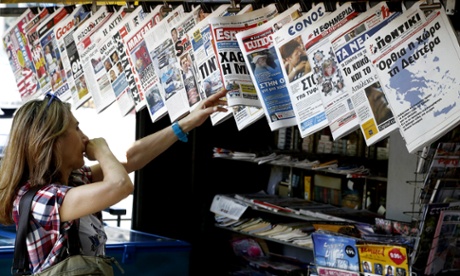
First, some context from Sophia Ignatidou of The Week. She writes that “most mainstream media outlets in Greece have close ties to political parties or business magnates, so their coverage is often viewed with a healthy degree of scepticism”. A number of papers are affiliated to Syriza or the Communist party, so their support for no is not surprising, she says.
Ethnos is calling on its readers to vote yes. “Greeks choose Europe” reads the front page of the Sunday edition of Ethnos, printed on the background of a photo of Greek and European Union flags. (The referendum means that Sunday papers are ready for Saturday).
Proto Thema, Greece’s biggest selling weekly, is also calling for yes.
No means immediate deposit haircut, banks and ATMs closed, rationing of food, medicine and gas, and, in the end, drachma and national tragedy.
Avgi, a newspaper affiliated to Syriza, followed the line of prime minister Alexis Tsipras that a no vote would be “the catalyst for a new deal”.
The referendum is the way through which the people take an active role in the negotiations, regardless of whether they choose yes or no.
Rizospastis, linked to the Communist party, echoed the language of Tsipras and Varoufakis, by calling on “people to turn their back to the blackmail and the terrorising dilemmas posed by the referendum”.
Updated
Greece solidarity rallies are now underway in London and Dublin.
Londoners stage rally to show support for Greece as country faces crunch referendum http://t.co/iLvzhbckzs pic.twitter.com/5tt50T97uQ
— Evening Standard (@standardnews) July 4, 2015
Demonstrators in solidarity with Greece now on Molesworth Street in Dublin. #Greece pic.twitter.com/EpvzrY0CnL
— Conor Barrins (@ConorBarrins) July 4, 2015
Italy no longer Greece's "companion in misfortune"
Italy’s prime minister Matteo Renzi has said his country is no longer a “companion in misfortune” of debt-ridden Greece, as it was three or four years ago.
We need to stop calling Italy the sick man of Europe, because it’s no longer true.
Speaking on Italian television Renzi said Italy was no longer afraid of the consequences of Greece’s financial troubles - unlike during the 2011 crisis when fears were high of contagion spreading from the Greek crisis to many other heavily-indebted European nations.
Reforms undertaken in Italy have shown that “we are on the side of those who seek to resolve the problem” he said.
Spillover from the Greek debt crisis is no longer such a big fear for Italy, Spain and Portugal.
But the threat hasn’t entirely gone away. The cost of borrowing jumped in all three countries when talks between Greece and the eurozone went into meltdown on Monday. However markets soon stabilised: borrowing costs for Italy, Spain and Portugal steadied at less than half levels seen three years ago.
With the European Central Bank standing ready to intervene, Renzi’s confidence is well-founded.
Quotes via AFP
Only war or the great depression of the 1930s has proved more destructive than Greece’s debt crisis and austerity years. This graph brings home the scale of Greece’s economic collapse.
Greece's GDP collapse is among the worst advanced economy falls since 1870. And most of those were war-related. pic.twitter.com/QLp6fYN83u
— RBS Economics (@RBS_Economics) July 4, 2015
The number crunchers at RBS also show how poorly Greece has fared compared to its southern European neighbours.
Greek banking deposits...an almost uninterrupted 5 year decline. #Greece #GreeceCrisis pic.twitter.com/MGiY7D7xUv
— RBS Economics (@RBS_Economics) July 3, 2015
#Greece export growth was the big hope...it hasn't worked - Spain, Portugal and Italy all fared better. #GreeceCrisis pic.twitter.com/h3ViP5jLK3
— RBS Economics (@RBS_Economics) July 3, 2015
Greece faces more instability and could see a rise in political extremism, no matter what the outcome of Sunday’s referendum.
That is the verdict of the Economist Intelligence Unit, which forecasts a victory for the no side.
The sober research organisation paints a picture of growing social strain and political division.
Joan Hoey, regional editor of the EIU, says Greece is heading for tumultuous times.
The EIU forecasts victory for the no camp, but whatever the outcome of the referendum, the stark divisions exposed by the referendum campaign are no basis for a future stable political equilibrium. This, as well as intransigence by Greece’s creditors, will make it difficult to reach a viable agreement on a future financing programme.
Greece today is angry and fearful, divided and conflicted, and will still be after Sunday’s vote. This means that Greece is headed for an even more tumultuous period ahead. With Greek society under immense strain and political divisions becoming sharper, the potential for political extremism will increase.
The analysis, released on Saturday, chimes with a recent article by the historian Mark Mazower.
In the New York Times on Wednesday he wrote:
Thanks to this ill-advised plebiscite, Greece faces major turmoil that will test the democratic institutions it established after 1974. The country doesn’t need a return to the worst excesses of student politics. Still less does it need the overheated rhetoric of violent struggle, national disaster and civil war that is already in the air.
The full article - Don’t Bet on Syriza - is very interesting on the activist culture that shaped the Greek prime minister Alexis Tsipras. Provocative and well worth reading if you haven’t already.
Greek banks were quick to deny rumours that they were going to seize a tranche of savers’ deposits - aka a “haircut” in financial slang.
Greek people have been no less quick to respond.
Syntagma Square, Athens, the morning after the demo the night before pic.twitter.com/i2tXIXX9PJ
— Ed Conway (@EdConwaySky) July 4, 2015
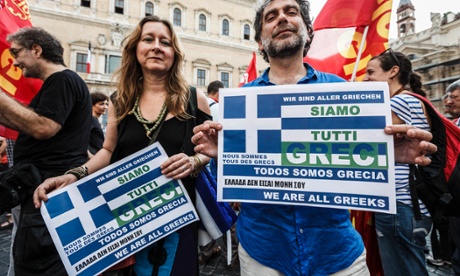
Europeans rally: "We are all Greeks"
It is not only Greeks who have been taking to the streets.
Rallies in support of Greece are due to get underway across the UK, in London, Liverpool and Edinburgh.
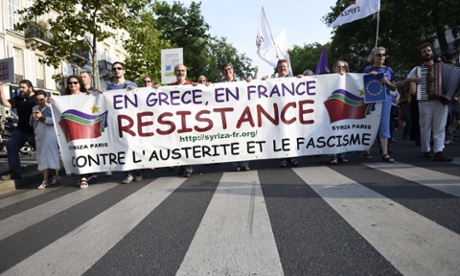
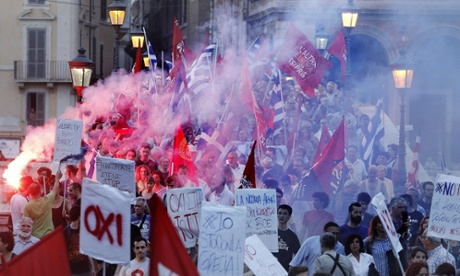
Solidarity marches - supporting a Greek no vote - have taken place in cities across Europe.
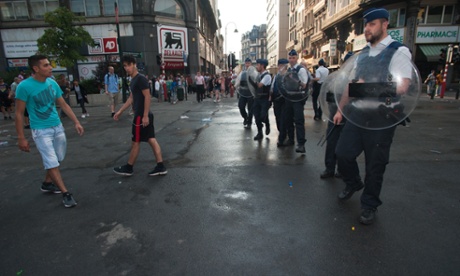
This was the scene in Brussels on Friday night.
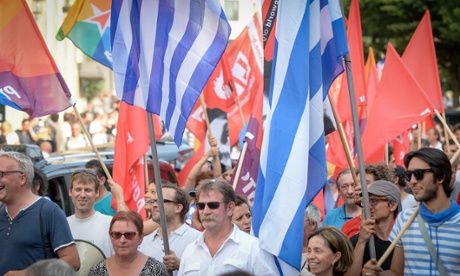
In the Belgian capital, police clashed with young people ahead of the march.

Anti-austerity demonstrators in Paris on Thursday expressed their solidarity with the Greek people.
And in Rome...
Updated
In an earlier entry, I posted this photograph that sums up how deeply sad the debt crisis is for ordinary Greek people.
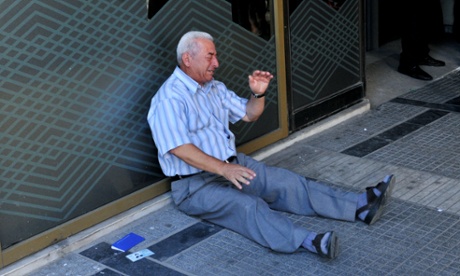
We now know more about the man, who is pensioner Giorgos Chatzifotiadis.
From the AFP news agency:
Giorgos Chatzifotiadis had queued up at three banks in Greece’s second city of Thessaloniki on Friday in the hope of withdrawing a pension on behalf of his wife, but all in vain.
When he was told at the fourth that he could not withdraw his €120 (£86, $133), it was all too much and he collapsed in tears.
The 77-year-old told AFP that he had broken down because he “cannot stand to see my country in this distress”.
“That’s why I feel so beaten, more than for my own personal problems,” Chatzifotiadis said.
The image of him sitting outside the bank, openly crying in despair with his savings book and identity card on the floor, was captured by an AFP photographer illustrating how ordinary Greeks are suffering during the country’s debt crisis.
Recounting how he had gone from bank to bank in a futile attempt to collect his wife’s pension, Chatzifotiadis said when he was told at the fourth “that I could not get the money, I just collapsed”.
Both he and his wife, like many Greeks in the north of the country, had spent several years in Germany where he “worked very hard” in a coal mine and later a foundry.
But Chatzifotiadis feels he can do little to change the situation, and he is not even sure if he would be able to vote at Sunday’s referendum on whether to accept international creditors’ bailout conditions.
European leaders have warned that a ‘No’ vote would also mean no to the eurozone.
Pointing out that the polling station is 80 kilometres (50 miles) away, Chatzifotiadis said: “I have no money to go there, unless perhaps if my children would take me in their car.”
The banks may be running out of money, but Greece is not short of creativity. Greece’s five-year debt crisis has created a thriving anti-austerity art movement.
Jon Henley has been speaking to some of the artists.
Greece's anti-austerity murals: street art expresses a nation's frustration http://t.co/InzWh0ph1y pic.twitter.com/SXxB8uACEd
— The Guardian (@guardian) July 4, 2015
Former photographer Cacao – responsible for works including “€urope without Greece is like a party without drugs”, “Cut the Debt”, “IMF Go Home”, and the now infamous “Then they used tanks. Now they use banks” – said Greece’s long-flourishing street art scene had exploded since the crisis began.
“Partly it was because of this big wave of anger that started in 2008 and just grew and grew,” he said. “But also, as the crisis got worse, there were more and more closed shops and empty buildings. There were a lot of walls to paint.”
You can read the full article here.
Spotted...
Scenes from the yes rally
The Guardian’s Southern Europe editor John Hooper visited the yes rally on Friday night and sent us this report.
The ‘yes’ campaign managed to get up an altogether more rumbustious – and better-attended – demonstration than the one on Tuesday in Syntagma Square, which was marred by rain. Supporters of an agreement turned the centre of the open-air – and open-ended - Panathenaic Stadium in central Athens into a sea of Greek flags dotted with some EU ones. They also spilled out for about 50 yards down the avenue that runs across the stadium’s open side.
Toting a big EU flag, Dimitris Tsaoussis, a financial analyst, said he was there to “tell my European family that we belong in Europe and we will stay in Europe”. Zacharias Sachinis, a marketing manager with a chemicals firms, who was at the rally with his wife and son, said he was going to vote “yes” on Sunday because “the euro is good for Greece”, even though he didn’t like “the dictatorship of Schauble.”
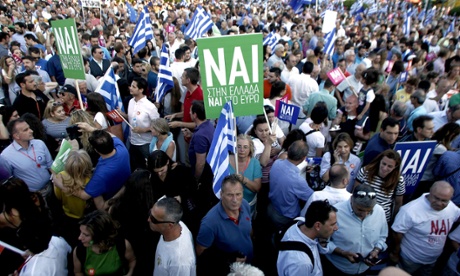
As on Tuesday, the atmosphere was good-natured. But below the surface calm there is deep concern – and some trepidation. With the approach of the referendum, growing numbers of Greeks are becoming reluctant to give their names to reporters.
“I came because we can’t be indifferent,” said one young woman emphatically. But she balked at identifying herself. So did her friend, who said: “We can’t predict the consequences of anything. That’s why we’re nervous.”
Updated
The no rally
Here is some footage from the no rally on Syntagma square on Friday night.
One voter summed up her hopes:
I hope the no [vote] is so powerful that we can see better days, because if people say yes they will be condemned.
Police using stun grenades to disperse the crowds, after scuffles between protesters and police broke out shortly before the rally got underway.
Updated
Photo of a Greek pensioner crying really sums up how sad the situation is. #GreekCrisis http://t.co/0pIWOeBGoO pic.twitter.com/vdl1UROpcs
— Anne-Marie Tomchak (@AMTomchak) July 4, 2015
Schäuble: "very difficult" talks ahead
Germany’s finance minister has said there will be no quick deal with Athens after Sunday’s referendum.
In an interview with top-selling tabloid Bild, Wolfgang Schäuble forecast difficult talks, although he promised that the Greek people would not be left in the lurch.
Greece is a member of the eurozone. There’s no doubt about that. Whether with the euro or temporarily without it*: only the Greeks can answer this question. And it is clear that we will not leave the people in the lurch.
He also said that the risks of the crisis spreading to other European countries were limited.
Even if it came to a collapse of some individual banks, the risk of contagion is relatively small.
The markets have reacted with restraint in the last few days. That shows that the problem is manageable.
Any talks with Greece on an aid-for-reforms deal would be “very difficult” after Sunday’s vote, Schäuble said, but he predicted that in a year’s time, Europe would be stronger than it was before the Greek crisis.
Bild has long been sceptical about bailouts for Greece. In the tabloid’s online poll, 89% said they opposed giving Greece further aid.
* Schäuble spoke of a temporary exit from the eurozone, which sounds (to this blogger at least) like a softening of Germany’s position that Greece would have to leave the single currency.
The full interview (in German) is here, I’ve taken translated quotes from Reuters.
Updated
The Guardian’s Jon Henley takes the temperature at Athens airport.
Taking off myself soon so little time but have now met 7 diaspora Greeks from 3 countries at airport and not a No among them ... #Greece
— jon henley (@jonhenley) July 4, 2015
Marina, bank employee, arriving to vote from London: "You kidding? Tmrw is biggest day in #Greece in 40 yrs. It's got to be a Yes."
— jon henley (@jonhenley) July 4, 2015
Minimal q at ATM in arrivals at Athens airport. Most tourists forewarned and holding folding € #Greece pic.twitter.com/NuseC39KcQ
— jon henley (@jonhenley) July 4, 2015
Yanis Varoufakis accuses Europe of terrorism
Greece’s finance minister Yanis Varoufakis has compared the action of his country’s European creditors to terrorism.
Never one to fear giving offence, the outspoken minister told El Mundo that the country’s lenders were trying to instil fear.
What they’re doing with Greece has a name -- terrorism. What Brussels and the troika want today is for the yes (vote) to win so they could humiliate the Greeks.
Why did they force us to close the banks? To instil fear in people. And spreading fear is called terrorism.
The troika refers to the International Monetary Fund, the European Central Bank and the European Commission. It is interesting that Varoufakis used the word. When Syriza came to power they pledged to expel the troika from Greece, but only succeeded in changing the name - to “the institutions”.
Varoufakis also said he was sure of reaching an agreement with Greece’s creditors if the country votes no.
Because there’s too much at stake, as much for Greece as for Europe, I’m sure. If Greece crashes, a trillion euros - the equivalent of Spain’s GDP - will be lost. It’s too much money and I don’t believe Europe could allow it.
The full interview in Spanish is here, but I’ve relied on translation from The Local.
Updated
Greek authorities deny plan to raid bank deposits
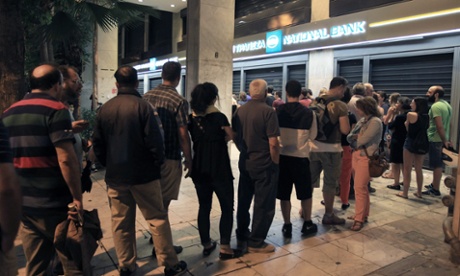
Greek authorities have move swiftly to deny a report that banks are planning to raid depositors’ funds to prevent the financial system from collapsing.
The Financial Times (£) reported that banks were preparing contingency plans to seize at least 30% of deposits holding more than €8,000.
The head of Greece’s Bank Association dismissed the report as “completely baseless.”
Louka Katseli, who also chairs the National Bank of Greece, told Skai TV that suggestions that authorities were planning a raid on deposits belonged “only in the sphere of fantasy.”
There are no such scenarios at any Greek bank, not even as an exercise on paper.
Rebuttals courtesy of Kathimerini
Updated
Greece prepares to vote in decisive referendum
Good morning and welcome to our rolling coverage of the Greek debt crisis.
Greece is on the brink of one of its most important votes since returning to democracy more than 40 years ago.
In less than 24 hours the polls will open on what will be a decisive day for Greece and Europe.
The vote will go ahead, after, as expected, Greece’s highest administrative court rejected an appeal to stop the vote.
Greeks are being asked to vote on a bailout deal that would mean more austerity and reform in exchange for desperately-needed cash.
One Greek woman told BBC Radio 4’s Today programme, it was like being asked to choose between sudden death or a slow death.
At a packed rally in Athens on Friday night, the Greek prime minister Alexis Tsipras said a no vote would enable him to negotiate a reform-for-debt-relief deal with the country’s creditors.

That is at odds with many European leaders, who have said Greece will leave the euro if it votes no.
But this hardline consensus is showing signs of cracking.
Donald Tusk, the head of the European Council, said Greece could stay in the eurozone even if it voted no.
In an interview published on Friday night in Politico, he said:
It’s very clear that the referendum is not … about being in the eurozone or not. No, in fact, nobody’s interested — I hope nobody’s interested — in this kind of choice.
Maybe we will have to get used to living with a country as a member of the eurozone in bankruptcy.
Meanwhile Greek banks have been forced to deny a report that they plan to raid the deposits of savers to stave off imminent collapse. More later.
But Greece is almost out of cash, as the Guardian’s team reports:
Greece’s economy is on the brink of collapse after the capital controls imposed ahead of Sunday’s referendum left the country with shortages of food and drugs, the tourist industry facing a wave of cancellations and banks with barely enough money to survive the weekend.
Banks said they had a €1bn cash buffer to see them through the weekend – equal to just €90 (£64) a head for the 11 million-strong population – and would require immediate help from the European Central Bank on Monday whatever the result of the referendum, in which the two sides are running neck and neck.
Greek economy close to collapse as food and medicine run short
After a dramatic week, we are expecting a quieter day today. But as the Greek debt crisis has proved, never say never...


.png?w=600)