

OK, that really is all for today.
Do check out my most recent summary, after a dramatic evening in which Greece was given just five days to reach a deal or face exit from the Euro.
Here’s Ian Traynor’s take:
Here’s how other news outlets are reporting it:
Greece gets five-day deadline to avoid euro exit. Last @AFP wrap after dramatic day http://t.co/IoJhU9mS46 pic.twitter.com/9rPdO1dZUL
— Danny Kemp (@dannyctkemp) July 7, 2015
Five days to save the eurozone from disaster warn leaders after Greek talks fail http://t.co/zhiftaJiG9
— Mehreen (@MehreenKhn) July 7, 2015
After tonite's summit, seems #Grexit may be days away. I'm shutting down. Final story of the night just posted here: http://t.co/20bqXPQMwx
— Peter Spiegel (@SpiegelPeter) July 7, 2015
We’ll be back on Wednesday morning. Thanks for reading, and for your help. Goodnight! GW
The final moment of truth is approaching quickly for Greek Prime Minister Alexis Tsipras, says analyst Wolf Piccoli of Teneo Intelligence.
Athens has until Sunday to agree with its lenders on a credible reform agenda so as to start negotiations for a new ESM program and potentially some bridge financing until talks are concluded and parliamentary sign-off has been achieved.
If the Sunday deadline is missed, Grexit will materialize.
We have the best readers in the business, I tell you.
Regular contributor equusmulusoctopus has kindly translated Alexis Tsipras’s statement into English, after I posted the Greek video here.
We couldn’t manage without you all.
Another long night for the Brussels press pack:
Leaving #eurosummit where Greece was set deadline of five days to agree deal or #grexit pic.twitter.com/B4hFRfED6Q
— Jennifer Rankin (@JenniferMerode) July 7, 2015
Alistair Darling, the former Chancellor of the Exchequer, told bankers assembled in the Mansion House tonight that the situation in Greece could have repercussions for the UK’s continued membership of the European Union.
“The longer this goes on, [given] the signals it sends to the world about the eurozone and the European Union ...the more risk is the contagion will spread” on both political and economic terms, said Darling, adding:
“People might think this isn’t a great success ... and we may be tempted when we have our referendum ... to say that we may want to leave”.
Speaking at the annual dinner of the British Bankers’ Association, he urged campaigners in the UK’s referendum not to dwell on migration.
Darling was a key figure in the Scottish referendum but stood down as an MP at the general election. He urged business leaders to speak out Europe; they were slow to do so in the Scottish referendum.
And ahead of the budget on Wednesday where there is speculation that George Osborne may signal a review of the bank levy, Darling told the bankers:
“The Chancellor needs money. (The industry) is an easy place to go”.
Donald Tusk didn’t just blame Greece for the crisis, points out my colleague Ian Traynor.
#greece funny thing is @eucopresident is having a go at merkel et al too
— Ian Traynor (@traynorbrussels) July 7, 2015
As covered here, Tusk spoke of ‘All sides of the negotiations’ sharing responsibility for this mess.
Summary: It's deal or Grexit
We’ve seen so many deadlines come and go since the Greek debt crisis began. But tonight, I really believe we’re rattling towards a crucial decision.
Europe has given Athens one last chance to produce a credible economic reform plan that could underpin a new bailout. It has also threatened that Greece will leave the eurozone if it doesn’t comply before Sunday, when a new emergency summit will be held.
Speaking after tonight’s eurozone summit, European Council president Donald Tusk warned gravely that the next five days are the most critical in the European Union’s history.
He has called all 28 European leaders to Brussels on Sunday, which could be the moment that Greece begins to leave the Euro.

Tusk warned:
Our inability to find agreement may lead to the bankruptcy of Greece and the insolvency of its banking system. And for sure, it will be most painful for the Greek people.
I have no doubt that this will affect all of Europe, also in the geo-political sense.
If someone has any illusion that it will not be so, they are naive.
The stark reality is that only have five days to find the ultimate agreement.
Famous last words, but of all the supposed final deadlines thrown down by the Eurogroup, this one does seem like the most final #Greece
— Ed Conway (@EdConwaySky) July 7, 2015
Commission president Jean-Claude Juncker revealed that Europe now has a “detailed” Grexit plan, suggesting a serious risk that Greece’s membership of the single currency is in doubt.
Juncker said:
I am strongly against Grexit but I can’t prevent it unless the Greek government do what they need to do. We have a Grexit scenario prepared in detail; we have a scenario as far as humanitarian aid is concerned.”
Juncker never watched Fight-club then?
— Lorcan Roche Kelly (@LorcanRK) July 7, 2015
A series of other eurozone leaders have added their weight to Tusk’s warning.
French President Francois Hollande said.
“It’s not just the problem of Greece [at stake], it’s the future of the European Union”
Italy’s Mattei Renzi said he was “not pessimistic” of a deal, adding:
“We’ll see if on Sunday this issue will be solved once and for all,”
But Germany’s Angela Merkel warned that Greece has not yet done enough to begin talks about a new bailout. Sunday’s summit has been called, she said, “because we think the situation is so dangerous”.
Alexis Tsipras, the Greek PM who arrived in Brussels with the backing of most Greek political parties, now faces the unpalatable option of signing up to a deal similar to the one that was rejected by the Greek people on Sunday.

Tsipras remained optimistic, though, telling reporters:
“The discussion was held in a positive atmosphere. The process will be fast, it starts in the coming hours with the aim of concluding it by the end of the week, at the latest.
“The Greek side will continue the effort, having the strong weapon of the Greek people’s verdict ... the vast majority’s will for a viable agreement to end the discussion (about a Grexit) and offer the prospect of finally exiting the crisis.”
Earlier in the evening Tsipras had presented his case for a new bailout to EU leaders, raising hopes that a deal was still possible. It still is, but the consequences of failure have never been quite this clear.
So what happens next?
On Wednesday morning, Greece must resubmit a modified bailout request to the Eurogroup of finance ministers. They will then discuss it on a conference call.
And Tsipras is due to appear before the European Parliament on Wednesday morning, at 9am Brussels time (8am BST).
And the political reaction in Athens will also be crucial.
Updated
Here’s a videoclip of Alexis Tsipras’s statement following tonight’s summit (no English translation, sorry)
Δήλωση μετά το τέλος της σημερινής Συνόδου Κορυφής. #EUsummit #Greece https://t.co/8bTRhUKaTy
— PrimeMinisterGR (@PrimeministerGR) July 7, 2015
There is a glimmer of a possibility that Sunday’s summit may yet be cancelled, from the leaders of Luxembourg and Austria:
#Luxembourg's Bettel: Sunday summit may be avoided if #Greece offers good plan. (BBG)
— Holger Zschaepitz (@Schuldensuehner) July 7, 2015
Faymann: We will have clarity on Saturday if Sunday's #EUCO will go ahead. (IE the #Grexit Summit)
— Open Europe (@OpenEurope) July 7, 2015
That also suggests, though, that if the Summit does go ahead, it will be to discuss Greece’s exit from the single currency.
The Austrian leader also criticised Tsipras’s decision to call a referendum on Sunday:
Faymann: No a single person today said that the #Greferendum made the situation easier. #Greece
— Open Europe (@OpenEurope) July 7, 2015
Faymann: Europe is known for compromises. Renegotiation until the last minute. Greece didn't do this when it walked out of negotation.
— Open Europe (@OpenEurope) July 7, 2015
Austria’s chancellor, Walter Faymann, has warned that Sunday’s summit will talk about Plan B (ie, Grexit), unless there is a deal by then.
Leader will also have to provide humanitarian aid for the poorest in Greece if a deal isn’t reached, he adds.
Faymann also warns that the situation in Greek bank reserves is “serious”, and said that leaders can’t discuss writing off some Greek debt.
Faymann: I don't know about the state of Greek bank reserves. But the situation is serious. #Greece
— Open Europe (@OpenEurope) July 7, 2015
Faymann: Debt is of course an issue. A haircut is not the table - but we could have taken about extending maturities. #Greece
— Open Europe (@OpenEurope) July 7, 2015
Francois Hollande has given his own briefing.
He says the Eurogroup (eurozone finance ministers) will meet on Saturday to consider Greece’s proposals, ready for the Sunday summit.
A deal is still possible, Hollande adds, talking about the need to keep Berlin and Paris aligned:
I am trying to to see to it that France and Germany have common visions, Hollande says, there may be differences of interpretation # Greece
— Jennifer Rankin (@JenniferMerode) July 7, 2015
Hollande "if you want to remain in the EZ you have to make credible, serious proposals."
— Jennifer Rankin (@JenniferMerode) July 7, 2015
Tsipras: We want a final exit from the crisis
It’s all go in Brussels tonight. Greece’s PM is now giving an inpromptu press conference.
Tsipras says that he submitted proposals that aim to deliver a “socially just and economically viable agreement”.
They included “credible reforms”, in return for funding commitments.
We had a “positive” discussion, he says, and the target is to conclude the process by the end of the week at the latest
Our aim, Tsipras concludes, is to achieve a “final exit from the crisis”.
(quotes via Reuters)
Talks progressing "very fast" Tsipras leaving EU Summit #Greece pic.twitter.com/vsBucCHQpy
— Derek Gatopoulos (@dgatopoulos) July 7, 2015
Juncker, Tusk and the other creditors didn't get the memo about Greece's stronger negotiating position post-referendum.
— Stanley Pignal (@spignal) July 7, 2015
This is v strong stuff from Tusk and Juncker.
— Tom Nuttall (@tom_nuttall) July 7, 2015
How long does Greece have to produce detailed proposals?
The deadline is 8.30am Friday morning, Juncker replies.
.@JunckerEU: 8.30 Friday morning is the deadline to receive proposals from Greece.
— Tom Nuttall (@tom_nuttall) July 7, 2015
Juncker also insists that he doesn’t want Greece to leave the euro, but it cannot be ruled out.
#EU's Juncker says he can't exclude #Grexit. (BBG)
— Holger Zschaepitz (@Schuldensuehner) July 7, 2015
Jean-Claude Juncker, president of the European Council, says the Greek crisis is a matter that affects the entire EU.
We have a Grexit scenario, prepared in detail, he reveals.
Thumping the lectern, Juncker demands to know how Greek officials dared to call the EC terrorists. Greece didn’t manage to supply a detailed reform plan tonight, but they need to do it fast.
Updated
Why are all 28 leaders coming to Sunday’s summit?
We cannot avoid the possibility that there will not be a proposal on the table by Sunday, Tusk says, mentioning the ‘black’ scenario.
And we may need to consider the issue of humanitarian aid for Greece.
I have no doubt that this is the most critical moment in our history - Europe and the Eurozone. No doubt that having all leaders around the table is the right thing to do, he concludes.
Tusk: Situation is critical, we can't exclude "black" scenario, we need to discuss consequences for whole EU inc emergency humanitarian aid
— Open Europe (@OpenEurope) July 7, 2015
Updated
Tusk: Just 5 days to solve Greek crisis
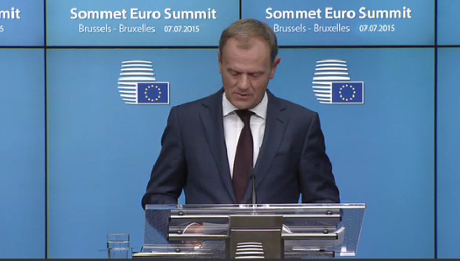
Donald Tusk then gives a stark warning that there are just five days to avoid the worst-case scenario and save Greece from bankruptcy.
The European Council president says:
All sides of the negotiations share responsibility for the current status quo. That is why today I called leaders to try to find a consensus which will be our common success with no losers or winners.
If that doesn’t happen, it will means the end of the negotiations with all the possible consequences including the worst case scenario where all of us will lose.
Our inability to find agreement may lead to the bankruptcy of Greece and the insolvency of its banking system. And for sure, it will be most painful for the Greek people.
I have no doubt that this will affect all of Europe, also in the geo-political sense.
If someone has any illusion that it will not be so, they are naive.
The stark reality is that only have five days to find the ultimate agreement.
Until now I have avoided talking about deadlines, but tonight I have to say it loud and clear - the final deadline ends this week. All of us are responsible for the crisis, and all of us have a responsibility to resolve it.
Updated
Tusk-Juncker press conference begins
Donald Tusk speaks first, telling reporters that:
- We met tonight to discuss the serious situation in Greece.
- Following the Greek referendum, Alexis Tsipras agreed to apply for a new bailout including strict conditionality.
- Greece will set out, by Thursday 9th July at the latest, its reform plans.
- Heads of state and government will meet on Sunday 12 July.
OK, let’s break away from Angela Merkel’s press conference - because presidents Donald Tusk and Jean-Claude Juncker are giving their own briefing. Livestream is here
Did leaders discuss the possibility that Greece might have to issue a parallel currency?
No, we didn’t, Merkel replied - and then she seemed to suggest that this is a matter for European finance ministers to consider.
#Merkel: We did not talk about parallel currency today. FinMins will talk about such technical matters. #Greece
— Open Europe (@OpenEurope) July 7, 2015
Greek PM has promised us detailed plan, we have only a few days to find a solution, says Merkel.
— Jennifer Rankin (@JenniferMerode) July 7, 2015
Important point -- Greece has not yet done enough to start negotiations about a new bailout programme:
Need to have certainty opening negotiations on ESM make sense, current conditions not sufficient, Merkel on #greece.
— Jennifer Rankin (@JenniferMerode) July 7, 2015
"The preconditions for a resumption of an ESM programme are not there," says #Merkel on #Greece. That's not particularly optimistic.
— Peter Spiegel (@SpiegelPeter) July 7, 2015
The economic conditions in Greece have not improved in the last 10 days, Merkel adds wryly.
Bridge financing did not play role in our deliberations, we need long term proposals, says Merkel. #greece
— Jennifer Rankin (@JenniferMerode) July 7, 2015
Why are all 28 EU members coming to Sunday’s meeting? Is it because Greece could soon be out of the euro?
We are all linked together in Europe, says Angela Merkel. Given the importance of the situation it is appropriate that all 28 leaders are there.
First, Greece must produce long-term proposals, and then we could talk about short-term financing needs, Merkel continues.
In other words -- the eurozone isn’t prepared to just kick the can by a couple of months, it wants to see a proper third bailout programme.
Alexis Tsipras’s hand may have been strengthened by Sunday’s referendum, Merkel adds, but the freedom of manoeuvre of the other 18 members has been reduced.
Merkel: Expect Greece to request multi-year bailout by Thursday
Angela Merkel is giving a press conference now.
She confirms that Greece will submit a loan request and a list of reform proposals on Wednesday, and also expects “detailed Greek proposals” for a new multi-year programme on Thursday.
She says leaders had a very clear and candid discussion at today’s summit.
We respect the result of a referendum, but there are 18 other states whose sovereignty needs to be considered.
It was a very long, intensive discussion, that reflects the seriousness of the situation at hand, the German chancellor adds.
In Greek saga summits come and go. Italian PM Renzi says a summit on Sunday will be 'decisive'. In Greece the banks remain the key#Greece
— Gavin Hewitt (@BBCGavinHewitt) July 7, 2015
EU to hold 'decisive' summit on Greece on Sunday, Italy PM @matteorenzi says
— Danny Kemp (@dannyctkemp) July 7, 2015
* Sunday's summit on Greece will involve all 28 EU leaders, not just Euro zone - Italy PM Renzi - RTRS
— Fabrizio Goria (@FGoria) July 7, 2015
Renzi hopes for happy ending for Greece on Sunday
It’s official! European leaders are going to meet again on Sunday for another meeting to discuss Greece.
That’s via Italy’s prime minister, Matteo Renzi, who is briefing the press now (live feed).
A cheerful looking Renzi says:
Tonight the decision is that we wait until Sunday for the new proposals to be submitted to the Institutions from the Greek government
I hope this could be the last meeting for Greece. I hope it could be a happy ending.
I think we can achieve an agreement on Sunday. I am not pessimistic about it.
Renzi then repeats his call for Europe to be reformed to stimulate growth and investment, and to move beyond the Greek crisis.
#Italy's Renzi says final meeting on #Greece scheduled for sunday. (RTRS)
— Holger Zschaepitz (@Schuldensuehner) July 7, 2015
Italian PM Renzi confirms leaders will meet again on Sunday. Summit will be called "in next few hours". #Greece
— Open Europe (@OpenEurope) July 7, 2015
Sounds like the Euro Summit has ended -- onto the press conferences, where we’ll find out what happened tonight.
Updated
And here’s Reuters take on tonight’s last-ditch push to find a deal for Greece:
Euro zone leaders could hold a further emergency summit on Sunday to approve a plan to aid Greece if creditor institutions are satisfied with a Greek loan application and reform commitments, two senior EU sources said.
The leaders were meeting on Tuesday evening in Brussels with Greek banks shuttered and fast running out of cash and the Greek economy on the verge of collapse.
The sources set out a tentative timetable that could offer a breakthrough to keep Greece afloat and in the euro zone, provided it accepts credible reforms and spending cuts to make its public finances sustainable in the mid-term.
Talks to keep #Greece in the euro zone may last through Sunday... Last chance extends... http://t.co/lbDxF8B6sW
— Shawn Donnan (@sdonnan) July 7, 2015
The Wall Street Journal has a good take on the emergency financing that eurozone leaders have been discussing tonight:
Greek Prime Minister Alexis Tsipras came to a meeting of eurozone leaders in Brussels with a proposal for interim financing until the end of the month, a senior Greek government official said.
“In return, Greece will pass some of the overhauls demanded by the country’s international creditors, the official said, adding that Greece remained open to other ideas for “a big viable solution.”
France, which has been Greece’s biggest eurozone ally, is pushing for a deal in which Athens accepts and passes the budgetary measures—with limited changes—that were in the plan that was rejected by Greek voters in their referendum Sunday.
Greece would then receive immediate financing and the prospect of a future restructuring of its debt, a senior French official said....
More here: Eurozone Considers Proposal to Offer Greece Interim Funding
A short term loan with Juncker-esque conditions feels very close to that rejected by vote. Promise of later talks on debt enough?
— Duncan Weldon (@DuncanWeldon) July 7, 2015
We’re hearing that tonight’s talks haven’t gone disastrously, so far.....
Coffee time for leaders at #eurosummit, discussion said to be easier than migration talks at last council. Low bar, but a start. #Greece
— Jennifer Rankin (@JenniferMerode) July 7, 2015
(coffee? Excellent idea)
The chief of Jean-Claude Juncker’s cabinet, Martin Selmayr, just tweeted a photo of a rainbow over the European Commission - and called it a sign of hope.
That must be an optimistic sign, right?
Hope over the Justus Lipsius #with Juncker pic.twitter.com/F91uaZ0DbY
— Martin Selmayr (@MartinSelmayr) July 7, 2015
Back in Brussels, there are more reports that Greece and its creditors are talking about a short-term agreement followed by a long-term one.
Dow Jones newswires says the deal would centre on the proposals on the table before Sunday’s referendum (where they were rejected by the people) but with some pledge on debt relief....
#Greece Would Accept Budgetary Measures of Pre-Referendum Proposal. Short-Term Deal Would Offer Prospect of Debt Relief. (DJ)
— Holger Zschaepitz (@Schuldensuehner) July 7, 2015
#Greece, Creditors Would Then Negotiate A 2-3 Year Deal. (DJ)
— Holger Zschaepitz (@Schuldensuehner) July 7, 2015
Hilary Clinton has echoed Barack Obama’s call on Europe to do more to resolve Greece:
Hillary Clinton on Greece: "I want to see a resolution" with country in eurozone. She urged Europe to help. pic.twitter.com/JWoT6H8lv3
— Eric Bradner (@ericbradner) July 7, 2015
"I want to see a resolution. At the end of the day, it is up to the Greek people to decide what they're going to do" - @HillaryClinton
— Megan Murphy (@meganmurp) July 7, 2015

Our own Ian Traynor grabbed a word with Euclid Tsakalotos as Greece’s new finance minister fought his way though the press area in Brussels tonight.
Ian reports:
He told me things: one, that his wife was from Glasgow; two, “I am pleased with the progress we have made today”
Both good signs, I’d say.
Tsakalotos’s wife is economist Heather D. Gibson, who advises the Bank of Greece.
Eurozone summits look more productive if you speed the action up:
Behind the scenes of the #EuroSummit: at the meeting table. #timelapse pic.twitter.com/v2SoYNdt0X
— EU Council (@EUCouncil) July 7, 2015
Evening summary: Greece's future in the balance
I think a recap might be helpful.
Eurozone leaders are locked in an emergency summit tonight that will, most likely, determine Greece’s future in the eurozone.
Alexis Tsipras, the Greek prime minister, has laid out Athens’ plans for a new aid programme.
There are reports that Greece going to ask for a short-term funding deal, to cover its immediate needs, and then a longer package.
Sources have told the Guardian that Donald Tusk, president of the European Council, wants a decision tonight on whether a third bailout package is viable. That will determine whether talks resume with Greece, or whether the eurozone starts planning to lose a member.
The stakes tonight are desperately high, as leaders talk over their vichyssoise soup, cod fillet, and chocolate mousse.
As Ireland’s Enda Kenny put it:
The time is now to bring some hope, certainty and stability to the people of Greece in the medium term, for they are now suffering.
Speculation is rife that a summit could be called on Sunday - either to hammer out a Greek aid plan, or to prepare Grexit.
.@Elbarbie reports there will be #Eurogroup meeting on Sat., Eurozone and EU summit on Sunday.
— Yannis Palaiologos (@yanpal7) July 7, 2015
Rumours flying of all sorts of summitology - EG phone call tomo, physical EG Fri/Sat, euro summit and poss full EU summit Sunday. #whoknows
— Tom Nuttall (@tom_nuttall) July 7, 2015
My colleague Ian Traynor has also heard that EU officials are planning ways to help Greece avoid defaulting on €3.5bn owed to the ECB on 20 July.
But Eurozone leaders have already warned that Greece cannot expect any debt relief soon.
More @WhiteHouse on @atsipras call: "President reiterated in everyone’s interest #Greece & creditors reach a mutually-acceptable agreement."
— Peter Spiegel (@SpiegelPeter) July 7, 2015
Earlier, Greece’s new finance minister Euclid Tsakalotos attended his first eurogroup meeting. Afterwards, he told reporters there is ‘political will’ for a deal.
Photos: Euclid @tsakalotos at the #Greece Eurogroup: (via Reuters and EPA). Live -> http://t.co/5LEybO23l2 pic.twitter.com/cfR7YDbxpp
— Graeme Wearden (@graemewearden) July 7, 2015
Updated
The White House has confirmed that President Obama spoke with Angela Merkel today, and pushed her to avoid Greece leaving the eurozone.
Obama calls Merkel, talks Greece. pic.twitter.com/8uj4YQARyl
— Simon Marks (@SimonMarksFSN) July 7, 2015
How Greece could avoid defaulting on the ECB
There is a way that Greece could agree a bailout programme and avoid defaulting on its payments to the European Central Bank in two weeks, if tonight’s negotiations go well.
Europe editor Ian Traynor has been speaking to insiders, and explains:
If the option of a new Greek bailout through the ESM gets the go-ahead, the best predictions of actual cash disbursements are mid-to end August, way too late to stop Greece defaulting big time on the €3.5bn in bonds it must redeem at the ECB on July 20 (as explained earlier).
But given a modicum of goodwill, something so far in very short supply (although the general temper today has been a lot better than when Yanis Varoufakis was doing the rounds), there is a fix available to the ECB problem.
When Greece’s 2nd bailout expired last Tuesday, some €3.3bn in ECB profits from its securities markets programme due to Greece also vanished [that’s money that the ECB made from bailing Greece out].
For 2014 the profits amounted to €1.85bn. These are held in an ESM account and could be released to the Greeks if the eurogroup so decided. There is also a further €1.5bn currently held by eurozone governments. This money could also be released to the Greeks -- meaning the ECB problem is effectively solved.
A eurozone source says:
“It’s not an easy solution, but probably the only solution,”
The advantage here is that this money could be released without having to wait for any tiresome parliamentary procedures. But the fly in the ointment here is that both wads of cash need to be authorised by the eurogroup unanimously, meaning that a single country could veto the whole show.
The German finance ministry, for example, has been sending negative signals on this, indeed it has been demanding back €500m of the money held by the ESM, the 2014 profits.
Updated
More developments......various sources are reporting that Greece is sending a letter tonight, outlining its request for a new bailout.
1/ Greek govt sources from Brussels confirmed #Greece is ready to send letter to ESM for new aid programme - state news agency >
— Daphne Papadopoulou (@daphnenews) July 7, 2015
2/ Same sources said #Greece also wants a bridge programme to cover funding needs for current month
— Daphne Papadopoulou (@daphnenews) July 7, 2015
This may be significant.
While he was being chased through the press centre, Greece’s new finance minister told reporters that there is ‘political will’ in Brussels to give Athens another chance.
Eurozone shows 'political will' to give Greece new chance: new Greek finance minister to colleagues chasing him from press room @AFP
— Rachel O'Brien (@robr1) July 7, 2015
Tsakalotos: "There is a political will to have a new start"
— miquelroig (@miquelroig) July 7, 2015
Tsakalotos, asked why he didn't bring a proposal today: "It is more complicated than that"
— miquelroig (@miquelroig) July 7, 2015
Updated
The FT’s Paris bureau chief, Anne Sylvaine Chassany, explains how Greece could actually seek two bailouts this year:
So #Greece could head for bridge-financing of 3-4 months (technically a 3d bailout prog) + a 4th 3-4 yr bailout program 1/2
— AnneSylvaineChassany (@ChassNews) July 7, 2015
But it won’t get any aid unless it signs up to meaningful reforms (the ‘conditionality’ Ian just mentioned)
But #Greece needs to commit to 'prior actions' to unlock bridge financing + credible structural reforms to start talks on 3-4 y rescue deal
— AnneSylvaineChassany (@ChassNews) July 7, 2015
Hungry work, saving the eurozone:
At #Greece summit now, European leaders are eating: vichyssoise soup, cod fillet w anchovy butter, chocolate mousse on a biscuit base, moka
— Zeke Turner (@zekeft) July 7, 2015
We can’t blame Greek finance minister Euclid Tsakalotos for wanting to mingle with the press pack:
Sudden media panic as @tsakalotos saunters out of #EU summit building through press area pic.twitter.com/5C0w1ZhBdU
— Peter Spiegel (@SpiegelPeter) July 7, 2015
One at a time, guys...
Comedy moment there as Brussels press pack tried to chase Tsakalotos through the tiny revolving doors of the Justus Lipsius
— Danny Kemp (@dannyctkemp) July 7, 2015
Updated
The measure of (qualified) success or failure tonight is whether there’s an actual agreement/decision to open a new negotiation towards a new bailout for Greece from via the European Stability Mechanism, Ian adds.
Alexis Tsipras is making case for new bailout now

Alexis Tsipras is said to be laying out his position to the summit now, reports Ian Traynor in Brussels.
Donald Tusk will then ask ECB president Mario Draghi, EC president Jean-Claude Juncker, and Eurogroup president Jeroen Dijsselbloem for their views.
Draghi is expected to dwell on capital controls and the dire condition of the Greek banks, Dijsselbloem is to brief on this afternoon’s eurogroup meeting. Juncker’s contribution is less than clear.
These expositions are likely to be followed by a broader exchange on the feasibility of a new longer-term ESM bailout, the conditionality [the reforms Greece would commit to], the deadlines. Basically, by the end of the evening, they should have decided whether the eurozone and Greece should open a new negotiation. This, from EU sources, is perhaps the upbeat narrative.
The more depressing scenario circulating is of another summit on Sunday, but not of the eurozone but of all 28 leaders, a full EU summit. If that transpires, the meat of the meeting is Grexit.
If a tentative accord to proceed with the ESM option is not looking good by the weekend, The Full Monty of Grexit becomes the dominant narrative, with Draghi throwing up his hands, saying he can’t do any more and the Greek banks collapsing.
#Greece says revised bailout proposal tomorrow 'taking into account' creditors' proposals. Asks for aid to tide it over to end July. #AFP
— Marc Burleigh (@marcburleigh) July 7, 2015
Bloomberg’s Arne Delfs is also hearing that we might all be back in five days:
#eusummit on Sunday is an option if finance ministers do not achieve sufficient progress, German official says #GREECE #Tsipras
— Arne Delfs (@ArneDelfs) July 7, 2015
Speculation continues to swirl around Brussels that another summit will be called on Sunday.
One theory is that Greece will submit a request for a short-term aid agreement, to tide it over the immediate funding crisis.
Acc to Greek gov sources, the Greek gov will ask for an interim deal. Crucial payments by the end of July. #Greece #eurosummit
— EfiKoutsokosta (@Efkouts) July 7, 2015
And Reuters says there is a “tentative plan” for a Sunday summit to approve ‘any plan to aid Greece’.
One of the more ominous realisations here is that the press pack’s accreditation cards for this evening’s summit are valid simply for “July.”
Usually, for security reasons, they only show the date of the meeting. A month of summits? Groan.
Barack Obama has been hitting the phones in an attempt to help break the deadlock.
President Obama Spoke With German Chancellor Merkel Tuesday About Crisis in #Greece. Continue to Encourage All Sides to Negotiate. (DJ)
— Holger Zschaepitz (@Schuldensuehner) July 7, 2015
That follows his call with Alexis Tsipras earlier today.
Ambitions for #Eurozone summit are to send political signal to re-start talks, says EU source, but bridge finance for #Greece not likely.
— Jennifer Rankin (@JenniferMerode) July 7, 2015
Tusk wants decision tonight on viability of Greek bailout
Donald Tusk, chairing the eurozone summit, wants the leaders to take a decision tonight on whether Greece can obtain a new, longer-term bailout deal from the European Stability Mechanism, EU sources said.
A green light for such a move will depend on what Tsipras tells the summit, they added, displaying frustration that the Greeks had not yet, as expected, formally submitted proposals for a rescue package.
Although a Greek application will be made to the European Stability Mechanism on Wednesday, officials also said Tsipras could also spring a surprise and unveil his proposals at this evening’s summit.
Unconfirmed rumours of another #Eurosummit on Sunday, so a reason for badges marked for July #Greece
— Jennifer Rankin (@JenniferMerode) July 7, 2015
Brussels reporters have just had a rather nasty shock:
Holy fuck. Our emergency summit passes are for all July not just today (as usual) pic.twitter.com/bZzRE5iwK8
— Bruno Waterfield (@BrunoBrussels) July 7, 2015
Just noticed my summit press credentials don't have today's date. Says "July 2015". Bad sign? Month of summits?
— Peter Spiegel (@SpiegelPeter) July 7, 2015
Photos: Eurozone summit begins
Alexis Tsipras spoke with Mario Draghi before the summit began - perhaps to push the ECB to provide more liquidity to the Greek banking sector:

It’s not clear that the conversation went well:

And then the leaders took their seats to discuss Greece:

Talk to the hands.....

Summary: Greece told not to expect debt relief soon
From Brussels, Jennifer Rankin sums up the situation:
The Greek government has been told by its eurozone partners not to expect debt relief any time soon, amid fading hopes of decisive action to stop the country tumbling out of the currency union.
Arriving at an emergency summit of eurozone leaders, Angela Merkel said there was no clear basis to negotiate with Athens after Greek voters rejected an EU bailout plan in a referendum on Sunday. The German chancellor warned that time was running out. “It is not a matter of weeks anymore, it is a matter of days.”
Eurozone finance ministers meeting ahead of the summit made it clear they were waiting on Athens to make the first move and were in no hurry to discuss debt relief.
Diplomatic niceties were abandoned as it emerged Greece’s new finance minister Euclid Tsakalotos had not come armed with detailed proposals.
“[With] the Greek government it is every time mañana,” said Lithuania’s president Dalia Grybauskaitė, one of the Greek government’s most tough-talking critics. “It can always be mañana every day.”
Greek banks are almost out of cash and some Eurozone figures are already saying that Grexit is the only option for the debt-ridden country.
The head of Latvia’s central bank told domestic radio that the “brave” Greek nation had “voted itself out of the eurozone”...
Here’s her full report from the Summit:
Get ready to cancel your weekend plans (again) folks:
Suddenly hearing from sources a possible summit on Sunday. #Greece
— Peter Spiegel (@SpiegelPeter) July 7, 2015
Sources: Greek bailout funds couldn't arrive for weeks
Greece’s financial situation is extremely serious. Even if progress is made tonight, there is no hope of any fresh bailout cash being granted soon.
Our Europe editor Ian Traynor explains:
Eurozone sources said that under the formal new bailout proposal to be tabled on Wednesday, it would take several weeks before Greece could hope to receive any disbursements.
None of that money would be possible before July 20 when Greece has to pay the European Central Bank €3.5bn.
Any agreement on a programme from the permanent bailout fund, the European Stability Mechanism, would have to be medium-term and would come with “tight conditionality.”
#greece won't be able to tap ESM dosh before july 20 even if deal done - eurozone source
— Ian Traynor (@traynorbrussels) July 7, 2015
Failure to repay the European Central Bank on July 20 could have very serious consequences; the ECB could respond by terminating the emergency liquidity assistance provided to Greek banks (which is already capped, of course)
The summit is just getting underway....
The #EuroSummit on #Greece has just started. pic.twitter.com/jrKwUzlDfr
— Donald Tusk (@eucopresident) July 7, 2015
Alexis Tsipras remained cheerful at his meeting with the heads of Germany, France and the Commission; Hollande and Juncker look less amused:
#Greece: A smilling but under pressure @tsipras_eu met Merkel, Hollande, Juncker before #eurogroup pic.twitter.com/iAkdIcrSvo Via @RegSprecher
— José Miguel Sardo (@jmsardo) July 7, 2015

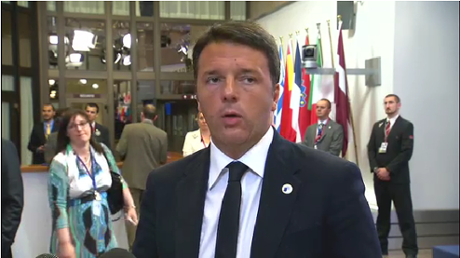
Italian prime minister Mattei Renzi sounded more optimistic than other leaders - he told reporters that a deal with Greece can be found in the hours ahead.
Renzi also cautioned, though, that Europe needs more than a mere ‘technical solution’ to the crisis:
Renzi: I'm more concerned about Europe. Europe as it is doesn't work. Europe needs to invest on growth, future, innovation. #Greece
— Open Europe (@OpenEurope) July 7, 2015
Mini outbreak of "deal optimism" in Brussels driven by Renzi sounding optimistic & previous hardliners saying Eurogroup was productive. 1/2
— Duncan Weldon (@DuncanWeldon) July 7, 2015
Oh dear...
Finland's PM says looking likely eurozone summit is waste of time. Starting on wrong footing w/o proposal from #Greece
— Jennifer Rankin (@JenniferMerode) July 7, 2015
Alex Stubb, Finland’s finance minister, tweets that today’s meeting was ‘useful’, even though Greece hasn’t submitted a request for aid yet.
A useful #Eurogroup. Now waiting for an #ESM-request from #Greece. Then normal procedures. After interviews wheels up from #Brussels.
— Alexander Stubb (@alexstubb) July 7, 2015
Greek people suffering an appalling trauma. Deal needed for certainty, stability & hope.
— Enda Kenny (@EndaKennyTD) July 7, 2015
Kenny: Greek people are suffering
“We need a deal here” declares Irish leader Enda Kenny as he arrives at tonight’s summit.
The time is now to bring some hope, certainty and stability to the people of Greece in the medium term, for they are now suffering.
I look forward “very much” to hear what prime minister Tsipras has to say, Kenny adds, before heading inside.
Updated
the brussels doorstep - seldom has so little been achieved by so many in the futile exercise of... didn't churchill...?
— Ian Traynor (@traynorbrussels) July 7, 2015

Ouch! Over in Athens, the Greek government is INSISTING that it has already tabled proposals that still stand, says Helena Smith.
If there was ever any proof that the leftist-led coalition is still not singing from the same hymn sheet as foreign lenders, it was produced in the last five minutes when the government issued one of its famous “non--papers” declaring:
“The Greeks side delivered proposals the previous Tuesday which remain on the table with some improvements. These proposals include reforms, financing, the investment programs and the restructuring of debt.”
The Greek government’s proposals will be discussed today and tomorrow, so that, soon, a mutually beneficial agreement can be closed with the mandate of the referendum as its base. An agreement, which at the same time, will reintroduce liquidity to the banking system.”
Updated
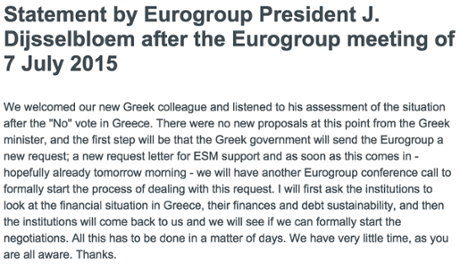
Here’s the transcript of Jeroen Dijsselbloem’s statement after today’s inconclusive Eurogroup meeting:
Video: In Athens' street markets, a Greek tragedy plays out
Away from the talking in Brussels, Greece’s economy is bleeding.
My colleague Phoebe Greenwood has visited the Athens market district, to find a dreadful scene of deserted shops, piles of unsold meat and vegetables, and shop-keepers and cafe owners on the brink of shutting down.
This is what capital controls does to a country, when people are unwilling and simply unable to spend.
Here’s Phoebe’s unmissable video:
The Greek government has just confirmed that prime minister Alexis Tsipras is meeting German chancellor, Angela Merkel, the French president Francois Hollande and the European Commission president Jean-Claude Juncker.
The statement did not state what either group hoped to achieve.
Updated
Angela Merkel, Francois Hollande, Alexis Tsipras and Jean-Claude Juncker are now locked in a room with their advisors:
Ahead of the #EuroSummit, @JunckerEU meets with PM @atsipras, Chancellor #Merkel & President @fhollande #Greece pic.twitter.com/fYEbUhEReS
— Mina Andreeva (@Mina_Andreeva) July 7, 2015
More from Francois Hollande:
Mr. Moral hazard is speaking: #France's Hollande says the objective is to keep #Greece in the Euro.
— Holger Zschaepitz (@Schuldensuehner) July 7, 2015
Hollande: We can't come back talking about #Greece every three months.
— Open Europe (@OpenEurope) July 7, 2015
Hollande says responsibility on #Greece to come up with proposals, stressing need for solidarity and speed.
— Jennifer Rankin (@JenniferMerode) July 7, 2015
Hollande: Greece must act swiftly
Another car sweeps into the arrivals zone, and out springs...Francois Hollande.
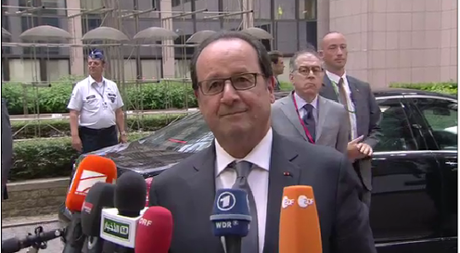
The French president says that Greece needs serious, credible, proposals and must present its reforms quickly.
Like Angela Merkel, he is also speaking about the importance that Eurozone countries show responsibility, as well as solidarity.
"We must display responsibility, solidarity and speed" Francois Hollande at Euro Summit #Greece pic.twitter.com/cWmUbkUhnP
— Derek Gatopoulos (@dgatopoulos) July 7, 2015
Barack Obama speaks with Alexis Tsipras
Barack Obama, US president, has spoken with Alexis Tsipras about Greece’s proposals, according to a Greek official.
That underlines how concerned America is about the prospect of the crisis escalating.
Greek PM Tsipras has briefed President Obama on his proposal #greececrisis
— Gavin Hewitt (@BBCGavinHewitt) July 7, 2015
Updated
Ever the optimist, European Commissioner Pierre Moscovici is still hopeful that a Greek agreement can be reached...
MOSCOVICI SAYS THERE IS HOPE FOR A DEAL WITH GREECE: RTRS.
— zerohedge (@zerohedge) July 7, 2015
Moscovici is still hopeful of a deal... I think France is Greece's only friend at the moment!
— RANsquawk (@RANsquawk) July 7, 2015
Merkel: Still no basis for negotiations with Greece
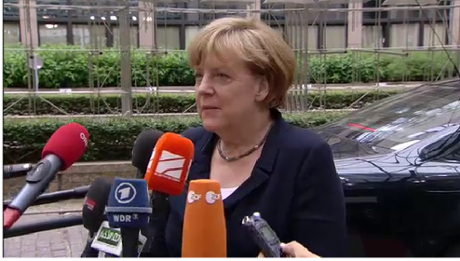
Here comes Angela Merkel...and she heads straight to the press microphones to deliver a clear message.
There is still no basis for negotiations after the very clear no in the Greek referendum on Sunday.
Solidarity at the European level, and responsibility at national level are still important. Without solidarity and without reforms we cannot embark on this path.
And the chancellor concludes by warning that time is extremely short:
It’s not a matter of weeks any more, it’s a matter of days.
#greece merkel - it's about a few days, not weeks. but no chance of a conclusive picture tonight
— Ian Traynor (@traynorbrussels) July 7, 2015
Updated
Alexis Tsipras has arrived at the summit looking cheerful and relaxed, but doesn’t stop to speak to the press (boo!).
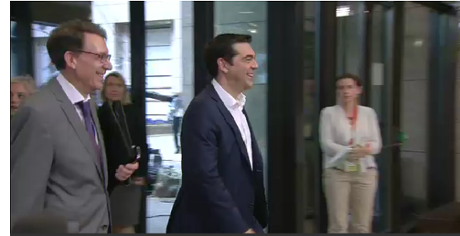
Dutch prime minister Mark Rutte has a stark warning as he arrives at the summit.
Greece is taking a big risk, the only solution is to make reforms. If it doesn’t come with proposals soon, eurozone leaders won’t be able to help.
#grexit will be decided in athens, not brussels - dutch pm rutte
— Ian Traynor (@traynorbrussels) July 7, 2015
Updated
Arrivals at the EU Summit
Leaders are now arriving in droves at the emergency summit on Greece.
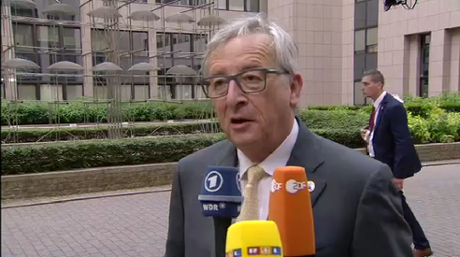
Jean-Claude Juncker, Commission president, tells reporters that the solution to the crisis “depends on Mr Tsipras”.
I am always happy to meet with him to discuss the situation, he adds.
Updated
Dijsselbloem: Greece will submit proposals tomorrow
Jeroen Dijsselbloem, president of the Eurogroup, is giving his statement now.
He says that eurozone finance ministers will hold a conference call on Wednesday to discuss a request from Greece for financial assistance through the European Stability Mechanism.
He confirms that the Greek government did not submit a written request today - remarkable, really, given the urgency of the crisis now -- but will produce one by tomorrow.
Eurogroup chief Dijsselbloem says #Greece did not submit new proposal today, due to do so by Wed when there will be Eurogroup teleconference
— Kathimerini English (@ekathimerini) July 7, 2015
They better had do.....
If you look hard enough you can see steam coming out of his ears Dijsselbloem: "We were under the impression proposals would come today"
— Stanley Pignal (@spignal) July 7, 2015
Oops. The Greek finance minister's notes....
Euclid Tsakalotos appears to have committed a schoolboy error at his first eurogroup meeting, by allowing his notes (written on hotel paper!) to be photographed.


It includes a reminder to avoid any “triumphalism” (presumably following Sunday’s referendum)
The personal notes of Euclid Tsakalotos before the #Eurogroup pic.twitter.com/WKLtKVdXbd
— Thanasis Koukakis (@nasoskook) July 7, 2015
The Eurogroup is officially over, according to social media manager Finland’s finance chief, Alex Stubb:
That's it for today's #Eurogroup.
— Alexander Stubb (@alexstubb) July 7, 2015
European Council president Donald Tusk and ECB president Mario Draghi are discussing the Greek situation, before tonight’s emergency summit.
#Tusk @eucopresident meets #ECB @ecb President #Draghi ahead the #EuroSummit on #Greece http://t.co/AS65CNLcaz pic.twitter.com/KFiLEDrWx6
— EU Council TV News (@EUCouncilTVNews) July 7, 2015
This crisis is no laughing matter, chaps.
Oops. Can't blame Euclid. He's new. #eurogroup pic.twitter.com/dAsfhFPOd6
— Berlaymonster (@Berlaymonster) July 7, 2015
No pushing at the back! The press pack are ready to watch Jeroen Dijsselbloem’s statement following the end of Eurogroup meeting.
Hier legt @J_Dijsselbloem straks een verklaring af, bijna onhoorbaar en niet live uitgezonden. #topklasse pic.twitter.com/4zlsTHel24
— Jürgen Gevaert (@jurgengevaert) July 7, 2015
As if there wasn’t enough drama, Alexis Tsipras is to address the European Parliament on Wednesday morning:
That’s via EP president Martin Schulz:
After our phone conversation @tsipras_eu confirmed he will be coming to plenary tomorrow morning
— EP President (@EP_President) July 7, 2015
#Greek Prime Minister #Tsipras will participate in the #EP debate on #Greece tomorrow at 9h45. https://t.co/z7QV8N4LvU
— Jaume Duch (@jduch) July 7, 2015
Updated
You can watch eurozone leaders arrive for tonight’s Greek summit here: EbS Live and possibly also here EbS+ Live.
Updated
Disappointing: Jeroen Dijsselbooem’s statement following the Eurogroup meeting may not be streamed live....
@jameskanter neither- it will be recorded, then made available asap on TV Newsroom.
— EU Council Press (@EUCouncilPress) July 7, 2015
I’m sure the Brussels press pack will do their usual bang-up job of tweeting the key points, though....
As one meeting ends, another is beginning....
Mario Draghi, the ECB president, just arrived at tonight’s summit of Eurozone leaders, but slipped inside without speaking to the press.
All may not be lost -- Euclid Tsakalotos has apparently verbally outlined Greece’s plans to the rest of the eurogroup:
May not have submitted written proposals, but Greek FinMin made a "good presentation" at the #Eurogroup meeting - source tells me #Greece
— AnneSylvaineChassany (@ChassNews) July 7, 2015
But will it be good enough, given the remarkable news that Athens didn’t produce some written proposals.
We’ll find out in a few minutes...
Is #Eurogroup drawing to close already. Jeroen Dijsselbloem expected to make statement around 16.10 Bxl time. #Greece
— Jennifer Rankin (@JenniferMerode) July 7, 2015
Updated
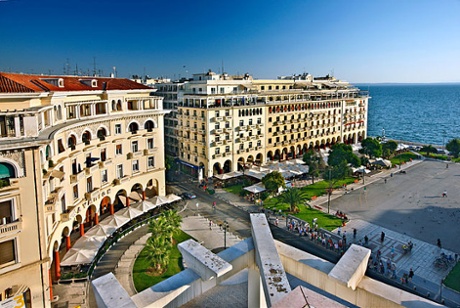
The British Ambassador to Greece, John Kittmer, has issued a statement - reassuring tourists that his staff are prepared to help then enjoy their holidays:
“My teams in Athens and on Rhodes, Corfu, Crete and Zakynthos are here to support British nationals who find themselves in need. As we enter peak holiday season we have strengthened our consular offices.
“Greece is a hospitable country, and Greeks will do all they can in exceptional times to make tourists welcome. There are no reports from tour operators to suggest that there are disruptions to services on the islands. My Embassy has been planning carefully, so that British holiday makers arrive well prepared and can complete their holidays with peace of mind.”
But as flagged earlier, tourists shouldn’t count on being able to access cash or medicines during their stay.
It does appear that today’s Eurogroup has failed to make progress....
Statement from @J_Dijsselbloem in 30 mins after Greeks fail to submit new proposal to the #eurgroup but will wait until Weds. @tsipras_eu
— James Kanter (@jameskanter) July 7, 2015
Word from Brussels - Jeroen Dijsselbloem, Eurogroup president, will speak in around half an hour:
We are told that @J_Dijsselbloem will give a short statement in+/- 30 minutes
— Pablo Rodríguez (@Suanzes) July 7, 2015
Britain has updated its travel advice for holidaymakers, to warn that Greek banks will remain closed until at least the close of business on 8 July.
It also advices that people take enough cash, and medicines, for the full length of their stay and any “unexpected delays”, and warns that cash machines and credit card transactions “could potentially become limited at short notice.”
Updated
The confusion continues:
Greece Submits Same Proposals as Before at Eurogroup Meeting -Greek Govt Official
— cigolo (@cigolo) July 7, 2015
Greek Govt Official: Proposals Not Discussed During Last Eurogroup Meeting
— cigolo (@cigolo) July 7, 2015
Greek Govt Official: Finance Ministers Decided To Wait For Outcome Of Referendum
— cigolo (@cigolo) July 7, 2015
Multiple sources are now reporting that Greece hasn’t brought new proposals to the Eurogroup (as rumoured earlier).
The FT’s Peter Spiegel says:
According to a third eurozone official, Greece will instead present its new plan tomorrow.
GREEKS HAVEN'T MADE NEW PROPOSAL YET, GERMAN OFFICIAL SAYS
— MineForNothing (@minefornothing) July 7, 2015
No wonder Euclid looked rather melancholy as he arrived at today’s meeting.
Beware Greeks not bearing proposals
— modest proposal (@modestproposal1) July 7, 2015
Bet your bottom euro that tomorrow....
Updated
No vote not a mandate for breaking away from eurozone - Greek president
EC president Donald Tusk has been speaking to Alexis Tsipras to prepare for tonight’s meeting:
Earlier today I was in touch with Greek PM @atsipras to prepare tonight's #EuroSummit on #Greece. #Greferendum
— Donald Tusk (@eucopresident) July 7, 2015
Meanwhile here is the letter from Greek president Prokopis Pavlopoulos to Tusk outlining Monday’s declaration by most of the country’s party leaders, which he hopes will lead to a “viable agreement”.
He also maintains the No vote was not a mandate for leaving the eurozone.
July 7, 2015
Dear Mr. President,
I would like to inform you that following a request by the Prime Minister of Greece Mr. Alexis Tsipras, I called a meeting yesterday of the political leaders of the Parties of the Greek Parliament, in which a common declaration was adopted by all Parties except the Communist Party of Greece stating the following:
The recent vote of the Greek people in the referendum does not constitute a mandate to break away from the Euro zone, but a mandate to continue and strengthen the effort for attaining a socially just and economically viable agreement. The Government will assume the responsibility of continuing negotiations, and every political leader will contribute to this effort on the basis of their institutional and political role.
The common goal, in this context, is the pursuit of a solution that will ensure:
- Covering, sufficiently, the financial needs of the country
- Credible reforms, based on a fair distribution of burdens and the promotion of growth, with as few recessionary consequences as possible
- A strong, front-loaded developmental program, primarily oriented to confronting unemployment and encouraging entrepreneurship
- A commitment to beginning a substantial discussion on confronting the problem of the viability of Greek public debt
The Political Leaders also underlined that the restoration of liquidity in the Greek banking system, in coordination with the ECB, constitutes an immediate priority.
The aforementioned consensual decision of most Greek Parliamentary parties constitutes a crucial opportunity for all euro zone partners to reach an economically and politically viable agreement.
I remain,
Sincerely yours
Prokopis Pavlopoulos
Updated
Not a promising sign:
#Greece Deputy min of Administrative Reform Katrougalos, says it's technically impossible for the banks to open this week
— Efthimia Efthimiou (@EfiEfthimiou) July 7, 2015
Same reason it it 'technically impossible' for me to by a new Ferrari today - not enough cash.. https://t.co/KkTYITUMQh
— Lorcan Roche Kelly (@LorcanRK) July 7, 2015
After today's #Eurogroup meeting, president @J_Dijsselbloem is expected to speak at the VIP entrance of the Justus Lipsius building. #Greece
— EU Council Press (@EUCouncilPress) July 7, 2015
Could be a short statement after a short meeting if Greece really hasn’t brought any new proposals to the table.
Updated
Photos: Euclid and the Eurogroup
Euclid Tsakalotos has attended eurogroup meetings before, but today is the first time he’s arrived as a full-blown finance minister.
He’s been welcomed by Eurogroup president Jeroen Dijsselbloem (who probably isn’t pining for Yanis Varoufakis):

Before getting down to business:

It can be a lonely business, being Greece’s finance minister:

Especially if everyone else wants to listen to Wolfgang Schäuble:


And then they got down to business, discussing Greece and its new proposals (assuming there are any.....)

Updated
The eurozone leaders meeting has been put back by half an hour, says Jennifer Rankin in Brussels, but this is nothing unusual.
Updated
Greece came without new proposals - Kathimerini report
Surely not?
Acc to info:Greeks came without proposals.Tomorrow will submit new request and proposals.#Eurogroup
— Eleni Varvitsiotis (@Elbarbie) July 7, 2015
Updated
A good sign ahead of the summit (as seen by Kate Connolly in Berlin)?
Is the fusion cuisine in the #Bundestag cantine a sign that #Greeks & Germans can come together? #Moussaka&KrautSalat pic.twitter.com/11w7HBSFUZ
— Kate Connolly (@connollyberlin) July 7, 2015
Updated
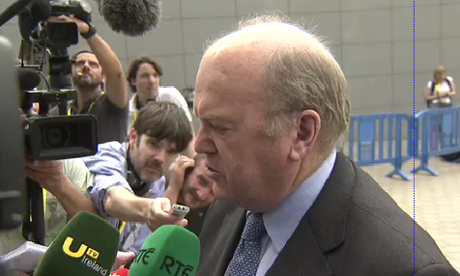
Irish finance minister Michael Noonan is hopeful for a new proposal:
Irish FinMin Noonan: I hope the proposal will be a formal application for new programme - which is a sustainable approach. #Eurogroup
— Open Europe (@OpenEurope) July 7, 2015
But he said:
There is a lot to do in a very short period of time, so I don’t think we’re looking at a conclusion today. But I hope there’s proper engagement.
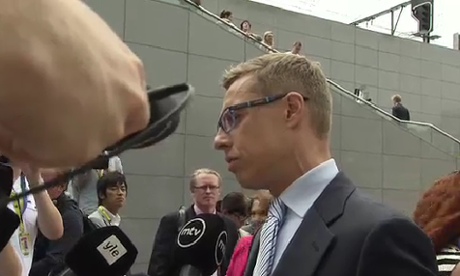
More from Finland’s Alexander Stubb.
We are looking at three things.
One. The short term financial needs of Greece. Money is running out, at the latest by 20 July.
Two. The role of Greece in the eurozone after the referendum.
Three. We have to deepen economic co-operations inside the euro.
We are not looking at Grexit.
On a possible deal today:
I am an eternal optimist but I don’t think we will have a result today. It is about listening and learning what the Greek government will do after the referendum.
We won’t be able to put forward any new commitments.
We will keep the doors to negotiations open.
We are not in the business of renegotiating debt.
Updated
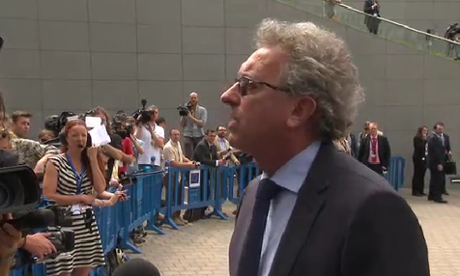
Pierre Gramegna of Luxembourg ( which currently holds the presidency) said they respected the results of the referendum, but now new proposals were needed.
We need to understand how [the Greek government] will resolve the contradiction - they want to stay in the eurozone but they say the proposals on the table are not acceptable.
[On debt relief] we have to look at all the options, everything must be discussed.
Lithuania’s Rimantas Sadzuis said what was needed was more clarity, following the referendum result.
Grexit is not the option for us. The eurozone should expand rather than contract.
But Greece needs to perform reforms.
In politics there is always room for compromise.
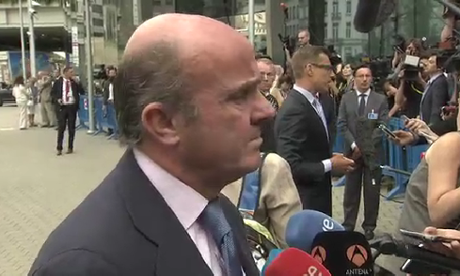
Spain’s Luis de Guindos said Grexit is not what anyone wants:
Spain's De Guindos: We are in the last seconds of this crisis - don't think #Grexit is a solution which anyone wants.
— Open Europe (@OpenEurope) July 7, 2015
Spanish FinMin De Guindos: The bansk are closed - they can't open. There isn't time. #Greece
— Open Europe (@OpenEurope) July 7, 2015
De Guindos: When asked about debt relief - this is not a urgent q right now. We first have to decide on if conditions can be implemented.
— Open Europe (@OpenEurope) July 7, 2015
De Guindos: The most important thing is if the rules can be followed. Any programme has conditions. #Greece
— Open Europe (@OpenEurope) July 7, 2015
Updated
More talk of Grexit, this time from Latvian finance minister Jānis Reirs:
Latvia's fin min: we put our house in order quickly after ec crisis. Not against #Grexit to strengthen eurozone
— Jennifer Rankin (@JenniferMerode) July 7, 2015
Latvian people do not understand the Greek people, says Janis Reirs. They are surprised abt referendum outcome.
— Jennifer Rankin (@JenniferMerode) July 7, 2015
I would have difficulties trusting Mr Varoufakis, hard to say about Tsipras b/c no personal dealings, says Latvia's fin min. #Greece
— Jennifer Rankin (@JenniferMerode) July 7, 2015
Updated
More quashing of hopes on Greece’s debt, from Finnish finance minister Alexander Stubb.
Finnish FinMin Stubb: Not Looking At Bridge Financing For Greece - BBG $EURUSD
— Live Squawk (@livesquawk) July 7, 2015
*FINLAND'S STUBB SAYS NOT WILLING TO EASE GREECE'S DEBT BURDEN
— lemasabachthani (@lemasabachthani) July 7, 2015
Updated
German finance minister Wolfgang Schäuble, asked if Greece can keep the euro, said you must ask the Greek goverment (quote from Reuters)
Lost in translation? Schaeuble Says He’s Waiting ‘With Excitement’ For Greece’s Offer #Greece #Germany #Eurogroup
— Nick Kounis (@nickkounis) July 7, 2015
Schaeuble: Greek government has fought with great success that it does not want a program, it has also gained big majority for this
— Nick Kounis (@nickkounis) July 7, 2015
Schaeuble: But without a program there is no possibility within the frame of the euro zone to help Greece”
— Nick Kounis (@nickkounis) July 7, 2015
Schaeuble: Everybody who knows European treaties knows that a debt cut would fall under the prohibition of a bailout
— Nick Kounis (@nickkounis) July 7, 2015
Grexit cannot be excluded - Dombrovskis
EC vice president Valdis Dombrovskis said:
If trust is not rebuilt, if there is no credible reform plan in place [Grexit] cannot be excluded.
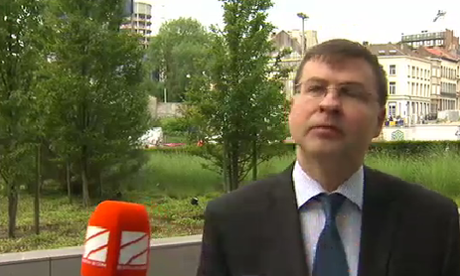
Slovakia sceptical of deal today
Slovakia’s Peter Kazimir said a viable deal was only possible at the highest level:
I am sceptical a deal will be found today.
The referendum result did not change the reality of Greece.
Greece is behind the curve.
On debt relief, he said that was a red line:
For my country nominal debt relief is impossible.
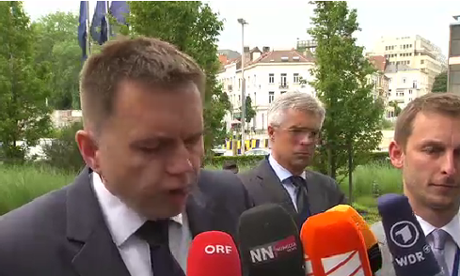
As he arrived at the meeting, Belgium finance minister Johan Van Overtveldt said:
The [Greek] economy is in freefall.
The banking system is in freefall.
We don’t have much time.
It is all about the Greek proposals
So new Greek Finance Minister arrived in Brussels without saying anything. In early days Varoufakis couldn't stop himself. Different times.
— Jonathan Rugman (@jrug) July 7, 2015
Eurogroup not about debt relief - Moscovici
EC economic affairs commissioner Pierre Moscovic said the Eurogroup was not about discussing Greece’s debt.
EU economy commissioner @pierremoscovici asked about debt relief: "The eurogroup meeting is not about that today" #Greece #Eurozone
— AnneSylvaineChassany (@ChassNews) July 7, 2015
He said it was up to Greek government to give concrete proposals, to say where they want to go.
There has been a lot of mistrust, we have to rebuild that.
Let us see what the intentions of the Greek government are.
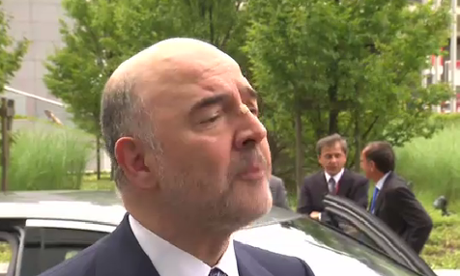
Eurogroup needs to see credible Greek proposals - Dijsselbloem
Eurogroup president Jeroen Dijsselbloem said finance ministers were still waiting for the Greek proposals, and needed to see if they were credible.
As he arrived at the Eurogroup meeting, he was asked if a new Greek finance minister would help talks, Dijsselbloem said it was not about personalities but “where we stand politically.”
The No [vote] means the old proposals were rejected, It is very difficult. We await the new proposals and see if they are credible.
Asked if they had not already been delivered and were a version of the previous reforms, he said:
You seem to have them, I am going in to see my colleagues.
We have been doing whatever it takes to strengthen the eurozone and keep it together.
We can’t have an outcome which would damage our credibility. It has to be credible for the future of Greece and the eurozone
We will be working on that and hopefully getting a solution.
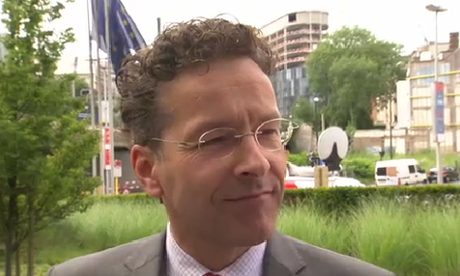
The eurozone finance ministers are arriving in Brussels (live feed here) but nothing revalatory so far:
French finmin Sapin arrives for #Eurogroup - no statement
— Viktoria Dendrinou (@v_dendrinou) July 7, 2015
Russia and Greece have played down the idea of any financial aid but:
Apparently Russia made an offer to lend to Greece a couple weeks ago - #livesquawk sources
— Live Squawk (@livesquawk) July 7, 2015
Greece's reported proposals
Greece’s proposals to the Eurogroup will be broadly similar to the plan which was rejected in the referendum, according to Süddeutsche Zeitung (in German).
It would keep the VAT rebate for islands, leave VAT for restaurants at 13% and contain limited cuts in defence spending.
VAT and pensions were of course the famous red lines, beyond which the Greek government would not go.
Meanwhile in the Stern report, Germany’s Gabriel hinted at the possibility of discussing debt relief but only if Greece agrees to reforms:
“If we simply emphasize debt, without that much will change fundamentally in Greece, nothing is won,” said Gabriel; they could also talk about “the possibility of reducing the debt, only talk if the Greek Government also indicates that will implement reforms.”But he was confident “at the end we will find a way out of the crisis in Greece”.
Updated
Oil has recovered some ground after a plunge on Monday.
Brent crude is currently up 1.75% at $57.53 a barrel following a drop of more than 6% on Monday. The price fall came as China’s stock market fell again, amid worries about the country’s future growth and thus its demand for oil, as well as the uncertainty caused by the Greek referendum. Talks in Vienna over Tehran’s nuclear programme could - if an agreement is reached - lead to increased supplies from Iran at a time of global oversupply.
ECB cautious of too generous emergency loans
The European Central Bank has clarified some of the rules on the emergency liquidity assistance, a day after tightening the conditions for Greece. In a document on its website the ECB suggested it was concerned that loosening the rules for Greece could lead others to act less responsibly. Bloomberg reports:
The Eurosystem’s functioning could be disrupted by “provision of ELA at overly generous conditions, which, in turn, could increase the risk of moral hazard on the side of financial institutions or responsible authorities,” the ECB said in a document published on its website Tuesday. “The objective of ELA is to support solvent credit institutions facing temporary liquidity problems. It is not a monetary-policy instrument.”
The document on the ECB’s financial-risk management clarifies the conditions surrounding emergency bank aid at a time when policy makers are restricting the provision of such funding to Greek banks. The reference to moral hazard indicates that officials are worried that bending the liquidity rules for Greece, as the country heads for a possible default, may lead future recipients to act less responsibly.
On Monday, the ECB increased the discounts on collateral for lenders receiving ELA from the Bank of Greece. That makes it more difficult for banks to access the funds that have kept them alive as deposit withdrawals accelerated amid uncertainty over the country’s place in the euro.
Cash theoretically available to Greek banks fell from €18bn to €5bn after ECB increased haircuts, Kathimerini https://t.co/HiCnI6k3fh
— Hugo Dixon (@Hugodixon) July 7, 2015
Updated
Marks & Spencer boss Marc Bolland said he felt it was important to remain in Greece where the retailer has 20 stores via a joint venture that has been in place since 1978.
He told reporters following a trading update: “We have taken steps to continue to trade there at the moment. The situation might change every day but over the last week stores have been trading at 60% to 70% [of the level of normal sales]. At a time when people are only able to get €60 out of a cash machine, that’s remarkable.” He said staff had been paid.
Bolland said Greece made up about 5% of M&S’s international business and so was “very small” but he added: “We feel it is important to stay in Greece.”
Germany's Gabriel: letting Greece into euro was a mistake
German vice chancellor Sigmar Gabriel has admitted it was a mistake to allow Greece into the euro.
*GABRIEL SAYS WAS 'NAIVE' TO ACCEPT GREECE INTO EURO: STERN
— Stavros Kallinos (@StKallinos) July 7, 2015
Here’s a translation of the report:
SPD leader Sigmar Gabriel has for the first time admitted that it was a mistake to allow Greece to join the euro zone. “The entry of Greece into the euro was done, from today’s perspective, very naively,” Gabriel said in an interview with Stern. “Worse is that all have watched far too long” as the country fell deeper and deeper into crisis, added the Vice-Chancellor.
Full report here (in German)
Updated
The Greek government is to blame for the current crisis and not Germany, according to Italy’s foreign minister Paolo Gentiloni. APF reports:
Greeks have their own leaders to blame for the crisis in their country, and not “mean Germans”, Gentiloni said Tuesday.
The current crisis “...is not the fault of mean Germans, but is the responsibility of the Greek governments which have followed one another these past 15-20 years,” he told the Italian daily Corriere della Sera.|
Germany, the eurozone’s de facto paymaster, has been the driving force behind requiring austerity policies to accompany bailout help for Greece.
German Chancellor Angela Merkel said Monday that conditions for a new Greek rescue package “have not yet been met.”
Capital Economics reckons a Grexit is likely sooner or later whatever happens today:
A #Greek deal covering financing for 6-12m & minor debt relief in exchange for creditors' last demands might kick the can down the road(1/2)
— Capital Economics (@CapEconEurope) July 7, 2015
But as we have always stressed, only a huge write-down can return #Greek debt to sustainable levels. Points to #Grexit sooner or later (2/2)
— Capital Economics (@CapEconEurope) July 7, 2015
Asked whether the Greek referendum success would mean other populist governments might use a plebiscite as a political weapon, he said:
“This has been discussed...what would happen if a referendum in another country put in doubt a compromise with Greece.
“We are in a difficult situation but we hope will will get a compromise acceptable to everyone.”
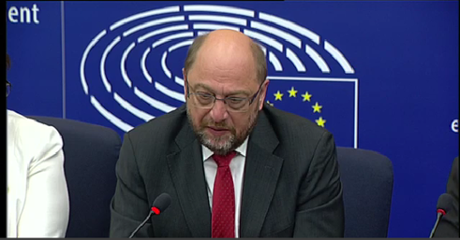
European president Martin Schulz has said he wants Greece to remain in the eurozone.
He told a press conference: “I’m in favour of keeping the eurozone together. Those who want to split up the eurozone are wrong.”
But he said it all depended on the new proposals from the Greek government: “Confrontation is not a solution... we need to get both sides together.”
Updated
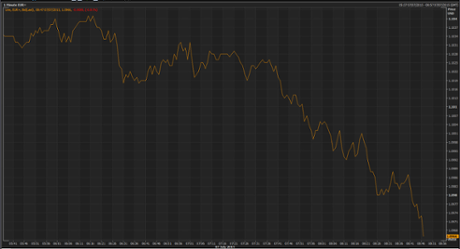
Euro falls ahead of summit
With fears growing that Greece will leave the eurozone, as leaders travel to Brussels for last ditch talks, the euro is coming under pressure. It is now fallen to below $1.10, its lowest level for more than a month.
At least three companies in Greece are paying staff in cash after the capital controls imposed last week to limit withdrawals from banks, according to Reuters.
The companies include Kotsovolos, the country’s biggest electronics retailer and a subsidiary of Britain’s Dixons Carphone.

Here’s an interesting chart from the economics team at RBS:
#Greece austerity gauge. Greek government spending has fallen 20% since 2008. In UK and Italy it's up. #GreekCrisis pic.twitter.com/WMQBxxVFqq
— RBS Economics (@RBS_Economics) July 7, 2015
Greece’s stock market will remain closed until Wednesday according to the Greek Capital Markets Commission, in line with the extended bank holiday.
Twitter (Varoufakis quits announcement), Facebook (Italian prime minister’s latest view on what must be done), and now texting. The modern way to run a crisis.
Now that's a relief: @JunckerEU says he's texting @tsipras_eu . Crisis solved!
— Gabriele Steinhauser (@gksteinhauser) July 7, 2015
Christine Lagarde, managing director of the International Monetary Fund, will reportedly be staying at home rather than attending the day’s meetings in Brussels.
Not a surprise really. Greece is already in arrears with the IMF after failing to make a $1.5bn payment due at the end of last month, so it is unlikely the fund would be taking part in any new bailout until that money is paid.
And the IMF also threw a spanner into the works just ahead of Greece’s referendum by saying that debt relief should be part of any new package, something seized on by Alexis Tsipras and his colleagues.

And if 16 out of 18 eurozone countries are in favour of Greece leaving then who are the other two?
@notayesmansecon France and Cyprus?
— MineForNothing (@minefornothing) July 7, 2015
@notayesmansecon @minefornothing I suspect France and Italy?
— Michael Hewson (@mhewson_CMC) July 7, 2015
@notayesmansecon @minefornothing don't think so - France because they've been softer on Greece and Italy cos they could be next
— Michael Hewson (@mhewson_CMC) July 7, 2015
Updated
European markets edge higher
Investors remain cautious ahead of the day’s meetings, with markets edging higher in early trading.
The FTSE 100 has added 0.1%, France’s Cac is 0.2% better, Germany’s Dax has risen 0.14%, Italy’s FTSE MIB is up 0.6%, and Spain’s Ibex has added 0.2%.
In the bond market Greek two-year and ten year yields have slipped back slightly, while ten-year yields for other peripherals - Italy, Spain and Portugal - are also a little lower.
And today’s “Ball is in the Greek’s court Award” goes to European Commission president Jean-Claude Juncker.
Speaking in Strasbourg, he said:
LIVE: @JunckerEU addresses @Europarl_EN: the ball is on #Greece's court; it 'll have to explain how we reach an agreement
— spyros gkelis (@northaura) July 7, 2015
The Greek gov must explain in Bxl today how it sees us extricating ourselves from this situation. #Greece #Eurosummit
— Jennifer Rankin (@JenniferMerode) July 7, 2015
EC Juncker: "I am against #Grexit. Some in EU are openly or covered in favor of Grexit. EC will do anything against it" #Greece
— Keep Talking Greece (@keeptalkingGR) July 7, 2015
#Juncker: 'Very saddened that Greek gov't left the negotiating table'
— Kathimerini English (@ekathimerini) July 7, 2015
*JUNCKER: EU READY TO DO WHATEVER NECESSARY TO REACH GREEK PACT
— Stavros Kallinos (@StKallinos) July 7, 2015
Juncker: 'We will not reach a deal with Greece today' http://t.co/WpKyqEdvq5 via @BIUK_Finance
— Lianna Brinded (@LiannaBrinded) July 7, 2015
But he must be glad to see the back of Yanis Varoufakis, the former Greek finance minister who described the country’s creditors as “terrorists”
Juncker: Is is unacceptable for the #greece govt to call us "terrorists"
— Efthimia Efthimiou (@EfiEfthimiou) July 7, 2015
#Juncker: the Commission and its President have tried hard to find deal, if only everyone had tried as hard
— Open Europe (@OpenEurope) July 7, 2015
Updated
Interesting snippet in the report on Monday’s events by Greek newspaper Kathimerini:
According to sources in Brussels, 16 of the other 18 countries in the eurozone are in favor of letting Greece leave the eurozone and they will have to weigh up the cost of any agreement to keep Athens in the single currency.
Breaking news:
S&P Believes That Greece Could Default On Debt Payment As Soon As This Week -Situation In Greece Is Leading To Return Of Econ. Depression
— Live Squawk (@livesquawk) July 7, 2015
Timetable for key meetings
Here are the expected timings for two Brussels meetings later.
First the Eurogroup of finance ministers:
12:00 (Brussels time, 11.00 BST) Arrivals
13:00 (12.00 BST) Roundtable chaired by Eurogroup President Jeroen Dijsselbloem
The agenda is as follows:
The Eurogroup will discuss the situation following the referendum in Greece that was held on 5 July 2015. Ministers expect new proposals from the Greek authorities.
And here’s the details of the leaders’ summit:
From 17.00 (16.00 BST)
Arrival of the heads of state or government of the Euro area
18.00 (17.00 BST)
Working dinner
at the end of the meeting
Press conference by the President of the European Council and the President of the European Commission
Updated
And European markets are forecast to open higher ahead of the day’s key meetings:
Our European opening calls: $FTSE 6557 up 21 $DAX 10931 up 40 $CAC 4726 up 15 $IBEX 10590 up 50 $MIB 21707 up 106
— IGSquawk (@IGSquawk) July 7, 2015
Markets came under pressure on Monday following the No victory in the Greek referendum, but things were nothing like as bad as some had feared. Economist Ian Williams at Peel Hunt said:
Given the apocalyptic predictions of the consequences of a Greek ‘no’ vote made before the weekend, losses of around 2% for the Eurozone indices should have been greeted with a sigh of relief. Similarly, the moves in Eurozone bond markets were modest, in the context of recently heightened levels of volatility. That sanguine response may not be so much based on optimism that a compromise deal can still be reached (given the removal of Mr Varoufakis) as reflecting a judgement that, even if Grexit is now more likely than before, the broader economic consequences for the region can be contained.
The Eurozone’s peripheral markets were understandably less sanguine than the core, with Italy’s MIB index losing 4% and the IBEX in Spain 2.2%.
Asian markets were mixed, with the Nikkei up 1.3% but the Hang Seng down 0.6%.
And China continued its recent slump:

Updated
Introduction: Leaders await new Greece proposals
Good morning and welcome to our coverage of the continuing eurozone crisis and the latest attempts to broker a deal between Greece and its creditors.
With time running out - to quote German Chancellor Angela Merkel - Greek prime minister Alexis Tsipras is set to present new proposals following his resounding victory in Sunday’s referendum.
Finance ministers will meet later to consider what Greece has put on the table, with European leaders discussing the situation in an emergency summit this evening. Here’s Ian Traynor’s story looking at the prospects for a deal:
Germany and France scrambled to avoid a major split over Greece on Monday evening as the eurozone delivered a damning verdict on Alexis Tsipras’s landslide referendum victory on Sunday and Angela Merkel demanded that the Greek prime minister put down new proposals to break the deadlock.
As concerns mount that Greek banks will run out of cash and about the damage being inflicted on the country’s economy, hopes for a breakthrough faded. EU leaders voiced despair and descended into recrimination over how to respond to Sunday’s overwhelming rejection of eurozone austerity terms as the price for keeping Greece in the currency.
Tsipras, meanwhile, moved to insure himself against purported eurozone plots to topple him and force regime change by engineering a national consensus of the country’s five mainstream parties behind his negotiating strategy, focused on securing debt relief.
Full story here:
One key participant will be new Greek finance minister Euclid Tsakalotos, appointed after the resignation of his colourful predecessor Yanis Varoufakis on Monday. Here is our profile of Tskalotos.
Meanwhile Greek banks will not reopen today after capital controls were extended until at least tomorrow. The European Central Bank put more pressure on the Greek system by tightening the rules for giving emergency funding. Michael Hewson at CMC Markets said:
[The ECB move} is likely to increase criticism that the central bank is getting involved in exerting political pressure and acting beyond its mandate of price stability, and as lender of last resort, which any credible central bank should do as a matter of course.
All the ECB has done is make it more likely that Greek banks will run out of money in a matter of days. Furthermore it remains highly unlikely that the Greek government will be able to make it to the next key payment deadline of 20th July when a €3.5bn bond to the ECB becomes repayable.
While the departure of the polarising Greek finance minister Yanis Varoufakis is likely to mean that relations between the creditors and the Greek government are likely to improve, in reality the move changes nothing, particularly since attitudes in some parts of Europe appear to have hardened.
The players may have changed but the problems remain the same and while European finance ministers have agreed to meet today to consider some new Greek proposals, the likelihood is that they are unlikely to be any more acceptable now than they would have been last week, particularly given that debt relief is likely to be one of the key demands from the Greece side.
This would suggest that any new agreement remains unlikely which means that Greece may well be forced to issue its own currency in a matter of days.
Updated











Here's the translation:
The Greek government has submitted today, to the eurogroup as well as to the summit of eurozone leaders, the Greek proposals, such as they have been formed as a national strategy, by yesterday's conference of the political leaders. Fundamental goal is an agreement which is socially just and economically sustainable for Greece, and also for the eurozone. This framework includes credible reforms with social justice as the criterion, includes on the other hand in return a committement to an adequate covering of the financial needs of the country in the medium term, a strong investment package, a package of investments to cope with the big problems, mainly the problem of unemployment, as well as the initiation of a meaningful discussion on the necessary restructuring of the debt.
The discussion took place in a positive atmosphere, the procedure will be fast, it will be very rapid, it is beginning in the next hours, with the goal of having reached a result by the end of the week at the latest.
[Unintelligible question from journo about Grexit. Possibly "They talk about Grexit"]
The Greek side will continue the effort having as a strong weapon the verdict of the Greek people which was clear, the will of the overwhelming majority of the Greek people for a viable agreement that will put an end to this discussion, to which you just referred, once and for all, and will give a prospective of a definite end to the crisis. I am glad, ehm, to say, that by the statements of my colleagues I realise that they all understand, that we do not have a Greek problem, but a European problem to which we are called to give a solution to all together, with responsibility. Thank you very much.