IMF fires a cannonball into Greek bailout
We’ve now got hold of the new IMF report into Greece’s debt sustainability.
And a quick perusal shows that the Fund has comprehensively obliterated the notion that this third Greek bailout will work, as it stands.
The introduction to the report says enough, really:
Greece’s public debt has become highly unsustainable. This is due to the easing of policies during the last year, with the recent deterioration in the domestic macroeconomic and financial environment because of the closure of the banking system adding significantly to the adverse dynamics.
The financing need through end-2018 is now estimated at €85bn and debt is expected to peak at close to 200 percent of GDP in the next two years, provided that there is an early agreement on a program. Greece’s debt can now only be made sustainable through debt relief measures that go far beyond what Europe has been willing to consider so far.
The IMF’s fundamental conclusion is that Greece will simply not be able to borrow at affordable rates again, until its debt burden is lower.
The situation was already bad - but recent developments make it much, much worse.
The events of the past two weeks—the closure of banks and imposition of capital controls—are extracting a heavy toll on the banking system and the economy, leading to a further significant deterioration in debt sustainability relative to what was projected in our recently published DSA.
Today’s report is light on projections, but the ones included are stark enough. The stand-out fact: Greek debt is on track to peak at close to 200% of GDP in the next two years. Only Japan, after two lost decades, comes close to that ratio.
Perhaps this is why the US government, led by Treasury secretary Jack Lew, has been so vocal about the need for debt sustainability to be addressed?
The IMF is also amusingly sniffy about the targets Greece is being set. For example:
Medium-term primary surplus target: Greece is expected to maintain primary surpluses for the next several decades of 3.5 percent of GDP. Few countries have managed to do so. The reversal of key public sector reforms already in place— notably pension and civil service reforms—without yet any specification of alternative reforms raises concerns about Greece’s ability to reach this target
But it’s conclusion is clear - if Europe wants this bailout to work, it must either grant Greece three decades grace before repaying its debts, or cut the face value of its borrowings, deeply....
And on that note, we’re going to shut down for the night. Back tomorrow. Goodnight! GW
Updated
This is important. IMF says Greece needs 30yr grace period on its debt. Even bigger debt relief https://t.co/JRbGA8Wyn7
— Ed Conway (@EdConwaySky) July 14, 2015
IMF: We walk away without Greek debt relief
IMF won't take new #Greece programme to board unless there is a solution to debt problem
— Alberto Nardelli (@AlbertoNardelli) July 14, 2015
THIS IS IT. The IMF stating as bluntly as it can that Europe must decide between giving Greece a 30-year grace period to repay its debt, and accepting the reality that serious haircuts must be taken:
IMF: Greece debt "highly unsustainable" - needs up front haircut or dramatic maturities extension and grace period pic.twitter.com/0YuWG2Va7j
— Alberto Nardelli (@AlbertoNardelli) July 14, 2015
Some late breaking news: The International Monetary Fund has confirmed today’s leaked report which warned that Greece needs much more debt relief than the eurozone has accepted:
Here’s the details;
IMF on Greece: €85bn may not be enough due to optimistic surplus and growth targets: pic.twitter.com/6pEmtovW47
— Alberto Nardelli (@AlbertoNardelli) July 14, 2015
Heads-up: the process of driving Greece’s bailout deal through parliament will start early:
#Greece | Prior actions draft bill to be introduced to parliamentary committees and plenary tomorrow 0700 GMT.
— Yannis Koutsomitis (@YanniKouts) July 14, 2015
Snap Summary: Tsipras shows leadership

Even if you think Alexis Tsipras has misplayed the crisis, it’s hard not to be impressed by his composure in tonight’s interview.
Barely 36 hours after agreeing the punitive bailout deal with fellow eurozone leaders, the Greek PM has given a solid defense of the agreement he brought back from Brussels.
He was scathing about the tactics played by his opponents, declaring:
“Last night was a bad night for Europe.”
and adding that the events last weekend “does not honour the tradition of a democratic Europe”.
He repeated his claim that, by calling a referendum, he had ended up with a better deal that addresses Greece’s medium-term funding needs. And, eventually, debt relief.
He said:
“To be frank, here, they [eurozone countries] are not only forced to give fresh money, but to give 82 billion, and are accepting the restructure of debt.”
However, there was no pretense that he’d played a blinder in Brussels. Tsipras even admitted that he didn’t believe in the plan forced on Greece - but he’d do his best to implement it.
“I am fully assuming my responsibilities, for mistakes and for oversights, and for the responsibility of signing a text that I do not believe in, but that I am obliged to implement,”
There were signs that Tsipras was still digesting the impact of his all-night battles with his eurozone neighbours, as he said bitterly that:
“The hard truth is this one-way street for Greece was imposed on us,”
That #Tsipras spoke of #Greece suffering post-traumatic stress at moment says all you need to know about what kind of w/e he had #Greece
— Nick Malkoutzis (@NickMalkoutzis) July 14, 2015
On Grexit, he warned that the risk hadn’t totally vanished, until the bailout deal has been ratified. But he was adamant that the country didn’t have the resources to cope outside the eurozone.
And he claimed that some conservative groups would be keen to see Syriza out on their collective ear. The bruises from the Euro summit may never really heal.
He didn’t dump the blame for the crisis on Yanis Varoufakis -- his former finance minister was a great economist; that doesn’t always translate into political skills, though.
But perhaps most importantly, Tsipras vowed to fight on and take hard decisions.
“The worst thing a captain could do while he is steering a ship during a storm, as difficult as it is, would be to abandon the helm.”
We’ll find out on Wednesday night whether Cap’n Alexis has the support of the crew, when Syriza are asked to vote on the tough austerity and radical economic reforms demanded by creditors. But tonight, he’s got his hand on the rudder.
So, hats off to @tsipras_eu at last?
— Frederik Ducrozet (@fwred) July 14, 2015
#Tsipras overarching theme: #Greece backed into corner. Doesn't believe in agreement. Bad night for Europe. But signed "to avoid disaster"
— Mark Lowen (@marklowen) July 14, 2015
Updated
Tsipras: Captain cannot just abandon ship
What about the big question ahead of tomorrow night’s vote on the bailout -- might you resign?
Tsipras says that “A captain cannot abandon ship” during a storm.
And on the possibility of a unity government, the PM says it is important not to “create instability” during these critical times.
So, is the threat of Grexit finally off the table?
Tsipras says that, until the bailout deal is finalised, nothing is certain.
Greek PM @atsipras asked if #Grexit finally avoided: I cannot say anything with certainty before the deal finally signed. #greekment
— Efi Koutsokosta (@Efkouts) July 14, 2015
We won’t reverse the measures we have taken this year, the PM insists (so the cleaning ladies re-instated after a long campaign may be safe)
Greek PM @atsipras: There is no issue of recalling laws considered to be unilateral by the creditors. #greekment
— Efi Koutsokosta (@Efkouts) July 14, 2015
Backstage from the #Tsipras interview (via @geoterzis) #Greece #erttsipras #greekment #rbnews pic.twitter.com/E1lsVX2beX
— Kostas Kallergis (@KallergisK) July 14, 2015
Whose phone was it? #Tsipras https://t.co/aNUZdpeWBq
— Mark Lowen (@marklowen) July 14, 2015
Comedy moment as a phone rings somewhere offstage.....
The hugely controversial €50bn privatisation fund could have been worse, Tsipras says.
Initially it was all going to pay down debt (Merkel’s demand); now half is going to recapitalise the banks.
.@tsipras_eu at first the sales from the privatization fund were only going to debt payments. Now it also goes to bank recapitalization.
— M. Caruso-Cabrera (@MCaruso_Cabrera) July 14, 2015
.@atsipras repeats few times that whatever mistakes Varoufakis made it is his (the PM's) responsibility.
— Stratos Safioleas (@stratosathens) July 14, 2015
Tsipras concedes that Yanis Varoufakis made mistakes, but takes responsibility for them himself. Great economists don’t always make good politicians....
#Tsipras "Being an excellent academic, doesn't necessarily make one a good politician" #Greece
— Nick Malkoutzis (@NickMalkoutzis) July 14, 2015
Greek PM @atsipras: I cannot blame @yanisvaroufakis for mistakes made. I take the responsibility, I am the prime minister. #Greekment
— Efi Koutsokosta (@Efkouts) July 14, 2015
Tsipras reveals that he challenged the German chancellor earlier this year, once former finance minister Yanis Varoufakis warned that Wolfgang Schäuble wanted Greece to leave.
#Tsipras: In march or april #Varoufakis told me Schaeuble said "agree or consensual grexit", "contacted merkel, she said it wasn't her plan"
— Janine Louloudi (@janinel83) July 14, 2015
On the issue of Grexit, Tsipras says Greece simply isn’t in a position to handle a return to the drachma. Not only would the banks collapse, but it would cause ‘huge problems’ elsewhere.
Tsipras: Country does not have sufficient currency reserves to return to a national currency #Greece pic.twitter.com/kGoC67wQGU
— Derek Gatopoulos (@dgatopoulos) July 14, 2015
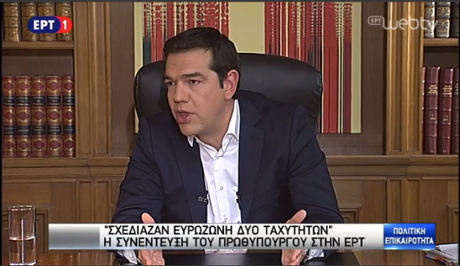
Interesting....Tsipras says he won’t claim the deal is a success, but it is the only one on offer:
.@tsipras_eu I went to Russia China and U.S. and there were no other options.
— M. Caruso-Cabrera (@MCaruso_Cabrera) July 14, 2015
Tsipras: Some Conservative groups want us out
Asked about suggestions Sunday’s deal was an attempted coup, Tsipras says there are some elements - in Greece and abroad - who would like his government to fall.
He singles out the European People’s Party - the home of Angela Merkel’s CDU party, Commission president Jean-Claude Juncker, Council president Donald Tusk, and Greece’s New Democracy party (and many other conservative groups)
Greek PM @atsipras: I am sure that some hard conservative groups in Europe would be happy if our government was a parenthesis. #Greekment
— Efi Koutsokosta (@Efkouts) July 14, 2015
Updated
I don’t believe in the agreement, but I’ll sign it anyway rather than walking away.....
Greek PM @tsipras: I am not going to escape and I will take the responsibility even by signing an agreement I don't believe in. #greekment
— Efi Koutsokosta (@Efkouts) July 14, 2015
The Big NO in Greece’s referendum 9 days ago didn’t actually spare us from austerity, Tsipras admits:
#Tsipras "Prior actions didn't change after referendum. Must be honest about that. But we have longer funding period & debt relief" #Greece
— Nick Malkoutzis (@NickMalkoutzis) July 14, 2015
More Tsipras.
He says that Greece “fought a battle” to protect wages and pensions from cuts.
And he suggests Greece can exit the crisis in three years.
That’s quite a change on his campaigning speeches in January. And it means Greece would have been in the mire for almost a decade.
Updated
.@tsipras_eu When you have higher VAT taxes, you collect less taxes but this was forced upon us. #supplysider pic.twitter.com/apAeuaIf1P
— M. Caruso-Cabrera (@MCaruso_Cabrera) July 14, 2015
Tsipras is adamant that he’s come back with a better deal.
He argues that Greece needs pension reforms - and that although VAT hikes will be regressive, the impact is balanced by other measures.
.@tsipras_eu We got a lower primary budget surplus requirement. pic.twitter.com/HUSgnWlJHx
— M. Caruso-Cabrera (@MCaruso_Cabrera) July 14, 2015
#Tsipras on increasing retirement age to 67: We should have done it ourselves. It's not progressive to allow people retire early.
— Damian Mac Con Uladh (@damomac) July 14, 2015
Tsipras is arguing that the yes/no referendum strengthened his hand, and meant Greece got a better than was on offer before - which covers all our medium-term financing needs.
We got an agreement with hard reforms but not the complete impasse of the 25th of June says the Greek pm @atsipras. #Greece #Greekment
— Efi Koutsokosta (@Efkouts) July 14, 2015
Tsipras: Bad night for Europe
The Greek PM @atsipras now on #ERT about the #Greekment pic.twitter.com/H45wSTOkRM
— Efi Koutsokosta (@Efkouts) July 14, 2015
Alexis Tsipras’s interview with ERT has begun, in his prime ministerial office.
The PM says that Sunday was a bad night for Europe, in which severe pressure was placed on his country and its people. The traditions of Europe were not respected.
We ended up with a tough agreement, but at least it’s not the dead end we faced earlier.
He’s speaking calmly, seriously, and tie-lessly of course.
.@tsipras_eu Yesterday was a bad night for Europe. The result was due to very strong pressure. pic.twitter.com/eJdC1DmSs7
— M. Caruso-Cabrera (@MCaruso_Cabrera) July 14, 2015
While we wait to hear from Alexis Tsipras, here’s some new polling data showing that a majority of Greeks wants parliament to approve the bailout agreement, and Tsipras to stay as PM.
Kapa Research poll for To Vima Who is to blame for tough measures? European leaders 48.7% Greek gov't 44.4% #Greece
— MacroPolis (@MacroPolis_gr) July 14, 2015
Kapa Research poll for To Vima Should Parliament approve the Brussels agreement? Yes 70.1% No 25.3% #Greece
— MacroPolis (@MacroPolis_gr) July 14, 2015
Kapa Research for To Vima If there is change to coalition, who should be PM? Tsipras 68.1% Another, widely accepted figure 22.6% #Greece
— MacroPolis (@MacroPolis_gr) July 14, 2015
Watch Alexis Tsipras's interview here
The Greek prime minister is due to begin giving an interview to state TV in around 10 minutes
It will be streamed live here.
Summary: IMF raises stakes ahead of Greek vote
Ahead of tomorrow’s vote in the Greek parliament on the bailout agreement tortuously agreed over the weekend , the International Monetary Fund has said the country needs massively more debt relief than the eurozone has admitted.
The IMF has updated its debt sustainability analysis to reflect the damage wrecked on the Greek economy since capital controls were imposed more than two weeks ago.
The IMF said:
“The dramatic deterioration in debt sustainability points to the need for debt relief on a scale that would need to go well beyond what has been under consideration to date - and what has been proposed by the ESM.”
This has led some to speculate the IMF wants to wash its hands of Greece altogether.
Got copy of #IMF DSA update. To me, most interesting thing not lines on debt relief. Tone sends signal they want out of #Greece completely
— Peter Spiegel (@SpiegelPeter) July 14, 2015
Here is our report on the IMF’s conclusions:
Meanwhile Greek prime minister Alexis Tsipras is due to appear on Greek television later (again). The finance ministry has submitted the necessary legislation ahead of the parlimentary vote tomorrow.
Tsipras may well win the vote but with members of his own party rebelling, his authority could be damaged enough that snap elections may be needed. In any case a reshuffle of his cabinet is likely. Antti-austerigy protests tomorrow will also put pressure on the government.
The bailout deal also has to be passed by other eurozone parliaments, with Austria and Germany set to both vote on Friday.
Elsewhere there were reports that the European Commission intended tapping the EFSM stability fund to help finance a bridging loan for Greece.
Updated
President Obama has reportedly welcomed the Greek deal in telephone conversation with German chancellor Angela Merkel. The US of course has been concerned about the impact of financial chaos in the eurozone on its own economic growth prospects.
JUST NOW - @POTUS called Chancellor Angela Merkel Welcomed Monday's agreement between Greece and its creditors. (1)
— Fanis Papathanasiou (@fpapathanasiou) July 14, 2015
@POTUS noted agreement is a positive step that could help to underpin a return to growth and debt stability in #Greece (2)
— Fanis Papathanasiou (@fpapathanasiou) July 14, 2015
@POTUS said that further work will be required. (3) #Greece
— Fanis Papathanasiou (@fpapathanasiou) July 14, 2015
Could there be trouble brewing even if the Greek parliament passes the legislation?
@SpiegelPeter Μinimal turnover.
— Yannis Koutsomitis (@YanniKouts) July 14, 2015
@YanniKouts Still, creditors have specifically mentioned they're worried about govt slipping things into legislation w/o telling them.
— Peter Spiegel (@SpiegelPeter) July 14, 2015
Greek MPs will pass the bailout terms on Wednesday, according to advisory firm Teneo, but there is the risk Alexis Tsipras will be so weakened there will be a snap election.
Teneo Intelligence's latest on #GREECE: Prior actions will pass, but political turmoil is looming large pic.twitter.com/gfuGnnCqHs
— wolf piccoli (@wolfpiccoli) July 14, 2015
The legislation on the bailout has been submitted to parliament, as required by the EU deal:
#Greece Bill on the bail out terms agreed on #EuroSummit submitted to MPs. #mnimonio3 per @enikos_gr
— spyros gkelis (@northaura) July 14, 2015
Final version of Greek gov's multi-bill with the pension & tax reforms agreed with creditors submitted to Parliament. Vote expected late Wed
— NikiKitsantonis (@NikiKitsantonis) July 14, 2015
Updated
Here are two Syriza MPs who it appears will vote against the bailout terms tomorrow:
#Syriza MPs @elsotiriou and @dkodelas will vote No. Both associated with Communist Organisation of Greece (@KOEgr), which has Maoist roots
— Damian Mac Con Uladh (@damomac) July 14, 2015
ΟΧΙ στο τρίτο μνημόνιο. Αρνούμαι ότι η χώρα πρέπει να είναι αποικία της Γερμανίας Δήλωση της Ελένης Σωτηρίου,... http://t.co/DMGPb0llD0
— Ελένη Σωτηρίου (@elsotiriou) July 14, 2015
Updated
European markets edge higher
In rather uncertain trading - hardly surprising given the circumstances - European markets have, in the main, ended the day in positive territory. But it was not a convincing move, as investors wait to see if the Greek deal agreed after marathon weekend meetings will actually stick. The final scores showed:
- The FTSE 100 finished 0.23% higher at 6753.75
- Germany’s Dax added 0.21% to 11,508.46
- France’s Cac closed up 0.61% at 5028.51
- Spain’s Ibex ended 0.38% bette at 11,266.4
- But Italy’s FTSE MIB dipped 0.3% to 23,097.51
In the US, the Dow Jones Industrial Average is currently up 0.29%.
Cabinet Reshuffle Will Go Beyond The Two Ministers Who Didn’t Support Bailout Greek Deal-Govt Official
— Viktoria Dendrinou (@v_dendrinou) July 14, 2015
#Greek Cabinet Reshuffle To Take Place After Wednesday’s Parliamentary Vote On Bailout Measures - Govt Official
— Viktoria Dendrinou (@v_dendrinou) July 14, 2015
More on the possible Greek government changes:
Greek govt officials restating that Tsirpas will not resign and also that any cabinet reshuffle will not change the make-up of the coalition
— RANsquawk (@RANsquawk) July 14, 2015
Updated
Over in Athens the Greek government has just announced that embattled prime minister Alexis Tsipras will be giving an exclusive interview to ERT1 this evening at 10 PM local time. Helena Smith reports:
Tsipras has taken increasingly to personally explaining his government’s policies and by extension, the twists and turns of the Greek crisis, on state-run television. This will be at least the fourth time in recent weeks that the leader has addressed Greeks. Despite everything, he still enjoys record popularity ratings - and his beleaguered government is clearly now keen to exploit that fact. Many Greeks have rallied around claims made by several leading members of the government today that a coup is in motion, aimed squarely, at regime change in Athens.

Updated
Here’s our report on the IMF’s call for a greater level of debt relief for Greece. Economics editor Larry Elliott writes:
The severe damage caused to the Greek economy by more than two weeks of bank closures and capital controls means the stricken eurozone country will require far more generous debt relief than is currently on offer from its single-currency partners, according to the International Monetary Fund.
A report by the Washington-based Fund leaked to the news agency Reuters shows that Greece’s public debt is likely to peak at 200% of its national income within the next two years, with the risk that the actual outcome could be even worse.
The debt sustainability analysis comes on the eve of a crucial vote in Athens when the prime minister, Alexis Tsipras, will be seeking parliamentary approval for the fresh austerity measures demanded by the eurozone in return for a three-year rescue package worth up to €86bn (£61bn).
Putting into question its involvement in the bailout, the IMF report paints a far darker picture of Greece’s public finances than contained in the blueprint released at the end of the marathon eurozone leaders’ summit on Monday.
“The dramatic deterioration in debt sustainability points to the need for debt relief on a scale that would need to go well beyond what has been under consideration to date – and what has been proposed by the ESM,” the IMF said, referring to the European Stability Mechanism bailout fund which will be used to bankroll the Greek bailout plan.
Throughout the Greek crisis, the IMF has consistently urged deeper debt relief but has met resistance from European finance ministers, who have been unwilling to make their taxpayers pay the cost of a write-down.
The full piece is here:
EC commissioner Pierre Moscovici has admitted the deal agreed yesterday will be tough on Greece but said it was a good one because it opens a way out of the recent impasse and keeps the country in the eurozone.
Writing in a blog post he said:
This timetable is tight, but it is a necessary antidote to the mistrust that has developed between Athens and its eurozone partners...
The agreement also sets Athens on a path of extremely precise reforms, and includes safeguards to prevent the country from deviating from that path.
But he added:
Some say the terms of the agreement are unacceptable for Greece, even describing them as a gun to the head. Some believe that they are too demanding for a country whose population has suffered greatly for five years, and whose economy entered into recession again this year. I understand that position. And I also care first and foremost about the Greek people. The future programme will have to strike a balance between economic necessity and political reality. If excessive mistrust led us to ask the impossible of Greece would be damaging for all. I hope we give Greece a chance to prove its good faith, and that the future programme allows the country to raise its head economically and politically.
Still, we lost six months. During which the situation in Greece has deeply deteriorated. The human, political and economic cost of the agreement increased dramatically. This makes me sad and leaves a bitter taste in my mouth. For it is the Greek people who, once again, will bear the costs.
The full post is here.
Updated
Austria’s parliament is reportedly set to vote on the Greek deal on Friday, the same day as Germany.
Peter Kazimir, the Slovak finance minister, ran into some controversy yesterday by tweeting that the compromise reached was tough for Athens because it was the result of their “Greece Spring.”
That was subsequently deleted but Kazimir has waded in again just now, changing “Greek Spring” to “Syriza Spring.”
There is a saying - tell someone the truth, lend him/her money and they will become your enemies
— Peter Kažimír (@KazimirPeter) July 14, 2015
The Greek compromise, reached on Monday, is considered to be tough and harsh. If it's so, it is the unfortunate outcome of ´Syriza Spring'
— Peter Kažimír (@KazimirPeter) July 14, 2015
In tense situations, some tweets can trigger anger. Our intention to be straightforward about our perspective, not to insult or offend
— Peter Kažimír (@KazimirPeter) July 14, 2015

The European Commission is downplaying the latest IMF report, writes Jennifer Rankin in Brussels.
A Commission spokeswoman said she had not seen it. She added that the IMF and the Commission had together signed off on an economic assessment that put Greece’s funding needs at €74-€78bn from 2015-18. This was the document sent to finance ministers on Saturday and formed the basis for the bailout agreement that emerged on Monday morning. She said: “This is the document that is relevant for a possible ESM programme,” a bailout under the European Stability Mechanism fund.
Tyrie: “Arguably it’s the IMF that also needs some reinforcement. The IMF has got itself into a bit of a pickle, hasn’t it? It’s heavily exposed. Is it going to get its money back? Are you looking at that issue and the vulnerability of the IMF itself?”
Carney: “I think it is important to recognise the preferred creditor status of the IMF and that any contemplated extension adjustment to the debt of Greece should respect that. I agree, as a personal view, that it’s important that the IMF in any situation is an independent institution providing objective advice and making appropriate lending decisions in that context.”
Tyrie: “Are you confident it has been doing that?”
Carney: “What I would say that... even with the benefit of hindsight, given the stakes in 2010 and the contagion that was possible in 2010 because of the very grave imperfections in Europe there was merit in not having a ... disorderly restructuring at that time.
“Now a much clearer eyed assessment of the scale of the restructuring that was necessary was apparent to some at the time and would have been welcome. It clearly would have been welcome in hindsight. What’s important now is that’s water under the bridge and what’s important now is that the IMF is as objective, and as transparent and as public as possible with its assessment of the debt sustainability of Greece. And I would say with the release of the debt sustainability analysis last week and perhaps subsequent comments that appears to be what they are trying to do.”
Updated
Tyrie: “Has the Bank been giving thought as to whether the IMF should have got itself so close to this whole issue rather than giving independent advice to its quota members?”
Carney: “The UK representative at the IMF is appointed by the Treasury not the Bank. We worked with - in recent days, weeks, months - with the IMF to offer independent perspective on some of these issues, potential solutions to these issues in an effort to be helpful. The Fund is dealing with an extremely fluid situation obviously in Greece and I’ll just reiterate that there is no simple solution as you can appreciate... There will need to be debt relief in our view... but debt relief in and of itself will not be sufficient to the other elements of structural reform and fiscal adjustment that are going to be required as will a measure of privatisation be required ultimately.
“And I will finish with this... I think it does underscore again that the institutions of European monetary union are unfinished and need to be reinforced. This process, the scale of the issue, the response and some of the things that were contemplated on the weekend for Greece by the eurogroup, underscore the need for considerable reinforcement and extension of those institutions for those countries that are part of the euro area.”
Updated
Bank of England governor Mark Carney has been continuing his evidence to parliament’s Treasury select committee, where the committee’s chair Andre Tyrie has just asked him about that IMF paper on the need for much bigger debt relief for Greece.
Here is the exchange, which alludes to Carney’s comments earlier this morning to the committee that working through the euro summit agreement requires “Herculean efforts from all sides”.
Tyrie: “You described this as a Herculean task, Governor. Hasn’t the IMF already confirmed your view that Hercules might not be up to it?”
Carney: “As you say, I haven’t seen what the Fund had said. I would say as follows, in the statement, of the euro group leaders there was an observation about ... subject to progress of Greece on various actions... they would look to the possibilitiy of smoothing the debt profile in order to provide additional relief... no haircuts but changing the profile.
“That is the extent to which debt relief has been contemplated as far as I am aware at the eurogroup. The point I was making, which sounds to be consistent with what the IMF was saying... is this is a considerable need and it’s one that should be assessed as objectively as possible.”

Updated
Merkel and Schäuble under fire in Germany
Angela Merkel and her finance minister, Wolfgang Schäuble, have come under sharp attack at home for their handling of the Greek crisis talks, with some opposition politicians accusing them of blackmailing Athens.
Ahead of a special session of the Bundestag on Friday at which Merkel, the German chancellor, will ask parliamentarians to support negotiations for a third bailout for Greece, some MPs accused her and Schäuble of deliberately trying to split Europe.
Gerhard Schick, the financial expert of the Green party, accused the finance minister of acting “extremely dangerously” concerning his proposals for a temporary exit of Greece from the eurozone. “With his Grexit plan Schäuble was calling for the division of Europe,” he said. He called Schäuble’s plan “a completely new negotiating position”, which had been tabled without the approval of the rest of the German government.
The deputy leader of the far-left Linke, Dietmar Bartsch, meanwhile accused the German government of extortion. “This negotiation result is a German diktat and nothing other than blackmail,” he told German television.
Schäuble in particular had “smashed an awful lot of porcelain” during the talks, he added. With his Grexit paper he had “taken the axe to Europe. It is terrible what he did and the way he used it to threaten other countries,” Bartsch said.
Full story:
Updated
Speaking of France... Marine Le Pen has kept up her barrage of criticism of the Greek deal, which she says will have “heavy consequences” on French taxpayers and the the country’s debt.
She accused the European Union of “totalitarian” behaviour, in a statement released by the Front National, adding:
“It’s clear he [Hollande] wasn’t guided by national interest, making this terrible declaration on the day of this national holiday, that the interests of the French people come after “European interests”.”
Updated
Hollande: Greece was not ‘humiliated’

François Hollande has used his traditional Bastille Day interview to insist that Greece was not “humiliated” by the EU bailout deal and that the most important thing for the Greeks and for Europe was that the country remained inside the eurozone.
He argued that “driving” Greece from the eurozone would have been considerably more humiliating.
“I could not accept the humiliation of a people…humiliation would have been to drive them from the euro zone,” Hollande said. And he insisted the France-German relationship, reportedly strained over the bailout negotiations, was a strong as ever.
“Without the Franco-German couple it was not possible to find an agreement. When Germany and France are not united, Europe cannot go forward.”
Hollande said he had advised Alexis Tsipras not to hold a referendum, but added that he respected the Greek prime minister’s decision to ignore that advice and described him as “courageous” .
“I told him: help me to help you,”
Hollande said France and Germany would now draw up new rules for “better economic governance” in the EU and that France would come up with proposals, though he did not give details.
“In the long run I would like there to be a parliament for the eurozone,” he added calling for greater harmonisation of “fiscal and social policies” in the single currency zone.
“This is what we, along with Germany, want,”
On the subject of European economic rules, the French president might want to look at putting his country’s own house in order: since 2003, France has repeatedly failed to meet European deadlines to bring its public deficit under the 3% of GDP required by the EU.
In 2013, exasperated European finance ministers gave France a two-year deadline to meet the target but have been persuaded to extend this for another two years. The French government does not currently envisage doing so before 2017, but has managed to convince Brussels to let it off being fined.
Updated
The eurozone leaders knew of the IMF’s debt analysis before agreeing the third bailout terms for Greece, an EU source has told Reuters.
Updated
More from the IMF. Deputy managing director Zhu Min added to the fund’s calls for debt relief for Greece. Bloomberg reports:
Greece needs debt relief to aid the economy after agreeing to a range of austerity measures in exchange for a bailout, said Zhu Min, deputy managing director of the International Monetary Fund.
“The financing is clearly a very important issue for the Greek economy and the debt relief is also an important issue,” Zhu said in an interview on Tuesday in Ethiopia’s capital, Addis Ababa, where he is attending a development finance conference. “Given the debt ratio is way high, something we need to think of is a proper way to do the debt relief profile and debt restructuring to reduce the burdens and help the economy move forward.”
Story here.
Updated
Look who’s talking (again).
Former Greek finance minister Yanis Varoufakis has blogged his views on the bailout deal which Alexis Tsipras reluctantly signed up for on Monday morning.
And he’s not impressed, declaring that:
Never before has the European Union made a decision that undermines so fundamentally the project of European Integration. Europe’s leaders, in treating Alexis Tsipras and our government the way they did, dealt a decisive blow against the European project.
The project of European integration has, indeed, been fatally wounded over the past few days. And as Paul Krugman rightly says, whatever you think of Syriza, or Greece, it wasn’t the Greeks or Syriza who killed off the dream of a democratic, united Europe....
Varoufakis is “reserving judgement” on the legislation until he hears from Alexis Tsipras and Euclid Tsakalotos. They were left dealing the Greek mess after Yanis hot-tailed it out of the finance ministry on his motorbike.
He also suggests the media are wrong to focus on whether MPs will pass the legislation into law.
The crucial question is: Does the Greek economy stand any chance of recovery under these terms?
Another question could be: Would the Greek economy be in a better state if Varoufakis had never rocked up at the finance ministry? #discuss
Varoufakis on bailout deal: Fire Brigade not using enough water on the fire I started. http://t.co/0D7fKTpLT1 (ht @OwenCallan )
— Burnett Tabrum (@BTabrum) July 14, 2015
Updated
Using the EFSM to fund the Greek bridging loan would cause the most almighty row in Europe, and not just with Britain.
Sweden and Denmark also opposed using the EU-wide fund to finance Greece, apparently:
Spanish FinMin Luis de Guindos says UK, Sweden and Denmark "have expressed reservations" on use of EFSM for bridge financing. #Greece
— Open Europe (@OpenEurope) July 14, 2015
Nothing has been decided yet, though; the official line from Valdis Dombrovskis at the lunchtime press conference was that work was continuing.
EC to recommend using EFSM for Greece despite UK objections
Developments in Brussels...... Reuters is snapping that the Commission is going to ignore George Osborne’s concerns, and recommend tapping the EFSM to fund Greece’s bridge financing.
EC to recommend use of EFSM for Greece bridge financing, despite objections from UK and Czechs
— Live Squawk (@livesquawk) July 14, 2015
That would mean breaking the agreement that the EFSM should not be used for eurozone rescues.
Updated
Instant reaction: IMF says no more extend and pretend
The IMF’s leaked report is potentially dynamite, because the Fund cannot lend to a country if it doesn’t believe it would be sustainable.
So unless Europe swallows the reality that Greece needs major debt relief, the IMF won’t provide any more bailout funds.
Officially, the IMF line that it “stands ready to work with the Greek authorities,”
But we can now see that it is actually saying that another “extend and pretend” bailout deal is fundamentally flawed.
As Greek parties agonise over Summit Deal, IMF debt sustainability update spells out: it cannot work without partial debt write-off
— Paul Mason (@paulmasonnews) July 14, 2015
Looks like #IMF is really pessimistic on #Greece debt sustainability. Its either annual transfers to GR budget or haircut to make it work.
— Jan Strupczewski (@reutersJanS) July 14, 2015
Shorter IMF, on Greece: “No deal”
— Frances Coppola (@Frances_Coppola) July 14, 2015
This secret IMF report also warns that Greece’s national debt could soon hit 200% of GDP, even further into unsustainable levels.
IMF: Greece needs much deeper debt relief
Breaking away from Brussels.... a leaked International Monetary Fund report has shown that Greece needs massively more debt relief than the eurozone has admitted.
The IMF has updated its debt sustainability analysis to reflect the damage wrecked on the Greek economy since capital controls were imposed more than two weeks ago.
And it shows that even more Greek debt needs to be wiped away that Europe faced up to.
The IMF says:
“The dramatic deterioration in debt sustainability points to the need for debt relief on a scale that would need to go well beyond what has been under consideration to date - and what has been proposed by the ESM.”
Currently, eurozone countries have been talking about ‘reprofiling’ Greek debt, to push back repayment dates or cut the interest rate on loans.
But this IMF report states that Greece would need a 30-year grace period.
Alternatively, the eurozone could make explicit annual transfers of cash to Greece, or it could bite the bullet and take “deep upfront haircuts”.
IMF finally says what they think about Greece http://t.co/JWH2Mj9Nrm (via @ForexLive) pic.twitter.com/NnshywvgG8
— Fabrizio Goria (@FGoria) July 14, 2015
Updated
No breakthrough on Greek bridge funding
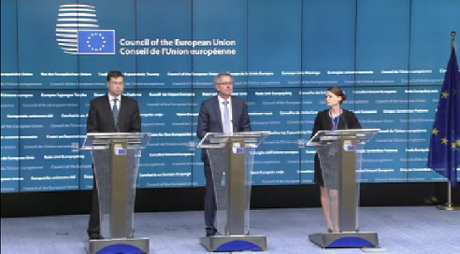
Eurogroup officials are still looking at solutions to find bridge funding for Greece, says vice-president Dombrovskis.
Different options are being explored, including using the EFSM.
Dombrovskis confirms that:
“Concerns were raised by several non-euro states. We need to take that into account.”
(So George Osborne wasn’t alone in raising concerns, given there was an agreement not to use EFSM funds for euro bailout)
All the options are quite difficult, and have political, legal or financial complications, Dombrovskis adds.
At post-FinMin meeting presser, @VDombrovskis confirms use of #EU-wide EFSM still on table as possible source of #Greece bridge financing
— Peter Spiegel (@SpiegelPeter) July 14, 2015
Updated
Recent developments in Greece shows the need to strengthen European monetary union, EC vice-president Valdis Dombrovskis tells the Ecofin press conference.
And the muted market reaction to the crisis shows that progress has been made in creating crisis-fighting tools and avoiding contagion, he adds.
Dombrovskis: Recent experience has shown us that respect of commonly agreed rules is of paramount importance. #Greece
— Open Europe (@OpenEurope) July 14, 2015
Updated
Schäuble has also outlined how Alexis Tsipras should blame himself for the way things worked out:
Schäuble: Despite election campaign filled with wild promises - no savings, no reforms, no troika, Greece was confronted with reality
— Open Europe (@OpenEurope) July 14, 2015
Schäuble: I don't know if EU budget could be used to provide bridge funding to Greece, I'm not an expert in EU law
— Open Europe (@OpenEurope) July 14, 2015
I’m not sure the UK would support using the EU budget to fund Greece either; it still puts money from non-eurozone members at stake (but what price European unity, George?)
Wolfgang Schäuble appears to have agreed with George Osborne, that the EFSM fund should not be used to find a loan to Greece.
#Schauble: risk for bridge financing should lie in Greece. If not: moral hazard → maybe EU-budget, but not EFSM.
— Rik Winkel (@RikWinkel) July 14, 2015
Schäuble: Greek bridging loan will be tough
European finance ministers have exited ECOFIN and are chatting to the press.
Germany’s Wolfgang Schäuble doesn’t sound too optimistic of finding a bridge loan for Athens (to cover repayments to the ECB in July and August)
Schäuble: Finding a temporary financing solution for Greece will be tough, this is what will occupy our attention over the next few days
— Open Europe (@OpenEurope) July 14, 2015
Spain’s Luis de Guindos is more upbeat.
Guindos: "No doubt" there'll be agreement on bridge financing, otherwise it makes no sense not to meet first condition aftr Sunday's deal
— Jorge Valero (@europressos) July 14, 2015
Updated
One solution to Greece’s bridging loan problem would be for another country to make a bilateral loan.
So who’s going to embrace European unity and dip into their pockets?
@dannyctkemp @SpiegelPeter being told France would not go it alone and give Greece loan money...needs others to chip in...
— Simon Marks (@MarksSimon) July 14, 2015
Minister: Greek reshuffle could come on Wednesday night
Greece’s economy minister George Stathakis, has predicted that Alexis Tsipras will reshuffle his cabinet tomorrow night, after the bailout vote.
Interviewed on Bloomberg, Stathakis added that he couldn’t rule out changes today, though.
Stathakis claimed that Greece’s banks will reopen just after European parliaments have given their approval to the bailout plan (so not until Monday, at the earliest). And that assumes the ECB responds by raising its cap on emergency liquidity.
Lifting capital controls will take “a couple of months”, though, given the complexity.
Stathakis says Capital Controls will probably last a couple of months.
— Joseph Weisenthal (@TheStalwart) July 14, 2015
Stathakis also denied that depositors will be ‘bailed-in’ to a bank rescue, pointing out that the bailout plan includes €25bn to recapitalise the sector.
"There is no way a bail-in will ever take place"
— Joseph Weisenthal (@TheStalwart) July 14, 2015
Updated
Heads-up.... the ECOFIN press conference is about to start.
Could there be developments on the Greek bridging loan?.......
Press conference #ECOFIN Council starting soon. Watch live: http://t.co/tvzwmx9yKc. #EuropeanSemester #EU2015LU
— EU Council Press (@EUCouncilPress) July 14, 2015
Back in Athens, there’s a rumour that the secretary of Syriza’s central committee, Tassos Koronakis, isn’t at all happy about the bailout deal.
Syriza party secretary Koronakis said to be opposing bailout #agreekment. #Greece
— Yannis Koutsomitis (@YanniKouts) July 14, 2015
#greece ordered to do reforms never done in italy, france. sunday trading? in germany? in austria? over-counter chemists? anywhere non-uk?
— Ian Traynor (@traynorbrussels) July 14, 2015
Traders are betting that Greece will remain in the euro until at least the start of next year, even though the deal isn’t in the bag yet.
Punters See #Grexit Probability Slide to 9% From 50% http://t.co/3u2yhQufoj via @NateLanxon #Greece pic.twitter.com/7MZRw2zC0N
— Zoe Schneeweiss (@ZSchneeweiss) July 14, 2015
Updated
Here’s a handy breakdown of the Greek bailout plan:
Third bailout for #Greece. @FinancialTimes pic.twitter.com/TRPe1AB28r
— Efi Koutsokosta (@Efkouts) July 14, 2015
Mark Carney isn’t alone in worrying that the Greek deal is hard to pull off.
Eric Lascelles, chief economist at RBC Global Asset Management, says there is “ample room for error”, as Alexis Tsipras tries to drive through labour market reforms, pension cuts, VAT tax increases, privatizations, higher corporate taxes, a military spending cut and additional IMF involvement in Greece.
In exchange, Greece is set to receive an €86bn euro bailout package that should in theory return the country and its banks to liquidity and solvency. Debt relief will apparently be put on the table for discussion once Greek is demonstrably compliant with the initial conditions.
This development has sharply reduced the risk of a Greek Eurozone exit by a significant margin, but that risk has not vanished altogether (we put it at around 35%, down from 60% over the next year).
But even if Greece clings on, there is “significant risk” that the country stumbles at some later juncture and is unable to recover within the constraints of the Eurozone, Lascelles adds.
Updated
Mark Carney’s deputy, Jon Cunliffe, says the eurozone is under “a lot of strain”.
He cites the German suggestion that Greece could get a “time out” from the euro.
BoE deputy governor Cunliffe: "The political will to hold the euro together has been pretty tested by this" #Greece
— Katie Allen (@KatieAllenGdn) July 14, 2015
BoE dep gov Cunliffe: msg from weekend was "there is still an awful lot of political capital invested in the euro and will to keep it whole"
— Katie Allen (@KatieAllenGdn) July 14, 2015
Updated
Bank of England: Greek deal has 'big execution risks'
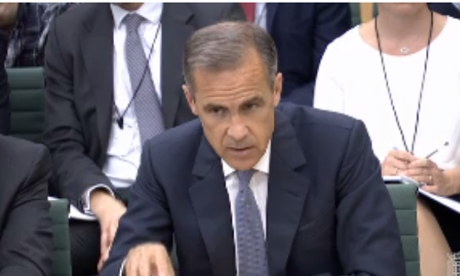
Bank of England governor Mark Carney has just warned MPs that it will be very hard to implement the Greek bailout deal.
Testifying to the Treasury Committee in Westminster, Carney warned that success will require “Herculean efforts” from all sides.
The scale of structural reforms, fiscal adjustment, privatisations required will be significant.
There are big execution risks....and Greece’s debts are not sustainable in their current form, he warns.
Carney adds that the events of recent months underline the eurozone’s “institutional shortcomings”. That’s not just his view - it’s shared by Europe’s “Four Presidents” (of the European Council, Commission, Parliament and ECB)
My colleague Andrew Sparrow is live-blogging the whole session here:
A nice summary of Athens’ stance today:
Govt's 2 lines of argument: They wanted to kick us out of euro so we're staying in & they wanted a coup so we're not going anywhere #Greece
— Nick Malkoutzis (@NickMalkoutzis) July 14, 2015
Photos: Inside today's ECOFIN
Here’s George Osborne making his views known to Alex Stubb and Jeroen Dijsselbloem:


Stubb and Dijsselbloem were in high spirits, as they were joined by Sweden’s Magdalena Andersson.

But how are they doing to get over the difficulties and legal impossibilities, and deliver bridge financing to Greece?

Updated
The UK chancellor is now kicking off in Brussels, over the idea that the short-term loans Greece desperately needs could be partly funded with British cash.
Told that inside #EU finmins meeting, @George_Osborne "furious" at suggestion EU-wide EFSM may be used for #Greece bridge financing
— Peter Spiegel (@SpiegelPeter) July 14, 2015
Coalition partner gives Tsipras support
The right-wing Independent Greeks party, the government’s junior partner, has just offered Tsipras some support over the hugely controversial deal he brought back from Brussels.
Panos Kammenos, the party’s leader, has just declared that:
“We will stand by Alexis Tsipras government.”
Many of Kammenos’s MPs have said the new agreement, as outlined in the marathon overnight meeting in Brussels, is much harsher than the original one the coalition had endorsed last weekend and, as such, is unacceptable.
But Kammenos is still backing the PM, telling reporters that:
“It is clear to all of Europe that yesterday night a coup happened in the heart of Europe.
The PM was blackmailed into signing a very different agreement. And this coup is continuing here in Greece where people want the government to fall.”
#now @PanosKammenos (ANEL) "Special purpose national government is what is wanted by the Coup masterminds" #Greece
— Yannis Karagiorgas (@IKaragiorgas) July 14, 2015
Whatever the outcome, Kammenos, who is also defence minister and clearly enjoying power, has said he will continue backing the government – but only if it remains a two-party coalition which, increasingly, does not look the case.
Updated
Tsipras could reshuffle cabinet

Over in Athens governing Syriza party sources are not ruling out a reshuffle taking place as early as today, following Tsipras’s meeting with his party.
Our correspondent Helena Smith reports.
Such is prime minister Alexis Tsipras’ determination to clear the political terrain, that speculation is mounting a cabinet reshuffle could take place today. The tough stance of energy minister and leading defector, Panagiotis Lafazanis, has helped focus minds, say insiders.
One told me:
“The preference would be for a reshuffle after the vote but nothing can now be ruled out.”
Among the scenarios being considered is the formation of a cross-party government of special purpose that would help lift the heavy weight of not only pushing reforms through parliament but implementing them too.
The radical left party is increasingly fighting a battle for survival in government with cadres saying Syriza’s overall aim is not to go down as a “left parenthesis” in power.
“Everything will be judged with the enforcement of real government policy which will not only be the agreement,” the interior minister Nikos Voutsis said this morning.
Calling the proposed deal “very difficult, very bad,” the minister said the real issue the government faced would be finding and enacting policies that could have an ameliorating affect on the painful consequences the measures were likely to have socially.
“Social counter-measures must be found which will give hope to people.”
George Osborne: UK won't help fund Greece
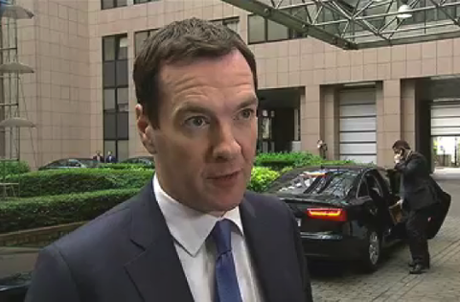
Britain won’t contribute any money to the Greek bailout, declared UK chancellor George Osborne as he arrived at today’s meeting of EU finance ministers in Brussels.
He told reporters:
Britain is not in the euro, so the idea that British taxpayers will be on the line for this Greek deal is a complete non-starter.
The eurozone needs to foot its own bill.
As explained earlier, Britain is adamant that it won’t let the European Financial Stability Mechanism (EFSM) be used to underwrite short-term loans to Greece (as this would break an earlier deal between the UK and Brussels).
So Osborne’s taking a tough line, and he wants us to know it.
And if the idea really isn’t possible, it won’t do the chancellor any harm to claim a victory on away soil against the eurocrats (especially if it really isn’t legally possible anyway).
Finland’s finance minister Alex Stubb agrees that bridge financing is a problem, as eurozone countries can’t just hand over funds to Greece without ‘conditionality’
But it is probably impossible to back down at this stage, so some kind of agreement will be found, Stubb replies. Perhaps bilateral loans to Greece?
Europe is battling to find a way to provide ‘bridge financing’ to help Greece meet its short-term funding demands, while a third bailout is agreed.
Arriving at today’s ECOFIN meeting, Eurogroup president Jeroen Dijsselbloem said officials are still working on a way to help Athens meet its repayments to ECB this summer, starting on July 20.
What’s holding it up?
We are looking at all the instruments and funds that we could use, Dijsselbloem replies.
They all seem to have disadvantages or impossibilities or legal objections, so we’re still working on it.
Updated
Syriza spokesman: MPs should not join the "coup"
Syriza parliamentary group spokesman Nikos Filis has urged MPs to support Tsipras -- warning that they would otherwise be allying with Greece’s enemies in Brussels.
He told reporters:
“Wasn’t what happened in Brussels a coup? What happened? Didn’t they say, either this deal or we take Greeks’ deposits and the banks go bankrupt? The government came under threat from economic and political forces that do not forgive the Greek people for making a different choice.
I think that, often, we facilitate these plans. We cannot end with a left interregnum with the complicity of people of the left.”
Finland’s finance minister tweets that he’s still hopeful of a happy ending to the crisis:
After the @epp meeting time for a short #Ecofin. It's been a tough few weeks, but I remain optimistic that solutions will be found.
— Alexander Stubb (@alexstubb) July 14, 2015
European stock markets are lacklustre in early trading.
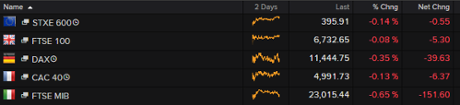
The initial relief that Grexit had been avoided has tailed away, as investors consider the political hurdles ahead.
Connor Campbell, financial analyst at Spreadex, explains:
Fresh from his mental ‘crucifixion’ at the EU summit, Alexis Tsipras has another few tortuous days ahead of him as he tries to stem a growing left-wing rebellion in his own party, all in order to pass legislation by Wednesday that will go some way to unlocking a third bailout.
Some are already speculating that inter-party issues over the weekend’s Greek deal could lead to a much-touted, and no doubt Germany pleasing, Tsipras resignation.
UK chancellor George Osborne is expected to fight efforts to make Britain contribute to the Greek bailout, at today’s ECOFIN meeting of finance ministers.
The British government isn’t impressed that the European Financial Stabilisation Mechanism (EFSM) would underwrite the deal. That would break an agreement that the EFSM (funded by all 28 EU members) wouldn’t fund eurozone bailouts again.
Here’s the story:
Greek minister urges Tsipras to take back bailout deal

In a fresh sign of political turmoil in Athens, an influential Greek minister has demanded that Alexis Tsipras withdraws the bailout deal agreed in Brussels.
Energy minister Panagiotis Lafazanis, who leads Syriza’s Left Platform, has released a statement damming the agreement as “unacceptable”.
Lafazanis said the deal “cancels the popular mandate and the proud ‘NO’ of the Greek people in the referendum”.
“Our so-called partners led by the German establishment, behaved towards our country as being their colony and they are nothing more than brutal blackmailers and financial assassins.”
(thanks to Enikos for the quotes)
#Greece EnergyMin Lafazanis says govt should take back agreement with creditors
— Efthimia Efthimiou (@EfiEfthimiou) July 14, 2015
Lafazanis was already on thin ice after abstaining in Friday night’s vote on the Greek government’s proposals to its creditors.
And the Left Platform’s position will be crucial in determining whether Tsipras holds onto power.
As Bloomberg TV’s Matt Campbell (in Athens today) points out, few people want to take bets on whether Tsipras’s government survives for long.
Updated
Syriza’s own parliamentary spokesman has described the deal forced on Greece at the Euro Summit as a “coup”, according to Reuters:
#Greece #Syriza parliamentary spokesman: Lawmakers will not overthrow mandate given by voters in Jan; There was a "coup" in #Brussels 1/2
— Global Markets Forum (@ReutersGMF) July 14, 2015
#Greece #Syriza parliamentary spokesman: Most important thing is to give response to "coup"; Govt of the left must not fall #EuroSummit
— Global Markets Forum (@ReutersGMF) July 14, 2015
Introduction: Tsipras faces furious MPs

Good morning, and welcome to our rolling coverage of Greece’s financial crisis.
Political tensions are bubbling away in Athens this morning after the Greek government caved in at last weekend’s Brussels summit in the hope of receiving a third bailout deal.
Alexis Tsipras’s decision to accept even deeper austerity, sweeping economic reforms, and the sequestering of €50bn of prime Greek assets for privatisation has enraged many in his own Syriza party.
The prime minister is meeting his MPs this morning, with speculation swirling that he could possibly resign soon if there is a major rebellion over the measures forced on Greece at the Euro Summit.
syriza political cttee meets at 9am as tsipras's biggest battle starts with opposition w/in the party. #GreekCrisis
— Diane Shugart (@dianalizia) July 14, 2015
Growing rumours that #Tsipras may resign this morning along with the whole SYRIZA party. Technocrat gov to come in. #GreeceCrisis
— Evan Lucas (@EvanLucas_IG) July 14, 2015
The deal forced on Tsipras during his night of pain in Brussels compels Greece to pass legislation by Wednesday night.
Although some opposition parties will probably back the plan, the Greek leader’s authority could be badly dented if his own MPs refuse to approve measures which they campaigned against.
While Tsipras locks horns with his leftwingers, European finance ministers will be meeting in Brussels for an ECOFIN meeting later this morning.
And in the UK, Bank of England governor Mark Carney will face questions over Greece when he testifies at parliament.
We’ll be tracking all the main events through the day....