PS: Another statement from the International Monetary Fund just arrived:
“Following on the Managing Director’s participation in the discussions on Greece held in Brussels over the weekend, she briefed the IMF’s Executive Board on the outcome as reflected in the Eurozone Leaders’ statement published earlier today.
The IMF stands ready to work with the Greek authorities and the European partners to help move this important effort forward.”
And finally, here’s our news story on the political fight ahead:
Alexis Tsipras was on course on Monday night to sway radical-leftist Syriza MPs to accept the most draconian rescue of a sovereign nation since the second world war after the Greek prime minister accepted a third bailout programme that one analyst said came after a weekend of “gunboat diplomacy”.
Tsipras, locked in fraught negotiations with EU leaders in Brussels until Monday morning, indicated that he would carry the Athens parliament, despite some defections, in a vote on the package by Wednesday.
Determined to keep his party together ahead of an expected onslaught by MPs opposing the outlined deal, Tsipras summoned his closest allies to a meeting in Athens before a gathering of his parliamentary party on Tuesday.
Likening the deal to the 1919 Versailles treaty – widely seen as the harbinger of the second world war for its crushing of Weimar Germany – the former Greek finance minister Yanis Varoufakis called it both “catastrophic” and “untenable”.
“This has nothing to do with economics. It has nothing to do with putting Greeceback on the rails towards recovery,” he told Australia’s public broadcaster, the ABC.
“This is a new Versailles treaty that is haunting Europe again, and the prime minister [Alexis Tsipras] knows it. He knows he’s damned if he does and he’s damned if he doesn’t.”....
Here’s the full story:
And here’s a thought to ponder:
GO figure: Merkel needs punitive deal to get approval in Bundestag for a deal which makes no economic sense and won't be met #GreeceCrisis
— Lionel Barber (@lionelbarber) July 13, 2015
And that’s a good time to stop. Back tomorrow, for more coverage of the Greek crisis. Goodnight! GW
Greece misses another IMF repayment
Some late breaking news. Greece has missed another payment to the International Monetary Fund today, worth around €450m.
That’s on top of the €1.6bn payment missed on 30 June, putting the Greek government deeper into arrears. Not a great way to mark today’s bailout deal -- but a reminder of Greece’s financial plight.
Spokesman Gerry Rice says:
“The SDR 360 million principal repayment (about €456 million) due by Greece to the IMF today was not received. We have informed our Executive Board of this development. Greece’s arrears to the IMF total SDR 1.6 billion (about €2.0bn) to date.
“The request by the Greek authorities for an extension of the repayment obligation due on June 30th is expected to be discussed by the Executive Board in the coming weeks.”
(SDR=special drawing reserves)
surprise, Greece missed its IMF payment today
— Tim Fernholz (@TimFernholz) July 13, 2015
Updated
The FT focuses on the political challenge facing Alexis Tsipras, with some Syriza considering mutiny.
FINANCIAL TIMES: Tsipras faces rebellion in Athens #tomorrowspaperstoday pic.twitter.com/jbg8obynQ7
— Neil Henderson (@hendopolis) July 13, 2015
The Telegraph reckons the UK’s bill for the third Greek bailout could be £1bn, if George Osborne can’t thwart it:
TELEGRAPH PAGE ONE: Britain faces £1bn bill for Greek bailout, by @mattholehouse #tomorrowspaperstoday pic.twitter.com/0KgQAeWNeX
— Neil Henderson (@hendopolis) July 13, 2015
Here come tomorrow’s newspapers....
And The Times reports that Britain could pay £850m into the Greek bailout (although, as we wrote earlier, the UK is fighting this)
Tomorrow’s front page: Cameron vows to close the pay gap for women #tomorrowspaperstoday pic.twitter.com/ZnvTTf5VZ2
— The Times of London (@thetimes) July 13, 2015
A couple more photos from tonight’s anti-austerity demonstration in Athens - apart from the flag-burning, it looks fairly subdued.


We’ve asked eight experts to give their view of the bailout deal, including former Belgium PM Guy Verhofstadt, Irish economist Dan O’Brien, and Greek journalist Nick Malkoutzis.
Another opinion poll from Germany, showing that the “mental waterboarding” and “crucifying” of Alexis Tsipras wasn’t received too badly back home.
In case u were wondering. #Germany poll: 64% satisfied w Schäuble's negotiations w #Greece, 62% w Merkel. pic.twitter.com/iYVBjaZpj1 ~@SMuresan
— Yannis Koutsomitis (@YanniKouts) July 13, 2015
Writing in the Guardian tonight, Paul Mason puts his finger one one of the causes behind Europe’s debt crisis:
It is the eurozone’s inability to contain the democratic wishes of 19 electorates. When the Finnish government threatened to collapse the talks, it was only expressing the wishes of the 38% of voters who backed the nationalist rightwingers of Finns Party. Likewise, when Schäuble sprang his temporary Grexit plan, he was expressing the demand of 52% of German voters, who want Greece to leave.
As for the Greeks, having tramped the streets of Athens alongside them for the best part of two months, I am certain that the “Oxi” movement was essentially a demand to stay in the Euro on different terms. You cannot get 70-80% of people in the working-class suburbs of Athens turning out – in the face of a rightwing media bombardment – on far-left anti-Euro sentiment alone.
My @guardian column about Greece, democracy etc http://t.co/fqLdUjeE1W
— Paul Mason (@paulmasonnews) July 13, 2015
Another German opinion poll, showing that Berlin’s hardline performance in Brussels has played well back home:
87% of Germans: conditions for Greece adequate or too soft, only 13% say too tough. 2/3 happy w. Schaeuble negotiations - ARD survey today!
— Marcel Fratzscher (@MFratzscher) July 13, 2015
Slovakia’s finance minister, Peter Kažimír, had second thoughts today about a tweet comparing Syriza’s election victory to the Arab Spring uprising (it’s been deleted)
Slovakia's Fin Min admits terms imposed on #Greece are about crushing a democratic uprising. Honest. #ThisIsACoup pic.twitter.com/IdbcGIdnpR
— Ronan Burtenshaw (@ronanburtenshaw) July 13, 2015

The New York stock market just closed at a two-week high, as US traders welcomed the overnight breakthrough in Brussels.
Despite the hurdles to come, the Dow Jones index jumped 217 points or 1.2% to 17,977.
Craig Erlam, a senior market analyst at currency trading firm OANDA, said:
Markets have responded very positively to the news, which comes following months of uncertainty and increasing fears that Greece could suffer a messy exit from the euro zone.”
Updated
A small majority of Germans are happy with the terms of the deal hammered out with Greece, even though most don’t trust Athens to enforce it.
That’s according to a poll for news magazine Spiegel Online, which also found that a third of Germans still expect Grexit eventually.
52% of the Germans think the deal with Greece is ok althought 78% of them doesnt trust the greek government https://t.co/hxPfqNCEcq
— Anastasios Telloglou (@telloglou) July 13, 2015
What #Germany thinks about the #Greece deal: 52% for new loans vs 44% against; 57% say reform measures ok (22% want more; 13% less). (1/2)
— Olaf Cramme (@olafcramme) July 13, 2015
But 78% think Greek government won’t implement reforms; 62% vs 32% for #Greece to remain in #Eurozone. http://t.co/8QoteZbpCf (2/2)
— Olaf Cramme (@olafcramme) July 13, 2015
Updated
Wednesday is going to be a dramatic day.
One of Greece’s main unions have called a 24-hour strike, in protest against the economic reforms which the Athens parliament will vote through that day.
Their union, Adedy, called the stoppage tonight, saying it was against the agreement with the eurozone. They are also planning a demonstration outside parliament.
I *think* this is the first 24-hour strike called by unions since January’s election. Another milestone for Alexis Tsipras’s premiership.
Updated
News of the last-ditch Brussels breakthrough has been welcomed in America, where the government had been making increasingly anxious noises in recent weeks.
White House spokesman Josh Earnest called the deal a “credible step” that would include difficult structural reforms by Greece, Reuters says.
Deutsche Bank analysts reckon Greece’s capital controls won’t be lifted until autumn.
They told clients tonight that the European Central Bank is unlikely to cut Greece much slack until the third bailout is agreed.
We suspect the ECB will stall an ELA decision until Greece begins to legislate the new deal later this week.
Greece would still face a tight ELA cap, however. We expect the ELA cap will remain carefully calibrated and controlled at least until the new ESM loan is fully in place. Access to banks could be fully normalised only in the fall.
Many Greeks may feel better about the new bailout deal once their banks reopen and capital controls are lifted.
That feels some way away tonight. But economy minister George Stathakis has pledged that savers’ deposits are safe (those that haven’t been removed and stuffed under the mattress already)
The bailout include €25bn to recapitalise the stricken banking sector, through the highly contentious €50bn asset sale plan.
Stathakis told ERT that:
“The recapitalisation is so secure that it fully safeguards deposits”
A group of leftist protesters gathered outside the Athens parliament tonight, to urge MPs to reject the bailout plan.
Judging by the photos we’ve seen, it was a fairly small demo:

One lady enlivened proceedings (and attracted a lot of photographers) by burning a Syriza flag.

UK 'won't help with bridging loan'
My colleague Phillip Inman reports on another potential stumbling block that has emerged following this morning’s deal and in particular the plans to come up with a bridging loan to avert the collapse of Greece’s banking system and help cover its debt repayments this summer.
All the EU’s 28 nations are expected to be asked to contribute towards a £10bn-£12bn bridging loan. However, UK chancellor George Osborne immediately rejected the idea, according to Treasury officials who said that Brussels was told the £1bn of UK funds in the European Financial Stabilisation Mechanism should not be used for eurozone bailouts, in accordance with a 2010 agreement.
Rating agencies comment on Greek outlook
In the wake of this morning’s potential deal to keep Greece in the eurozone and allow it to tap a third bailout, the credit ratings agencies have been commenting on the country’s economic prospects and the outlook for its credit score.
Standard & Poor’s has told Reuters news agency that it could upgrade Greece’s credit rating “pretty quickly” if a plan for a third bailout seems solid.
Moody’s, however, says that Greece’s rock-bottom credit rating was unlikely to be raised any time soon.
Fitch meanwhile comments that today’s agreement may ease the Greece’s “extreme liquidity pressure and raises the possibility of a third bail-out programme, but substantial near-term and long-term challenges to the sovereign’s creditworthiness remain”.
Greek Deal May Help Sovereign Liquidity; Big Risks Remain #FitchWire https://t.co/rbOeEbFu9D
— Fitch Ratings (@FitchRatings) July 13, 2015
As European leaders digest the tough new deal set out for Greece, our reporter Jennifer Rankin sums up the day after the longest of nights in Brussels and looks at what comes next:
European leaders lined up to say Grexit has been averted, but this snappy soundbite glides over the fact the eurozone has simply agreed to open negotiations on an €86bn (£62bn) bailout. Although this is a step to shoring-up confidence in the euro, it is only a promise to have more talks with no guarantee of success.
Talks on the bailout plan are forecast to last around four weeks. “We know time is critical for Greece, but there are no shortcuts,” said Klaus Regling, the official in charge of the the European Stability Mechanism, the eurozone’s permanent bailout fund that Greece hopes to tap.
But these formal talks can only begin, if eurozone leaders avoid several political and financial tripwires. The Greek government has until the end of Wednesday to ensure that sweeping reforms to its pension system and VAT rates are written into law. If Greek lawmakers meet this eurozone-imposed deadline, the baton will pass to the creditors. At least five countries, including Germany, the Netherlands and Finland, will have to put the idea of opening negotiations on a bailout to a parliamentary vote.
Politics could be overtaken by financial deadlines. Athens faces demands to repay €7bn of debts in July, including €3.5bn due to the European Central Bank on Monday (20 July).
Eurozone officials are working round the clock to come up with emergency funds that will help Greece bridge the gap before a permanent bailout kicks in. “It’s not going to be easy,” said Jeroen Dijsselbloem, the hawkish Dutch politician, who was re-elected chair of the eurozone group of finance ministers on Monday. Several options were being discussed on bridge finance, but no one had found “the golden key to solve the problem”, he said, although he hopes to see progress by Wednesday.
And here again, is Jennifer’s very handy guide to key events ahead:
Updated
Tsipras heads for showdown in Athens after marathon Brussels summit
If you are just joining us, here is a brief summary of the latest events in the Greek debt crisis.
- After almost 17 hours of talks in Brussels, Europe’s longest-ever summit, Greece and the rest of the eurozone have reached an agreement that could lead to a third bailout and keep the country in the single currency bloc.
- It’s a deal that will force Greek PM Alexis Tsipras to compromise on what had previously been red lines for his negotiation time. The swathe of austerity measures and reforms affect pensions, VAT, the size of Greece’s public administration and require the country to go back to the IMF for help next year. We have been through the statement and explained the key points here.
- The deal stipulated talks would begin immediately on bridging finance to avert the collapse of Greece’s banking system and help cover its debt repayments this summer. This afternoon, fresh from being re-elected as president of the eurogroup, Jeroen Dijsselbloem said described such financing as complex and said “it’s not going to be easy”
- Tsipras is now back in Athens and has got straight down to business holding an emergency meeting of top officials following the announcement of the deal
- Germany has faced criticism of its approach to Greece’s debt mountain and this weekend’s talks, sparking a Twitter trend under the hashtag #ThisIsACoup
- The IMF says it stands “ready to work” with Greece and its European partners
- Former Greek finance minister has dubbed the bailout deal “the politics of humiliation”. Speaking to Australian radio station ABC, he said Tsipras knows that this is an “impossible deal...a deal that is simply not viable.” In a separate interview with the New Statesman he has opened up about five months of tense talks with Greece’s creditors.
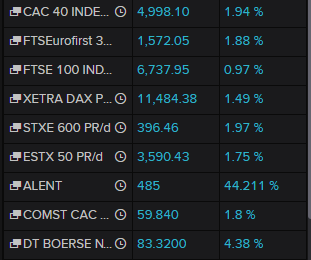
- European stock markets have rallied on the news of a tentative deal with banking stocks providing much of the upward momentum.
Our main story tonight:
After a fraught weekend with his eurozone counterparts in Brussels, Alexis Tsipras is now heading for a showdown with his own party and opposition MPs after accepting a third bailout programme that will bring further austerity to the debt-stricken country.
Tsipras convened a meeting of government officials in Athens to thrash out a way to convince his radical-leftist Syriza party and its coalition partner to vote through the package by Wednesday.
Determined to keep his party together ahead of an expected onslaught by MPs opposing the outline deal, Tsipras summoned his finance minister, Euclid Tsakalotos, and Nikos Filis, representative of the Syriza parliamentary group, to the Athens meeting, before a gathering of his parliamentary party on Tuesday.
Efforts to win the vote in the national parliament came after Tsipras and Greece’s creditors agreed on the basis for talks on a bailout that will keep the country in the eurozone.
The full story from Phillip Inman in London and Jennifer Rankin in Brussels:
Former Labour MP Denis MacShane says he is hearing from political contacts in Athens that Greek PM Alexis Tsipras has the votes he needs to get a deal through now he is home from those exhausting talks in Brussels.
Greek pol friends in Athens say Tsipras has votes for deal. They are shocked at some interview Varoufakis has given N S'man @graemewearden
— Denis MacShane (@DenisMacShane) July 13, 2015
He is referring to a wide-ranging interview former Greek finance minister Yanis Varoufakis has given to the New Statesman here. (Note the interview with the New Statesman’s Harry Lambert is the first since Varoufakis stepped down as finance minister and was conducted last week, before this latest deal was drawn up over the weekend.)
Varoufakis tells Lambert about five months of stalled debt crisis talks, that the Eurogroup is “completely and utterly” controlled by Germany and that in his view “we were set up”.
.@yanisvaroufakis tells @NewStatesman—democracy was ignored, we were shut out, French silenced http://t.co/xz5NkaB8mn pic.twitter.com/6KF0THCDkB
— Harry Lambert (@harrylambert1) July 13, 2015
The New Statesman also provides the full interview text here.
And from the man himself:
An account of the past five months of negotiations. http://t.co/Rrh83elEwA
— Yanis Varoufakis (@yanisvaroufakis) July 13, 2015
Our economics editor Larry Elliott has been going through the details of this morning’s deal and concludes it will deepen the country’s recession, make its debt position less sustainable and that it “virtually guarantees that its problems come bubbling back to the surface before too long.”
He continues:
One line in the seven-page euro summit statement sums up the thinking behind this act of folly, the one that talks about “quasi-automatic spending cuts in case of deviations from ambitious primary surplus targets”.
Translated into everyday English, what this means is that leaving to one side the interest payments on its debt, Greece will have to raise more in revenues than the government spends each and every year. If the performance of the economy is not strong enough to meet these targets, the “quasi-automatic” spending cuts will kick in. If Greece is in a hole, the rest of the euro zone will hand it a spade and tell it to keep digging.
This approach to the public finances went out of fashion during the 1930s but is now back. Most modern governments operate what are known as “automatic stabilisers”, under which they run bigger deficits (or smaller surpluses) in bad times because it is accepted that raising taxes or cutting spending during a recession reduces demand and so makes the recession worse.
Here’s Larry’s full analysis:
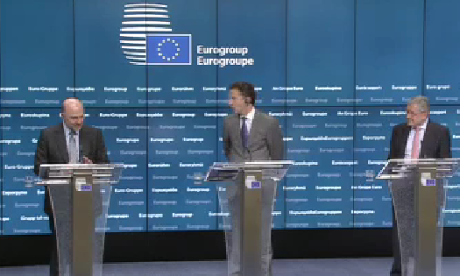
That’s it from the eurogroup press conference in Brussels. Newly re-elected head of the group, Dutch finance minister Jeroen Dijsselbloem, came back to bridging finance at the close of the briefing.
@J_Dijsselbloem on bridge financing: "it's not going to be easy." #Greece running out of time for 20 July ECB debt payment.
— Jennifer Rankin (@JenniferMerode) July 13, 2015
Note that this morning’s deal stipulated talks would begin immediately on bridging finance to avert the collapse of Greece’s banking system and help cover its debt repayments this summer. Greece must repay more than €7bn to the European Central Bank (ECB) in July and August, before any bailout cash can be handed over.
While his colleagues are briefing the press on their Eurogroup meeting, Slovakia’s finance minister Peter Kažimír has turned to Twitter to get something off his chest:
It 's unfortunate how much money, trust and achievements was wasted over past few months #Greece #eurozone
— Peter Kažimír (@KazimirPeter) July 13, 2015
Updated
We already know from the statement this morning out of the leaders’ marathon summit that Greece is being prevailed upon to request continued International Monetary Fund support from March 2016. A loss for Tsipras, who had reportedly resisted further IMF involvement in Greece’s rescue.
From Brussels we now have more details from Klaus Regling, head of the European Stability Mechanism, on the IMF’s role in a new bailout.
IMF expected to chip into #Greece's €86bn bailout, says Klaus Regling of ESM once its arrears are cleared.
— Jennifer Rankin (@JenniferMerode) July 13, 2015
More from Moscovici from Jennifer Rankin who is at the Brussels press conference for us.
The Greek people need a more transparent effective state that works for its citizens, says Moscovici.
— Jennifer Rankin (@JenniferMerode) July 13, 2015
Moscovici: irreversibility and integrity of eurozone has been strengthened but more needs to be done.
— Jennifer Rankin (@JenniferMerode) July 13, 2015
Moscovici finishes with a few words of praise for the reporters working through last night in Brussels.
Reality of covering #eurosummit which goes through the night pic.twitter.com/UD7SrhohoV
— Richard Quest (@richardquest) July 12, 2015
Pierre Moscovici, commissioner for economic affairs, is now speaking at the press conference following the Eurogroup meeting in Brussels.
He wants everyone to take a moment to congratulate themselves: Integrity of eurozone reaffirmed, goal reached, congratulations in order, he says.
Intégrité #zoneeuro réaffirmée : objectif atteint, il faut s'en féliciter @EU_Commission #Eurogroupe #Grèce
— Pierre Moscovici (@pierremoscovici) July 13, 2015
Dijsselbloem also says he expects talsk on Greece’s third bailout to take four rather than two weeks.
Talks on Greece's bailout likely to take four weeks rather than two weeks to negotiate, says Dijsselbloem.
— Jennifer Rankin (@JenniferMerode) July 13, 2015
On bridge financing, the Eurogroup of finance ministers has asked experts to look into how it would work and “it is very complex”, adds the Eurogroup head.
Bridge financing very complex, says @Dijsselbloem, technical experts looking into options. Haven't yet found golden key to solve issue.
— Jennifer Rankin (@JenniferMerode) July 13, 2015
Looking ahead, he says there may be a Eurogroup conference call on Wednesday or Thursday after a Greek parliament vote on the new reform demands.
Updated
Dijsselbloem is now speaking to reporters at a press conference in Brussels.
Jennifer Rankin is there.
Doesn't sound like urgency on bridge financing for #greece at today's euro group, Dijsselbloem says discussed timetable for next few days.
— Jennifer Rankin (@JenniferMerode) July 13, 2015
Sticking with the Eurogroup, its meeting this afternoon has now concluded and a press conference is about to start. You can follow it online, as the newly re-elected president points out:
Press conference following today's #Eurogroup live via: http://t.co/UxnaxuRr11
— Jeroen Dijsselbloem (@J_Dijsselbloem) July 13, 2015
A bit more detail on that re-election of Dutch finance minister Jeroen Dijsselbloem as president of the Eurogroup of finance ministers from the single currency bloc.
After seeing off his only challenger, Spain’s centre-right Economy Minister Luis de Guindos, Dijsselbloem will serve another two-and-a-half year term.
In a statement, EU officials add:
“This decision was unanimously supported by all Eurogroup members.”
Jeroen Dijsselbloem re-elected Eurogroup president
Dutch finance minister Jeroen Dijsselbloem has been re-elected president of the Eurogroup of finance ministers, Reuters and others report.
The deed is done: @J_Dijsselbloem beats @Luis_De_Guindos to take 2nd term as head of #eurogroup https://t.co/XJ1ObXDT17
— Peter Spiegel (@SpiegelPeter) July 13, 2015
I thank my colleagues for their support and cooperation and look forward to a second term as President of the #Eurogroup
— Jeroen Dijsselbloem (@J_Dijsselbloem) July 13, 2015
Updated
An item for your diaries if you would like to hear what a panel of UK-based experts thinks about this tentative Greek deal.
On Wednesday 15 July at 10.15am BST, the UK’s House of Lords committee dealing with EU financial affairs will be putting questions on reforms, the Greek referendum, the Greek banking system, implications for the UK and more to experts including professor Charles Goodhart from the LSE, professor Richard Portes from London Business School and Roger Bootle, economist and head of the thinktank Capital Economics.
It will be streamed live on www.parliamentlive.tv and available to watch there after the event.
And while we are on diaries, our reporter Jennifer Rankin has compiled this very handy guide to what happens next:
Updated
IMF "ready to work" with Greece and European partners
The International Monetary Fund has put out a short statement following this morning’s euro summit statement and the weekend crisis talks, attended by IMF managing director Christine Lagarde.
Gerry Rice, IMF director of communications says:
“Following on the managing director’s participation in the discussions on Greece held in Brussels over the weekend, she briefed the IMF’s executive board on the outcome as reflected in the eurozone leaders’ statement published earlier today. The IMF stands ready to work with the Greek authorities and the European partners to help move this important effort forward.”
Tsipras holds emergency meeting
Over in Athens the Greek prime minister has got straight down to business holding an emergency meeting of top officials following the announcement of the deal.
Our correspondent Helena Smith reports:
Alexis Tsipras has wasted no time since his arrival back in Athens at 4 PM local time.
The leader, according to aides, has convened an emergency meeting of top government officials, including finance minister Euclid Tsakalotos and his Syriza party’s parliamentary representative Nikos Filis.
The inclusion of Filis, who earlier today said cadres disagreeing with the new measures should immediately resign, suggests that the meeting will focus on how to deal with party dissidents. The energy minister, who heads Syriza’s hardline Far Left faction, the parliament speaker Zoe Konstantopoulou and the former finance minister Yanis Varoufakis have all spoken out against the policies Tsipras has signed up to.
The leader will then meet Panos Kammenos, the defence minister who heads the coalition’s junior partner, the right wing Independent Greeks party.
Kammenos, a rapid opponent of austerity, is acutely aware that his party would be routed if fresh elections are held. On learning of the deal he reacted by immediately uploading a picture of a weeping woman on his twitter account under the words: “Only if we face fate standing upright do we kill death.”
In a subsequent tweet he said: “Don’t rush to any conclusions, nothing is a given.”
Political developments in Athens; Alexis Tsipras has returned the Greek capital and started meeting ministers.
#Greece PM Tsipras meeting with Mins and close associates now. To meet ANEL's Kammenos later.
— Yannis Koutsomitis (@YanniKouts) July 13, 2015
The Economist Intelligence Unit warns that Greece’s membership of the euro isn’t guaranteed:
Team think Grexit delayed, but not avoided. Tough line taken means political risks of one side or other not delivering are high
— Robin Bew (@RobinBew) July 13, 2015
Varoufakis: It's a new Versailles Treaty
Gone but not forgotten. Greece’s former finance minister, Yanis Varoufakis, has dubbed the bailout deal “the politics of humiliation”.
Speaking to Australian radio station ABC, he said Alexis Tsipras knows that this is an “impossible deal...a deal that is simply not viable.”
Greece’s lenders, he added, were taking revenge on Alexis Tsipras:
‘The troika have made sure that they will make him eat every single word that he uttered in criticism of the troika over the last five years. Not just these six months we’ve been in government, but in the five years prior to that.
‘This has nothing to do with economics. It has nothing to do with putting Greece back on the rails towards recovery. This is a new Versailles Treaty that is haunting Europe again, and the prime minister knows it. He knows that he’s damned if he does and he’s damned if he doesn’t.’
He also laid into the €50bn of Greek asset sales demanded by Europe.
In the [1967] coup d’état the choice of weapon used in order to bring down democracy then was the tanks. Well, this time it was the banks.
And Varoufakis also reiterated his claim that Wolfgang Schäuble wanted to force Greece out of the eurozone to frighten France and Italy.
Schäuble considers Grexit to be “essential for his plan for Europe”....
One that is not a federation, but on the capacity of a single fiscal overlord to veto national budgets and therefore to annul national sovereignty.
You can hear the interview here.
Varoufakis to Tsipras: "I am going to simply steal into the night”’- another rip-roaring "first interview since" here http://t.co/u3oK0olcjV
— Stephen Smith (@SteveNickSmith) July 13, 2015
Updated
And here’s a reminder of Alexis Tsipras’s political vulnerability:
Citi: Assuming radical parties reject deal, it would only take 12 opposing votes from Syriza/Anel to loose support. pic.twitter.com/i1fKxS55oB
— Holger Zschaepitz (@Schuldensuehner) July 13, 2015
Eurozone crisis veterans looking for a day off should check this calendar:
SocGen: the Greek timeline updated after the Euro Summit pic.twitter.com/K03Gtmg4R1
— Fabrizio Goria (@FGoria) July 13, 2015
August looks pretty free :)
Pierre Moscovici, perhaps the most optimistic voice around the Greek crisis this year, is striking a cautious note this afternoon:
Agreement paves the way for a reformed #Greece to stay in the #eurozone: @EU_Commission objective reached, but more work ahead. @EEAthina
— Pierre Moscovici (@pierremoscovici) July 13, 2015
Analysts at Deutsche Bank sum up the agreement:
Deutsche on today's deal: +ve: roadmap for Greece to remove itself from crisis -ve: execution issues and further Greek anti-euro sentiment
— RANsquawk (@RANsquawk) July 13, 2015
About that €50bn privatisation fund...
One of Alexis Tsipras’s few triumphs last night was ensuring that the fund that will sell off €50bn of Greek assets will be based in Athens, not Luxembourg.
But analysts are now questioning whether this plan is really viable at all.
Gary Jenkins of LNG Capital argues that it’s not:
The amount, €50bn, is in line with an IMF projection of value of potential Greek privatisations made by the IMF in 2011. Now I just might take a guess that the value of those assets have decreased somewhat since that date. How much by? Impossible for me to even speculate, but as a starting point how much is the Greek stock market down since then? 40%? Oh and so far they have raised approx. €3.2bn.
The income that these assets currently generate flow through to the Greek government. Diverting them for other purposes only reduces Greek government income so it is kinda like robbing Peter to pay Paul.
The privatisation fund will take time to set up. But the banks need the €25bn as soon as possible for recapitalisation purposes. Oh and guess what assets contributed to that initial valuation? Banks…
Perhaps the best line about the privatisation fund though comes from Mr Tsipras, who proudly stated that he had kept Greek assets from going abroad. In the sense that the admin will be situated in Greece. If he had signed the deal on offer just a few short weeks ago there wouldn’t have been any such segregated fund.
Everyone knows the €50bn privatisation target is a fiction. Who will tell the empress that she's wearing no clothes? #Greece
— Damian Mac Con Uladh (@damomac) July 13, 2015
Mohamed El-Erian, the chief economic adviser of German financial services group Allianz, wasn’t impressed with how events played out in Brussels either:
The sad reality of #Greece & #Europe : Its not long now until historians draw a parallel with historical episodes of “gunboat diplomacy.”
— Mohamed A. El-Erian (@elerianm) July 13, 2015
Debt campaigners are deeply disappointed (although probably not surprised) that Greece is receiving more bailout loans, rather than substantial debt relief now.
Tim Jones, economist at the Jubilee Debt Campaign, says this will simply extend the five-year Greek debt crisis for at least another decade.
“At the heart of it is a lie from Eurozone leaders that ‘nominal haircuts on the debt cannot be undertaken’. They can, they should and they must.
Sub-Saharan Africa and Latin America suffered from 20 years of economic stagnation and increasing poverty in the 1980s and 1990s because of a refusal to cancel debt and the imposition of austerity overriding democracy. The same now awaits Greece and the Eurozone unless there is a sudden change of direction.
Last night, Greece was threatened with the ‘offer’ of a temporary exit from the eurozone, if a deal couldn’t be reached.
And although that “time-out” didn’t survive to the final statement, it highlights the damage caused to the European project this year:
Wolfgang Munchau's damning assessment of Greece's 'brutal' creditors http://t.co/BRjl59ZEQZ pic.twitter.com/PT5Na8Xyua
— Tony Tassell (@TonyTassell) July 13, 2015
How #thisisacoup went viral
The call went out on Sunday afternoon. “Hi guys, this is an important message about Greece,” wrote an activist named Francesca in a text message to 40 people, including members of Spain’s Indignado movement and leftist coalition party Barcelona en Comú.
She continued:
“These guys meeting now in the Eurogroup, they all have twitter handles, they deserve to be told by the world to do a deal with Tsipras and stop trying to overthrow him,”
Minutes later, the hashtag #ThisIsACoup was born in Barcelona. It quickly shot to the top of trending lists around the world, including Germany and Greece, sparking a social media backlash against Germany and its finance minister, Wolfgang Schäuble, over the draconian list of demands being forced on the Greek government in return for a third bailout.
The hashtag was first attributed to a physics teacher in Barcelona, who clarified on Monday that it was a collective campaign.
Shortly after, those behind the campaign published a declaration, explaining their motivations. “#ThisIsACoup may have started in Barcelona, but it resonated around the world because it expressed a common sense of impotence of citizens in the face of globalised financial powers,” they wrote.
“We decided to support Francesca’s call to launch an online campaign to support the democratic will of the Greek people in the face of extortion by the EuroGroup in its negotiations with Syriza,” the statement continued.
“The scandalous Eurogroup proposals yesterday made last night the ideal moment to create a hashtag to express and, above all, coordinate, our outrage at the extortion the Greek government and its people were being subject to.”
The hashtag was a nod to the Egyptian hashtag #NotACoup, that trended in 2013.
“We’ve learned how to mobilise online from our counterparts of the Arab Spring and from our own experiences of occupying the squares of Spain.”
Yanis Balafas, a Syriza lawmaker close to Alexis Tsipras, has also warned that the government could split badly over the deal.
He told Bloomberg:
“There’s a vista of division within the party, part of Syriza officials and lawmakers do not accept the tactics followed by our prime minister.”
But right now, the important thing is that the “worst case scenario” of Greece defaulting has been averted.
Tsipras is facing a SYRIZA mutiny when he arrives home in Athens http://t.co/Il6wCSmDyr pic.twitter.com/NZIpPGVWZW
— Bloomberg Markets (@markets) July 13, 2015
The main threat of a mutiny comes from Syriza’s hard-line wing, the Left Platform.
And there are already signs that they are unwilling to swallow the bailout deal.
Enikos, the Greek news site, explains:
The new bailout agreement signed by Alexis Tsipras is a humiliation for Greece, says an editorial in Iskra website which reflects the views of Syriza’s hardliners.
The article says that the agreement reestablishes and extends the guardianship of the Troika and seals “social enslavement”.
It maintains the country’s colonial status under German tutelage of the EU, it notes.
“The Greek people must not become disappointed, on the contrary it must remain stubborn, as it did in the referendum and the countrywide protests for a ‘No’ to the very end. A ‘No’ to clash with the bailout, neo-liberalism and austerity which are institutionalized in the euro zone.”
Panagiotis Lafazanis, the head of the Left Platform, abstained in last Friday’s vote on whether to accept the initial austerity deal, and could now be reshuffled.
Analysts at Eurasia Group suspect Greece could soon head towards a national unity government, if many government MPs refuse to back the bailout deal on Wednesday night.
If Tsipras loses his majority and potentially even more support than he did on Saturday, it makes no sense for him to try and reshuffle the government.
In this case, he will instead likely choose to offer his and the support of the remaining Syriza MP’s towards a special purpose national unity government, but one which he will not head.
And that administration would sign off on a third bailout, overseeing some initial implementation, and then probably disband for elections in a few months’ time, “probably by autumn but certainly before December”.
[Tsipras’s coalition has 162 seats in the 300-seat parliament. But, at Friday night’s vote to approve negotiations eight MPs abstained, two voted no, and seven were absent].
Video: Tsipras is 'damaged goods'
The Financial Times has some tantalising details of how last night’s marathon summit nearly collapsed around dawn today:
Alexis Tsipras of Greece and Angela Merkel, the German chancellor, decided after 14 hours of anguished talks that they had reached a dead end. With no room for compromise, neither saw any reason to carry on. Grexit was the only realistic option
As the two leaders made for the door it was Donald Tusk, the president of the European Council, who moved to prevent the fatigue and frustration from triggering a historic rupture for the eurozone.
“Sorry, but there is no way you are leaving this room,” the former Polish prime minister said.
The dispute centred on the plan to put €50bn of Greek assets in a new fund. Merkel wanted it all used for debt repayment; Tsipras wanted a smaller fund, devoted to funding investment, to avoid national humiliation.
In the end, they fudged it - with half used to recapitalise the banks and the other half split between debt repayments and investment.
And as officials staggered into the morning light, they agreed that the Greek PM had come off worst:
“They crucified Tsipras in there,” a senior eurozone official who had attended the summit remarked. “Crucified.”
FT: “They crucified Tsipras in there,” a senior eurozone official who had attended the summit remarked. “Crucified.” European solidarity.
— Stefanos Livos (@stefivos) July 13, 2015
That is on top of the ‘mental waterboarding’ which officials described to Ian Traynor last night.
#greece merkel/holland session with tsipras said to resemble 'extensive mental waterboarding' - top official
— Ian Traynor (@traynorbrussels) July 12, 2015
Updated

French government welcomes deal
French prime minister Manuel Valls said the French parliament would vote on the Greek deal on Wednesday.
Valls added he was “proud” of President François Hollande’s role in the agreement.
“François Hollande rose to the historic occasion,” he told BFM-TV.
“I am proud to be at the side of François Hollande and to succeed today what just a week ago seemed impossible. It’s a victory for Europe.”
At a press conference after the deal was announced Hollande told journalists it was “an historic occasion”.

“What I wanted was not just in the interests of Greece, it was in the interestS of Europe and of France. France’s own interests are not separate from those of Europe. France has a special role to play, she has to make sure that the process of construction that linked us following the war continues,” the French president said.
“There’s a willingness to embody a strength: the eurozone, a monetary zone that give stability and growth…France’s role has also been to seek to bring the parties together, to respect the Greek people while also respecting the other eurozone nations. France’s role is to find the right way for the eurozone and for Europe.”
The French magazine Capital described the deal as an “agreement delivered by forceps…after endless negotiations”.
“The pill is still a bitter one for Alexis Tsipras’ radical left, which has made the battle against austerity its symbol to the (Greek) electorate,” Capital wrote.
Le Parisien added that the deal was possible thanks to the “French-German couple”, even though the two countries that form what French commentators call the “motor of Europe” were having difficulty “speaking with one voice” over Greece.
Both the extreme right and the extreme left lambasted the Greek deal.
On the far left, Jean-Luc Melenchon, co-president of the Front de Gauche, described it as “holding a revolver to Greece’s temple” and accused Hollande of being nothing but an “sidekick” to Angela Merkel.
Florian Philippot of the Front National tweeted:
“We are witnessing the horror of the European Union, we are in the process of saving the euro at any price…nobody is thinking of the Greeks…or the French taxpayers who will be broke after this deal.”
Personne n'a pensé aux Grecs, ni aux contribuables français, qui sortiront rincés de cet accord. Mais seulement à l'euro, par pure idéologie
— Florian Philippot (@f_philippot) July 13, 2015
Here’s the full seven-page statement released by the European Council this morning, announcing the agreement with Greece.
ECB leaves cap on Greek banks unchanged - reports
The European Central Bank has decided to maintain the emergency liquidity assistance that has kept Greek banks afloat this year, sources say.
That means that it remains capped at €89bn, so capital controls remain in place and the Greek banks stay shut.
Despite the extra austerity and reforms being heaped on Greece, Athens cafe owner Dimitris is mainly relieved that Grexit has been avoided.
Dimitris told the Guardian:
“I’m not disappointed because the prime minister [Alexis Tsipras] couldn’t have done anything else. Leaving the euro would have been much worse.”
Tsipras odds on to step down as PM this year
Alexis Tsipras is more likely than not to quit as Greek PM this year, reckons UK bookmakers Ladbrokes.
They are offering evens that Tsipras celebrates New Year’s Eve in Maximos Mansion but only 8/11 that he has stepped down.
Greek PM Tsipras seen out of office by year-end, says @Ladbrokes. Offers odds of 8/11, meaning a 58% probability he won't last the year.
— Jamie McGeever (@ReutersJamie) July 13, 2015
The odds on Grexit this year have also widened, to 6/1 (bet €1, get €7 back)
If you believe Greece will still be in the euro come 2016, tou have to speculate €12 to win €1 profit.
This is a “toxic deal” that will have political consequences in Greece, warned Wolf Piccoli of Teneo Intelligence:
In the short-term, Tsipras can stagger on, relying on the opposition to win the vote on Wednesday (15 July) and any other immediate vote (22 July) required by the lenders. The Greek PM might even reshuffle his cabinet in an effort to diminish the political weight of the most staunch opponents to the deal. But his authority and grip on the party is set to decline, making it harder for him to contain an almost inevitable rebellion within SYRIZA.
In fact, the government’s parliamentary majority is likely to end as soon as Wednesday after the vote on the measures requested by the lenders. At that point, Tsipras will be forced to either reconfigure the current governing arrangement by striking a deal with the mainstream opposition parties or call an early election.
UK: Implementing Greek deal will be challenging

A spokeswoman for British prime minister David Cameron has warned that there is more work to do to end the Greek crisis:
She told reporters this morning that:
“Clearly the challenge now will be on delivering on that [deal] and the implementation which lies ahead ... and I don’t think we underestimate the size of that challenge.
We are glad an agreement has been reached but there is still more to do.”
Newsflash from Berlin: The German parliament is likely to vote on the Greek bailout plan on Friday (assuming it gets through the Athens parliament on Wednesday)
#BREAKING German parliament vote on Greek bailout expected Friday: speaker
— Agence France-Presse (@AFP) July 13, 2015
Updated
In Thessaloniki, people look to the future

Withdrawing his daily allowance of 50 euros from a cashpoint next to the Bank of Greece in Thessaloniki, Spiros Mousionis smiled with relief at the deal.
“We feel much better now,” said the 66-year-old cotton trader, already looking forward to a day when he could take out more money from the bank.
“I couldn’t have imagined a Greece outside the European Union and outside the Euro.”
The coming austerity would be tough, Mousionis said, but the only option.
“I expect it, and I will deal with it. Maybe it’s better for us to have some discipline and order in our society.”
A few kilometres away, standing outside his kidswear factory, Konstantinos Chantizaridis said the specifics of the new deal, if passed by parliament, would hit his business hard. They will mean that the owner of any business, however big or small, will have to pay corporation tax a year in advance.
“We already paid 55% tax in advance [details], and now we have to pay 28% more on non-existent income,” Chantizaridis sighed.
“But we have to pay it to support the national economy.”
Even after five years of austerity, more financial pain was still the only option, he argued. “With this deal, we will keep our European passport and open up the banks – I can’t see any other advantages,” said Chantizaridis, who also doubles as the secretary-general of the Thessaloniki chamber of commerce.
“But at least with this environment, we know more or less what it means. If we’d gone back to the drachma, it would be very different to going back to the drachma we had in 2000. Now the country is not producing anything, and is mostly reliant on service industries like tourism. Leaving the euro would have been very hard.”
If you’re looking to get up to speed on the Greek story, check out Jennifer Rankin’s latest news story from Brussels:

Over in Greece, the backlash has begun... with a lot of anger being directed at Germany over the extra austerity that will now be heaped on the country.
Reuters has a good take:
“Listen, it is some sort of victory but it is a pyrrhic victory because the measures are very strict,” Marianna, 73, told Reuters on an Athens street.
“People have suffered the past five years and there is more to come now. This is what makes things difficult for us. We wanted to stay in Europe, it goes without saying that we did. But what about the terms?”
Their economy pummelled by years of recession, their banks shut and dozens of businesses closing daily, some Greeks vented their anger on German Chancellor Angela Merkel and Finance Minister Wolfgang Schaeuble.
Newspapers laced the morning’s headlines with references to World War Two and railed against what they see as Berlin’s attempts to humiliate Greece as punishment for its resistance to another round of cuts.
Introduction: Deal reached overnight, but more drama ahead

Good morning, and welcome to our rolling coverage after Greece’s government and its eurozone creditors reached an agreement to pave the way to a third Greek bailout.
Here’s the situation:
Greek PM Alexis Tsipras has conceded to a further swathe of austerity measures and economic reforms after more than 16 hours of negotiations in Brussels that began on Sunday afternoon and ran through the night.
He has agreed to immediately pass laws to further reform the tax and pension system, liberalise the labour market, and open up closed professions. Sunday trading laws will be relaxed, and even milk producers and bakers will be deregulated.
The FT has dubbed it:
The most intrusive economic supervision programme ever mounted in the EU.
Greece was forced to accept these measures after Germany piled intense pressure, as a price for a new deal. EU officials told us that Tsipras was subjected to “mental waterboarding” in closed-door meetings with Angela Merkel, Donald Tusk and Francois Hollande.
The plan must now be approved by the Athens parliament by Wednesday, and then voted through various national parliaments. If agreement is reached, talks can then begin towards a a new three-year bailout worth up to €86bn (£61bn), accompanied by further monitoring by Greece’s creditors.
The deal comes after Greece’s five-month battle with its creditors, which has gripped the eurozone, dominated the political agenda and alarmed the markets.
Emerging from the summit, Tsipras admitted it had been tough - but insisted he had won concessions on debt relief (sometime in the future) as well as the medium-term funding plan.
He also managed to persuade the eurozone that a new investment fund, that will manage and sell off €50bn Greek assets, would be based in Athens not Luxembourg.
But generally, Tsipras appears to have finally capitulated in the face of threats that Greece would be ejected from the eurozone.
For the full story details, check out out earlier liveblog of the events in Brussels on Sunday, and Monday morning.
Attention now turns to Athens, where Tsipras will arrive home to swirling speculation of cabinet reshuffles, unity governments and even fresh elections.
Meanwhile eurozone finance ministers will be meeting in Brussels, for the third day running, to discuss urgently needed bridge financing.
We’ll be tracking all the reaction through the day....
Updated