And finally, the threat that Greeks are voting on their eurozone future on Sunday makes the front page of the Tuesday’s Guardian and the Financial Times:
No vote means you are out of Euro. Tomorrow's Guardian front page pic.twitter.com/4n7J5MbhEX
— Paul johnson (@paul__johnson) June 29, 2015
Guardian: Europe’s big guns warn Greek voters that a no vote means euro exit
FT: Greek voters warned that bailout rejection would spell 'No to Europe' #tomorrowspaperstoday #BBCPapers pic.twitter.com/tM4GjWuBWB
— Neil Henderson (@hendopolis) June 29, 2015
FT: EU tells Greeks: You’re voting on the euro
Tuesday is going to be historic too -- with Greece’s bailout on track to expire at the end of the day, and an IMF default perhaps inevitable too.
And as it’s just turned midnight in the UK, I’d better stop. Thanks all, and goodnight. GW
Before we go....It’s getting nasty in Greece tonight.
If you thought Syriza knew how to turn a tough phrase then listen to this. The anti-capitalist bloc, Antarsya, has in the last few minutes declared that the EU president and German chancellor has declared “a war of fear” on Greece.
Helena Smith reports.
The far-left Antarsya movement- ever growing in popularity and ever present in workers’ associations and trade unions - has just issued a blistering attack against the “black forces of capital” accusing Europe’s leaders of trying not only to influence Sunday’s vote but entrap Greeks in “a war of fear.”
“From Juncker, Merkel and Hollande to Samaras’ New Democracy, Pasok and Potami , they are erecting a nightmarish web over the people of Greece,” the party railed in a statement released after midnight.
“A web of war and insecurity with the aim of blackmailing an entire people into submission so that they can defame it ... and loot what has remained of the crumbs with which it has been forced to live in recent years.
So that they can snatch the last piece of bread from the table of the unemployed and pensioners, to steal what has remained unsold from state assets, to destroy every last worker’s right and to eradicate what he has gained with sacrifice and struggle.”
Updated
Yet another example of anti-EU sentiment tonight:
#Greece: at the #Syntagma demo tonight, tens of thousands against austerity: "#OXI! We didn't join #EU for this!" pic.twitter.com/IA9Qaeam2J
— Jerome Roos (@JeromeRoos) June 29, 2015

The were also protests in Thessaloniki, Greece’s second city, tonight - the AFP newswire reports that around 17,000 people took part in protests in Athens and Thessaloniki.
AFP explains:
“Our lives do not belong to the creditors!” read banners held aloft by demonstrators, many of whom support Prime Minister Alexis Tsipras and said they would heed his call to vote against the latest deal in Sunday’s referendum -- despite risks it could send the country crashing out of the eurozone.
“The people of Greece have made many sacrifices. What interests me is not the euro but guaranteeing a dignified way of life for the next generations,” 50-year-old Vanguelis Tseres, who has been unemployed since the start of the debt crisis in 2010, told AFP in Syntagma square in the capital.
Greek government applauds tonight's demonstrators
Over in Athens the governing Syriza party has issued a statement applauding what it described as a huge turn-out for tonight’s rally.
“Today, in Syntagma, thousands of citizens responded to the ultimatums [made by creditors],” the statement said.
“People said a big and resounding “no” to blackmail, terrorisation, threats internally and externally, and a big “yes” to democracy, dignity, popular sovereignty, values that are the foundation of modern European civilisation.”
“In these historic moments, the “struggle of this land for life” will be expressed next Sunday with a clear “NO,” the announcement said.
Updated
The ratings agencies are busy tonight - Fitch has just downgraded Greece’s major banks to ‘restricted default’.
It took the move following the imposition of capital controls - had that not happened, Fitch says, they would not have survived long:
The downgrade of NBG’s, Piraeus’, Eurobank’s and Alpha’s VR to ‘f’ from ‘ccc’ reflects Fitch’s view that these banks have failed and would have defaulted had capital controls not been imposed, given the high rates of ongoing deposit withdrawal and the ECB’s decision on 28 June 2015 not to raise the Bank of Greece’s Emergency Liquidity Assistance (ELA) ceiling.

The Guardian’s Jon Henley is in Syntagma Square tonight, and reports that No protesters are united behind one cause - bringing Greece’s dignity back:
He writes:
Rallying in front of the Greek parliament on Monday night, supporters of the Syriza-led government of prime minister Alexis Tsipras demanded an end to the “economic asphyxia” and “social catastrophe” of austerity – and the return of dignity.
“I’m here to support my country,” said Katherine, a psychologist.
“I want freedom for my country and dignity for its people, because right now my country does not have its freedom and its people do not have their dignity. It might be very hard work after Sunday, but freedom needs hard work.”
Waving banners and placards calling for a no vote in Sunday’s referendum on whether Athens should accept or reject the reforms-for-aid package Greece’s creditors have said must be agreed before they will extend the country’s bailout, the demonstrators acknowledged the risk that Greece could crash out of the eurozone (as many EU leaders warned today).

“We probably have a lot to lose if we leave Europe,” said Alex Zoubouglou, a photographer.
“But it will be worth if if that is what it takes to recover our dignity. We’re here because we’re fed up with being treated as if we were ignorant. We’re well educated, we’re civilised, we’ve been around and we’re being being treated like so much less.”
Here’s Jon’s full dispatch:
VIDEO: Tsipras urges no Vote in the referendum
A treat for non-Greek readers - here’s an English translation of Alexis Tsipras calling for the Greek people to vote “no” on Sunday, and predicting that lenders won’t push for Grexit.
Our Athens correspondent watched the whole interview, and confirms that Tsipras hinted that he might resign if the Yes campaign wins.
#Greek PM #AlexisTsipras says his gov will "respect" result of Sunday ref but "will not serve it" if outcome is not the one he wants
— Helena Smith (@HelenaSmithGDN) June 29, 2015
Channelling FDR again....
We have justice on our side. If we can overcome fear, then there is nothing left to fear. @ErtSocial #ert #Greece pic.twitter.com/EISB3xw93m
— Alexis Tsipras (@tsipras_eu) June 29, 2015
Alexis Tsipras is suggesting that he’s still prepared to negotiate, while also warning that Greece won’t repay €1.6bn to the International Monetary Fund tomorrow.
#Greek PM #AlexisTsipras - conciliatory! "We have not left the negotiating table, we are still at the negot table," he says in TV i/view
— Helena Smith (@HelenaSmithGDN) June 29, 2015
Having asphyxiated banks & denied extension request, is it reasonable to expect that IMF installment will be paid tomorrow? #ert #Greece
— Alexis Tsipras (@tsipras_eu) June 29, 2015
The partners accept IMF's proposals for tough austerity measures but not proposals for restructuring debt. #ert #Greece #Greferendum
— Alexis Tsipras (@tsipras_eu) June 29, 2015
For anyone just tuning in, here’s our latest news story on today’s major developments in Greece:
Relations between Alexis Tsipras and Jean-Claude Juncker look as damaged as ever, judging by tonight’s TV interview.
The Greek PM has criticised the EC president for toeing the IMF’s line, rather than proposing measure in line with European values.
Speaking of the IMF, Tsipras suggests that Athens could possibly meet the €1.6bn repayment due to the International Monetary Fund on Tuesday, if creditors propose a workable deal extremely soon (however there’s no sign that is about to happen....)
Greek PM Tsipras: If there is an agreement tonight, #Greece will pay #IMF tomorrow. (DJ)
— Holger Zschaepitz (@Schuldensuehner) June 29, 2015
Greek Prime Minister Alexis Tsipras says Athens would pay the IMF tomorrow if creditors offer #Greece a deal today
— Sky News Newsdesk (@SkyNewsBreak) June 29, 2015
This looks like good news tonight for Greece’s pensioners, hit hard by the imposition of capital controls:
Daily withdrawal limit for pensioners increases to €120 (from €60), 850 bank branches to pay pensions open on Wed (via @capitalgr) #Greece
— Manos Giakoumis (@ManosGiakoumis) June 29, 2015
The turnout at tonight’s “No” protest is reminiscent of the major demonstrations seen back in 2011 and 2012, although there’s no sign of the violence seen at times back then.
Proud to have been there today #OXI #Greferendum #Greece #Syntagma pic.twitter.com/BYlefWo0h8
— Aria Danika (@AriaDanika) June 29, 2015
Tsipras says he will ‘respect the outcome’ of the referendum, and act in accordance with the Greek constitution -- which suggests he’s resign if the public vote Yes.
As if there wasn’t enough riding on this vote already....
More: Tsipras hints strongly he would resign if "yes" vote wins #Greece
— Derek Gatopoulos (@dgatopoulos) June 29, 2015
The Greek PM rejects the suggestion that a No vote will lead inevitably to Grexit -- that would be simply too costly for the other side....
Greek PM @tsipras_eu says of creditors, 'I don't think they want to throw us out of the euro because the cost is too great for them.'
— NikiKitsantonis (@NikiKitsantonis) June 29, 2015
Tsipras is rebutting the suggestion that he wrecked hopes of a good deal by walking away:
#Tsipras insisting he was given 48 hours to accept a take-it-or-leave-it offer, rejects claim that #Greece walked away from talks #euro
— Nick Malkoutzis (@NickMalkoutzis) June 29, 2015
Tsipras: Reject lenders' offer with all our strength
Alexis Tsipras is being interviewed on the ERT TV station now.
After some tumultuous days, the Greek PM is appealing to the people to vote No on Sunday, to ensure Greece has a better future:
“We’re asking you to reject it with all our strength’”.
Tsipras is rebutting Jean-Claude’s Juncker’s attack this morning. We did everything humanely possible in the five months since winning power, he says. and blames the Institutions for the failure to reach a deal in recent days.
And Tsipras is adamant that a NO vote on Sunday will give Athens the mandate to seek a better deal.
The Greek people have a right to decide on their future. @ErtSocial #ert #Greece #Greferendum
— Alexis Tsipras (@tsipras_eu) June 29, 2015
The higher the participation & numbers of people voting "NO" / #OXI, the stronger our position will be. @ErtSocial #ert #Greece #Greferendum
— Alexis Tsipras (@tsipras_eu) June 29, 2015
Tonight’s demonstration was firm, but gentle No to the deal on offer from creditors, says Phoebe Greenwood in her last video clip from Syntagma Square tonight.
Updated

US stock markets are still in the red. The Dow is down over 1.5%, the S&P 1.7% and the Nasdaq has suffered the most at over 2%. Still US investors don’t seem overly concerned about Greece.
Jack Ablin, chief strategist at BMP Private Bank writes:
The breakdown of talks between the Greek government and the eurozone leadership has pushed global stock markets lower and volatility higher, suggesting the news was a surprise. However, the most likely scenario in the event of a Greek default and the country’s departure from the eurozone is not a global economic crisis...
However, we must recognize that while traders could take advantage of near-term dips, most equity markets are relatively expensive; a modest pullback probably doesn’t represent buying opportunities for longer-term investors. We will continue to monitor global economic progress, liquidity levels and momentum – and the good news is that they all remain positive.
Ian Traynor on the day Europe said Tsipras must be stopped.
This is a must-read piece: Ian Traynor, our Europe editor, sums up how Europe’s most powerful leaders have lined up to attack Alexis Tsipras, in a desperate attempt to save the euro and avoid Grexit:
A teaser:
In what was arguably the biggest speech of his career, the president of the European commission, Jean-Claude Juncker, appeared before a packed press hall in Brussels against a giant backdrop of the Greek and EU flags.
He was impassioned, bitter and disingenuous in appealing to the Greek people to vote yes to the euro and his bailout terms, arguing that he and the creditors – rather than the Syriza government – had the best interests of Greeks at heart.
Tsipras had lied to his people, deceived and betrayed Europe’s negotiators and distorted the bailout terms that were shredded when the negotiations collapsed and the referendum was called, he said.
“I feel betrayed. The Greek people are very close to my heart. I know their hardship … they have to know the truth,” he said.
“I’d like to ask the Greek people to vote yes … no would mean that Greece is saying no to Europe.”
In a country where an estimated 11,000 people have killed themselves during the hardship wrought by austerity, Juncker offered unfortunate advice. “I say to the Greeks, don’t commit suicide because you’re afraid of dying,” he said.
Juncker’s extraordinary performance sounded and looked as if he were already mourning the passing of a Europe to which he has dedicated his long political career. His 45-minute speech was both proprietorial and poignant about his vision, which seems to be giving way to a rawer and rowdier place...
Here’s the full piece on another momentous day for Europe: Alexis Tsipras must be stopped: the underlying message of Europe’s leaders
Updated
S&P has downgraded Greece because, unless circumstances change for the better, it feels Athens will probably default on its commercial debt during the next six months.
In other words, not bonds held by the IMF or the ECB, but by a bank, insurance group, etc.
The decicson was prompted by:
...the central government’s decision to reject official creditors’ loan proposals and instead schedule a national referendum on whether to accept the terms of the proposals.
The deviation also reflects further deterioration since June 10 of liquidity conditions in Greece’s banking system, which depends heavily on official financing from the Eurosystem, the eurozone’s monetary authority. This led to the imposition of emergency capital controls in Greece as of yesterday.
S&P have also warned that Greece’s economy will shrink by 3% this year -- and even more if the banks stay shut.
- S&P- INTERPRET GREECE GOVT’S INABILITY TO AGREE OFFICIAL CREDITORS ON A LOAN PROGRAM AS A SIGN IT WILL LIKELY MISS PAYMENT OBLIGATIONS DUE ON JUNE 30
- S&P SAYS AN EXTENDED BANK HOLIDAY INVOLVING CAPITAL CONTROLS WILL FURTHER WEIGH ON GREECE’S ECONOMY, “WHICH WE EXPECT WILL CONTRACT BY 3% THIS YEAR”
S&P downgrades Greece
Ever quick on the uptake, Standard & Poor’s have just downgraded Greece and warned that there is a 50% chance of a Grexit.
- S&P LOWERS GREECE SOVEREIGN CREDIT RATING TO CCC- FROM CCC
- S&P- SAYS THE PROBABILITY OF GREECE EXITING THE EUROZONE IS NOW ABOUT 50%
- S&P - THE PROBABILITY OF GREECE EXITING THE EUROZONE IS NOW ABOUT 50 PCT
- S&P -INTERPRET GREECE’S DECISION TO HOLD REFERENDUM ON OFFICIAL CREDITORS’ LOAN PROPOSALS INDICATION TSIPRAS GOVT WILL PRIORITIZE DOMESTIC POLITICS
- S&P -NEGATIVE OUTLOOK ON GREECE MEANS “WE COULD LOWER THE LONG-TERM RATINGS TO ‘SD’ WITHIN THE NEXT SIX MONTHS IN THE EVENT OF A DISTRESSED EXCHANGE”
- S&P - BELIEVE THAT “ABSENT UNANTICIPATED FAVORABLE CHANGES IN GREECE’S CIRCUMSTANCES, A COMMERCIAL DEFAULT IS INEVITABLE WITHIN THE NEXT SIX MONTHS”
- S&P - WOULD NOT LOWER LONG-TERM RATINGS ON GREECE TO ‘SD’ SHOULD THE GOVERNMENT MISS PAYMENTS ON BONDS HELD BY THE ECB
- S&P SAYS EXIT FROM THE EUROZONE WOULD LEAD S&P TO REVISE TRANSFER AND CONVERTIBILITY ASSESSMENT ON GREECE TO ‘CCC’ FROM ‘AAA’

Updated
It’s 2000 miles from Carlisle, in Britain’s beautiful and glorious North, to Athens -- not too far to take part in tonight’s protest:
Solidarity with the people of Greece from Carlisle England live at #Syntagma #Greferendum #OXI (pic @MakisSinodinos) pic.twitter.com/rLNdqsMR90
— george mastropavlos (@g_mastropavlos) June 29, 2015
Protesters: Bring back the drachma
Back at the Syntagma Square protests, two“No” protester have told the Guardian’s Phoebe Greenwood that they want a return to the drachma:
So they, at least, haven’t been deterred by today’s warnings from Juncker, Renzi, Hollande, Cameron and Gabriel that a No vote means Greece is voting to break from the euro.
And nor have the thousands of other people who have massed outside the Greek parliament:


Updated
Here’s proof of the Greek crisis’s global impact - a protest calling for Greek debt relief is taking place in London’s Trafalgar Square now.
Solidarity from London for those of us who cant be in #Syntagma #OXI #Greferendum @MilenaBuyum pic.twitter.com/kpHrVKdkyW
— Leda Avgousti (@LedaAvgousti) June 29, 2015
More pictures of the day’s rallies:


Just for clarification, the deadline for Greece to pay the €1.6bn due to the International Monetary Fund is 6pm Washington DC time or 11pm BST.
Markets slump on Greek worries
The weekend’s dramatic events which seem to bring Greece closer to default and perhaps an exit from the eurozone have sent investors to the exits. The final scores showed:
- The FTSE 100 fell 1.97% to 6620.48
- Germany’s Dax dropped 3.56% to 11,083.20
- France’s Cac closed 3.74% to 4869.82
- Italy’s FTSE MIB lost 5.17% to 22,569.95
- Spain’s Ibex ended down 4.56% to 10,853.9
- The Athens market was of course closed
On Wall Street the Dow Jones Industrial Average is currently down 1.37% or 246 points.
The euro fell against most major currencies, but came off its worst levels with talk of intervention by the Swiss central bank to weaken the Swiss franc and some buying of the euro by investors still hopeful of a positive outcome to the current dispute.
The European Central bank should see if it can assist Greece ahead of the referendum, said ECB board member and president of the National Bank of Austria Ewald Nowotny:
* Ecb's Nowotny says must examine whether ECB can assist Greece in runup to referendum - newspaper wiener zeitung online
— Fabrizio Goria (@FGoria) June 29, 2015
The rallies are beginning in Athens, my colleague Jon Henley tweets:
Pro-Syriza, anti-austerity rally in Syntagma this evening pic.twitter.com/9GMItPHfoe
— jon henley (@jonhenley) June 29, 2015
Rally in front of #Greece parliament this evening pic.twitter.com/sRBHgcFZfu
— jon henley (@jonhenley) June 29, 2015
Greece will not pay IMF on Tuesday - Wall Street Journal
Greece will not make the €1.6bn due to the International Monetary Fund on Tuesday, the Wall Street Journal is reporting:
Greece won’t make a debt repayment to the International Monetary Fund due Tuesday, a senior Greek government official said Monday.
Earlier this month, Greece had notified the IMF it plans to bundle its loan repayments falling due this month into one payment of around 1.6 billion euros, which is due Tuesday.
The IMF has said that Greece will immediately be in arrears if it fails to make the debt repayment.
Letter of support for Greece
A number of academics, including former Archibishop of Canterbury Rowan Williams, have written to us to support the Greeks and calling on the European union to recommit to the principles of democracy:
Over the past five years, the EU and the IMF have imposed unprecedented austerity on Greece. It has failed badly. The economy has shrunk by 26%, unemployment has risen to 27%, youth unemployment to 60% and, the debt-to-GDP ratio jumped from 120% to 180%. The economic catastrophe has led to a humanitarian crisis, with more than 3 million people on or below the poverty line.
Against this background, the Greek people elected the Syriza-led government on 25 January with a clear mandate to put an end to austerity. In the ensuing negotiations, the government made it clear that the future of Greece is in the Eurozone and the EU. The lenders, however, insisted on the continuation of their failed recipe, refused to discuss a write down of the debt – which the IMF is on record as considering unviable – and finally, on 26 June, issued an ultimatum to Greece by means of a non-negotiable package that would entrench austerity. This was followed by a suspension of liquidity to the Greek banks and the imposition of capital controls.
In this situation, the government has asked the Greek people to decide the future of the country in a referendum to be held next Sunday. We believe that this ultimatum to the Greek people and democracy should be rejected. The Greek referendum gives the European Union a chance to restate its commitment to the values of the enlightenment – equality, justice, solidarity – and to the principles of democracy on which its legitimacy rests. The place where democracy was born gives Europe the opportunity to recommit to its ideals in the 21st century.
Etienne Balibar
Costas Douzinas
Barbara Spinelli
Rowan Williams
Immanuel Wallerstein
Slavoj Zizek
Michael Mansfield
Judith Butler
Chantal Mouffe
Homi Bhabha
Wendy Brown
Eric Fassin
Tariq Ali
More on the European Central Bank’s support for Greek banks. The bank rejected a Greek request for $6bn of extra emergency funds on Sunday, Reuters reported earlier.
Now it appears the ECB will continue to give limited support to Greek banks until the July 5 referendum, allowing them to tap what remains of the emergency funding already allocated, says Reuters.
The size of the problem is shown by talk the Greek central bank may have had less than €150m to give to retail banks when it was agreed to impose capital controls on Sunday, according to a financial source in Athens. Southern Europe editor John Hooper says that according to the source, at the start of the weekend, there was €2.25bn available. But withdrawals on Saturday were around €1bn and reached €1.1bn the next day.
“That is without factoring in withdrawals in the private banking sector whose figures are not circulated,” said the source.
More on the Greek banks in the UK:
There are four Greek banks operating in London: Two are branches of Greek banks Pireaus and National Bank of Greece and so regulated domestically, one is a branch of a Luxembourg arm of Eurobank while another is a subsidiary of Alpha Bank.
Located on Cannon Street, in the heart of the financial district, customers of Alpha Bank are regulated by the Bank of England’s Prudential Regulation Authority and not impacted by the situation in Greece. Senior official Lindsay Mackay said: “It is a UK legal entity with a separate banking licence and separate capital base.”
Some customers - who tend to be wealthier - have moved their business into the London arm in recent years. But any customers of the Greek arm are still impacted by the bank closures. A sign explains that online banking is unavailable and accounts not accessible. The Cannon Street outlet is empty of customers although queries are coming in over the phone.
Tourists can still withdraw €600 a day but Osborne warned this could change, and ATMs could run out of cash.
So the advice is to take enough cash for the duration of their holiday, and to cover emergencies and delays.
Updated
Osborne said no one should underestimate the impact of a Greek exit on the UK economy.
The four biggest Greek banks all have branches in the UK with total deposits between them of £225m. All four are open in the UK and protection of deposits is regulated by Greek authorities.
One bank, Alpha, has a UK subsidiary with half a billion pounds of assets and deposits are regulated by the Bank of England.
Osborne said the referendum was a matter for the Greek people. But it was effectively a choice as to whether they leave the eurozone.
We hope for the best, prepare for the worst, says UK's Osborne
UK Chancellor George Osborne is now speaking in the commons.
He has spoken to fellow finance ministers in the past 48 hours.
“We hope for the best, but prepare for the worst,” he says.
Whether Greece should have joined the euro in the first place, its exit would be traumatic.
Osborne: Five years ago, we were much less prepared to deal with shocks from abroad. We're in stronger position now. #Greece
— Open Europe (@OpenEurope) June 29, 2015
Updated
The UK treasury has issued guidance for UK firms dealing with Greece:
- 29-Jun-2015 17:10:24 - UK FINANCE MINISTRY SAYS ISSUES GUIDELINES FOR UK FIRMS AFFECTED BY GREEK CAPITAL CONTROLS
- 29-Jun-2015 17:11:28 - UK FINANCE MINISTRY SAYS UK FIRMS WHICH TRADE WITH GREECE SHOULD “FIND OUT WHETHER CUSTOMERS CAN STILL PAY YOU”
- 29-Jun-2015 17:13:05 UK FINANCE MINISTRY SAYS UK BRANCHES OF GREEK BANKS NOT APPLYING CAPITAL CONTROLS BUT MAY FACE DISRUPTION
(courtesy Reuters)
Economist Joseph Stiglitz has looked at the options in the Greek referendum, and he concludes neither alternative – approval or rejection of the troika’s terms – would be easy, and both carry huge risks.
But in his latest Project Syndicate piece he says:
We should be clear: almost none of the huge amount of money loaned to Greece has actually gone there. It has gone to pay out private-sector creditors – including German and French banks. Greece has gotten but a pittance, but it has paid a high price to preserve these countries’ banking systems. The IMF and the other “official” creditors do not need the money that is being demanded. Under a business-as-usual scenario, the money received would most likely just be lent out again to Greece.
But, again, it’s not about the money. It’s about using “deadlines” to force Greece to knuckle under, and to accept the unacceptable – not only austerity measures, but other regressive and punitive policies.
And he says he knows which way he would choose in the referendum in the full piece here:
Here’s a useful timeline of the weekend’s dramatic events in the Greek crisis, from my colleague Katie Allen:
Another sign - if needed - that the current Greek crisis has repercussions beyond just the eurozone.
French president Francois Hollande has been on the phone with US president Barack Obama about the Greek situation, Reuters is reporting. The two reportedly agreed to work together to help restart dialogue on the crisis.
The current crisis is also having an impact on the arts, in particular the planned Athens Festival.
Theatre producer Oli Sones says a cast of 23 performers were due to fly out to Athens tomorrow to perform Jesus Christ Superstar at the Herodes Atticus as part of the festival. But the promotor has now decided to cancel the shows:
1/3 We're devastated by the cancellation of #jcsathens. Due to the current financial crisis in Greece our promoter took the decision...
— Oli Sones (@olisones) June 29, 2015
2/3 to cancel the shows. Thank you to our extremely talented cast and team for their work - we hope we can return to Athens in better...
— Oli Sones (@olisones) June 29, 2015
3/3 ..times and show the audiences there the brilliant show we had put together for them.
— Oli Sones (@olisones) June 29, 2015
Ahead of UK chancellor George Osborne speaking in parliament about Greece, UBS has taken a look at the possible impact on the UK of the Greek crisis:
While the direct exposure of the UK to Greece is very limited, it is the potential for contagion that will likely be of most concern. For now the main focus is on the impact on financial markets. The monetary policy committee has scope to watch how the Greek referendum unfolds. If it needs to act, we believe the Committee is likely to sound rhetorically dovish first and foremost. After that, it has a range of options.
The most immediate asset market transmission from greater Grexit risk to the UK is likely through the currency. At the Asia open the euro/pound had already breached 0.70 before recovering. We expect the euro to continue trading heavily in the coming days and, barring a surge in general dollar demand, the Bank of England exchange rate index could break 93, dragging sterling further away from the Bank’s own assumptions (at 90) and comfort levels. Rhetoric on the currency may rise but more explicit action looks unlikely barring serious contagion.
Here’s confirmation of Alexis Tsipras’ appearance on television tonight, from the man himself:
Today at 10pm, I will be interviewed live on #ert by journalists P. Haritos and A. Alafogiorgos. #Greece
— Alexis Tsipras (@tsipras_eu) June 29, 2015
Europe turns its guns on Tsipras
Two may be a coincidence, three is a trend, and four looks rather like a plan.
The eurozone’s three largest economies have all come out today and told Greece exactly what they believe Sunday’s referendum is about, and it’s not simply about choosing the old reform offer.
Matteo Renzi warning that Greece is voting to choose between the euro and the drachma makes a hat-trick.
France went first - with Francois Hollande appearing outside the Elysse Palace to declare:
It is democracy, it is the right of the Greek people to decide what they want for their future. What is at stake is whether or not Greeks want to stay in the eurozone (or) take the risk of leaving,”
And then came Germany -- although Angela Merkel left it to her coalition partner, Sigmar Gabriel, to deliver the news:
#greece #gabriel greece is voting in/out to euro. no vote 'is a clear decision against staying in the euro'
— Ian Traynor (@traynorbrussels) June 29, 2015
#greece #merkel over. she didn't really say grexit happens if no vote. she left that to #gabriel. different party, same government
— Ian Traynor (@traynorbrussels) June 29, 2015
And on top of that, don’t forget Jean-Claude Juncker’s plea to Greece not to break away from Europe.
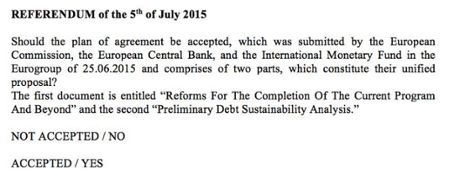
On the other hand, Greece is actually asking its people to vote on whether or not to accept the last proposal from its lenders:
Updated
Renzi: Referendum is euro vs drachma
Italy’s prime minister Matteo Renzi has added his weight to those warning that Greece is voting on its eurozone membership on Sunday.
The leftwing PM has just tweeted that Greeks aren’t refereeing a bout between their prime minister and Brussels, it’s about much, much more.
The point is: greek referendum won’t be a derby EU Commission vs Tsipras, but euro vs dracma. This is the choice.
— Matteo Renzi (@matteorenzi) June 29, 2015
Renzi had been one of Tsipras’s closer allies – jokingly giving him a tie earlier this year, and even joshing around at Thursday’s EUCO summit:
It feels so long ago....

Updated
The door is still open for negotiations between Greece and its creditors, Eurogroup chairman Jeroen Dijsselbloem has said.
He said he was disappointed that after months of negotiations, Greece had ended discussions, according to Reuters. But he added:
“I continue to say our door is open, although the options and the time are very limited.
“This really is about the future of Greece and also of the eurozone, but mainly of Greece.”
With Wall Street now open, America is now joining in the global sell-off. Our correspondent Rupert Neate reports:
US markets fell sharply on Monday morning as fears about a Greek exit from the Euro spread across the Atlantic. The Dow Jones, S&P 500 and Nasdaq were down as much as 0.9% shortly after the markets opened. Nearly all world markets fell on Monday, with most suffering much greater falls than the US, whose economy has little exposure to Greece.“A week ago, it seemed very likely that we were close to having a resolution, and now all of a sudden we’re waking up to capital controls?” Leo Grohowski, chief investment officer at BNY Mellon Wealth Management, told Reuters.
“I’m not confident that today reflects all the bad news that could happen. Investors are really bumping up the odds that Greece will exit the euro.”
Updated
Away from the financial markets – and the political blame game, and the queues, and the empty restaurants – there are people in Greece who have already lost everything since the crisis began.
Jon Henley visited one couple who lost their job, then their home, and would be sleeping on the streets if their friends hadn’t rallied around and paid for a caravan...
Jon writes:
The caravan is old, but spotless. It is home to Georgios Karvouniaris, 61, and his sister Barbara, 64, two Greeks for whom all the Brussels wrangling over VAT rates, corporation tax and pension reforms has meant nothing – because they have nothing, no income of any kind.
Next Sunday’s referendum – which, if the country stays solvent that long, will either send Greece back to the negotiating table with its creditors or precipitate its exit from the eurozone – is unlikely to affect them much either.
“I do not see how any of it will change our lives. I have no hope, anyway,” said Georgios, sitting in a scavenged plastic garden chair beneath a parasol liberated from a skip.
Here’s the full piece:
Updated
Meanwhile, some Greek bank branches may open again on Thursday, a government official has said.
Specifically, 850 branches are expected to open to allow for the payment of pensions, although they will be shut for other business, according to Reuters. The official also suggested that the €60 daily limit could also be raised, but only if the European Central Bank continues to support the banks though its emergency funding programme.

Reuters has heard that Greece asked the European Central Bank for €6bn in extra liquidity at yesterday’s emergency meeting.
As we already know, the ECB rejected the request and left ELA at its current €89bn, following the news that Greece’s bailout would expire on 30 June.
I think €6bn would have been the biggest jump in ELA funding since the Greek crisis started, showing just how much cash was taken out over the weekend - and how much more the Bank of Greece was likely to leave if the banks reopened.
Tsipras on TV tonight
Greek journalists are flagging up that Alexis Tsipras may address the nation again this evening - 9pm local time or 7pm BST.
PM Tsipras to speak after 9:00 News on state TV #Greece https://t.co/DoYpeb5Jaw
— Derek Gatopoulos (@dgatopoulos) June 29, 2015
Back in Brussels, European Parliament president Martin Schulz is holding a press conference – and urging a Yes vote on Sunday.
He’s also warning that the referendum is effectively on Greece’s membership of the eurozone.
We make an appeal to the Greek people to vote yes, Martin Schulz of @Europarl_EN, I will run and I will fight to convince Gk people to stay
— Jennifer Rankin (@JenniferMerode) June 29, 2015
So much for Angela Merkel’s claim that no-one should put pressure on the Greek people …
Schulz is also suggesting he might visit Greece to put forward Brussels’ case.
SCHULZ: I was asked to go to #Greece by the conference of EP Presidents and I am prepared to go
— Ryan Heath (@PoliticoRyan) June 29, 2015
Phoebe Greenwood has also met with a restaurant owner in Plaka, the historical Athens district close to the Acropolis, whose tables are unusually deserted today:
My colleague Phoebe Greenwood reports from this cash machine in Syntagma Square which re-opened this lunchtime:
Updated
Merkel is downplaying the potential impact of a Greek default, saying finance minister Wolfgang Schäuble has already said Germany is well prepared.
#greece #gabriel debt relief only in 3rd programme, meaning longer maturities, lower rates - no debt swap
— Ian Traynor (@traynorbrussels) June 29, 2015
#greece #merkel already in damage limitation mode. losses from greek default not a big problem, efsf is solidly structured
— Ian Traynor (@traynorbrussels) June 29, 2015
And the German chancellor suggests there’s no legal basis to keep providing funds to Greece after its bailout expires tomorrow night.
#greece #merkel no legal basis for interim programme for greece
— Ian Traynor (@traynorbrussels) June 29, 2015
Merkel isn’t rushing back to Brussels either:
#greece #merkel no real reason for another EU summit
— Ian Traynor (@traynorbrussels) June 29, 2015
Angela Merkel is now suggesting that no-one should try to influence the Greek referendum.....
(surely that ship sailed over the horizon mid-way though Jean-Claude Juncker’s speech?!).
....we just need to point out the consequences, Merkel adds.
#greece #merkel don't want to put pressure, but we have to point out the consequences
— Ian Traynor (@traynorbrussels) June 29, 2015
Berlin is also adamant that Greece is voting on its eurozone membership next Sunday.
#greece #gabriel greece is voting in/out to euro. no vote 'is a clear decision against staying in the euro'
— Ian Traynor (@traynorbrussels) June 29, 2015
Sigmar Gabriel, the German vice-chancellor (and social democrat), is alongside Merkel at the press conference.
He’s being extremely critical of Alexis Tsipras, saying the Greek PM threatens the entire eurozone.
Our Europe editor Ian Traynor is covering the press conference.
#greece #gabriel europe in its worst crisis since the treaty of rome founding
— Ian Traynor (@traynorbrussels) June 29, 2015
#greece #gabriel last offer was the best greece has ever got from troika
— Ian Traynor (@traynorbrussels) June 29, 2015
#greece #gabriel europe and germany cannot hand out money unconditionally
— Ian Traynor (@traynorbrussels) June 29, 2015
#greece #gabriel tsipras wanted to change the rules for the euro
— Ian Traynor (@traynorbrussels) June 29, 2015
#greece #gabriel tsipras wanted a different eurozone politically and ideologically. very dangerous
— Ian Traynor (@traynorbrussels) June 29, 2015
#greece #gabriel very tough. tsipras policies and ideology imperils entire eurozone
— Ian Traynor (@traynorbrussels) June 29, 2015
Angela Merkel is talking about how the eurozone is now facing a decisive challenge.
She’s not ruling out more talks with Greece after Sunday’s referendum, but insisting that Athens was given a generous offer
#greece #merkel the euro 'faces a decisive challenge'
— Ian Traynor (@traynorbrussels) June 29, 2015
#greece #merkel if greek govt asks for more negs after the referendum, we won't close that off
— Ian Traynor (@traynorbrussels) June 29, 2015
Merkel press conference begins
German chancellor Angela Merkel has begun giving her press conference on the Greek crisis -- here’s a livefeed.
Updated
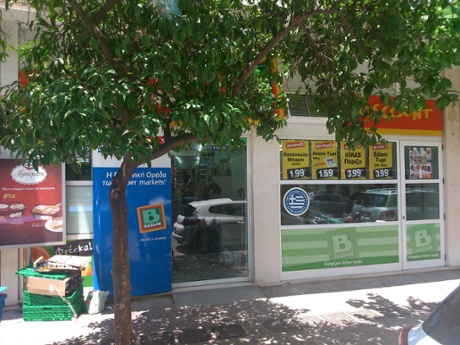
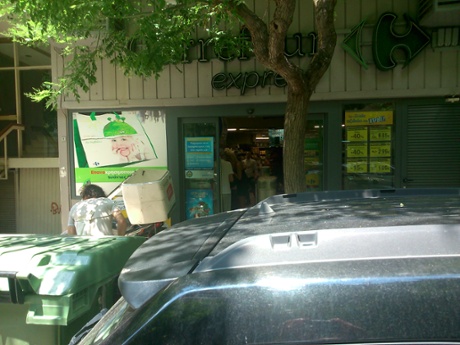
A reader, Martin Royalton-Kisch, has got in touch to report that the situation in Kolonaki, central Athens, remains calm.
No panic at the two banks and two supermarkets there, he tells me.
At the Carrefour Express, there was just one customer paying, at the other, about 6, a normal Monday.
Updated
In another surprise development, it has emerged that the Greek prime minister Alexis Tsipras spoke with EU Commission chief by phone just before Juncker’s press conference in Brussels.
The Greek prime minister made it clear that “impeding the democratic expression of the Greek people by closing banks is outside the democratic tradition of Europe.”
“He also told the president of the commission that he, himself, as as European citizen ought to defend the traditions of Europe so the Greek people can decide on Sunday undistracted.”
“With this in mind, he [Tsipras] asked [Juncker] to help so that the [bailout] programme could be extended by a few days and liquidity restored to the country’s banking system.”

And now it emerges that even that symbol of democracy itself, the Acropolis, has not been spared the spat now dominating Greece’s relations with creditors.
The Greek culture minister has JUST released an announcement saying that with cash being sparse, visitors and organised groups, can now pay for entrance tickets to the site with plastic.
In a statement, it said:
“It has been a demand for many years and now will be fulfilled. Especially for as long as there is a difficulty with liquid cash groups of tourists will be given vouchers.”
Updated

In a surprise move the deputy transport minister Christos Spirtzis has decided that all forms of transport across Athens’ transit network will be free until after the referendum is held.
Trams, trolleys, buses and trains are included in the decision and will be running free services until next Monday.
Here’s our Europe editor Ian Traynor on Juncker’s speech:
#greece @JunckerEU sounded proprietorial about *his* europe. Knows he's losing it
— Ian Traynor (@traynorbrussels) June 29, 2015
#greece like it or lump it, @atsipras has bits of eu elite desperate and panicking. @JunckerEU felt like end of an era
— Ian Traynor (@traynorbrussels) June 29, 2015
#greece @JunckerEU teases on debt relief, says talking to ESM boss. deeply disingeneous.EU chaps make clear nothing new on offer and not now
— Ian Traynor (@traynorbrussels) June 29, 2015
Back in the UK, David Cameron has called a top-level contingency planning meeting on Greece, with Bank of England governor Mark Carney and chancellor George Osborne.
It will look at the impact on Greek bank branches in the UK, and ‘consular issues’, says the PM’s spokeswoman.
In London British PM Cameron holds another contingency planning meeting on #Grexit
— Stephen Castle (@_StephenCastle) June 29, 2015
Juncker’s appeal for Greeks to vote “Yes” in the referendum next week is likely to further inflame spirits, writes Helena Smith from Athens.
The EU president’s interjection today will not go down well with the NO camp or the government, whose ministers this morning, have been busily accusing creditors of trying to influence the outcome by “terrorising” the Greek people.
“Juncker was clearly panic-stricken throughout the press conference because Tsipras has not only wrong-footed them but outmaneuvered them,” said Alexis Mantheakis, former spokesman of the right-wing LAOS party in comments that will echo widely.
“The Greek government called their bluff after the ‘take it or leave it’ ultimatum to Greece. Tsipras is no longer in the orbit of their control. He is the bird that has flown the cage.”
And the Greek government has shot back with a fiery response to Juncker’s claims.
In a terse one-line statement, the government spokesman Gavriel Sakellarides said:
“The indispensable factor as a sign of goodwill and credibility in any negotiation is sincerity.”
Updated
And here’s some instant reaction from Greeks to Juncker’s intervention – his comment about “not choosing suicide over death” has not gone down well.
At this late stage, nothing to gain from Greek/European leaders claiming to have done right but only from admitting mistakes #Greece #euro
— Nick Malkoutzis (@NickMalkoutzis) June 29, 2015
Another (implied) #Juncker highlight: "Vote yes now and trust us to maybe, possibly discuss debt relief in the fall." Yeah, we trust you.
— Theodora Oikonomides (@IrateGreek) June 29, 2015
Juncker "You sh'd not commit suicide bec u are afraid of death" Austerity=> 35% rise in suicides in just 2yrs #Greece http://t.co/FfUBeDmAZH
— Albert Broomhead (@albertjohn) June 29, 2015
@damomac @northaura 11,000 ppl since 2011 11,000 families affected
— Emmy B (@greekemmy) June 29, 2015
Updated
Here’s how European correspondents are responding to Juncker’s speech:
Plenty of govts/officials thought it v dangerous for outsiders to insert themselves into Greek campaign. @JunckerEU clearly not among them
— Tom Nuttall (@tom_nuttall) June 29, 2015
INSTANT ANALYSIS: @JunckerEU has just appointed himself head of the "YES" campaign in #Greferendum - & his political gloves are off #Greece
— Ryan Heath (@PoliticoRyan) June 29, 2015
45 minutes of drama in the @eucommission briefing room, Juncker didn't pull any punches, called Tsipras a liar & begged the Greeks for mercy
— Tara Palmeri (@tarapalmeri) June 29, 2015
Can't wait til Juncker does this speech again ahead of the UK referendum.
— Matthew Holehouse (@mattholehouse) June 29, 2015
Updated
Snap summary: Juncker tells Greece to vote Yes

When the full tale of the eurozone crisis is finally written, the last hour deserves a special mention.
Jean-Claude Juncker, president of the European Commission, has made a remarkable intervention into the Greek crisis in what looks like desperate, last-gasp bid to prevent the country ploughing out of the eurozone.
He has effectively told the Greek people that they are choosing between the euro and the exit door on Sunday, that their government has lied to them, and that he has been their friend and ally at the negotiating table.
Underneath it all, the desperate fear that the European project is swerving off course and about to lose its first member.
Juncker confirmed the claim that Greece’s creditors were prepared to discuss debt relief as part of a future aid deal, before Alexis Tsipras shattered hopes of a breakthrough last weekend.
A clearly wounded Juncker spoke of feeling “deeply distressed and saddened by the spectacle that Europe gave last Saturday”.
In a single night, the European conscience has taken a heavy blow. Goodwill has somewhat evaporated.
Crucially, Juncker is not offering a new compromise. Instead, he is arguing that the Commission was making a fair proposal – not “stupid austerity” – for the Greek people.
But his comments on the referendum are jaw-dropping: telling Greeks to vote Yes in Sunday’s referendum is one thing, but warning “not to commit suicide for fear of death” is another level altogether.
And he has raised the stakes in Sunday’s referendum to the highest level possible, by warning that “the whole planet” will see a no vote as a declaration that Greece wants to leave Europe.
Updated
Ever the polyglot, Juncker concludes a remarkable session with a few words of Greek.
And that just highlights how he’s now trying to reach out to those in Greece, who he insists he cares deeply about.
Killer line from #Juncker - I will never let the Greek people down, ever – and I know that the Greek people don’t want to let the EU down.
— Emily Purser (@EmilyPurser) June 29, 2015
Snap summary to follow...
Updated
A No vote would be disastrous for Greece, Juncker reiterates.
The entire planet would take it as a sign that the Greek people want to distance themselves from Europe.
Juncker is asked how much damage has been done to relations between Brussels and the current Greek government.
The referendum came as a surprise, Juncker says. Alexis Tsipras didn’t tell me, but I don’t blame him personally.
Updated
Juncker's backdrop is giant Greek and EU flags #Greece pic.twitter.com/99FgNXHID8
— Derek Gatopoulos (@dgatopoulos) June 29, 2015
Juncker urges Greece to vote YES to stay in the euro
WOW. The head of the European Commission has effectively said Sunday’s referendum is a vote on Greece’s membership of the eurozone.
I ask the Greek people to vote Yes in Sunday’s referendum, says Juncker. Vote Yes to stay in the euro.
And he adds:
I say to the Greek people, you should not commit suicide because you are afraid of death.
"You should not commit suicide because you're afraid of death": @JunckerEU to the Greek people. Well that'll clinch it.
— Heather Stewart (@heatherstewart3) June 29, 2015
Juncker says the Greek people deserve to know the whole story -- accusing Athens of not telling the truth.
Juncker accusing Greek government of lying: "it would be advisable if the Greek government told the truth."
— Jennifer Rankin (@JenniferMerode) June 29, 2015
The door is still open, Juncker says, but he’s not announcing a new proposal now.
We really moved mountains, until the last minute, until the Greek authorities closed the door...
So, despite reports, I am not announcing anything new today, he adds.
President @JunckerEU confirms that he has no new proposals for #Greece today. #Greferendum
— EfiKoutsokosta (@Efkouts) June 29, 2015
Juncker’s claim that Greece’s creditors never wanted to cut Greek pensions has sent eyebrows soaring in the press room:
Pension cuts, creditor target is to reduce Greek spending on pensioners by 1% of GDP for next year. @JunckerEU is telling porkies
— Bruno Waterfield (@BrunoBrussels) June 29, 2015
Creditors' bailout offer includes phasing out EKAS "solidarity grant" by Dec 2019. That's a pension cut, regardless of what @JunckerEU says
— Peter Spiegel (@SpiegelPeter) June 29, 2015
Updated
President @JunckerEU says Greek negotiating team left the table at the worst moment. "We were ready to discuss debt measures". #Greferendum
— EfiKoutsokosta (@Efkouts) June 29, 2015
Juncker: Gk authorities walked away "unexpectedly I must say" on Fri night
— Katie Allen (@KatieAllenGdn) June 29, 2015
Updated
Juncker is now insisting that Greece’s creditors were ready to discuss debt relief, in line with a pledge made in 2012. Mr Tsipras knows that.
[that 2012 pledge has been sitting dormant ever since, though]
Updated
Yes, it was a demanding package, says Juncker - but also a fair one.
We did not propose pension cuts … This was never, ever on the table, and it is wrong to claim that it was, says Juncker (another attack on the Greek side).
The Greek government had the ability to substitute measures, he adds. And we also pushed for structural changes to tackle vested interests, Juncker insists:
It took some times, hours, to persuade the Greek government to impose a less-favourable tax regime for ship owners, even though this is common sense.
Juncker adds that Greece suffers from a lack of competition, meaning that energy and commodity prices are among the highest in Europe. He says he wanted to tackle that.
Updated
Juncker is arguing that the Greek side deliberately dragged out talks, leading to the current crisis:
We've been patient waiting for Greek proposals, which were often delayed, deliberately altered says Juncker i.e it's not our fault.
— Jennifer Rankin (@JenniferMerode) June 29, 2015
Juncker seems extremely keen to emphasise the 'i have done everything i can line'
— Katie Allen (@KatieAllenGdn) June 29, 2015
I put the talks on a more political level, as Greek authorities wished, says Juncker. We did not leave the talks to technocrats.
I have done everything I can to deliver a deal, he reiterates.

This is quite an attack on Alexis Tsipras from Juncker.
Other European countries have been down “very difficult paths” and took very difficult decisions, he says.
We were doing everything we could, working day and night, he says, to get a deal before the Greeks unilaterally terminated talks by calling a referendum.
Updated
#greece @JunckerEU fears his life's work unravelling
— Ian Traynor (@traynorbrussels) June 29, 2015
Jean-Claude Juncker, who looks desperately glum, says he was ‘deeply saddened’ by the events of last Saturday.
We saw egotism, tactical games, populist games, says Juncker - “after my efforts, I feel betrayed”.
Playing one democracy against the other 18 is not worthy of the great Greek nation, and not fair on Greece’s citizens.
I have done everything I could, others did everything they could, and we do not deserve the criticism aimed at us.
In one night Europe suffered a major blow and goodwill was blown to the wind, says Juncker. I feel a little betrayed. #Greece
— Jennifer Rankin (@JenniferMerode) June 29, 2015
Updated
Juncker begins by reminding us that Greece joined the European Union in the early 19980s.
Brussels didn’t want Plato to play in the second division then, and I don’t want it to play there today.
"I still don't want to see Plato play in the 2nd division" says @JunckerEU. Very Monty Python.
— James Mackintosh (@jmackin2) June 29, 2015
LIVE now | press conference with @JunckerEU: http://t.co/P0BIU0PzXA #Greece pic.twitter.com/wdogNCfbZj
— European Commission (@EU_Commission) June 29, 2015
Juncker press conference on Greece
Heads-up. Jean-Claude Juncker, president of the European Commission, is discussing the Greek crisis now in Brussels
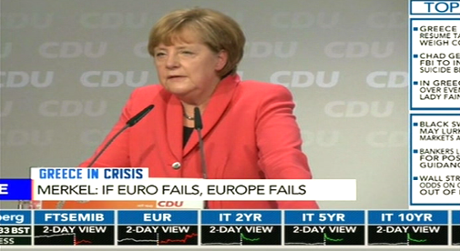
Angela Merkel is addressing her CDU party now, and warning that “If the euro fails, Europe fails”.
That’s a phrase she has used before in the debt crisis when the single currency has come under strain. And there’s another familiar line from the chancellor -- that solidarity and reforms go together:
- GERMAN CHANCELLOR MERKEL SAYS EUROPE LIVES FROM THE ABILITY TO MAKE COMPROMISES
- GERMAN CHANCELLOR MERKEL SAYS GERMAN FINMIN SCHAEUBLE IS ALSO IN FAVOUR OF THIS APPROACH
- GERMAN CHANCELLOR MERKEL SAYS IF WE LOSE THE ABILITY TO MAKE COMPROMISES IN EUROPE, THEN THE CONTINENT IS LOST
- GERMAN CHANCELLOR MERKEL SAYS IT’S ESSENTIAL WITH THE EURO THAT SOLIDARITY AND OWN EFFORTS GO TOGETHER
- GERMAN CHANCELLOR MERKEL SAYS EUROPE CAN DEAL WITH CRISES LIKE IN GREECE MUCH BETTER NOW THAN IN THE PAST
Pensioners in Greece’s second city, Thessaloniki, also queuing at their banks this morning in the hope of getting funds - but no luck:

And in Athens, there are reminders of Sunday’s referendum everywhere:

Downtown Athens covered in OXI graffiti #Greece #Greferendum pic.twitter.com/dZrXKk820A
— Theopi Skarlatos (@TheopiSkarlatos) June 29, 2015

Greek journalist Niki Kitsantonis has been told that shopper in Athens have been stocking up on basic goods, confirming what our own Helena Smith reported earlier.
After ATMs + gas stations come supermarkets. In one Athens store, worker refilling shelves said shoppers snapped up spaghetti, other staples
— NikiKitsantonis (@NikiKitsantonis) June 29, 2015
Updated
Looks like Greek cash machines are up and running under the new regime of capital controls:
ΑΤΜs now working in #Greece, withdraw limit is 60€ [this does not apply to foreign bills] pic.twitter.com/5PsKDKkxcK pic @MakisSinodinos
— spyros gkelis (@northaura) June 29, 2015
Merkel: Greece must make first move to end standoff
Here’s the inside line on Angela Merkel’s meeting with her CDU party today, from Reuters:
German Chancellor Angela Merkel told a leadership meeting of her Christian Democrats (CDU) on Monday that it was up to Greece to move in the reform standoff with its euro zone partners, according to participants.
Merkel also told senior CDU colleagues that decisions on Greece could only be taken on a day-to-day basis given the current level of uncertainty, the participants said.
A few minutes earlier, Merkel’s spokesman was telling reporters that the Chancellor was prepared to talk to Alexis Tsipras again.
Breaking: @RegSprecher Merkel ready for talks with @tsipras_eu if he wishes #Greece via @BloombergTV
— Moritz (@mingleM) June 29, 2015
Analysts at RBC have issued a research note, explaining why Tuesday will be a momentous day:
First, the current Greek bail-out programme expires.
This is important as this means the legal basis on which all potential further bail-outs were dependent expires. As the eurogroup meeting declined to prolong the current programme further that means that at the time of the proposed referendum, there is no contract in place that the Greek authorities could then accept or decline (i.e. technically, there is nothing to vote upon). Furthermore, the European side will find it difficult to then pay out any funds even if the referendum went in favour of any further bail-out. In that case, we reckon, a completely new contract would have to be drawn up that would then have to be passed by all relevant member states’ parliaments.
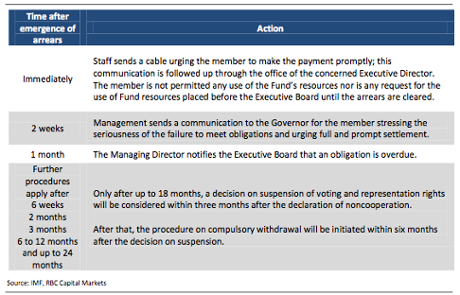
Second, the IMF payment will (most likely) be missed.
It seems very unlikely that the Greek authorities can or want to pay the €1.6bn due to the IMF on 30 June. There have been extensive debates about what this technically means and whether that constitutes a default. On the IMF itself, this is not 100% clear. IMF managing director Lagarde said in a previous comment that the IMF would not apply any grace periods and would consider Greece to be in arrears straight away.
Given the acrimonious deliberations and this weekend’s developments this seems possible. On the other hand, the IMF could also apply a four-week grace period before declaring a state of default. If it opted to do so, this could be bridging the time until after the referendum. We actually think that this is a distinct probability.
Last night, Alexis Tsipras revealed he had asked European leaders to extend Greece’s bailout beyond Tuesday’s deadline - until the referendum has been held.
That initial request was rebuffed on Saturday, by finance ministers at the Eurogroup, so Tsipras is now going over their heads.
The FT has now uploaded one of those letters, sent to Luxembourg’s prime minister, in which Tsipras argues that an extension will allow:
a mutually beneficial agreement, to secure fiscal, financial debt sustainability, that will return Greece to growth within the eurozone.
Paragraph in @atsipras letter to PMs requesting (again) bailout extension. Full letter here: http://t.co/YgV3UqybU4 pic.twitter.com/YcbeXRAlTP
— Peter Spiegel (@SpiegelPeter) June 29, 2015
This video shows how Greek pensioners arrived at banks in the hope of accessing their money this morning, but were rebuffed.
Totally understandably, they look very anxious about the situation; some must be getting tired of the constant media scrum. As one man put it when asked what he was doing:
I am here to get my pension. What else would I be doing here? Looking at the bank?
Updated
UK finance minister George Osborne will update MPs on the crisis later today.
Chancellor of the Exchequer @George_Osborne will give a statement to Parliament on #Greece this afternoon
— HM Treasury (@hmtreasury) June 29, 2015
Harris Georgiades, Cyprus’s finance minister, is telling Bloomberg TV now that he hopes Greece’s capital measures will be temporary, adding:
I am very concerned for the Greek people, and I still hope there can be a way out from this very difficult situation.
But a former deputy governor of Cyprus’s central bank, Spyros Stavrinakis, has warned that reopening the banks will be hard.
Stavrinakis lived through the 2013 Cyprus crisis, in which capital controls were imposed for almost two years.
He says:
Once you impose capital controls, you immediately send a message that there is something wrong with the banking sector.
It is very difficult to phase down and unwind capital controls, once they are imposed, Stavrinakis adds.
Updated
British tourists visiting Greece can still enjoy a “smooth and fun” stay, claims the Greek government.
It has issued a statement that reminds us that foreigners will not be hit by capital controls; in an attempt to prevent worried holidaymakers going elsewhere.
Greek govt clearly v worried abt Brits cancelling their holidays. Their London press office just issued this: pic.twitter.com/euvW22o2Ai
— Ed Conway (@EdConwaySky) June 29, 2015
Vangelis Kotsos, the president of Chania’s petrol station owners, has just called for calm on the state-run TV channel, ERT 1:
“Panic is mounting, for example I opened at 7:30am and by 10am I had sold the amount (of gas) that I would normally sell by tomorrow afternoon.
But I foresee that soon things will normalised, more reserves will be brought in.”
Siege mentality setting in across Greece
There have been scenes of panic in northern Greece where pensioners have reportedly fainted outside banks in Salonika.
From Athens, Helena Smith reports:
Reports of panic outside banks, in supermarkets and at petrol stations are now coming through thick and fast. Pensioners, waiting outside closed banks in Salonika, collapsed when it became apparent that the lenders weren’t going to open and they would not be getting their monthly allowance.
An announcement may come later today:
#Greece's FinMinistry to announce at 4 pm local time, which bank branches will be open for pensioners to withdraw pensions #capital_controls
— Keep Talking Greece (@keeptalkingGR) June 29, 2015
In Crete, gas stations were also forced to close after running out of petrol.
Vangelis Kotsos, president of gas station owners in Chania, said around 50% of gas stations had now run dry and described scenes of chaos as nervous Greek motorists (and presumably visiting tourists) flocked to gas stations to fill up.
“A lot have been coming in carrying cans so they have extra reserves.”
I have been getting word from friends around the capital of panic in supermarkets now being stampeded by consumers worried that stocks will run out.
“Mayhem in Carrefour Kolonaki,” said one text, referring to Greece’s upmarket district above Syntagma Square.
Panicked buyers were snapping up everything in sight, not least staple foods such as sugar and flour.
By mid-morning it has become clear that a siege mentality appears to have taken hold of Greeks following the shock announcement of the closure of banks and imposition of capital controls.

Updated
The French president is now tweeting that a Greek deal is still possible...
Je souhaite que la négociation avec la #Grèce reprenne, un accord reste possible. La France est toujours disponible pour le dialogue.
— François Hollande (@fhollande) June 29, 2015
...and insisting that the French economy is stronger than four years ago and has nothing to fear from the Greek crisis.....
Aujourd'hui l’économie française est plus robuste qu’il y a 4 ans et n’a rien à craindre de ce qui pourrait se produire. #Grèce
— François Hollande (@fhollande) June 29, 2015

Richard Hunter, Head of Equities at Hargreaves Lansdown Stockbrokers, says markets are facing a “triple whammy” of negative news.
As well as the Greek crisis, there is Friday’s terrorist atrocities in Tunisia, France and Kuwait, and another slump in Chinese markets.
The IMF deadline tomorrow now looms large, whilst investors will now be looking for any possibility of an eleventh hour rescue to prevent either or both of a Greek default or exit.
Meanwhile, Friday’s terrorist attacks have added to the generally risk averse sentiment, with travel companies being inevitably hit. In addition, and despite a relaxation of bank reserves and a further interest rate cut, Chinese markets fell another 7%, pulling it into a technical bear market, while also implying that the Chinese authorities are keen to act extremely quickly to stem further declines.

French president Francois Hollande has emerged from an emergency cabinet meeting on Greece, to announce that there is still time, just, to save a deal.
Hollande said:
“There are a few hours before the negotiation is definitively closed, in particular for the prolongation of the Greek aid programme.
I wish, if the Greeks, if their government, so decide, that talks resume.”
Hollande also warned that Sunday’s referendum is a choice between staying in the eurozone and taking “the risk to leave it.”
#GreeceCrisis MT @ThomaisERT_RIK Hollande: The #Greferendumis a "sovereign choice" by the Greeks on whether they stay of leave the euro
— spyros gkelis (@northaura) June 29, 2015
French President Hollande: Greek referendum is choice to remain in Euro or likely exit. (DJ) #Greferendum #Grexit
— Holger Zschaepitz (@Schuldensuehner) June 29, 2015
Updated

The market turmoil has forced Switzerland’s central bank to intervene in the currency markets to weaken the Swiss franc.
Thomas Jordan, head of the Swiss National Bank, revealed this morning that the SNB stepped in, to protect Switzerland being hit by the Greek crisis.
He also told a financial conference in Bern that the Greek situation remained uncertain:
- SWISS NATIONAL BANK’S JORDAN SAYS NOBODY KNOWS WHERE THINGS ARE HEADED IN GREEK SITUATION
- SWISS NATIONAL BANK’S JORDAN SAYS IT IS POSSIBLE FOR SOLUTION TO BE FOUND FOR GREECE, THINKS NEGOTIATIONS ARE ONGOING
- SWISS NATIONAL BANK’S JORDAN SAYS IN THIS DIFFICULT ECONOMIC SITUATION ANY FURTHER UNCERTAINTY IS DIFFICULT
- SWISS NATIONAL BANK’S JORDAN SAYS THE SNB HAS INTERVENED IN CURRENCY MARKET
- SWISS NATIONAL BANK’S JORDAN SAYS HAS INTERVENED IN THE MARKET IN DIFFICULT SITUATION
And this chart shows how the euro had plunged against the Swiss franc in early trading, only to bounce back as the SNB revealed it had intervened:
SNB's Jordan: Intervened in Franc overnight as #Greece is a very critical situation and SNB is watching closely. pic.twitter.com/zQFzRVPOi8
— Holger Zschaepitz (@Schuldensuehner) June 29, 2015
A war of tweets appears to have broken out between Athens and Brussels this morning.
This follows the European Commission’s claims on Sunday that Greece had been offered a sweetened version of a cash-for-reform deal to avert bankruptcy, when prime minister Alexis Tsipras announced his shock referendum.
Our correspondent Helena Smith reports from the Greek capital.
The radical leftists in power in Athens are not backing down. Denying that a better offer had ever been made, Minister of state Nikos Pappas, the Greek prime minister’s closest ally, took to twitter this morning to denounce what government officials are calling the chicanery now being spun out of Brussels.
“Look at the “non existent” ultimatum,” he tweeted under a picture showing him holding a sheet of proposals from creditors. “They are asking us to say “YES to everything.”
Ιδού το "ανύπαρκτο" τελεσίγραφο. Ζητάνε να πούμε "ΝΑΙ σε όλα". pic.twitter.com/j2Gn3g3gJY
— Νίκος Παππάς (@nikospappas16) June 29, 2015
On Sunday EU commission chief Jean-Claude Juncker, addressing Greek voters directly, published what he said was a sweetened version of the deal the Athens government was looking at when Tsipras made his bombshell announcement.
In a tweet also released in Greek (Juncker’s spokesman Margaritis Schinas is Greek), the EU chief wrote:
“In the interest of transparency and for the information of the Greek people”
and linked to a 10-page document of budgetary and other “prior actions” set by the EU and IMF as conditions for releasing cash to Greece.
Για την ενημέρωση του ελληνικού λαού και σε πνεύμα διαφάνειας η Ευρωπαϊκή Επιτροπή ενημερώνει. http://t.co/dgkGu2AywX
— Jean-Claude Juncker (@JunckerEU) June 28, 2015
Coming up: Juncker and Merkel....
Reminder: EC president Jean-Claude Juncker will speak about the Greek situation in two and a half hours (11.45am BST/1.45pm Athens)
Shortly afterwards (and possibly clashing), Angela Merkel is due in the German parliament to discuss the crisis. She also due to hold emergency meetings today with German political party leaders, and her own CDU party.
Le Président @JunckerEU fera annonce à 12h45 sur la voie à suivre avec #Grèce. Les dernières prop. @EU_Commission sont connues et publiées
— Pierre Moscovici (@pierremoscovici) June 29, 2015
Reminder: #Merkel to address Bundestag at 12.30 BST today. We'll follow and translate live from @OpenEurope #Greece #Greferendum
— Nina Schick (@NinaDSchick) June 29, 2015
Pensioners queuing at Greek banks
Back in Athens, pensioners have been queuing outside some bank branches - even though the system has been shut down for a week.


According to the Kathimerini newspaper, “some local lenders’ branches were expected to open on Monday in order to services pensioners unable to use credit or cash cards to retrieve their pensions”.
Banks were expected to release more information regarding which branches would open their doors later in the day, Kathimerini adds.
Banks are closed but have seen quite a few pensioners, many of whom usually use banks rather than ATMs, outside them pic.twitter.com/SX6q1phb1v
— Jess Brammar (@jessbrammar) June 29, 2015
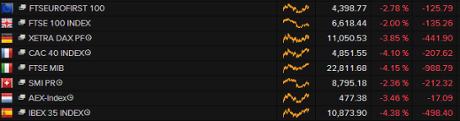
All Europe’s main stock markets are deep in the red, after a nervy opening session.
David Cameron explains that a Downing Street team had been preparing for months for the possibility of a Greek exit from the Euro, and said he would put the “final touches” to a plan in a meeting later today.
“We must make sure we are prepared for any eventuality, that means advising British tourists, looking after British pensioners and people receiving benefits who are living in Greece as well as dealing with issues of Greek banks.”
The prime minister skirted around whether a Greek departure from the eurozone would make Britain’s renegotiation with the European Union ahead of the UK’s own “in-out” referendum easier.
“If this organisation is going to would it has to be flexible enough to work for both Eurozone members and countries that I believer are never going to join the Euro, like Britain. My point is that this organisation needs to have the flexibility of a network not the rigidity of a block. This is a two-way street... there are lots of difficult negotiations to come but every journey starts with a single step, as they say.”
Cameron: Greek referendum is about eurozone membership

David Cameron has just discussed the Greek crisis on BBC Radio 4’s Today Programme.
Does he believe Greece should leave the euro? (the Guardian revealed on Friday that the UK PM told a fellow EU leader that it “might be better” for Greece to withdraw from the eurozone)
Britain’s interest are best served by an agreement between Greece and the eurozone that delivers the security that we want to see, Cameron replies.
Will Sunday’s referendum effectively be a vote on whether to stay in the euro?
I think that’s what it will come down to, Cameron replies.
If the Greek people vote yes, they are voting for the sort of deal put forward by the institutions....
“If they vote no, I find it hard to see how that is consistent with staying in the euro, because there would be, I think, a very significant default and a very significant problem.”
#Cameron: Greek Referendum ‘No’ Vote May Lead to Debt Default
— Francine Lacqua (@flacqua) June 29, 2015
Cameron adds that Britain has drawn up contingency plan for Greece, and he’ll put the final touches to it today.
Most of the interview covered the terrorism attacks in Tunisia - my colleague Andrew Sparrow covered it in his Politics Live blog.
Updated
The overall European banking index has tumbled by over 4% in the opening minutes of trading, as investors react to last weekend’s drama.
Deutsche Bank’s Francis Yared explains that there will be short, and long-term consequences of the Greek crisis:
Given market optimism towards a Greek deal over the last week, the initial risk-off move could be pronounced.
Post the initial shock, the ECB’s response and sticky domestic capital should limit contagion. Longer term, the events in Greece are a stark reminder that the current eurozone architecture is vulnerable to domestic politics. This in itself will justify some structural risk premium unless there is an institutional change or further economic convergence
Updated
Bank shares hammered
Bank shares across Europe are in retreat:
- 08:01:25 - SHARES IN BANCO COMERCIAL PORTUGUES DOWN 9.6 PERCENT
- 08:02:13 - SHARES IN BANCA POPOLARE DI SONDRIO DOWN 9.7 PERCENT
- 08:02:38 - FRANCE’S BNP PARIBAS SHARES DOWN 7 PCT, SOCGEN DOWN 5.8 PCT, AFTER GREECE SHUTS BANKS, IMPOSES CAPITAL CONTROLS
- 08:02:53 - SHARES IN BANK OF IRELAND DOWN 8 PERCENT
- 08:04:00 - UK HSBC SHARES DOWN 2.2 PCT, BARCLAYS DOWN 4 PCT, FRANCE’S CREDIT AGRICOLE DOWN 8 PCT, NATIXIS DOWN 9 PCT AFTER GREECE IMPOSES CAPITAL CONTROLS
- 08:04:08 - SHARES IN ERSTE GROUP BANK DOWN 6.1 PERCENT
- 08:04:47 - SHARES IN RAIFFEISEN DOWN 14.4 PERCENT
- 08:06:20 - SHARES IN COMMERZBANK DOWN 7.1 PERCENT
- 08:06:29 - SPAIN’S BBVA SHARES DOWN 8.4 PCT, DEUTSCHE BANK DOWN 6.3 PCT, ING GROUP DOWN 5 PCT AFTER GREECE SHUTS BANKS
- 08:07:17 - SHARES IN BANKIA DOWN 8.4 PERCENT
- 08:09:07 - SPAIN’S SANTANDER SHARES DOWN 8.5 PCT AFTER GREECE IMPOSES CAPITAL CONTROLS
European markets tumble at the open
The German DAX and French CAC have both tumbled by around 4.4% at the open.
And the Portuguese stock market plunged by around 5.8%, as the Greek crisis ripples through the markets.
Europe’s stock markets are opening... and the FTSE 100 index has promptly tumbled by 2.2%, or 147 points.
France’s finance minister, Michel Sapin, has admitted that Greece could leave the euro, in an interview with France Inter radio this morning.
Of a euro exit for Greece, he said:
“It’s always a possibility, it’s a risk.”
Sapin insisted that negotiations could resume at any time -- and added that Athens must decide:
“Do you want to continue the negotiations or do you want to take the risk of exiting the euro?”
The Economist Intelligence Unit reckons Grexit is now more likely than not:
#Greece referendum is game changer. Team revise probability of Grexit to 60%. Vote likely to either reject bailout deal, or reject Gov.
— Robin Bew (@RobinBew) June 29, 2015
El-Erian: 85% chance of Grexit
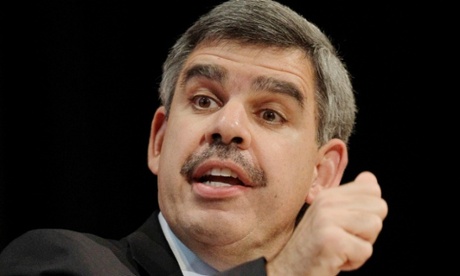
Mohamed El-Erian, the chief economic adviser at German financial services firm Allianz, believes there is only a 15% chance that Greece will stay in the eurozone.
He told Bloomberg this morning that Greece will probably be forced to leave the single currency in the weeks ahead, saying:
“There’s an 85 percent probability that Greece will be forced to leave the euro zone.”
“What we are seeing here is what economists call the sudden stop, when the payment system stops. The logic of a sudden stop is a massive economic contraction, social unrest and it’s going to make continued membership of the euro zone very difficult for Greece.
Those capital controls in full:
Overnight, the Greek government released details of its capital control measures..
Here are the key points:
All banks shut until 6 July
All Greek banks – including branches of foreign banks – will remain closed until after the referendum on the bailout proposals. The government says they will reopen on Tuesday 7 July.
ATM withdrawals limited to €60 a day
Cash machine withdrawals will be capped until 6 July. Many machines are already reported to have run out of bank notes, although the government said ATMs should “operate normally again by Monday noon at the latest”.
The €60 limit is per bank card. The limit can be changed by the finance minister.
Foreign bank cards exempted from controls
People using a credit or debit card issued in a foreign country will not be affected by the limits on ATM withdrawals. Thousands of foreign tourists currently staying in Greece could still be affected by cash machines running dry, however, and the finance minister could yet set withdrawal limits here too.
Stock exchange closed on Monday
The Athens stock exchange will not open on Monday.
Bank card payments ‘as normal’
Paying by credit or debit card in shops and between Greek bank accounts should continue to work as normal.
Internet banking ‘unaffected’
The government statement said online transactions inside Greece will not be affected.
Foreign transfers prohibited
Transfers of money to destinations outside Greece are prohibited and will require approval from a Ministry of Finance commission.
Other transactions subject to approval
A new banking transactions approval committee will have to approve, on a case-by-case basis, any urgent transactions deemed “necessary to safeguard a public or social interest”, such as medical expenses or pharmaceutical imports.
Interest surcharges prohibited
Interest surcharges on due payments are prohibited during the period of closure.
Penalties for banks breaching controls
Banks breaching the rules face fines of up to 10% of the amount of any transaction violating the control measures.
What will happen after 6 July?
The statement allows for the “bank holiday period” to be extended – or shortened – by the finance minister.
Updated
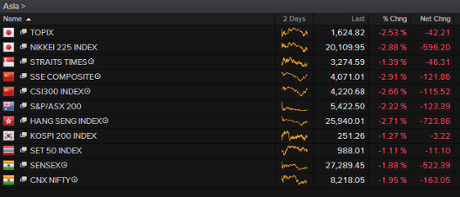
Asian markets in the red
Overnight, markets from Mumbai to Tokyo were rattled by the Greek debt crisis:
Updated
Introduction: Greek crisis throws markets into turmoil

Good morning.
The Greek debt crisis is set to sent turmoil through Europe’s financial markets this morning, as the looming prospect of Greece plunging out of the eurozone sends panic through trading floors.
Shares are set to tumble in London, Frankfurt, Paris and beyond, after a dramatic weekend which began with Alexis Tsipras announce a referendum on bailout terms next Sunday - and ended with the imposition of capital controls and a bank holiday for at least a week.
In Greece, people are facing up to the news that banks will remain shut for at least a week - and that they will be restricted to taking out €60 per day at the cash machines.
Greece crisis deepens as banks close for a week after weekend that shook euro
Germany’s DAX index is predicted to plunge by 5% - an alarming selloff - while Britain’s FTSE 100 is on track to shed over 2% when trading begins at 8am BST.
European government bonds could also come under pressure, if investors calculate that the eurozone debt crisis is going to spread.
Asian stock markets have already been through a torrid day, with Japan’s Nikkei tumbling almost 3%. And the euro has already shed around 1% against the US dollar.
Here’s our overnight story:
Greece crisis: markets begin to tumble as investors flee
Europe’s political leaders are also scrambling to address the crisis, with Greece now on track to exit its bailout tomorrow night and default on its €1.6bn repayment to the International Monetary Fund.
European Commission head Jean-Claude Juncker is due to hold a press conference at 10.45am BST to discuss the latest developments on Greece.
In Berlin, German Chancellor Angela Merkel has called an emergency meeting with the heads of parliamentary groups and party leaders today, while French President Francois Hollande will chair crisis talks with key ministers in Paris this morning.
UK prime minister David Cameron is due to speak on the situation soon - he’s due on Radio 4’s Today Programme this morning (the ten past eight slot).
I’ll be tracking all the main events through the day....