And finally, over to Reuters for a snap summary:
Greek lawmakers on Sunday authorised prime minister Alexis Tsipras’ proposed 5 July bailout referendum, setting Greece on course for a plebiscite that has enraged international creditors and increased Greece’s chances of exiting the eurozone.
The government easily passed the 151-vote threshold needed to authorise the referendum, with deputies from the far-right Golden Dawn voting with the government and pro-European opposition parties New Democracy, Pasok and To Potami and the KKE Communist party voting against.
Greeks are due to vote on whether to accept or reject the latest terms offered by creditors to Athens in order to unlock billions of euros in bailout funds.
European partners have reacted negatively to the announcement of the referendum. On Saturday, they rejected a request by Tsipras to extend the current bailout in order to cover the period leading up to the referendum. The rejection means Athens is likely to default on a key payment to the International Monetary Fund on Tuesday.
So, what a day. Thanks for sticking with us. I’d better shut down now. Back in the morning.
If you’re not already sated, check out Ian’s latest report. Goodnight! GW.
Tsipras’s shock call for vote on Greek bailout sets day of destiny for Europe http://t.co/4PYP4XIAH5
— Ian Traynor (@traynorbrussels) June 27, 2015
Updated
Some instant reaction to tonight’s vote:
The die is cast. #greferendum on Sunday.
— Rik Winkel (@RikWinkel) June 28, 2015
We've got the referendum confirmed, but no proposal the referendum will decide about. Bizarre. #Greferendum
— Jakub Krupa (@JakubKrupaFE) June 28, 2015
undefined
With 178 votes in favour and 120 against, #Greece is headed for a referendum next Sunday. Stay tuned. Goodnight, good luck... #Greferendum
— Janine Louloudi (@janinel83) June 27, 2015
The details of the vote are being checked, but it looks like a substantial majority in favour of referendum.
Correction: 179 yes, 120 no
— Loukia Gyftopoulou (@loukia_g) June 27, 2015
That’s because the extremist Golden Dawn lined up with MPs from the left-wing Syriza coalition, and the populist right-wingers of ANEL.
GREEK GOVERNMENT WINS REFERENDUM VOTE
A majority of Greek MPs have voted in favour of holding a referendum on its bailout terms on Sunday, 5th July.
Even though, as covered through the day, that bailout it set to expires in three day’s time.
I think the government has got to its majority now.
And so does Reuters:
- GREEK PARLIAMENT VOTES TO AUTHORIZE JULY 5 REFERENDUM ON BAILOUT TERMS - RTRS
Greek parliament passes the bill calling for the #Greferendum on the creditors' proposal to be held on Sunday, July 5th.
— Jakub Krupa (@JakubKrupaFE) June 27, 2015
The chamber’s thinning out now, as more MPs give their verdict and depart.
Nearly there...
Ψηφοφορία στη Βουλή για το δημοψήφισμα: ΝΑΙ 146, ΟΧΙ 102, ΠΑΡΩΝ 0
— BankingNews.gr (@bankingnewsgr) June 27, 2015
The government is starting to open up a lead. Some 91 MPs have voted yes, while 70 have voted no. First to 151 wins.
The far-right Golden Dawn are voting for a referendum.
That suggests that the government should get a comfortable majority, as Syriza and ANEL have 161 seats out of 300 anyway.....
So, if no surprises occur, #Greferendum is to be shortly validated by #Greece's Parliament with votes of Syriza, ANEL (gov) and GoldenDawn.
— spyros gkelis (@northaura) June 27, 2015
MPs from the communist KKE party are voting against holding the referendum.
That was indeed Yanis Varoufakis we spied earlier:
Βουλευτές του ΣΥΡΙΖΑ περικύκλωσαν τον Γ. Βαρουφάκη μετά την επίστροφή του για να ενημερώθουν σχετικά με το Eurogroup pic.twitter.com/2qkmY5z1Mu
— Mega Gegonota (@MegaGegonota) June 27, 2015
The vote takes place by roll call, so each MPs name is read out, and they reply ναι η οχι (yes or no :) ).
Just 300 names to get through.....
And here we go... #Greferendum pic.twitter.com/0eRsTA9TBw
— Danai Dasopoulou (@d_daso) June 27, 2015
OK, that spat is out of the way, and it’s vote time (followed swiftly by bed time).
I think we’ll get a five minute recess first -- time to dig out those pyjamas or pour another mug or glass of whatever’s keeping you going.
Here’s the problem:
KKE wants a vote to decide on which referendum questions to vote. More #vouli brilliance.
— Theodora Oikonomides (@IrateGreek) June 27, 2015
There’s a vigorous exchange of views underway between communist MPs, Tsipras, and temporary speaker Mitropoulos - who is now laying down the law.
It's 2am in Athens, the Greek parliament is in full session and tempers flare. pic.twitter.com/7vkfHPlrWs
— Mathieu von Rohr (@mathieuvonrohr) June 27, 2015
Starting to worry that the bailout will expire before we get round to tonight’s vote.....
tsipras's speech was repetitious, long on buzzwords and short on substance, especially on the specifics of a 'no' vote.
— Diane Shugart (@dianalizia) June 27, 2015
Syriza’s MPs are on their feet and applauding hard as Tsipras ends his address.
Now, and not before time, it’s the vote - although a procedural issue is being raised by the Communist KKE party first.
Updated
Tsipras is back on familiar ground as his speech comes to a climax:
#Greek PM rachets up the rhetoric: "they chose to b the troika who kill off democracy. Our referendum will send msg of dignity 2 Europe."
— Helena Smith (@HelenaSmithGDN) June 27, 2015
#Tsipras: "We have a mandate to go ahead. We don't have a right to let our country be a colony of debt for the coming decades" #Greferendum
— Janine Louloudi (@janinel83) June 27, 2015
Voting No in a week’s time would actually be a positive message for the future, says the PM.
#Greece "the big no will be a big yes to not aaccepting ultimatums" says PM #AlexisTsipras
— Helena Smith (@HelenaSmithGDN) June 27, 2015
He’s also vowing to abide by the result, even if the public choose Yes.
#Greek PM #AlexisTsipras: "We will respect the result of the July 5th referendum, whatever it is."
— Helena Smith (@HelenaSmithGDN) June 27, 2015
Not much clarity about exactly what a No vote would lead to....
Not a word about the day after a "no" vote. This meansSYRIZA are losing the #Greferendum before they even vote to hold it.
— Theodora Oikonomides (@IrateGreek) June 27, 2015
#Referendum is not about a split with #Europe but practices that offend #Europe," says #Greek PMAlexis Tsipras
— Helena Smith (@HelenaSmithGDN) June 27, 2015
We don’t want to break away with Europe, Tsipras pledges, just the policies which are counter to Europe’s traditional values.....
Syriza MPs are applauding, as their leader takes New Democracy to task:
#Greek PM blasts opposition in parliament tonight 2night : "we are doing what you wanted to do but didn't, which is resist."
— Helena Smith (@HelenaSmithGDN) June 27, 2015
Our Athens correspondent, Helena Smith, is tweeting the key points from Alexis Tsipras’s speech:
"Those who condemn #Greek economy to recession & speak of recession r killing off tourism our most successful sector" says #Tsipras
— Helena Smith (@HelenaSmithGDN) June 27, 2015
#Tsipras accuses EU/IMF of "not wanting us to reach deal but surrender our political dignity," in speech before House 2night
— Helena Smith (@HelenaSmithGDN) June 27, 2015
Tsipras is now criticising creditors, for insisting on further cuts to pension spending, hitting the poorest, and refusing to allow the minimum wage to rise.
He also tries to build bridges with EC president Jean-Claude Juncker; not so much with the IMF though.
Tsipras thanks EU Commission President Juncker for "genuine effort" to try and find deal, blames IMF for interfering in policy #Greece
— Derek Gatopoulos (@dgatopoulos) June 27, 2015
#Greek pm #AlexisTsipras tells House" The #IMF knows [our] debt is not viable" ahead of vote on referendum over proposed reforms
— Helena Smith (@HelenaSmithGDN) June 27, 2015
This is a defiant speech from Tsipras; no sign of a backward step following today’s sensational development in Brussels, where finance ministers decided Greece’s bailout must end on Tuesday.
Tsipras speech: High on pride of Greek nation and related concepts, low on any specifics whatsoever
— Antonis Polemitis (@polemitis) June 27, 2015
#Greek PM #AlexisTsipras "our only fear is fear itself" - FDR once again spicing up the otherwise wooden speeches of leftwing pols
— Helena Smith (@HelenaSmithGDN) June 27, 2015
Yesterday our creditors blackmailed us with the threat of depriving liquidity, says Tsipras, today they use the fear of a bank run.
He speaks of a propaganda of fear - but argues that the referendum could shake it off.
Tsipras says Europe shouldn’t fear referendums - many countries have held them before, including to implement treaties such as Maastricht.
Το #dimopsifisma για να αποφασίσει κυρίαρχα ο λαός μας για το μέλλον του θα γίνει την επόμενη Κυριακή. #Greece #vouli
— PrimeMinisterGR (@PrimeministerGR) June 27, 2015
Tsipras gets an early round of applause by telling MPs he won’t ask permission from Eurogroup president Dijsselbloem to hold a referendum. Nor Germany’s finance minister, either.
tsipras: we won't ask schauble or dijessbloem for permission to protect democracy in the land where it was born.
— Diane Shugart (@dianalizia) June 27, 2015
#Greek pm #Alexis Tsipras tell parliament: "We r not going to ask Schauble et al for permission to hold referendum"
— Helena Smith (@HelenaSmithGDN) June 27, 2015
Updated
Tsipras: It's a historic moment
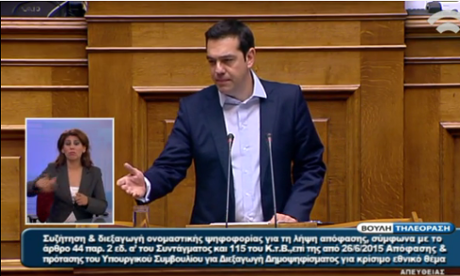
Alexis Tsipras begins by telling MPs that today is a historic day, when a democratically elected government’s ability to decide its future was blocked by the eurogroup.
#Greece pm #AlexisTsipras "we have come face to face with history" he tells parliament ahead of vote on referendum
— Helena Smith (@HelenaSmithGDN) June 27, 2015
Antonis Samaras appears to be attempting to mobilise a public backlash to the referendum plan.
More: Samaras "We won't let anyone turn Greece into Zambia" Calls for pro-EU political alliance, public demonstrations #Greece
— Derek Gatopoulos (@dgatopoulos) June 27, 2015
Anyway, he’s finished now, and here comes the PM
#Samaras "you are not telling the Greek people what a "no" means. No means bankruptcy and euro exit," he tells parliament 2night
— Helena Smith (@HelenaSmithGDN) June 27, 2015
Samaras is now describing the referendum as a ‘coup’ attempt -- to get Greece out of the eurozone against the public will.
#Samaras accuses #Tsipras gov of representing "the drachma lobby" which which will destroy #Greece
— Helena Smith (@HelenaSmithGDN) June 27, 2015
Once Samaras finishes his speech, then we’ll finally hear from Alexis Tsipras. Then MPs can vote, so we’ll know if Greece will press on with a referendum in just over a week’s time.
I think I spotted Yanis Varoufakis arriving in the chamber a few minutes ago, which means the Greek finance minister should be able to vote for the referendum.
Opposition leader Samaras: No vote is bankruptcy, euro-exit, suicide #Greece pic.twitter.com/lmVYOsuUDt
— Derek Gatopoulos (@dgatopoulos) June 27, 2015
#Greece ex pm #AntonisSamaras tells parliament euro exit is the equivalent of "committing suicide" for Greeks as House votes on ref
— Helena Smith (@HelenaSmithGDN) June 27, 2015
New Democracy opposes a referendum, adds Samaras, but if it happens they’ll campaign for a Yes vote - to preserve Greece’s place in Europe.
Samaras is accusing Tsipras of engineering a Grexit:
#Greece "u r calling on Greek people to approve exit from euro, u allowed time to draw out so u cd remove country from currency bloc."
— Helena Smith (@HelenaSmithGDN) June 27, 2015
Antonis Samaras is finishing his speech - telling MPs that the government has left Greeks very fearful:
#Greece ex pm #AntonisSamaras tells parliament "we r all afraid what we will wake up to tomorrow."
— Helena Smith (@HelenaSmithGDN) June 27, 2015
samaras: the best mirror of what is happening today with the negotiations is exactly what is happening in front of the ATMs, banks, >>
— Diane Shugart (@dianalizia) June 27, 2015
<<supermarkets bcz the country being brought to its knees by the coming measures and the recession the govt provoked w/out doing anthg
— Diane Shugart (@dianalizia) June 27, 2015
(reminder: our correspondents did report that some cash machines were very busy, but others rather quieter)
Updated
Now they’ve stopped for another recess! That’s so another MP (Dimitris Mitropoulos, I think) can chair the end of the session.
Speaker Konstantopoulou appears to have sent herself off, to restore harmony, after breaching a parliamentary rule by taking her seat during Samara’s speech.
and a five-minute recess for all this to happen. when parliament reconvenes, we have samaras, tsipras, and voting.
— Diane Shugart (@dianalizia) June 27, 2015
I don't like Konstantopoulou so much, but just now she was a real class act. That pack of hyenas didn't deserve such polite behaviour.
— Theodora Oikonomides (@IrateGreek) June 27, 2015
MPs are taking their seats again.... Zoe Konstantopoulou is back in the Speaker’s Chair too, and telling MPs that it’s important to maintain parliament’s image, with the world watching.
I fear that particular ship sailed mid-way through the finger-pointing row that ended with New Democracy exiting stage left.
konstantopoulou explaining the rule that she broke that angered samaras amid some comments from the floor. (i hope this doesn't take long)
— Diane Shugart (@dianalizia) June 27, 2015
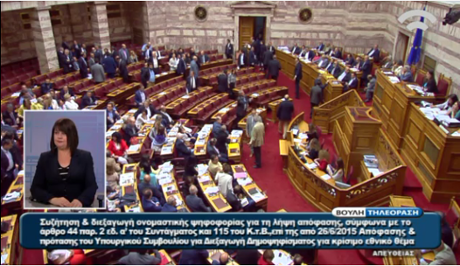
Ah...Tsipras has asked for, and got, a short recess -- so that New Democracy MPs who left the chamber following Samaras’s speech (in a row with speaker Zoe Konstantopoulou) can take their seats again:
#Samaras leads ND out of parliament, telling speaker "you're behaving like a dictator". Tells Tsipras to "control her". #vouli
— Damian Mac Con Uladh (@damomac) June 27, 2015
And here’s a picture of that walkout:
Tsipras speaks
And finally, Alexis Tsipras is speaking in the Athens parliament - just 24 hours after announcing his referendum plan.
Updated
Former prime minister Antonis Samaras is now speaking in parliament, and telling MPs that Tsipras has failed to win the better deal for Greece that he promised.
samaras: you are the moral instigator of the proposal you censure today.
— Diane Shugart (@dianalizia) June 27, 2015
samaras: the agreement you bring is worse than any previous bailout. not just what the creditors proposed but yours too.
— Diane Shugart (@dianalizia) June 27, 2015
New Democracy leader Antonis Samaras "we are pro eu when the referendum proposal drags Greece out of the ez" #vouli #greece
— Chris Koseloglou (@chriskose) June 27, 2015
There’s an awful lot of barracking and shouting from the floor too -- it’s more like the Punch and Judy of Westminster’s Prime Minister’s Questions than the more respectful debate we often see in the Bundestag.
Greece’s minister of state, Nikos Pappas had earlier rejected criticism of the referendum - arguing it would help avoid the ‘catastrophe’ of further austerity:
pappas: let's not wrap this discussion in the issue of the currency. we aim for an agreement that is economic feasible.
— Diane Shugart (@dianalizia) June 27, 2015
pappas: we want an agreement that is socially just and distributes burden on the haves too and leads greece to growth soon.
— Diane Shugart (@dianalizia) June 27, 2015
pappas: the yes isn't to europe, it's yes to memorandums...this time there isn't a 'yes to everything'. we will support our red line.
— Diane Shugart (@dianalizia) June 27, 2015
undefined
Greece’s parliament is still debating whether to hold a referendum on Sunday 5th July, and there’s no sign that a vote is imminent.
Fofi Gennimata, the new leader of the opposition left-wing Pasok party, is currently speaking [livefeed]- she’s called on Tsipras to drop the referendum and hold snap elections instead.
Revoke referendum and call snap elections, PASOK leader Gennimata suggests to #Greece gov't at parliament. #politics #Greferendum
— Manos Giakoumis (@ManosGiakoumis) June 27, 2015
gennimata: referendum is not a brave act, it is not an act of resistance. you divide greeks so that you won't divide syriza.
— Diane Shugart (@dianalizia) June 27, 2015
gennimata: we must speak the language of truth. bankruptcy hides behind these choices. and that wd be national humiliation.
— Diane Shugart (@dianalizia) June 27, 2015
If you’re just catching up with today’s events, here’s Ian Traynor’s news story on the situation tonight:
Europe’s single currency entered the stage of rupture for the first time in its 16-year life on Saturday night when 18 governments told Greece its bailout package would be terminated within days. The country plunged towards financial collapse after its leftwing prime minister, Alexis Tsipras, abandoned negotiations and called a referendum on his lenders’ terms for continuing the lifeline.
An emergency meeting of eurozone finance ministers took place in Brussels on Saturday evening without Greece for the first time since the crisis began in 2010. It turned into a crisis planning session devoted to quarantining Greece and insulating the rest of the eurozone from the impact of anticipated financial mayhem.
The weekend events threw Europe into weeks of confusion and turbulence as 10 days of intense last-ditch attempts to salvage an agreement between Greece and its creditors collapsed. Tsipras accused the country’s creditors of a vengeful act of humiliation against Greece and urged voters to follow him in rejecting the terms imposing more austerity in return for cash in the plebiscite on 5 July.
The finance ministers refused to extend Greece’s bailout beyond Tuesday, hastening the likelihood of Greece’s ejection from the euro. Yanis Varoufakis, the Greek finance minister, refused to endorse the collective statement and left the meeting.
Tsipras’s gamble, following an EU summit in Brussels on Friday, leaves Europe’s leaders, notably Angela Merkel of Germany and Mario Draghi, the president of the European Central Bank, with a stark dilemma – whether to let Greece sink or swim...
EU ministers refuse bailout extension for Greece as referendum looms http://t.co/bXazn5ki9s
— Ian Traynor (@traynorbrussels) June 27, 2015
Our Europe editor, Ian Traynor, has the inside line on today’s Eurogroup meeting:
#greece schaeuble told eurogroup no way now he would take a bailout extension to the bundestag. curtains - sources
— Ian Traynor (@traynorbrussels) June 27, 2015
#greece at least france's sapin had the humility to tell eurogroup it had made mistakes, things could've been done differently
— Ian Traynor (@traynorbrussels) June 27, 2015
I didn’t spell it out earlier, but the reference to Greece taking ‘measures to ensure financial stability’ is a pretty clear hint that capital controls will be needed:
Eurogroup statement with nicely hidden hint to #Greece to start capital controls. http://t.co/X9FIZYP46t
— Carsten Brzeski (@carstenbrzeski) June 27, 2015
#Eurogroup statement telling markets it can handle the upcoming #Grexit & urging #Greece to initiate capital controls http://t.co/9Pl2kkcUcD
— Bojan Pancevski (@bopanc) June 27, 2015
Chart of the day (which doesn’t include the fact Greece dropped back into recession early this year)
Still, the Greek reaction is understandable given the sheer extent of the economic destruction. pic.twitter.com/QoqwJGOfzK
— Robin Wigglesworth (@RobinWigg) June 27, 2015

Must stress that we’ve not heard of any reports of thefts at cash machines today - so that last post was purely precautionary.
Greek readers, please stay safe tonight:
Local radio in #Athens reporting police are patrolling some ATMs now that it's dark to protect against robberies as ppl use them. #Greece
— Nick Barnets (@NickBarnets) June 27, 2015
A protest in support of the Greek government has taken place in Madrid tonight, attended by (among others) the leader of Podemos, Spain’s anti-austerity party.


Here’s the Slovak finance minister’s take:
Greece walked out of negotiations not us. the second programme will expire on Tuesday, which does not mean we gave up on #Greece
— Peter Kažimír (@KazimirPeter) June 27, 2015
Current situation is not pleasant. I reiterate it's about all 19 eurozone countries and we will pursue stability and credibility of the euro
— Peter Kažimír (@KazimirPeter) June 27, 2015
Michael Noonan added that we won’t know until late Sunday, or perhaps Monday morning, whether the ECB will extend more emergency liquidity to the Greek banks.
They have other options, he adds. “Monday could be a bank holiday”. (you can see the whole interview here)
Finance ministers are popping up all over the Commission, now the eurogroup meeting has broken up.
Here’s Ireland’s Michael Noonan, telling reporters that the Greek referendum scuppered chances of an agreement today:
Irish fin min Noonan: referendum announcement "took the ground from under us". "The crisis has commenced" pic.twitter.com/Xs0O6Teh2X
— Alex Barker (@alexebarker) June 27, 2015
Noonan 'I would like a situation to come around that even at this late stage that progress could be made towards an amicable solution'
— Paul Cunningham (@RTENewsPaulC) June 27, 2015
Eurogroup's Plan A: Hope the Greek government collapses when the parliament debates the referendum. Plan B: Mario Draghi save us all.
— Matthew Dalton (@DJMatthewDalton) June 27, 2015
Greece "must take measures to ensure stability"
The European Council has now issued the official statement following this evening’s meeting of the other 18 finance ministers.
Ministerial statement on 27 June 2015
It warns that Athens must take measures to ensure financial stability, once its bailout ends:
We stress that the expiry of the EFSF financial arrangement with Greece, without immediate prospects of a follow-up arrangement, will require measures by the Greek authorities, with the technical assistance of the institutions, to safeguard the stability of the Greek financial system.
The Eurogroup will monitor very closely the economic and financial situation in Greece and the Eurogroup stands ready to reconvene to take appropriate decisions where needed, in the interest of Greece as euro area member.
Today’s decisions don’t mean Greece is leaving the eurozone, Schäuble says.
#Schäuble: We decided today that we will not extend the 2nd programme. We did not decide to end the Eurozone membership of #Greece.
— Open Europe (@OpenEurope) June 27, 2015
#Schäuble: We wouldn't have been able to end Eurozone membership of #Greece today - how? We don't know the rules (of leaving Euro.)
— Open Europe (@OpenEurope) June 27, 2015
Germany’s Wolfgang Schauble has been giving his own press conference -- and claimed that Greece is likely to get into a “difficult situation” in the days ahead.
Reuters has snapped the key points:
- GERMANY’S SCHAEUBLE SAYS THE GREEK REFUSAL TO CONTINUE NEGOTIATIONS SURPRISED EVERYBODY
- GERMANY’S SCHAEUBLE SAYS THE REFERENDUM ANNOUNCED AT SHORT NOTICED WON’T SOLVE PROBLEMS
- GERMANY’S SCHAEUBLE SAYS IT IS PROBABLE THAT GREECE WILL GET INTO DIFFICULT SITUATION IN COMING DAYS
- GERMANY’S SCHAEUBLE SAYS “WE WILL DO EVERYTHING TO FIGHT ANY POSSIBLE CONTAGION”
- GERMANY’S SCHAEUBLE SAYS GREECE REMAINS PART OF EURO ZONE AND PART OF EUROPE, WILL DO EVERYTHING WHAT CAN BE DONE TO HELP GREECE IN DIFFICULT SITUATION
Schäuble: "This is not a good day for Europe. But Europe usually became stronger during crises."
— Stefan Leifert (@StefanLeifert) June 27, 2015
The decision to break off talks last night and call a referendum was untimely, so why should we allow more time, Dijsselbloem asks.
Things might be easier if the Greeks had called a referendum earlier, or had recommended that the people support the measures
He then adds that the Athens parliament still has to take “a wise position, and I hope that may lead to a different political situation.”
#Dijsselbloem: Greek parliament still has to take a wise decision on that, hope it will lead to a different political situation
— Open Europe (@OpenEurope) June 27, 2015
Did you exclude the Greek delegation from today’s Eurogroup?
Mr Varoufakis left the meeting before it ended, on his own account, says Dijsselbloem.
Varoufakis left, @J_Dijsselbloem then ministers asked for another
— Bruno Waterfield (@BrunoBrussels) June 27, 2015
Are you planning to call another eurogroup meetings?
We will monitor events, and reconvene if necessary, Dijsselbloem adds.
Updated
Is there a risk of contagion now?
Dijsselbloem says that the former programme countries (those who have been through a bailout) are in much better shape. And the eurozone institutions are ready to take any action needed.
Onto questions: Will Dijsselbloem respond to Yanis Varoufakis’s suggestion that the Greek government will campaign for a “yes” vote in the referendum, if the institutions make new proposals?
Dijsselbloem replies that it was Greece that broke off talks last night, not the creditors. The door is open to more talks with Greece.
He then adds that “the process hasn’t ended, it will never end, probably...”
Speaking a little hesitantly, Dijsselbloem says that the 18 eurozone finance ministers discussed “our strong determination to ensure the strength of our monetary union”.
And we will use all the instruments at our disposal to ensure financial stability, alongside the ECB.
The eurogroup still consists of 19 members , he states firmly. And we stand ready to support Greece if and when required, after the programme expires.
Final Eurogroup press conferences begin
Later than advertised, here comes the final act after a historic day in Brussels -- a press conference from Jeroen Dijsselbloem, president of the eurogroup. Here’s the live stream.
Looks like Germany’s Wolfgang Schäuble will also give a briefing, which should be streamed here.
EC vice-president Vladis Dombrovskis has also surfaced from the Eurogroup meeting:
#Greece remains part of the eurozone. #Eurogroup decisive to ensure the financial stability and to further strengthen the eurozone.
— Valdis Dombrovskis (@VDombrovskis) June 27, 2015
Meeting ends. Press conferences imminent.
— Alexander Stubb (@alexstubb) June 27, 2015
Back in Greece...energy minister Panagiotis Lafazanis has just told Mega News that whatever changes (if any?) are made by creditors in the days ahead they won’t change the “essence of the proposal”, which is unacceptable.
He said:
“We went into the euro to improve our lives, not to accept constant blackmail. Syriza’s choice was not to leave the euro zone but to defend the interests of the people. If there is no agreement there are other roads that Greece has at its disposal.”
Lafazanis heads the far left faction in prime minister Alexis Tsipras’ Syriza party.
Updated
European commissioner Pierre Moscovici, the former French finance minister, has denied that Greece is exiting the eurozone:
- EU’S MOSCOVICI SAYS ON LEAVING THE MEETING OF EURO ZONE FINANCE MINISTERS THAT EURO ZONE WILL INCLUDE 19 COUNTRIES
The Dijsselbloem press conference appears to be running late, sorry.
France appears to have been Greece’s only ally in the Eurogroup today:
Acc to Greek diplomat sources the French fin min #Sapin was the only one who was in favour of the extension of the Greek progr. #Greferendum
— EfiKoutsokosta (@Efkouts) June 27, 2015
The killer line in DSK’s take on Greece is that creditors are failing to learn lessons and “seem to be repeating the mistakes”.
#greece oh dear, this blamegame...@dstrausskahn now seems to be having a go a @Lagarde
— Ian Traynor (@traynorbrussels) June 27, 2015
Dominique Strauss-Kahn, who ran the IMF when the first Greek bailout was arranged, has published a ‘mea culpa’ about the mistakes the Fund made:
He’s admitted that it should have pushed other eurozone countries to do more to help Greece and fought against the push for tough austerity, admitting that it also miscalculated the impact of such “pro-cyclical adjustment”.
And while it’s too late to change that, DSK does make a case for giving Greece debt relief now - by rolling over and extending repayments due to official creditors.
Greece : On learning from one's mistakes http://t.co/LU3p3RcPal #Greece #EU
— DSK (@dstrausskahn) June 27, 2015
Michel Sapin is going out of his way to argue that a deal between Greece and its creditors can yet be revived.
Big contrast between Sapin & @J_Dijsselbloem. France stressing Greece will stay in euro, that talks can continue
— Bruno Waterfield (@BrunoBrussels) June 27, 2015
More is coming in about the telephone conversation the Greek prime minister Alexis Tsipras had this afternoon with the German chancellor Angela Merkel and French president Francois Hollande.
Helena Smith our correspondent writes:
Courtesy of Mega News we are now learning that Tsipras’ chat with both leaders was far from cordial. The Greek prime minister, responding to Merkel’s protestations that the referendum would ultimately boil down to a choice “between the euro and drachma” is reported to have said:
“No it isn’t.
This is the birthplace of democracy. We are a sovereign country and will not be told what question to pose in this referendum. The referendum wiill take place regardless of whatever the decision the Eurogroup takes.”
The TV channel has also reported this evening that some €400m euro have been withdrawn from ATMs since Tsipras announced the vote. Dozens of MPs have been seen lining up at ATMs in the parliament building today.
French fin min #Sapin said that France could work from tomorrow as a mediator to reach an agreement with #Greece. #Greferendum #Eurogroup
— EfiKoutsokosta (@Efkouts) June 27, 2015
Meanwhile, France’s Michel Sapin is insisting, adamantly, that a deal can be salvaged.
Sapin: I will repeat, France is on hand at any time to find a solution for #Greece. Before the 30th, on the 30th, after the 30th...
— Open Europe (@OpenEurope) June 27, 2015
Here’s your 15 minute warning -- eurogroup president Jeroen Dijsselbloem will hold a closing press conference at 8pm Brussels time (9pm Athens, 7pm UK).
Hopefully we’ll learn what measures the eurozone will take to preserve financial stability given the dramatic escalation of the Greek crisis:
#Eurogroup press conference at 20:00 Brussels' time #Greece #Greferendum
— María Tejero Martín (@Maria_Tejero) June 27, 2015
Sapin: I will say with force - what happened today does not mean that #Greece has left the #Eurozone.
— Open Europe (@OpenEurope) June 27, 2015
France's Sapin: We want Greece to stay in the euro
The remaining 18 finance minister have just ended their meeting -- Michel Sapin of France is giving a briefing now (livefeed here).
He is telling reporters that France is ready to restart talks at any time with Greece. Nobody, least of all France, wants Grexit.
We talked about issues of bank solvency this afternoon, Sapin says, but not Grexit.
And he criticises the decision to call a referendum - it creates problems, particularly for Greece itself.
Summary: Greece on brink of default

A quick recap of the last few few hours.
Greece is on the brink of exiting its bailout programme and defaulting on the International Monetary Fund next Tuesday.
At what must have been an exceptionally tense meeting in Brussels, fellow finance ministers rejected Yanis Varoufakis’s request to provide time for the Greek government to hold a referendum on Sunday, July 5.
Instead, the remaining 18 members issued a statement saying the bailout will expire in five days time.
They are now holding a second meeting - without Athens at the table - to prepare for the consequences, as Europe’s long-running financial crisis enters a new and dangerous phase.
Greece’s shock decision to call a referendum on the proposals from its creditors has clearly stunned many finance ministers. Arriving at the meeting, eurogroup president Jeroen Dijsselbloem called it a negative surprise:
And speaking afterwards, Dijsselbloem spoke of the risk that Greece faces once its bailout ends:
“It is the responsibility of the Greek government to meet its obligations, firstly with the IMF,...It is a responsibility and it doesn’t go away.”
Yanis Varoufakis called it “A bad day for Europe” as he left the Commission.
He also criticised the eurogroup for failing to accept that Athens had to put the creditors’ proposal to its people, saying he feared it would suffer permanent damage to its credibility as a democratic institution.
And Varoufakis even floated the prospect of the Greek government reversing its position and backing the plan in next Sunday’s referendum - if creditors offered better terms.

The ECB, whose emergency funds have helped Greek banks keep running as savers withdrew funds this year, says it is monitoring the situation closely.
And there are reports that bank withdrawals have continued through the day:
One-third of #Greece ATMs has run out of banknotes since Fri night, outflows at €1 bln so far (via @MegaGegonota) #ecb #ela #Greferendum
— Manos Giakoumis (@ManosGiakoumis) June 27, 2015
Greek MPs are still debating whether to hold a referendum, with a vote expected at midnight Athens time (10pm BST).
Very surreal atmosphere in press room here in Brussels. One journalist in tears. Most reporters shocked euro rupture is happening. #Greece
— Ed Conway (@EdConwaySky) June 27, 2015
Helena Smith, our Athens correspondent, has more details of Tsipras’s call to Merkel and Hollande today.
Tsipras apparently told both leaders:
“Democracy is of the highest order in Greece and the referendum will take place regardless of the Euro group decision.”
Some instant reaction to this afternoon’s drama:
Tsipras set off a chain of event/uncertainties w/ his ref move that his govt cannot control. Hard to see how it can end well for #Greece
— wolf piccoli (@wolfpiccoli) June 27, 2015
Welcome to #Draghi's nightmare: #Greece plunging euro into huge political/legal mess. This is one for jurists now? Not Europe's finest hours
— Maxime Sbaihi (@MxSba) June 27, 2015
If you've got 18 euro fin mins signing a PFO to Greece, you are not going to get 2/3 of @ecb GC voting to do much to help Greece.
— Lorcan Roche Kelly (@LorcanRK) June 27, 2015
GC = governing council. PFO = Please File Outside (only less polite)
Greek MPs are continuing to debate whether to hold a referendum next Sunday on the offer from its creditors - even though that offer is on track to expire on Tuesday night.
We now have surreal situation of Greek MPs debating a referendum on proposal from lenders that won't exist by Sunday's vote #Greece #euro
— Nick Malkoutzis (@NickMalkoutzis) June 27, 2015
A Greek government insider has told local media that Alexis Tsipras has spoken by phone to Angela Merkel and Francois Hollande.
Apparently he told them that the Greek people will survive, whatever the Eurogroup decides:
Greek gov source: Tsipras spoke w Merkel, Hollande, said whatever Eurogroup decision is Greek people will have oxygen nxt wk, will survive!
— NikiKitsantonis (@NikiKitsantonis) June 27, 2015
ECB: closely monitoring developments
The European Central Bank has just tweeted that it will ‘hold a meeting in due course’ to discuss Greece.
The Governing Council of the ECB will hold a meeting in due course to discuss the situation. The ECB is closely monitoring developments.
— ECB (@ecb) June 27, 2015
Not a surprise that they’re ‘closely monitoring’ events, given the ECB has provided €89bn of emergency liquidity to keep Greece’s banks running.
Not forgetting its own exposure to Greece.
Here’s the full statement from the eurogroup (excluding Greece):
Since the 20 February 2015 agreement of the Eurogroup on the extension of the current financial assistance arrangement, intensive negotiations have taken place between the institutions and the Greek authorities to achieve a successful conclusion of the review. Given the prolonged deadlock in negotiations and the urgency of the situation, institutions have put forward a comprehensive proposal on policy conditionality, making use of the given flexibility within the current arrangement.
Regrettably, despite efforts at all levels and full support of the Eurogroup, this proposal has been rejected by the Greek authorities who broke off the programme negotiations late on the 26 June unilaterally. The Eurogroup recalls the significant financial transfers and support provided to Greece over the last years. The Eurogroup has been open until the very last moment to further support the Greek people through a continued growth-oriented programme.
The Eurogroup takes note of the decision of the Greek government to put forward a proposal to call for a referendum, which is expected to take place on Sunday July 5, which is after the expiration of the programme period. The current financial assistance arrangement with Greece will expire on 30 June 2015, as well as all agreements related to the current Greek programme including the transfer by euro area Member States of SMP and ANFA equivalent profits.
The euro area authorities stand ready to do whatever is necessary to ensure financial stability of the euro area. [END]
seems greece just lost €3.3 bn in SMP profits, disappears with bailout expiry on tuesday - eurogroup statement (minus greece)
— Ian Traynor (@traynorbrussels) June 27, 2015
Pretty much everything you need to know about #Greece today in one footnote. #eurogroup pic.twitter.com/04SUMe0ZyY
— Peter Spiegel (@SpiegelPeter) June 27, 2015
Varoufakis: It's a sad day for Europe
Greece’s finance minister then headed to the exit door of the commission.
As he left, one reporter asked “Is this a sad day for you?”
Yanis Varoufakis replied instantly:
It’s a sad day for Europe, but we will overcome it.
Extraordinary #Eurogroup Doorstep #Greece @yanisvaroufakis "This is a sad day for Europe" http://t.co/ekjKDNoDBr pic.twitter.com/iQwQ0ZnJYX
— EU Council TV News (@EUCouncilTVNews) June 27, 2015
And with that, Yanis Varoufakis’s Eurogroup press conference ends. Will there ever be another one?
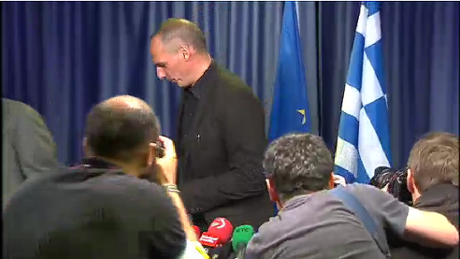
Finally, Varoufakis confirms that he spoke with the head of the European Central Bank, Mario Draghi, but gives no more details.
You have to hand it to @yanisvaroufakis. Still has the calm aura of a university lecturer even as Greece is on brink of bankruptcy/euro exit
— Ed Conway (@EdConwaySky) June 27, 2015
Varoufakis says that the eurogroup made a ‘comprehensive’ proposals two days ago, and that’s what we will put to the Greek people.
And we are leaving the door open for that proposal to be improved -- no ambiguity there.
We were asked whether to say yes, or no, and as democrats we are asking the people what we should.
And on the issue of Grexit, Varoufakis insists::
Anyone who says that this referendum is about the euro is putting a very shaky interpretation on a clear fact - there are no provisions for exit from the monetary union.
More Varoufakis: Greece was "not invited" to second part of Eurogroup meetring tonight #Greece
— Derek Gatopoulos (@dgatopoulos) June 27, 2015
Greece’s finance minister denies that the July 5 referendum would eb about eurozone membership:
- VAROUFAKIS -THERE ARE NO PROVISIONS FOR A COUNTRY TO LEAVE EURO
- VAROUFAKIS -REFERENDUM IS NOT ABOUT EURO
Varoufakis: We don't have mandate to reject the deal. We still have day-night-day for better agreement # Greece pic.twitter.com/T65o4CNlb9
— Derek Gatopoulos (@dgatopoulos) June 27, 2015
Varoufakis claims that a deal can still be reached by Tuesday -- adding that the Greek government could even support it if creditors offered better terms.
The Greek finance minister says he would abide by the will of the people in next Sunday’s vote:
Varoufakis: ,,If the Greek people say yes, we will sign the agreement."
— Jaap Jansen (@JaapJansen) June 27, 2015
Varoufakis: We couldn't accept creditors' proposals
Yanis Varoufakis is now giving a press conference in Brussels. He is telling reporters that Greece couldn’t accept the recessionary consequences of the proposals from its lenders.
Nor did we have the mandate to reject them - only the Greek people could decide.
And he criticises Greece’s creditors for trying to drag Greece back to its old bailout terms rather than allowing it to breath and return to growth.
He claims that there is still time to improve the proposals - and that Greece would work ‘night and day’ to achieve this.
And Varoufakis ends by attacking his fellow finance ministers:
The refusal of the eurogroup today to endorse our request for an extension of this agreement for a few days, a couple of weeks, to allow the Greek people to vote on their proposals - even when there is a very high probability that Greeks will go against our recommendation and vote yes - will certainly damage the credibility of the eurogroup as a democratic union of partner member state.
I’m very much afraid that damage will be permanent.
Reuters has snapped the key points:
- GREEK FINMIN VAROUFAKIS SAYS I EXPLAINED TO EURO ZONE COLLEAGUES WHY WE COULD NOT ACCEPT PROPOSALS
- GREEK FINMIN VAROUFAKIS SAYS BAILOUT TERMS WERE RECESSIONARY, FINANCING TERMS DID NOT ADD UP, NO ELEMENTS TO SUGGEST PLAN COULD END CRISIS
- GREEK FINMIN VAROUFAKIS SAYS I EXPLAINED WE DID NOT HAVE MANDATE TO SIGN UP TO NON-VIABLE PROPOSALS, BUT NO MANDATE TO REJECT THE PROPOSALS WITHOUT CONSULTING THE PEOPLE
- GREEK FINMIN VAROUFAKIS SAYS WE ARE ABSOLUTELY DETERMINED TO FIND SOLUTION
- GREEK FINMIN VAROUFAKIS SAYS GREEK PEOPLE WILL BE ASKED WHETHER THEY ACCEPT PROPOSALS, THERE IS ROOM TO CONTINUE NEGOTIATING NIGHT AND DAY TO IMPROVE LENDERS’ PROPOSALS
- VAROUFAKIS - REFUSAL OF EUROGROUP TO ENDORSE REQUEST TO EXTEND BAILOUT FOR FEW WEEKS WILL DAMAGE EUROGROUP CREDIBILITY, DAMAGE MAY BE PERMANENT
A final question about the consequences if the Greek people were to vote Yes vote in the referendum (ie, to accept the creditors offer)
Dijsselbloem: Much to our regret, the Greek authorities have rejected what was on the table even though it wasn’t finished.
In the meantime there are already major risks for the Greek government handle.
And if they vote yes, the question is ‘who are we working with to implement the programme?”
Will Greece be in the room when you reconvene in a few minutes?
And did you discuss the implications of Greece defaulting on its 6.7bn euro payment to the ECB on July 20?
Dijsselbloem declines to speculate, but confirms that Greece won’t be in the room when the other ministers discuss what steps to protect themselves.
Steps that eurozone needs to take to protect itself, talks without Greece, @J_Dijsselbloem
— Bruno Waterfield (@BrunoBrussels) June 27, 2015
Updated
The Greek government must meet its obligations to its creditors, says Dijsselbloem. That responsibility doesn’t go away.
Can emergency liquidity still be provided to the Greek banks once the programme has expired?
Only the ECB governing council can answer that question, says Dijsselbloem.
If the programme expires on 30 June, what are the Greek people going to vote on?
You should ask the Greek government, says Dijsselbloem. I cannot answer it.
Is there anything the Greek people can do to stay in the eurozone?
Right now, a referendum on this problem, with a ‘negative advice’ is in the Athens parliament, Dijsselbloem replies.
Greek MPs need to understand that the package wasn’t completed - there is no comprehensive package from the eurogroup - and need to understand the risks that are ahead in the coming weeks.
I regret those risks, but they are there.
The Greek parliament needs to consider where we are in the process, if they’ve been properly informed about the programme, and what is ahead.
Only then can they take a ‘wise decision’.
There are no easy programmes - if the Greek government can’t take that message to their people they have a credibility problem, Dijsselbloem concludes.
It is not clear how the Greek government will survive without funding, Dijsselbloem adds.
Historic moment here in Brussels. The 19 member eurogroup has now effectively become 18 members, w/o Greece pic.twitter.com/XpZBMXIvXT
— Ed Conway (@EdConwaySky) June 27, 2015
Onto questions:
What would a yes vote mean?
Many ministers asked our Greek colleague that, Dijsselbloem replies. And he said that if the people voted yes, then he and the government would immediately implement it.
But there is a “great” problem of credibility. We have found that such programmes only work if the government supports the measure being implemented.
Updated
Dijsselbloem: Greek program will expire on Tuesday night
Dijsselbloem says that talks were still continuing between Greece and the creditors last night, when the Greek delegation suddenly had to leave the room.
The other 18 members of the eurogroup regret the fact that Greece has rejected these last proposals from the institutions, he continues.
The proposals on the table had already offered the “maximum” flexibility possible, he continues.
But the proposals weren’t concluded, they weren’t finished, but yet the Greek government has rejected them and put them to the Greek people.
Given that situation, however regrettable, the Greek programme will expire on Tuesday night.
Press conference underway
And we’re off.
Dijsselbloem says that a statement is being issued shortly, from 18 ministers. Not supported by Greece.
We will immediately have a second meeting after this press conference, to discuss consequences and to prepare for whatever is needed to preserve the stability of the eurozone.
Jeroen Dijsselbloem, president of the Eurogroup, has been spotted heading to the press room, and he doesn’t look very happy:
D-boom on his way
— Danny Kemp (@dannyctkemp) June 27, 2015
Face like thunder
— Danny Kemp (@dannyctkemp) June 27, 2015
The press room is starting to fill up.... reminder, there’s a live stream here.
Serious levels of confusion in Brussels right now -- sounds like all 19 finance ministers are back in the room, but the Greek side might yet depart early.
I've been told that the #Eurogroup has resumed WITH @yanisvaroufakis, but he may leave it later on. No press conf yet #Greece #Greferendum
— María Tejero Martín (@Maria_Tejero) June 27, 2015
And apparently there might be a press conference with Jeroen Dijsselbloem soon after all.
Reuters reporting that Eurogroup ministers are planning to meet without Greece shortly.
- 27-Jun-2015 16:10:53 - EUROGROUP MEETING WITH GREECE RESUMES, WILL BREAK AGAIN BEFORE MEETING OF 18 FINMINS WITHOUT GREECE -EURO ZONE OFFICIALS
Updated
There’s confusion in Brussels as to whether we’re going to get a press conference now, or now.
Dijsselblscreens presser was announced on screens, now cancelled and press room empties. Madness
— Danny Kemp (@dannyctkemp) June 27, 2015
Eurogroup meeting to continue 'without Greece'
Brussels reporters have heard that Greece’s delegation is leaving today’s Eurogroup meeting, following the rejection of its request for an extension:
I'm being told #Eurogroup break will be a short one with 18 reconvening without #Greece delegation after.
— Peter Spiegel (@SpiegelPeter) June 27, 2015
Confirmed info. #Eurogroup will continue without @yanisvaroufakis
— Eleni Varvitsiotis (@Elbarbie) June 27, 2015
Updated
AFP says Greece’s request for an extension has been turned down:
Eurozone ministers have rejected Greece bailout extension, sources tell @AFP
— Danny Kemp (@dannyctkemp) June 27, 2015
Stefan Leifert of ZDF, the German TV station, reports that Yanis Varoufakis is speaking to the European Central Bank team during this pause in negotiations, while Germany’s Wolfgang Schäuble is with the IMF’s Christine Lagarde.
Eurogruppe unterbrochen. Varoufakis redet mit EZB. Schäuble mit Lagarde.
— Stefan Leifert (@StefanLeifert) June 27, 2015
Wait wait wait!! #Eurogroup is taking a break, press conferences -Dijsselbloem, Varoufakis- to start soon, say diplomats sources #Greece
— María Tejero Martín (@Maria_Tejero) June 27, 2015
EbS, the Brussels TV channel, has just started transmitting from the press conference room. It’s virtually empty right now, but that might mean something is about to happen.
The latest word from Brussels is that Greece will not be granted the one-month extension which it is seeking:
greek govt wants no vote. but wants 1-month unconditional bailout extension in case it loses. no wonder they say bizarre via @Elbarbie
— Ian Traynor (@traynorbrussels) June 27, 2015
german govt sources say clear eurogroup consensus on no bailout extension via @StefanLeifert
— Ian Traynor (@traynorbrussels) June 27, 2015
And that would mean that the current bailout would expire on Tuesday, 30 June.
Eurogroup is presently discussing the greek referendum. "But we will soon start discussing Plan B", we hear from inside the Eurogroup.
— Stefan Leifert (@StefanLeifert) June 27, 2015
Updated
Great pic by @Brussels_PJ @yanisvaroufakis arrives at eurogroup pic.twitter.com/ysEr1mEq3l
— Bruno Waterfield (@BrunoBrussels) June 27, 2015
A reminder that you can watch the Greek debate here.
If you tune in now, you can see Andreas Loverdos of the left-wing Pasok party heavily criticising the decision to hold a referendum:
loverdos accuses tsipras is trying to hide behind the citizens.
— Diane Shugart (@dianalizia) June 27, 2015
loverdos: to keep his party together, the PM is dividing the country. we say yes to europe, yes to euro, no to this govt.
— Diane Shugart (@dianalizia) June 27, 2015
AFP reporter Roland Jackson has tweeted a picture of one Athens cash machine that ran dry, although he quickly found another that was working:
No money left at this Greek ATM in #athens #greece ... But the next one along worked fine... #greferendum pic.twitter.com/6clj2bPMFV
— Roland Jackson (@rolandfj) June 27, 2015
Here’s a similar tale from the Greek capital:
4 of the 5 ATMs I tried would give no money. There's been a bankrun; Monday will be fun for banks, if they open. #Greece #referendum
— Finisterre67 (@Finisterre67) June 27, 2015
The machine in the Athens parliament still appears to be running, though:
No good sign: a queue even at the ATM inside the Athens parliament. #Greece pic.twitter.com/ObZUVDiRxZ
— Zacharias Zacharakis (@zacys) June 27, 2015
Tensions on the streets of Athens
Saturday seemed business as usual in central Athens, my colleague Jon Henley writes.
Shoppers are out in force, and a steady stream of people taking cash out of many ATMs but – except for National Bank branches, where pensions deposited last night were being withdrawn today – nothing you could reasonably call a long queue.
Customers were, though, understandably starting to get a bit fed up with all the attention. At a Eurobank branch ATM on Syntagma Square there was a furious row between two photographers and four or five people waiting to take out money.
“I wasn’t taking out my savings, actually: I still think this will work out okay eventually,” said Iannis Kairis, a web developer.
“But if I was, I wouldn’t want my photograph taken. It’s normal.”
Shoppers on nearby Ermou, one of central Athens’ main shopping streets, seemed mostly relaxed – if unsure about what next week might hold. “I don’t have any money in the bank – I didn’t have much to start with, but there’s none there now,” said Dimitra, a primary school teacher, who asked not to be fully named. “But I think we’ll vote to stay in the euro. Both sides have been playing games.”
Haris Sakelios, who is unemployed, said he was “quite sure” Greeks would vote No in next Sunday’s referendum – but that did not necessarily mean Greece would end up leaving the euro.
“People are tired,” he said, adding:
“It’s enough now. So they will vote No. But I think if (prime minister Alexis) Tsipras goes back to the table in Brussels with a referendum result, it will show them he is not alone. He will be stronger.”
Spyros Vasilakis, a university teacher, was less confident. “I have no idea what will happen next week,” he said.
“The banks may close. The institutions may withdraw their proposal, in which case what would we technically be voting on? It’s a confused picture right now.”
Despina Moragianis, who had been out to a shopping mall in the northern suburbs, said the queues at the banks there were:
“Long. I’ve not seen them like that for quite a while. And there were lines at a couple of petrol stations. I think people are concerned, whatever they say.”
This courtesy of @peristeraRa. pic.twitter.com/t9sOUoepkx
— John Hooper (@john_hooper) June 27, 2015
Summary: Eurozone ministers debating Greek bailout now

Time for a recap:
Eurozone finance ministers are debating their next move after Greece took the shock decision to announce a referendum on its bailout programme.
Arriving in Brussels, the Eurogroup president, Jeroen Dijsselbloem, told reporters he was saddened by the move, following weeks of negotiations, and just five days before the bailout ends.
Dijsselbloem suggested that the Eurogroup may have reached the end of the line with Greece, saying:
I am very negatively surprised by today’s decision by the Greek government
They have apparently rejected the final proposals from the institutions.
Germany’s Wolfgang Schauble also said Greece had ended talks. And several other ministers suggested it could be time for Europe to consider Plan B, ie, how to handle a Greek default, and potential exit from the single currency.
The IMF’s Christine Lagarde, though, said work would continue with Greece.
Yanis Varoufakis, Greece’s finance minister, is expected to ask the Eurogroup for a small extension to allow the referendum to be held.
In Greece there have been long queues at some cash machines in Athens as people react to Alexisis Tsipras’s shock announcement late last night. At least one bank unexpectedly didn’t open, apparently due to security concerns, leaving a group of people waiting outside.

But activity at cash machines in other areas has reportedly been calm, and a top bank official has insisted that machines are being replenished as needed.

Greek MPs will vote late tonight (midnight Athens time) on whether to hold the referendum.
Opening today’s debate, the interior minister, Nikos Voutsis, urged all parties to back the plan.
But some opposition parties are refusing. New Democracy, the rightwing party which lost power in January, has urged the Greek people to vote yes if the referendum is held:
voridis: it is clear what the greek people will say: yes to europe and no to the government.
— Diane Shugart (@dianalizia) June 27, 2015
voridis ends with a rhetorical flourish about the patriotic vote being yes to europe
— Diane Shugart (@dianalizia) June 27, 2015
And the centrist To Potami opposition party also criticised the plan:
lykoudis: government is asking the people to pull the trigger on their suicide
— Diane Shugart (@dianalizia) June 27, 2015
Updated
A couple more photos from inside the Eurogroup meeting on Greece:


Updated
The FT’s Peter Spiegel has got hold of the latest offer made by Greece’s creditors, and explains how there’s really no new money on offer:
On Friday, there was a bit of buzz that creditors had tabled a new €15.3bn offer to Greece to extend the current bailout through the end of November. But in reality, there was nothing new to it at all.
It is essentially all the money left in the bailout, which was presented to Athens in a more fully articulated two-page memo.
And here’s the full memo (somewhat crumpled since entering Peter’s tender clutches)
Remember that "new" €15.3bn offer to #Greece from Friday? Here's why it wasn't new. Leaked memo posted, too: http://t.co/N3zKGuv8DD
— Peter Spiegel (@SpiegelPeter) June 27, 2015
Updated
Here are a a few photos from inside today’s Eurogroup meeting, before it began:


Updated
While I was watching the Eurogroup in Brussels, Greece’s prime minister was getting a standing ovation from his MPs as he arrived for today’s referendum debate:


Updated
Newsflash: Yanis Varoufakis has told Reuters that he will ask fellow finance ministers for a bailout extension of “a few weeks” to accommodate the referendum.
Here what they just snapped:
- GREEK FINANCE MINISTER VAROUFAKIS TELLS REUTERS HE WILL ASK EUROGROUP FOR BAILOUT EXTENSION OF FEW WEEKS TO ACCOMMODATE REFERENDUM
- GREECE’S VAROUFAKIS SAYS GOVT COMMITTED TO IMPLEMENTING OUTCOME OF REFERENDUM AND REACHING QUICK DEAL WITH CREDITORS IN THE SPIRIT OF VOTE RESULT
- GREECE’S VAROUFAKIS SAYS JUNE 30 IMF PAYMENT DEPENDS ON FLEXIBILITY OF CREDITORS
- GREECE’S VAROUFAKIS SAYS WANTS EU TO RETURN 1.9 BLN EUROS OF PROFITS ON ECB HOLDINGS OF GREEK GOVT BONDS TO PAY IMF ON TUESDAY
- GREECE’S VAROUFAKIS SAYS BANKS MUST STAY OPEN DURING BAILOUT TRANSITION PERIOD, CENTRAL BANK ROLE IS TO ENSURE THIS
Analysts at Barclays have warned that the referendum plunges Greece into fresh turmoil, whether the result is Yes or No.
Here’s a flavour of a note they sent to clients this morning:
What happens if Greece votes no?
Government officials are currently emphasizing that this is simply a vote on the negotiations and not on the Greek position within the EMU [eurozone] and EU.
In reality, the two questions are related. We believe that the odds of a Greek exit increase substantially if Greece votes no. And if capital controls have not been imposed by then, they would almost certainly be after 5 July.
What happens if Greece votes yes?
Every indication is that the existing Greek government is opposed to the creditors’ current terms.
Consequently, it is very possible that in the event of a yes vote, Greece would face a political crisis, with a new government having to be formed in order to finalize the negotiations and implement the agreed-upon reforms.
Yanis Varoufakis’s press officer has hit back at Peter Kazimir’s claim that the Greek finance minister lectures the rest of the eurogroup:
"Lecturing" is a common excuse for shrugging off well-supported arguments that participants are unable to refute. @RaoulRuparel @OpenEurope
— Dimitris Yannopoulos (@DimitrisY) June 27, 2015
Eurozone finance ministers have begun debating the Greek situation.
The #Eurogroup begins.
— Alexander Stubb (@alexstubb) June 27, 2015
Slovakia’s finance minister, Peter Kažimír, looks like a man who’d rather be anywhere else than the Eurogroup (his fifth in under two weeks).
The Greek government was elected to make decisions, so they should make them, says Kažimír.
Greece can hold a referendum on anything it wants, but if they reject the package on the table, then the programme is over.
Asked what he expects from Yanis Varoufakis, he replies “the same, the lecturing”, before going into the eurogroup.
Ireland’s Michael Noonan says he is “disappointed” that Greece appears to have unilaterally ended negotiations.
He had hoped that finance ministers would have closed the gaps between the two competing proposals at today’s meeting.
I don’t know what happens next week, it’s impossible to speculate. We’re entering totally uncharted waters, Noonan adds.
Schauble: Greece appear to have ended talks
Germany’s finance minister, Wolfgang Schäuble, arrives, and tells a scrum of reporters that there appears to be no basis for further talks with Greece :
- GERMAN FINMIN SAYS GREECE HAS DECIDED TO END NEGOTIATIONS
- GERMAN FINMIN SAYS NO BASIS FOR FURTHER TALKS WITH GREECE
However:
- GERMAN FINMIN SAYS YOU CAN NEVER RULE OUT SURPRISES WITH GREECE
The Greeks appeared to have ended negotiations said German fin min #Schauble . #Greferendum #Eurogroup #Greece pic.twitter.com/vRkZ4yGdAp
— EfiKoutsokosta (@Efkouts) June 27, 2015
There have been some rather grim faces among the finance ministers arriving at today’s Eurogroup meeting:
Stubb (Finland) and Guindos (Spain) both used same expression: 'Plan B' is fast turning into 'Plan A'. Not looking good at all. #Greece
— Vincenzo Scarpetta (@LondonerVince) June 27, 2015
Finland: Plan B is becoming Plan A for Greece
Finland’s Alex Stubb has arrived at the Eurogroup, and told reporters that the referendum means we are “closing the door” on future negotiations.
Stubb says:
I think there is a clear majority-cum-consensus inside the eurogroup that an extension of the programme is out of the question.
I think that as an avid pro-European, yesterdays announcement of a referendum was an unpleasant surprise, and I feel quite sad about the situation, especially from the perspective of the Greek people
And speaking to a second reporter inside the building, Stubb adds that:
I would argue that Plan B is becoming Plan A.
Spain’s finance minister, Luis de Guindos, says that the decision to call a referendum has made life “more difficult for everyone”, making a successful end to this saga less likely:
Spanish fin min De Guindos said that it's the time that we are closer to a plan B than a plan A. #Eurogroup #Greece #Greferendum
— EfiKoutsokosta (@Efkouts) June 27, 2015
Moscovici: Greece must prove its own will
European commissioner Pierre Moscovici has arrived - and he insists that the game isn’t up:
The Commission has always worked on the position that Greece’s place is in the eurozone, says Moscovic:
When I look at where we are, I see that there are differences, but they are quite limited, and they are well identified.
Where there is a will there is a way, and the Greek government should prove its own will.
Could Greece get the extension it has asked for?
We will hear from the Institutions (IMF, ECB, EC) and we will speak to the Greek finance minister, Yanis Varoufakis.
The proposals on the table are favourable to the Greek government, he insists.
#Greferendum we need a chat with @yanisvaroufakis. eurogroup decisions depend on what he says - @pierremoscovici
— Ian Traynor (@traynorbrussels) June 27, 2015
Lagarde: We will continue to work
Christine Lagarde arrives, looking extremely serious.
She starts by expressing the IMF’s condolences and support to the families of the victims who have been killed in the terrorist attacks of recent days (the attacks in Tunisia, Kuwait and France).
On Greece, she says:
Together with the other institutions, we’ve always shown flexibility in order to adjust to the new economic and political situation in Greece.
The porpose of what we’re doing is to restore the stability of the economy in Greece, and restore its financial independence, as in Portugal and Ireland.
And that is what we will continue to do.
That is slightly more positive than Dijsselbloem’s statement, that the door is closed:
#Greferendum lagarde's stress on 'continuing to work' contrasts with dijsselbloem's 'doors closed'
— Ian Traynor (@traynorbrussels) June 27, 2015
Lagarde then spells out the IMF’s position:
Greece must implement “deep” structural reforms and growth-friendly fiscal consolidation...
And its partners must provide financial support and ‘debt operation’.
Upon arrival at #eurogroup, @Lagarde once again raises need for "debt operation" on the part of Europeans. She means debt relief #Greece
— Peter Spiegel (@SpiegelPeter) June 27, 2015
#IMF #Lagarde doesn't say a word about possible extension of #Greece program #Greferendum #Eurogroup pic.twitter.com/BfBfcRUs3P
— Dirk Hoeren (@DirkHoeren) June 27, 2015
Updated
#Greferendum eurogroup finmins sound genuinely surprised. @atsipras has pulled a fast one
— Ian Traynor (@traynorbrussels) June 27, 2015
Malta’s finance minister, Edward Scicluna, tells reporters that the referendum has come as a nasty shock to the eurogroup:
Democratic government have the right to call a referendum, he points out, but:
It’s the timing that is very unfortunate, and that is an understatement.
The referendum should have been called months ago, Scicluna argues, once it became clear that the Greek government’s mandate meant it couldn’t accept the proposals on the table.
Goodnight, thanks for playing: Eurogroup chief @J_Dijsselbloem says 'sad' Greek referendum decision 'closes door to further talks'
— Danny Kemp (@dannyctkemp) June 27, 2015
Dijsselbloem: It's a sad day for Greece
Jeroen Dijsselbloem, head of the eurogroup, has just arrived in Brussels.
He tells reporters that:
I am very negatively surprised by today’s decision by the Greek government
They have apparently rejected the final proposals from the Institutions.
Dijsselbloem is also unimpressed that the Greek government is recommending rejecting the proposal:
That is a sad decision for Greece, for it has closed the door on future talks.
Greece’s finance minister, Yanis Varoufakis, has arrived at the meeting. He smiles at the cameras, but doesn’t speak to the assembled press.
Big grin but no comment from @yanisvaroufakis as he enters #Eurogroup
— Danny Kemp (@dannyctkemp) June 27, 2015
Belgium's finance minister: We must decide on issues today
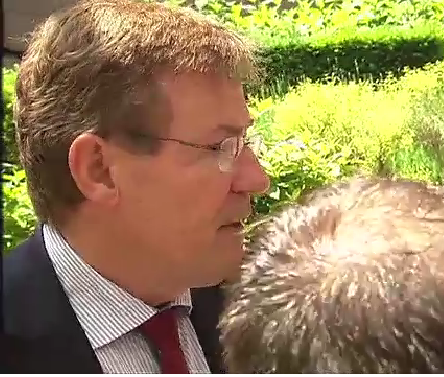
Belgium’s finance minister, Johan Van Overtveldt, has arrived at the eurogroup meeting in Brussels, and warned that time is running out.
Obviously June 30 is coming to us very quickly now, he says, calling the referendum a ‘bizarre move’.
Are we going to see capital controls in Greece?
The Eurogroup meeting starts at 2pm. We’ll look at the evidence, and depending on the conclusions, we will take appropriate action, says Van Overtveldt.
We can no longer prolong whever action we need to take. We will have to decide on issues today.
Finance ministers from centre-right countries are meeting first to discuss Greece, before arriving at the full eurogroup meeting.
That’s via Finland’s Alex Stubb:
In Brussels. Beginning with @epp Finance Ministers. Then #Eurogroup. #Greferendum
— Alexander Stubb (@alexstubb) June 27, 2015
Latest word from Brussels is that eurozone ministers are unlikely to offer Greece an extension at today’s eurogroup:
- AN EXTENSION OF THE PROGRAMME FOR GREECE AT EUROGROUP ON SAT IS UNLIKELY AS SEVERAL COUNTIRES OPPOSE IT - EURO ZONE OFFICIAL
Open Europe: Capital controls are now likely
Open Europe’s analyst Raoul Ruparel fears that there are few positive outcomes for Greece now.
As he points out, there is no guarantee that the creditors’ offer of a bailout extension will still be on offer when the referendum takes place (it may not even survive today’s eurogroup meeting)
He writes:
No matter what, capital controls and bank holidays will likely be needed in the short term (and possibly longer) in Greece. Even if the referendum gives a positive outcome, this may still provoke uncertainty.
It is not clear whether the deal to be voted on is actually still on the table. Furthermore, Tsipras has set himself up to reject the proposal, so it might be hard to avoid new elections if the people back the creditors. If there is a No vote, this is likely to be seen as a vote for Grexit, since any offer on the table from creditors will be a take it or leave it one.
There remains a small chance that the referendum may not come to pass, if a new deal is offered or the bill is not approved by the Greek Parliament or President.
However, given Tsipras’ insistence on the referendum, it would again be hard from him to survive such an event.
It’s well worth reading the full piece:
What will shock Greek referendum mean for the Eurozone and Greece?
The government, though, is insisting that a referendum can be held on Greece’s bailout programme, given its importance:
SYRIZA spokesman Fylis says referendum question being posed as "crucial national issue," which is permitted by constitution #Greece #euro
— Nick Malkoutzis (@NickMalkoutzis) June 27, 2015
fylis: none of venizelos's arguments stand. ultimatum is a text of broader significance that determines future of our kids and our society
— Diane Shugart (@dianalizia) June 27, 2015
Updated
It’s going to be a long debate....
syriza's fylis rebutted venizelos's arguments about referendum's constitutionality: his speech confused viewership w/substance
— Diane Shugart (@dianalizia) June 27, 2015
Venizelos is insisting that the terms of Greece’s bailout simply isn’t an issue of national security, so it can’t be the subject of a referendum....
MP Venizelos challenges the constitutionality of the referendum on the basis that fiscal issues no threat to national security of country
— tsimitakis (@tsimitakis) June 27, 2015
Amid occasional barracking and constant low-level grumbling, Evangelos Venizelos is insisting that the Greek constitution prohibits referendum on fiscal issues.
Votes on national issues are allowed, but they mean foreign policy not financial matters, he tells MPs.
Back in the Athens parliament, things are getting heated. Former deputy PM Evangelos Venizelos is on his feet, questioning whether a referendum is constitutional.
He’s reminding MPs that Alexis Tsipras was highly critical of ex PM George Papandreou’s (failed) attempt to hold a referendum in 2011, calling it a “trick” to keep himself in power.
@graemewearden A transcript of @atsipras's scathing criticism of the 2011 proposed referendum, with compliments. pic.twitter.com/TIqQ10ZAdp
— Finisterre67 (@Finisterre67) June 27, 2015
Over in Brussels, eurozone finance ministers are starting to arrive for today’s extraordinary meeting on Greece.
French Finance Minister Sapin has arrived at Eurogroup meeting. No doorstep declaration. #Greece
— Open Europe (@OpenEurope) June 27, 2015
Our Southern Europe editor, John Hooper, reports a queue at a cash machine in Syntagma Square (the site of the parliament)
Queuing round the corner for ATM in Syntagma Square pic.twitter.com/4vyVEMVAXr
— John Hooper (@john_hooper) June 27, 2015
Updated
I can't speak for other areas but in Kallithea it's business as usual - except for the sound of Parliament TV out of every window. #Greece
— Theodora Oikonomides (@IrateGreek) June 27, 2015
The head of the Greek Bank Association, Louka Katseli, has assured the Athens News Agency that cash machines are being “replenished smoothly.”
Katseli, who also chairs the National Bank of Greece added that any “isolated problems” due to an increase in outflows is being dealt with “as soon as possible” by the Central Bank of Greece.
(via Reuters).
Updated
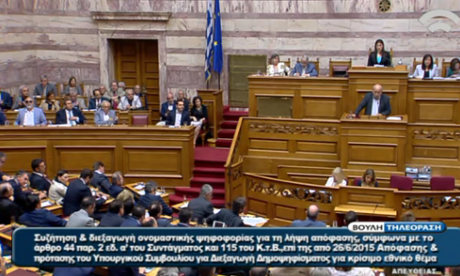
Syriza MPs have been applauding warmly at several points, including as Voutsis concludes his speech.
voutsis concludes with fact that the referendum will be groundshaking and lead to an "honest agreement" afterwards.
— Diane Shugart (@dianalizia) June 27, 2015
Updated
voutsis: it's not game over for our country or its people or its government or this parliament.
— Diane Shugart (@dianalizia) June 27, 2015
Nicos Voutsis is telling MPs that the referendum can help end austerity in Greece:
Twitter user Diane Shugart is tweeting the key points:
voutsis says the multiple blackmail directed at greece cannot go unanswered
— Diane Shugart (@dianalizia) June 27, 2015
voutsis: the millions of our compatriots who have been pushed to or below the poverty line will participate on equal basis
— Diane Shugart (@dianalizia) June 27, 2015
voutsis: we all have responsibility for the fact that their voices not being heard but we are taking the initiative today to restore the >>
— Diane Shugart (@dianalizia) June 27, 2015
voutsis: we're not willing to accept that there is only a one-way street, the one-way street of austerity
— Diane Shugart (@dianalizia) June 27, 2015
Greek referendum debate begins
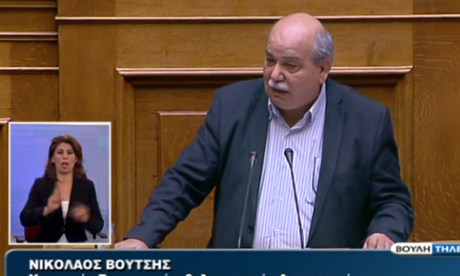
Greece’s interior minister, Nikos Voutsis, has opened the debate. He criticises the country’s lenders, and calls on all parties to vote in favour of holding a referendum:
A unanimous decision would give us a stronger negotiating position, he argues, confirming that Syriza will vote “No”.
Minister Voutsis slamming the "undemocratic logic" in the negotiations with the institutions. #Greferendum #dimopsifisma
— The Greek Analyst (@GreekAnalyst) June 27, 2015
Minister Voutsis: "As obvious by yday's speech by the PM, the GR govt is not neutral; we ask to vote against the proposal." #Greferendum
— The Greek Analyst (@GreekAnalyst) June 27, 2015
A senior member of Angela Merkel’s CDU party says there is no chance of the Bundestag approving a short-term extension to the Greek bailout:
Gunther Krichbaum added that the Greek PM has “pulled the plug”:
- MERKEL ALLY KRICHBAUM SAYS DOESN’T SEE MAJORITY IN CONSERVATIVE PARTY FOR GREEK EXTENSION THROUGH JULY 5TH
- KRICHBAUM SAYS TSIPRAS ‘HAS PULLED THE PLUG’ HIMSELF WITH REFERENDUM CALL, MEANS NO VOTE IN GERMAN PARLIAMENT BY TUESDAY ON GREEK AID
The debate in the Greek parliament has begun, around 90 minutes later than billed:
parliament approves process, with debate ending with midnight vote.
— Diane Shugart (@dianalizia) June 27, 2015
Here's how Greek political parties have reacted:

It is not only on the streets that tensions are on the rise, reports our correspondent Helena Smith.
In parliament, where party leaders have rushed to convene emergency meetings, the rhetoric is also becoming ever more shrill.
Addressing her MPs, the newly elected leader of the left-wing Pasok party, Fofi Gennimatas, said it was important the referendum did not take place .
She said:
“They are gambling with the country. The real question is ‘yes or no’ to Europe.”
Greece’s defense minister Panos Kammenos, who heads the government’s junior partner, the right-wing nationalist Independent Greeks party, has been busy talking to reporters this morning and has heartedly denied that Greeks have been posed with the dilemma of having to choose between the euro or drachma.
“We tried to compromise with lenders, this is about national dignity, about ending an era of humiliation of Greeks,” he said as he made his way through a crush of reporters outside parliament.
Minister of state Alekos Flambouraris, widely seen as prime minister Alexis Tsipras’ mentor, rejected suggestions that Greeks were now being forced to make a choice about their future in the single currency. ‘That is propaganda,” he said. “This is part of the negotiating [process].”
The far right Golden Dawn leader Nikos Michaloliakos has also waded in saying his party will call on Greeks to reject creditors’ proposals when the referendum is held next Sunday. “We’ll call on Greeks to say no to the profiteers and all those who for five years have wanted to humiliate our homeland,” he railed in typically combattive mood outside the 300-member House.
MPs representing the conservative New Democracy party, meanwhile, have been busy lambasting the government for calling the referendum but predicted that Greeks would say ‘a big yes’ to Europe and the euro.
Delaying the referendum vote means Greek MPs should know the result of today’s meeting of eurozone finance ministers on Greece (unless that also runs on until midnight!)
We’re now hearing that the vote on whether to hold a referendum has been pushed back to midnight Athens time, from 7pm.
#Greece parliament vote on referendum to be held at midnight. It will be a very long day.
— Yannis Koutsomitis (@YanniKouts) June 27, 2015
Freelance journalist Nick Barnets reports that it’s business as usual in his area of central Athens:
So far in central #Athens between Exarchia and Syntagma, I have seen almost nobody using an ATM. Typical Saturday afternoon here. #Greece
— Nick Barnets (@NickBarnets) June 27, 2015
That backs up what Helena reported earlier - there are queues in some parts of town, but it’s not a panic.
Reuters has been told that ‘security issues’ were the reason one Greek bank didn’t open as usual this morning (causing that queue flagged up earlier):
By mid-morning, there were dozens queuing outside a branch of Piraeus Bank in central Athens, although that is not unusual as many Greeks who don’t use cash cards come to banks on Saturdays. The bank was still closed nearly an hour after it was meant to open at 0730 GMT.
A senior executive at Piraeus said it intended to open the branch but was considering security issues because of the queues.
Many banks in Greece are usually closed on Saturdays but some lenders keep open one or two branches for a few hours.
And one central bank official told Reuters that:
“The Bank of Greece is making a huge effort to keep ATMs fed with cash,”

The FT’s Peter Spiegel has heard that eurozone finance ministers are very unlikely to accept Greece’s request for a short bailout extension to accommodate the referendum, when they meet today.
Two senior #eurozone officials tell me it's highly unlikely #eurogroup will extend #Greece bailout beyond Tues.
— Peter Spiegel (@SpiegelPeter) June 27, 2015
Ministers were already expected to work on a Plan B for Greece, if their latest offer of a five-month extension was rejected, as Ian Traynor explained last night:
Greek government ministers have been making their way into parliament, where the governing Syriza party is to hold a meeting of its political secretariat:
Asked if banks were at risk, the interior minister Nikos Vroutsis told reporters minutes ago:
“I am very optimistic and optimistic about banks.”
Dimitris Stratoulis, the deputy social security minister, said the referendum would arm the leftist-led government with renewed determination to forge ahead with its programme.
“Why should [the result of the vote] have negative consequences?” he asked.
“I am optimistic, optimistic that Greeks will say a resounding ‘no’ to their [creditors’] brazen demands.”
Smiles all round among Syriza officials in parliament. They are a happy bunch today #greece #Greferendum
— Stelios Bouras (@SteliosBouras1) June 27, 2015
Updated
Some Athens banks still quiet
Over in Athens, our correspondent Helena Smith says queues now forming outside banks are noticeably longer in the less affluent areas of the capital.
In the suburbs of Athens, especially in areas worst hit by the biting effects of austery, queues are much longer than they are down town.
In the plush area of Kolonaki, it is coffee shops that are drawing people, not banks, according to my colleague John Hooper who happens to be just there.
In the historic district of Plaka, home to some of the wealthiest Greeks, too, and from where I now write these lines (from my humble office), there are -- with the exception of tourists attempting to withdraw cash -- almost no lines outside banks.
Updated
My colleague Jon Henley is tweeting from the Greek capital:
Tensions that little bit higher in Athens today - furious row between press photographers and ppl queuing to take cash out #Greece
— jon henley (@jonhenley) June 27, 2015
Euro zone finance ministers are still planning to hold their emergency meeting on Greece today, despite the referendum, one EU official has told Reuters.
The meeting is due to start at 2pm Brussels time (1pm UK, 3pm Athens)
Greece will ask the Eurogroup to extend their bailout programme by a few days, beyond 30 June, to accommodate the referendum.
But there is no guarantee that this will be granted. And if Greece is no longer in a bailout programme, it is harder for the European Central Bank to keep providing emergency funds.
EU official: "Cannot see how bailout extension can possibly be accommodated by eurogroup". #Greece talks today more likely to be on "plan B"
— Ed Conway (@EdConwaySky) June 27, 2015
Enormous sense of betrayal in Brussels. First that there was no pre-warning of referendum. 2nd that Tsipras has already chosen his answer
— Ed Conway (@EdConwaySky) June 27, 2015
More from Sky’s reporting team in Athens:
We have seen an ATM run out of money and the queue move down to next bank. Radio stns broadcasting which ATMs still have cash.
— Robert Nisbet (@RobNisbetSky) June 27, 2015

And here’s another queue outside a Greek bank in the capital, via Associated Press (who say it didn’t actually open in the end)


From Athens, Sky News’s Rob Nisbet reports a long queue at one ATM machine:
At least 40 people queueing at this ATM in Kallithea pic.twitter.com/1KDPHBcRFd
— Robert Nisbet (@RobNisbetSky) June 27, 2015
“We would consider the recent turn of events as a particularly negative market outcome”.
That’s the snap verdict from Deutsche Bank, who say the question of Greece’s membership of the euro is now “officially opened”.
Here’s the key points from a new research note issued by DB this morning:
First, the European political response.
A Euro leaders summit may be called at short notice. Similarly to the Papandreou referendum proposal in 2012, we expect that Europeans will make it clear that the government’s referendum will be equivalent to a question on euro membership. The Europeans will also need to decide on whether to grant a short-term legal extension to the loan agreement. Though we are still waiting for the European reaction, we consider a more likely outcome that the program is allowed to expire: extension requires multiple parliamentary approval processes, and given the tone of the Greek PM’s speech it is unlikely that the political appetite exists to grant such an extension. The IMF response will also be important: when and if Lagarde notifies the IMF board of a non-payment event, this will trigger cross-default on Greece’s EFSF loans and the EFSF board of directors (the finance ministers) will have the option, but not the obligation, to call these loans immediately due and payable.
Second, the ECB response.
The central bank has been holding daily reviews of Greek bank ELA provision this week, and officials have in multiple statements last week made it clear that ongoing liquidity provision is based on a “credible perspective” of an agreement being reached. Decisions are likely to be taken in conjunction with the European political response and program extension this weekend. The situation remains very fluid, but as things stand we consider the most likely outcome being an ECB decision not to raise ELA funding beyond existing levels as of this past Friday, or alternatively an aggressive adjustment in collateral haircuts resulting in an implicit cap at some point next week. The Greek deputy PM has said he will seek a meeting with ECB’s Draghi on Saturday.
The third factor to watch will be public opinion polls on the referendum question.
So far, these have shown that support for euro membership when an “unconditional” (“simple”) question is asked stands at around 70%. However, when this question is made conditional on more austerity, support drops to 55--65% depending on how the question is phrased. We expect the Greek PM’s position and the phrasing of the question itself to likely lead to additional swing towards a “no” vote. This is particularly so as Greek government officials have stated that the referendum will not be on euro membership, but rather the agreement. The extent to which European pressure and the situation of the banking system next week swings the vote the other way remains an open question. Overall, we expect the outcome to be very close and uncertain. The closer opinion polls are to a “no” vote, the greater probability is the market likely to price to a Greek Eurozone exit.
Greece will be given a straight choice whether to accept, or reject, the package of measures drawn up by the IMF, ECB and EU:
SORTED refQ saga: "THOSE CITIZENS REJECTING PROPOSAL OF 3 INSTITUTIONS -- NO "THOSE CITIZENS SUPPORTING PROPOSAL OF 3 INSTITUTIONS -- YES
— Anthee Carassava (@antheecarassava) June 27, 2015
Here is Referendum question (h/t @antheecarassava) Do citizens reject the proposal of the three institutions? NAI / OXI
— Robert Nisbet (@RobNisbetSky) June 27, 2015
Updated
Greeks 'odd-on' to reject bailout terms
Ladbrokes, the betting firm, reckons that Greeks are likely to reject the proposal drawn up by its lenders:
#Greece bailout #referendum odds: 1/3 NO to deal 2/1 YES to deal http://t.co/4CWIfTXJ2p pic.twitter.com/dY7OqtsnXX
— Ladbrokes Politics (@LadPolitics) June 27, 2015
Coalition leader: Greeks shouldn't panic
The head of the junior coalition party in Greece, Panos Kammenos, has told Greeks to remain calm, as banks will remain open.
Kammenos told local TV that the decision to call a referendum shouldn’t spark alarm.
“Citizens should not be scared - there is no blackmail,”
“The banks won’t shut, the ATMs will (have cash). All this is exaggeration.”
Kammenos, who leads the populist right-wing Independent Greek party, has also suggested that the referendum could yet be cancelled if creditors blink.
Ind Greeks leader Kammenos (coalition party) says if creditors back down & accept Greek proposal "everything changes-referendum called off."
— Robert Nisbet (@RobNisbetSky) June 27, 2015
Updated
Cash machine queues in Athens

There are signs that worried Greeks are heading to the cash machines in greater numbers this morning.
Ουρές σε ΑΤΜ στο Γαλάτσι pic.twitter.com/7LvU8v6Aoi
— BankingNews.gr (@bankingnewsgr) June 27, 2015
Denis MacShane, the former Labour MP, says he’s had some trouble getting money out in Athens:
2 out of 3 ATM in Athens refused my card and could only get €100 out of Eurobank one. Old Greek ladies shoving 1, 2, 3 cards into ATMs
— Denis MacShane (@DenisMacShane) June 27, 2015
However, the situation seems calm on the Greek island of Poros:
bank run watch, poros: two people at the ATM, both weekending yachties from athens. locals haggling with fishermen over day's catch.
— Diane Shugart (@dianalizia) June 27, 2015
Introduction: Referendum debate and Eurogroup meeting
Good morning.
Europe has woken up to a new phase of uncertainty this morning after Greek Alexis Tsipras stunned the nation, and beyond, by calling a referendum on its bailout deal.
By taking the issue to the people, Tsipras has ensured that the next week or so will be absolutely critical for deciding Greece’s future in the eurozone. Starting right now.
Greek PMs will be heading to parliament shortly to vote on whether to back Tsipras’s plan for a national vote on Sunday 5th June.
The debate starts at noon local time (or 10am BST), with a vote expected seven hours later. A simple majority is all it needs to put the issue in the hands of the Greek population.
#Greece parliament plenary session at noon, #Eurogroup at 3pm (GR), vote on #Greferendum at 7pm (GR). #politics #euro
— Manos Giakoumis (@ManosGiakoumis) June 27, 2015
And while that’s happening, eurozone finance ministers will be heading to Brussels for another Eurogroup meeting.
That session was due to start at 1pm Central European time (2pm Athens, or noon BST). Ministers were expected to see Greece handed a “take-it-or-leave-it” offer, in return for a bailout extension.
Tsipras, though, has already dismissed this offer of “severe and humiliating austerity without end”, and is asking creditors for a short extension to the current bailout (which expires on Tuesday).
Will they agree, or will they press on with work on a “Plan B” for Greece, including capital controls?
Today's Eurogroup has a big decision to make: do they extend bailout to 5th July or not? The Greeks have requested that & it would 1/2
— Duncan Weldon (@DuncanWeldon) June 27, 2015
allow the ECB to keep funding the banks. But why agree from their point of view? Would require a difficult Bundestag vote. 2/2
— Duncan Weldon (@DuncanWeldon) June 27, 2015
Tsipras’s decision to take the issue to the people has already fanned fears over its banks ability to keep running; will the European Central Bank continue to provide emergency help?
As our Athens correspondent Helena Smith reported:
Describing the vote as a “historic decision”, Tsipras said he had informed the leaders of France, Germany and Mario Draghi, the head of the European Central Bank about the decision. “I asked them to extend our current bailout by a few days so this democratic process could take place,” he said.
Greeks would be asked whether they wanted to accept or reject excoriating tax hikes and pension cuts that the EU, ECB and International Monetary Fund have set as a condition to release desperately needed bailout funds. Greece’s current rescue programme, already extended once, expires on 30 June.
Panic-stricken depositors, worried that capital controls may only be hours away, rushed to ATMs to withdraw savings. Queues quickly formed outside banks around the capital .
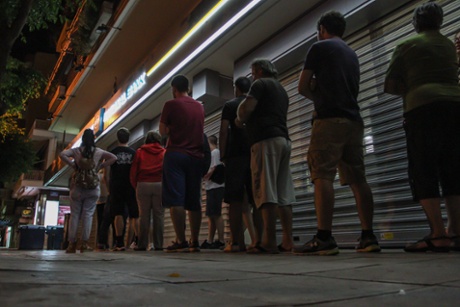
After months of wrangling between the Greek government and its creditors, matters are finally, dramatically, coming to a head.
I’ll be tracking all the action though the day.....
Updated