And finally, Alexis Tsipras’s defiant and confrontational speech this afternoon makes the front page of The Guardian:
Wednesday's Guardian: Greece accuses ‘criminal’ creditors as default nears #tomorrowspaperstoday #bbcpapers pic.twitter.com/E0K6FBgYl0
— Nick Sutton (@suttonnick) June 16, 2015
And here’s a flavour, for anyone whose not been following this blog for the last 15 hours :)
Fears that the five-year Greek financial crisis will culminate in debt default and exit from the euro have intensified as Athens hardened its rhetoric against its creditors and insisted it would miss a payment to the International Monetary Fund unless it received debt relief.
With just 48 hours to go before a meeting of eurozone finance ministers, seen as the last realistic chance to reach a deal before Greece has to pay the IMF at the end of June, Alexis Tsipras, showed no sign of bowing to demands for cuts in pensions and increases in VAT. Instead, the Greek prime minister accused the Fund of “criminal responsibility” for the situation and said lenders were seeking to “humiliate” his country.
Greece would face unprecedented hardship if capital controls were introduced, and the Syrizia party would see its populist support plummet rather fastRead more
Jean-Claude Juncker, the president of the European commission, reflected the anger in Brussels at the way Tsipras has been approaching the deadlocked negotiations by saying he had “sympathy for the Greek people but not the Greek government”. Juncker was until recently rated as one of Tsipras’s only allies.
EU officials wereon Tuesday night making preparations for a crisis meeting of leaders on Sunday if, as now expected, the talks between finance ministers on Thursday prove fruitless. Amid the third straight day of sharp declines on the Athens stock market, EU leaders are for the first time talking openly about Greek default and its ejection from the euro.
Valdis Dombrovskis, vice-president of the commission, said eurozone leaders were discussing “less favourable scenarios” for Greece, while the Finnish prime minister, Juha Sipila, said an agreement with Greece now would require a miracle....
And if you can’t wait for the paperboy or girl, here’s the full story:
Greek exit real prospect as eurozone hardens towards belligerent Athens
I think that’s all for tonight -- see you tomorrow for more of the same. Goodnight! GW
JP Morgan analysts have predicted tonight that restrictions on Greek banks could be brought in this weekend, if eurozone finance ministers fail to make progress in 48 hours time.
JPM: "We think Greece may impose capital controls as soon as this weekend if it fails to achieve a breakthrough at Thu Eurogroup meeting."
— Greg Ip (@greg_ip) June 16, 2015
Look who’s sitting on the front page of the FT tonight....
Financial Times: just published, US front page, Wednesday June 17, 2015 pic.twitter.com/ZA6FDyFGVb
— Financial Times (@FT) June 16, 2015
Even though the Dow Jones index rose today, investors are still jittery about the eurozone.
Scott Brown, chief economist at Raymond James in St. Petersburg, Florida, says:
“The market is still anxious about Greece and would like the situation to be dealt with one way or another. The week-after-week uncertainty isn’t good for the market.”
Wall Street also has one eye on tomorrow’s Federal Reserve meeting, for signs that a rate rise is close....
Wall Street remains optimistic too. The New York stock index has closed for the night, with shares in the green:
The Dow ended up by 112 points, or 0.6%. More info on today's market movement: http://t.co/zDcuH8nTBq pic.twitter.com/dr7DFEdXYJ
— MarketWatch (@MarketWatch) June 16, 2015
Over 40% of City investors are hopeful that this crisis will result in a deal, according to Bank of America Merrill Lynch:
The latest @BofAML Global Fund Manager Survey on Greece pic.twitter.com/AYLIBIgciK
— Fabrizio Goria (@FGoria) June 16, 2015
City analysts are catching up with events today. BNP Paribas, the French bank, reckons there’s a roughly even chance of Greece defaulting (so let’s just flip a coin....).
Perhaps more usefully, BNPP also point out that Greece might not lose its eurozone membership; after all, there’s no obvious way to expel a euro member.
BNPP: Probability of a Greek default has risen to around 50%. Default would not automatically herald #Grexit. pic.twitter.com/ha0s0kYtoN
— Holger Zschaepitz (@Schuldensuehner) June 16, 2015
Graffiti in #Greece only gets better. Spotted tonight: "Europe without Greece is like a party without drugs!"
— Helena Smith (@HelenaSmithGDN) June 16, 2015
US Treasury secretary urges Greece to reach a deal

America has just made a new intervention in the crisis tonight.
US Treasury secretary Jack Lew has telephoned Alexis Tsipras to urge him to reach a realistic compromise, urgently.
In a statement, the Treasury revealed that Lew told Tsipras that the Greek people, and the global economy, would suffer if Athens can’t reach a deal with creditors.
It added:
“Lew underscored the urgency of Greece making a serious move to reach a pragmatic compromise with its creditors.”
The intervention came shortly after White House spokesman spokesman Josh Earnest told reporters that the US is eager to see the Greek crisis resolved soon.
Last month, Lew told an audience in London that all sides should “double down” their efforts to get a deal fast. That plea didn’t spark a deal, so with just two weeks to go until Greece’s bail expires, Lew has made this fresh intervention.
In call to PM Tsipras, Treasury Sec Lew "underscored urgency of Greece making a serious move to reach a pragmatic compromise with creditors"
— Katerina Sokou (@KaterinaSokou) June 16, 2015
Updated
Greece tries to make up with Juncker
Over in Athens the government’s spokesman has just released a statement attempting to douse tensions with EU commission president Jean-Claude Juncker, reports Helena Smith .
Responding to the EU commission chief’s thinly disguised fury today, the Greek government - acutely aware that the Luxembourger is among Greece’s greatest supporters - has moved fast to kiss and make up.
“We never said it was the view of the Commission, or of Mr Juncker personally,” said the statement referring to the cash-for-reforms proposal that Juncker handed prime minister Alexis Tsipras last week.
“[We laid the blame] with the entire proposal made by the three institutions.” [Greece’s lenders].
It was, the statement said, “positive” that the EU chief had made it clear that he, too, also disagreed with several of the proposal’s aspects.
“The Greek government has submitted proposals with measures that fully cover the fiscal gap, transferring the burden from the weakest social classes as well as suggesting a reduction in defense spending.”
Updated
Jean-Claude Juncker’s statement that he’s had ‘no contact’ with the Greek government since Sunday doesn’t tell the full story.
Our Europe editor, Ian Traynor, points out that the European Commission president has been in contact with Greek politicians and officials this week, so it would be wrong to think he’s frozen off all contact with Greece....
And here’s a clearly disgruntled Jean-Claude Juncker today, as he he tore into the Greek government.

As we covered earlier, Juncker accused Alexis Tsipras’s administration of misleading voters about proposals he had made to help solve the country’s debt crisis.
According to Reuters, the president of the European Commission declared:
“I don’t care about the Greek government, I do care about the Greek people,” he said noting that many “are suffering more than others in the European Union” from efforts to reduce debts.
“The debate in Greece and outside Greece would be easier if the Greek government would tell exactly what the Commission ... is really proposing. I am blaming the Greeks (for telling) things to the Greek public which are not consistent with what I’ve told the Greek prime minister.”

Updated
Greek president vows to preserve euro membership

Greece’s president has waded in declaring that he will do everything in his power to ensure the debt-strcken country remains in the eurozone.
Helena Smith reports from Athens
On a day marked by escalating brinkmanship and fiery rhetoric, Greece’s head of state, president Prokopis Pavlopoulos has, in a rare intervention, stepped in saying “a solid national front” is needed to ensure the country remains in the euro zone.
Pavlopoulos, a veteran former conservative MP, whose election earlier this year won unanimous support in the 300-seat House, said it was his role to secure Athens’ place at Europe’s core in the single currency.
In comments aired this afternoon, Pavlopoulos said:
“I know that my role, not least because of my election by the majority of the parliament who chose me, is to ensure the course of the country in Europe and the euro zone.”
Adding:
“In front of this aim there has to be a solid internal front of all democratic forces. Petty party views and friction can’t come before the achievement of such a goal.”
The head of state, who once represented the staunchly pro-European centre right New Democracy party, said he was “determined in the framework of my authorities and touching the boundaries of my authorities to fulfill this mission.”
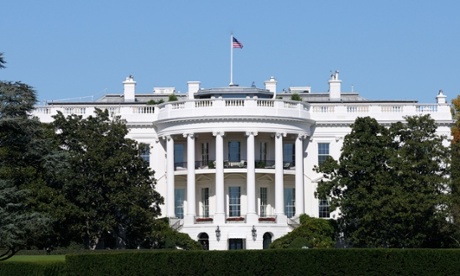
Over in Washington, the White House has given all parties in the Greek bailout saga a nudge to sort this crisis out, soon, without rattling the financial markets.
Spokesman Josh Earnest told reporters that the US hopes the situation is resolved before it has a negative impact on the world economy.
America has been dropping increasingly heavy hints in recent weeks that the Greek crisis needs to be cleaned up, before triggering a repeat of the chaos we lived through in 2008 after the collapse of Lehman Brothers.
Latest on #Greece is the potential for a summit on Sat post Eurogroup meeting on Thurs... sounds like they're planning for the worst!
— RANsquawk (@RANsquawk) June 16, 2015
Greek market falls again but rest of Europe recovers
The early signs that Greece was moving closer to the brink sent investors heading for the doors. But despite the rhetoric from Greek president Alexis Tsipras in parliament, there were growing hopes a deal of some sort could perhaps be done after all. With Wall Street moving higher in early trading - ahead of Wednesday’s US Federal Reserve comments on interest rates - most markets managed to regain some ground. Greece was an exception, with the Athens market falling again to record a 14.59% decline in the past three sessions. Overall the scores showed:
- The FTSE 100 finished virtually unchanged, down just 0.42 points at 6710.10
- Germany’s Dax added 0.54% to 11,044.01
- France’s Cac closed 0.51% higher at 4839.86
- Italy’s FTSE MIB edged up 0.25% to 22,383.48
- Spain’s Ibex ended up 0.27% at 10,871.4
- The Athens market fell 4.77% to 703.05
On Wall Street the Dow Jones Industrial Average is currently up 85 points or 0.48%.
European Commission president Jean-Claude Juncker has come out fighting:
- 16-Jun-2015 16:53:36 - EU’S JUNCKER SAYS DOESN’T CARE ABOUT GREEK GOVT BUT ABOUT GREEK PEOPLE
- 16-Jun-2015 16:54:00 - EU’S JUNCKER SAYS HAS HAD NO CONTACT WITH GREEK GOVT SINCE SUNDAY BECAUSE NEGOTIATIONS GOING NOWHERE
- 16-Jun-2015 16:54:26 - EU’S JUNCKER SAYS WOULD BE MAJOR MISTAKE TO INCREASE GREEK VAT ON MEDICINES AND ELECTRICITY
- 16-Jun-2015 16:55:05 - EU’S JUNCKER SAYS BLAMES GREEK GOVT FOR TELLING VOTERS THINGS THAT ARE NOT WHAT JUNCKER TOLD GOVT
And there we have it:
[BREAKING] ECB’s Knot: Business As Usual On ELA Until Greece Defaults - BBG $EURUSD $MACRO
— Live Squawk (@livesquawk) June 16, 2015
European Central Bank board member Yves Mersch has tried to pour cold water on the idea of a Grexit:
ECB MERSCH: EXIT FROM EURO NOT FORESEEN BY TREATY; WE CONSIDER PARTICIPATION IN EURO IRREVOCABLE
— MNI Eurozone (@MNIEurozone) June 16, 2015
Meanwhile the ECB’s Klaas Knot has said Greek banks are solvent at the moment and can take some stress although - and no surprises here - they would be in trouble if Greece defaulted (courtesy Reuters).
A reminder that the ECB will soon make its weekly decison on the emergency funding given to Greek banks, which will continue as long as they are deemed to be solvent. So Knot’s comments seem to suggest the ECB will not pull the plug on the so-called emergency liquidity assistance yet.
Updated
Speaking of Varoufakis, Germany’s Spiegel Online has some quotes from today. He told them the proposals for spending cuts and reforms were already so harsh and brutal, the Germans themselves would never accept them. He said:
Greece will only commit to them if Europe agrees to a debt restructuring, investments and an end to the liquidity crisis.
And he advised “Ask [Angela] Merkel” if an agreement would be reached this week.
In case anyone was wondering where Greek finance minister Yanis Varoufakis was during the fiery speech in parliament from prime minister Alexis Tspiras, here he is listening, combining casual with intensity:

More talks, but this time it is Cyprus president Nicos Anastasiades getting in on the act. According to China’s Xinhua News Agency, he will be speaking with EU officials some time today about the Greek crisis:
His spokesman said that Anastasiades earlier in the day had a telephone conversation with the president of Greece, Prokopis Pavlopoulos, “in connection with Greece’s effort to reach a deal with (European) institutions”.
When asked whether finance minister Harris Georgiades will take up any mediatory role in Greece’s effort to close a deal with its international lenders, the spokesman said the question should be what the president will do following his conversation with the Greek President.
“The president will possibly have telephone talks with European Union leaders and those in charge of institutions involved in the negotiations, tonight or tomorrow at the latest,” the spokesman said.

He did not say either whom Anastasiades will talk to or what line he will take on the Greek issue.
But sources said that he will probably call German Chancellor Angela Merkel, French President Francois Hollande, European Commission President Jean-Claude Juncker and European Central Bank president Mario Draghi.
Besides Greece, Cyprus is the only other euro country still in a bailout program after it was pulled back from bankruptcy in a €10bn financial assistance deal signed in March 2013.
It is expected to return to growth this year after four years in recession and end its memorandum obligations next year.
And here’s a thought to put things in perspective:
Greece adopted € cash Jan 1 '02. Putting the start of the crisis at Oct 1 08 it will have spent half its membership in crisis by end Aug '15
— Lorcan Roche Kelly (@LorcanRK) June 16, 2015
Wall Street moves higher
US markets are in positive territory in early trading, with the Dow Jones Industrial Average up around 50 points.
The latest US Federal Reserve meeting starts today with the central bank’s latest thinking on interest rates due to be announced tomorrow. Investors believe there will be no increase in borrowing costs until later in the year at the earliest.
The rise on Wall Street has helped mitigate some of the gloom in Europe, with Germany’s Dax and France’s Cac now in positive territory after earlier falls, and the FTSE 100 now down just 8 points.
Hopes that Greece can come to a deal with its creditors, despite prime minister Alexis Tspiras’ rhetoric in parliament earlier.
The pattern since Syriza's election: (i) The rhetoric from both Greece & the creditors has increased. (ii) The actual gap has narrowed.
— Duncan Weldon (@DuncanWeldon) June 16, 2015
@SpiegelPeter This feels a very long way from the starting point back in January: http://t.co/iJ0mlhQcQC
— Duncan Weldon (@DuncanWeldon) June 16, 2015
@Birdyword I think a deal is do-able and I think it'll happen. But, I've been wrong about this quite a lot over the last few weeks...
— Duncan Weldon (@DuncanWeldon) June 16, 2015
Pimco, the asset manager which is part of insurer Allianz, has increased its holding of Greek debt and is second only to the ECB, according to Bloomberg:
Allianz SE, Europe’s biggest insurer and asset manager, increased its holdings of Greek sovereign debt to more than €1.2bn from about €1bn reported in May.
Allianz, through its asset manager Pimco Investment Management Co., had the largest holdings of Greek bonds of any investor after the European Central Bank, according to data compiled by Bloomberg. Pimco invests capital on behalf of clients. Allianz’s direct exposure to Greece is €2m, according to its first-quarter earnings.
Updated
The AFP newswire have just published the details of Alexis Tsipras’s attack on the International Monetary Fund in the Greek parliament today.
IMF has ‘criminal responsibility’ for Greek crisis: PM
Greek prime minister Alexis Tsipras said the International Monetary Fund had “criminal responsibility” for Greece’s debt crisis on Tuesday, and called on the country’s European creditors to assess the IMF’s policies.
“The time has come for the IMF’s proposals to be judged not just by us but especially by Europe,” Tsipras told his parliamentary group, two days after the failure of debt talks with the IMF and the European Union brought Greece closer to a possible default.
“The IMF has criminal responsibility for today’s situation.”.
Acrimonious talks over the past five months have seen the Fund insist on further cuts to Greece’s pension system and a rise in value-added tax on basic goods, like electricity, which Athens says will only deepen hardships for ordinary Greeks.
“Right now, what dominates is the IMF’s harsh views on tough measures, and Europe’s on denying any discussion over debt viability,” Tsipras said, adding:
“The fixation on cuts... is most likely part of a political plan... to humiliate an entire people that has suffered in the past five years through no fault of its own,”
“The time has come for the IMF’s proposals to be judged in public.. .by Europe,” he told the MPs of his radical left Syriza party.
Snap Summary: Tsipras had his eye on a deal

Here’s Helena Smith’s instant verdict on Alexis Tsipras’s address
Tsipras’ speech was aimed as much at an internal audience – in this case his own far left Syriza party – as audiences in the corridors of economic power abroad. It contained some nuggets: there were forces in Europe that were working towards a fair deal, (for which read the European Commission) as there were forces working against, he said, singling out the IMF for taking a particularly hard stance.
In a nod to hardliners (for which, soon, we may have to read Syriza’s ENTIRE parliamentary group), Tsipras repeated the mantra that proposals made by creditors, so far, were “absurd and unrealistic.”
He told MPs:
“They are asking us to accept an agreement which will drag us into a vortex of recession and uncertainty.
We submitted a proposal for a viable deal and got back a 5-page text that ignored the negotiations that had already taken place.”
This was Tsipras, Greece’s youngest premier and its first belonging to the radical left, in his stride, taking the moral high-ground, accusing creditors of skulduggery but also telling his MPs that the ultimate goal is the implementation of a visionary leftwing government program - “a spring of democracy” - over the next four years.
The subtext is that, ultimately, any deal that is eventually reached should be wholeheartedly endorsed because it will be a stepping stone to overhauling the way Greece works. That is the cherry on the cake.
And is why (short of there not being any deal at all) Syriza’s cadres will give the agreement and the government their support when push comes to shove.
While Alexis Tsipras was speaking, Angela Merkel was telling reporters in Berlin that “unfortunately” she has little new to report on Greece.
The German chancellor said she hope the deadlock can be broken at Thursday’s eurozone finance ministers meeting.
Bloomberg has the details:
“I’m concentrating all of my energy on helping the three institutions find a solution with Greece,” Merkel told reporters. “That’s what I see as my task. I want to do everything possible to keep Greece in the euro zone.”
Tsipras brands IMF "criminal" as Merkel admits no Greece deal in sight http://t.co/CUsAQcGM03 pic.twitter.com/eyYfXdeImp
— Bloomberg Business (@business) June 16, 2015
Tsipras pushes for debt relief in defiant address
That was quite a defiant speech by Alexis Tsipras, in which he insisted he won’t bow to the demands of Greece’s lenders, despite the growing risk of default.
The Greek PM told his MPs:
“The mandate we have got from the Greek people is to end austerity policy.
“In order to achieve that, we have to seek a deal which will spread the burden evenly and which will not hurt wage earners and pensioners.”
It sounded inflammatory, at a time when lenders were hoping for conciliatory words.
At one stage, Tsipras accused creditors of trying to “humiliate” Greece, with the European Central Bank insisting on financial “strangulation”.
And he even declared that the International Monetary Fund has “criminal responsibility” for the damage caused to the Greek economy since its first bailout.
#Tsipras says ECB insists on tactics that strangle Greece; IMF has “criminal responsibility” for what happened in Greece during crisis
— Francine Lacqua (@flacqua) June 16, 2015
TSIPRAS: IMF has "criminal responsibility" for mistakes left uncorrected in Greek program #Greece
— Derek Gatopoulos (@dgatopoulos) June 16, 2015
So has he burned all his bridges? Perhaps, or maybe it’s another dose of brinksmanship before a last-minute deal is cut.
The key point, I think, is that Tsipras called for debt relief -- something the IMF also believes is needed. As he put it:
Why do [European leaders] accept [the IMF’s] harsh measures but not its proposals for debt restructuring?”
Nick Malkoutzis, of the Kathimerini newspaper, sees the framework of a deal:
Too much focus on Tsipras's language. Main point is challenge to EU over adopting IMF's measures & not its call for debt relief #Greece
— Nick Malkoutzis (@NickMalkoutzis) June 16, 2015
If lenders looking for a msg from #Tsipras speech, it's: If you want me to consider pension cuts, give me something on debt relief #Greece
— Nick Malkoutzis (@NickMalkoutzis) June 16, 2015
Updated
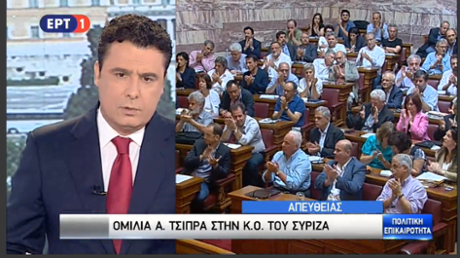
In conclusion, Tsipras tells his MPs that he will keep working towards a deal; one that is in line with his mandate to end austerity in Greece.
tsipras: we're entering the home stretch. i'd say the real negotiations are starting now.
— Diane Shugart (@dianalizia) June 16, 2015
#Greece Tsipras: "The mandate we've taken by the GR people is *not* a mandate of creative ambiguity; it is clear mandate to stop austerity."
— The Greek Analyst (@GreekAnalyst) June 16, 2015
* Greek PM says we want a deal that ends talk of grexit once and for all - RTRS
— Fabrizio Goria (@FGoria) June 16, 2015
#Greece Tsipras: "This bet is not only ours; it is a bet of the GR people; but also a bet of Europe's people; for a Europe of democracy."
— The Greek Analyst (@GreekAnalyst) June 16, 2015
Tsipras: Creditors want to humiliate Greece
We’ll get the key quotes from Alexis Tsipras’s speech soon (livefeed here).
In the meantime, here are Reuters early news flashes, showing that the Greek PM is sticking to his guns:
- GREEK PM TELLS SYRIZA LAWMAKERS LENDERS’ OBSESSION FOR A PROGRAMME OF CUTS CANNOT BE A MISTAKE, IT HAS POLITICAL ENDS
- GREEK PM TELLS SYRIZA LAWMAKERS SAYS LENDERS WANT TO HUMILIATE GREEK GOVT
- GREEK PM TELLS SYRIZA LAWMAKERS LENDERS ARE USING NEGOTIATIONS TO SHOW THEIR FORCE, WE ARE NEGOTIATING IN GOOD FAITH
- GREEK PM TELLS SYRIZA LAWMAKERS ECB INSISTING ON LINE OF FINANCIAL STRANGULATION
- GREEK PM SAYS DESPITE AGGRESSIVE STATEMENTS, THERE ARE POWERS IN EUROPE WORKING FOR A FAIR DEAL
- GREEK PM SAYS WE ARE IN THIS POSITION BECAUSE IMF WANTS DIFFICULT MEASURES AND EUROPE REFUSES DEBT RELIEF
PM #Tsipras remains defiant, blames #ECB, institutions; says no deal in place unless creditors change course #Greece
— Vassilis Karamanis (@vkaramanis_fx) June 16, 2015
Tsipras does not appear to be caving in. At all. Instead, the Greek PM is questioning whether creditors are actually serious about getting a deal.
GreekPM @atsipras says the obsession of the Institutions on such measures means that they want the humiliation of the greek people #Greece
— EfiKoutsokosta (@Efkouts) June 16, 2015
#Greece PM #Tsipras questions true will of creditors to find solution
— Kathimerini English (@ekathimerini) June 16, 2015
Alexis Tsipras is insisting that Greece has done its best, and once again attacks the recent proposals from its creditors.
Three weeks ago we produced a “comprehensive plan that could be viable”, but lenders failed to also compromise. Instead, they insisted on unacceptable measures, such as wage cuts and higher taxes.
#Greece Tsipras calls the last doc sent the institutions to the govt as "absurd, unrealistic and unacceptable."
— The Greek Analyst (@GreekAnalyst) June 16, 2015
#Tsipras says lenders propose 'horizontal measures' with cuts in wages, hikes in electricity bills
— Daphne Papadopoulou (@daphnenews) June 16, 2015
#Tsipras says certain if we take advantage of this opportunity these 4 years could prove to be a 'spring time of democracy' for Greece
— Daphne Papadopoulou (@daphnenews) June 16, 2015
Tsipras says that in order for the gov't to continue with its 4-year plan it needs an agrment that will provide adequate financing. #Greece
— Yannis Koutsomitis (@YanniKouts) June 16, 2015
Updated
Tsipras is arguing against early elections, saying Syriza can achieve a lot in the next four years. Bigger challenges lie ahead....
#Tsipras says 'it's our responsibility and duty to bear this burden + we'll do it as long as people support us'
— Daphne Papadopoulou (@daphnenews) June 16, 2015
#Greece Tsipras: "The big fights are in front of us, and we must be ready to fight them."
— The Greek Analyst (@GreekAnalyst) June 16, 2015
Greek PM addresses MPs
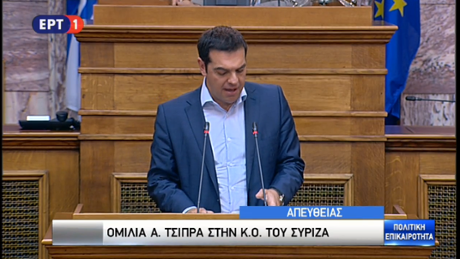
Alexis Tsipras is addressing his Syriza MPs in the Athens parliament now! Here’s the livefeed
Speaking in Greek to a silent chamber, Greece’s prime minister is defending his decision to trigger January’s general elections and take power. We knew we had to take responsibility, and fight the humanitarian crisis, he says.
Tsipras trying to justify why Syriza pressed for early elections. "We saw that MoU measures were becoming irreversible"
— Yannis Koutsomitis (@YanniKouts) June 16, 2015
#Greece PM #Tsipras: we knew the problems but made a bold choice: to take on the responsibility of governance
— Kathimerini English (@ekathimerini) June 16, 2015
And Tsipras insists that his administrations has helped the poorest, despite the deadlock with lenders.
#Greece Tsipras: "We managed to stand in our meet, &with our focus always on the front of negotiations, we managed to take relief measures."
— The Greek Analyst (@GreekAnalyst) June 16, 2015
More to follow....
European Commission vice-president Valdis Dombrovskis has revealed that there has been been “some discussion within the eurozone” of the implications of “less favourable scenarios” for Greece.
That’s via Reuters.
That strongly suggests they are now planning for failure in the negotiations..... or at least firing a warning shot at Athens....
Alexis Tsipras will begin addressing his Syriza party’s MPs in Athens shortly. It should be streamed live here.
Σε λίγο, στη συνεδρίαση της Κ.Ο του #syriza. Παρακολουθήστε ζωντανά http://t.co/Y471PpOFy2 pic.twitter.com/DXgHCmD5FN
— PrimeMinisterGR (@PrimeministerGR) June 16, 2015
German tabloid Bild just gave the financial markets a jolt, by reporting that Greece wants to delay its €1.6bn IMF repayment until the end of this year.
It says:
According to information obtained by Bild, Greece doesn’t want to pay back any of the June debt instalments to the IMF. It wants to postpone the repayments of the €1.55bn repayment due in June by six months.
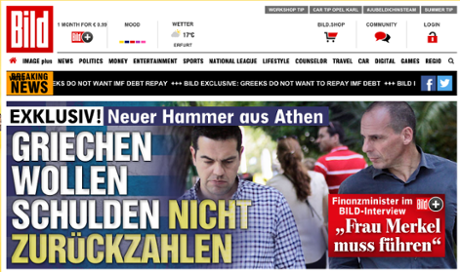
Bild claims that the Greeks have found “a technical option to postpone the payment unilaterally, in the IMF rules.”
Under the Fund’s rules, a country does have a month’s grace before its Executive Board is formally notified, and they might not be formally suspended for 15 months.
It is unclear whether Athens also wants to – or can – postpone its €6.7bn debt repayment to the ECB this summer, Bild adds.
Athens officials quickly denied the report:
@OpenEurope FYI it's now been quickly denied by a Greek official
— RANsquawk (@RANsquawk) June 16, 2015
Updated
Finnish PM: It will take a miracle to get a Greek deal this month

Finland’s prime minister has declared that it would take a “miracle” to get a deal before Greece’s bailout expires at the end of June.
Speaking in Helsinki this morning, Juha Sipila also told reporters that EU leaders have “mentally prepared” for the prospect of Greece running out of cash.
Reuters has the story:
It would need a miracle to reach a deal between Greece and its creditors by the end-of-June deadline, the Finnish prime minister said on Tuesday.
“The situation is tough and the timetable is tight. One could say that it needs a miracle to have this issue solved next week... But that is still the aim for everybody,” Prime Minister Juha Sipila told reporters.
“The possibility of (Greek) insolvency was discussed in the sidelines of the EU summit last week... several countries have mentally prepared for it,” he added.
"Finnish PM Says Greece Deal for Next Week Needs a Miracle" by REUTERS via NYT http://t.co/FcNltwpMDM
— Henry Jans (@henryjanp) June 16, 2015
If Sipila is correct, then there appears to be little chance that Greece will repay €1.6bn to the IMF on 30 June, given Alexis Tsipras’s comments this morning.
That wouldn’t be a formal default (as the Fund isn’t a commercial creditor), but it could force the ECB to reconsider the emergency liquidity it is providing to Greece’s banks.
Updated
Summary: Markets hit by Greek deadlock
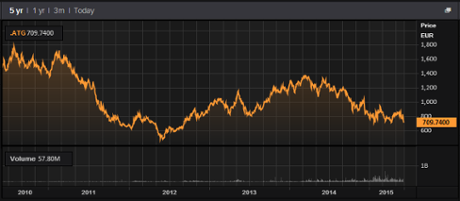
The Greek stock market has slumped close to its lowest level since the summer of 2012 today, as the deadlock between Athens and its creditors continues to spook the markets.
Bank shares are being routed again, as alarm spreads across trading floors. National Bank of Greece is down 7.8%, pulling the ATG index down another 3.8% to 709 points.
That’s only a few points above its recent low, set in mid-April.
The news that Alexis Tsipras intends to not repay the IMF on 30 June, unless he has a deal, has helped keep other European markets deep in the red, at their lowest levels in four months.
- German DAX: down 1.2%
- France CAC: down 1%
- Spanish IBEX: down 1.5%
-
Italian FTSE MIB: down 1.5%
And in the bond markets, Greek debt is being hammered again - driving bond yields to increasingly alarming levels.
Borrowing rates thru the roof! 2-yr yield near 30% #Greece HT @Investingcom pic.twitter.com/UwAENr5x5X
— Derek Gatopoulos (@dgatopoulos) June 16, 2015
As we covered earlier, Greece is refusing to submit new plans to its creditors. That’s a clear “line in the sand”, ahead of Thursday’s eurogroup meeting.
Michael Hewson, analyst at CMC Markets, believes Athens has calculated it has nothing to lose by holding firm
Why agree to a program that has manifestly failed on pretty much every level irrespective of the amount of blame to spread around, and it would be a massive climb-down at this late stage if they were to suddenly pull back?
Tsipras may also believe that the US and EU will do whatever it takes to avoid Greece becoming a failed state, or too reliant on Russia.
Hewson adds:
This suggests irrespective of what happens in the coming days, and despite the dire warnings of non-compliance by German and EU officials, Greece will not be left to fend for itself, and Varoufakis and Tsipras must surely know this.
With the IMF already uneasy about the sustainability of the current debt load it could be reasoned that Varoufakis surmises that the only way to open up a discussion on any form of debt renegotiation is for Greece to force the creditors hand, given they currently won’t entertain the idea.
And as there’s no mechanism to force a country out of the eurozone, this saga could yet run for months.....
Updated
Greece "Won't pay IMF on 30 June" without a deal
Has the Greek prime minister Alexis Tsipras made up his mind not to honour the €1.6bn debt repayment Athens must make to the IMF this month?
Our correspondent Helena Smith reports that it has emerged the leader made clear in talks with opposition leader Stavros Theodorakis today that:
“the government will not pay the IMF, if by the end of the month an agreement hasn’t been achieved with lenders.”
According to Theodorakis’ close aides, Tsipras described the decision as “the only route” the government could take - if a cash-for-reform deal wasn’t closed.
This payment consists of four loan instalments due in June, which Athens elected earlier this month to bundle up into one payment.
#Greek PM @atsipras to @toPotami leader: Without an agreement we are not paying the IMF. reports @kzoulas http://t.co/LNibDiaE4Z
— Eleni Varvitsiotis (@Elbarbie) June 16, 2015
Default would not automatically mean euro exit – but it could set Greece’s ejection from the single currency in motion. Greek media today has included wide coverage of the effects that a departure from the euro would have on ordinary Greeks, such as capital controls....
Updated
Fofi Gennimata, the new leader of Greece’s left-wing Pasok party, has warned that it would be a “disaster” if the country fails to reach a deal with creditors.
Gennimata was speaking following her meeting with Alexis Tsipras this lunchtime (as previewed earlier)
Enikos has the details:
The newly elected leader of Pasok said that Greece is going through a critical time and what is required is “frank dialogue and consultation”.
She reintroduced an earlier Pasok proposal for a national negotiating team and stressed that the country “needs an agreement as soon as possible.”
Rupture with creditors a disaster, says Pasok's leader - http://t.co/29CVJ9opTs pic.twitter.com/wu1B1ZFIfk
— enikos_en (@enikos_en) June 16, 2015
Bruno Waterfield, The Times’s man in Brussels, has heard that EU leaders are unlikely to hold an emergency summit on Sunday (as was rumoured earlier).
He reckons there’s still enough time to get any deal ratified by European parliaments, if needed (Germany’s Bundestag may require a vote, if there is any new aid for Greece).
I'm told emergency Sun #EUCO 'is unlikely when there's a summit next Thurs anyway'. Urgent timing of nat parli ratifications 'overstated'
— Bruno Waterfield (@BrunoBrussels) June 16, 2015
Several analysts fear that capital controls could soon be implemented in Greece to stem the outflow of liquidity from its banks.
Guy Foster, head of research at City firm Brewin Dolphin, suggests they could compromise three elements:
- Cash machine withdrawal limits
- Foreign transfer restrictions
- Physical currency limits - imposed at border controls
The objective is to limit runs on banks, Foster explains:
Capital controls would essentially buy time for a more serious resolution to the Greek crisis - namely a new government which can deliver reforms which might placate the creditors - so more talks and elections would follow.
Alternatively these would have to be the circumstances under which a parallel currency would be introduced or a full exit could be planned.

Stavros Theodorakis, the leader of Greece’s centrist party, To Potami, has urged prime minister Alexis Tsipras to reach a deal soon.
Emerging from talks with Tsipras this morning, Theodorakis warned that the situation is becoming perilous.
He told reporters:
“I called on the prime minister to consider that the Greek economy is desperately close to its limits....Greek society is suffering from the constant postponement of a deal.”
Theodorakis added that European officials are worried that Greece may be “flirting with other choices.”
“The country is at a crossroads ... where both [junctions] are difficult,” he continued, emphasising that with each passing day the Greek economy was hit more from the adverse effects of the uncertainty now engulfing talks.

Tsipras is meeting with other opposition leaders through the day. After Theodorakis, he sat down with Fofi Gennimata, elected as the first woman leader to the helm of Pasok on Sunday.
Then he’s due to meet Dora Bakoyannis, the former conservative foreign minister, who also announced yesterday that she would support a deal in Athens’ 300-seat House if it meant securing Greece’s future in Europe.
At 2pm local time (an hour later than originally scheduled) the prime minister will address the parliamentary group of his radical left Syriza party, now said to be at boiling point following publication of the measures outlined in the economic reform proposals submitted by Athens. Almost nobody (not least in Syriza) believes that the deal in its proposed form is ENFORCEABLE.
Last night I spoke to the deputy defence minister Costas Isychos, a close ally of Tsipras, who insisted the government was “determined to stop this neo-liberal tsunami.”
“We will stay at our red lines, we will not go back on our pre-electoral agenda. We are not bluffing, this is not a poker game, we do not belong to the past we belong to the future and we are not going to go back on our promises.”
Isychos, who was raised in Canada, denied that Syriza was riven with disagreement saying hardliners on its far left would also endorse a deal - even if they were at odds with it. That chimes with what insiders have long said: that no one would dare take the step of triggering the collapse of Greece’s first Leftist government.
Echoing what is fast becoming a widely held view, Isychos said it had become ever more apparent that lenders were working with the aim of pushing the government to such a point (though reversal of its policies) that it eventually collapsed.
“They want to tar Syriza with the brush of austerity and humiliate the prime minister so that the government collapses,” he told me.
“That is the strategy being pushed by Greek oligarchs who are in control of most of the private media and are in complete agreement with lenders.”
There is much excitement about Tsipras’ address. What is he going to tell his own MPs at this very difficult time?
Updated
This might send shivers through Berlin. German investor sentiment has fallen this month, as the Greek crisis hurts Europe’s largest economy.
The forward-looking Economic Conditions index, tracked by the ZEW Institute, fell to 31.5, down from 41.9.
That’s a “pretty precipitous decline”, says Bloomberg’s Hans Nichols.
And ZEW President Professor Clemens Fuest pins the blame firmly on Greece, saying:
“External factors are reducing the scope for further improvement of Germany’s good economic situation.
These include, in particular, the ongoing uncertainty over Greece’s future and the restrained dynamic of the global economy.”
ZEW’s measure of the current situation in the German economy also dipped, to 62.9 this month from 65.7 in May.
And its Indicator of Economic Sentiment for the Eurozone slid by 7.5 points to a reading of 53.7 points. Here’s the full report.
ZEW German Current Conditions Index falls to 62.7 in June (May:65.7).Econ sentiment at 7-month low of 31.5 (May:41.9) http://t.co/jdWdkrT4EY
— Markit Economics (@MarkitEconomics) June 16, 2015
Updated
EU mulling emergency summit
There is chatter in Brussels today that EU leaders could hold an emergency summit this weekend, if there is no progress at Thursday’s eurogroup meeting of finance chiefs.
However, it’s not clear that they would actually have much to get their teeth into -- as the FT’s Peter Speigel reports:
Eurozone officials are discussing holding an emergency summit on Sunday for leaders to tackle the crisis in Greece amid mounting fears a deal to break an ongoing impasse between Athens and its bailout creditors will not be reached at a high-stakes finance ministers meeting on Thursday.
According to two senior officials, the idea of holding a summit of eurozone heads of government was mooted in meetings among representatives of Greece’s creditors on Monday, a day after last-ditch negotiations to reach a deal to release €7.2bn in much-needed bailout aid collapsed.
They said that although the idea was discussed, there is considerable resistance to convening the summit among several creditors since technocratic issues like Greek pension reforms and tax rates are not normally the province of EU presidents and prime ministers.
“If there’s nothing to discuss among finance ministers, there wouldn’t be anything to discuss among heads,” said one official from a Greek creditor institution.
#EU leaders weighing summit on Sunday to deal w/#Greece if Thurs #eurogroup fails. But some think it's a bad idea http://t.co/iFljBsyz76
— Peter Spiegel (@SpiegelPeter) June 16, 2015
Die Welt’s Jan Dams has also heard that a summit is on the cards....
#EU gov sources: emergency summit on #Greece likely on Sunday or Monday. #grexit #tsipras #merkel #IMF @welt @WELT_Economy @OlafGersemann
— Jan Dams (@jandams) June 16, 2015
Greek officials: No idea when talks will restart

Over in Athens officials appear to have drawn a line in the sand, saying it is now in the court of lenders to resume talks.
Our correspondent Helena Smith reports:
Senior government sources are ruling out any deal before the euro group - now aiming for to cut a deal towards the end of the month.
Echoing what Greece’s chief negotiator Euclid Tsakalotos told me yesterday, officials say they have “no idea” when stalled talks will now resume.
What many are banking on is that creditors, led by Germany, will want to see movement - any kind at this point - before Thursday’s meeting of euro group finance ministers.
Officials appeared adamant this morning that Tsipras’ leftist-led government will not be making any more proposals.
With three proposals already submitted by Athens (the last outlining measures worth €5.5bn) Greece has reached the end of the road in what it can offer, they say.
And that squares with Varoufakis’s comments to Bild this morning, that he won’t bring a new plan to Thursday’s Eurogroup. Those comments are getting a lot of coverage in the Athens media today.
Updated
Britain’s brief flirtation with negative inflation is over.
The Consumer Prices Index rose by 0.1% year-on-year in May, having dipped to -0.1% in April.
Food prices continued to fall, down 1.8% year-on-year, while cheaper oil prices meant transport costs were 1.5% cheaper.
But many other items cost more than a year ago - including alcohol (+2.2%), health (+2.2%), education (+10%) and restaurants (+1.9%).
Varoufakis: I won't present new reforms on Thursday

Despite pressure from Europe, there’s no sign this morning that Greece is prepared to capitulate and agree to tougher austerity measures demanded by lenders.
Indeed, finance minister Yanis Varoufakis has told the German Bild newspaper that he won’t present a new reform plan at Thursday’s eurogroup meeting.
That’s helping to drive today’s selloff in the markets, given Mario Draghi’s warning on Monday that a strong, comprehensive deal is needed ASAP.
Asked if he would present such a list, Varoufakis replied:
“No, because the Eurogroup (of euro zone finance ministers) is not the right place to present proposals which haven’t been discussed and negotiated on a lower level before.”
And those lower-level talks remain frozen, after Greece’s latest plan was dismissed as inadequate on Sunday night.
The cost of insuring Spanish and Italian debt has risen this morning, in a further sign of jitteriness.
Spanish and Italian CDS spreads jump 10bps on #Grexit fears http://t.co/wb91mQtrUk pic.twitter.com/MSuQCRba81
— Markit (@Markit) June 16, 2015
The Greek stock market is feeling the pain too.
The main ATG index fell by 1.5% at the start of trading, adding to yesterday’s side of nearly 5%.
Updated
Greek bonds hit again
Greek government bonds are weakening again this morning, driving up the yield (or interest rate) on its two-year bonds over 30%.
That’s a stomach-clenchingly high yield -- suggesting that the debt is rather unlikely to be repaid in full (yields rise when prices fall).
Bang! #Greece's 2yr yields just crossed the 30% mark. pic.twitter.com/tkB7ls7KI0
— Holger Zschaepitz (@Schuldensuehner) June 16, 2015
The yield on 10-year Greek bonds has jumped too, from 12.7% to 13%. That also suggests alarm in the markets.
Updated
ECJ: Draghi's OMT programme is OK.
Breaking news: The European Court of Justice has ruled that the ECB’s bond-buying programme is legal.
#ECB wins EU top court backing for 2012 OMT bond-buying plan
— Francine Lacqua (@flacqua) June 16, 2015
That’s a win for President Draghi (We never doubted you, Mario), and a blow to critics in Germany who claimed the OMT programme breached European treaties and was effectively monetary financing.
Basic thrust of #ECJ ruling is that even if #ECB #OMT has indirect economic effects, primary objective makes it monetary not econ policy
— Open Europe (@OpenEurope) June 16, 2015
Updated
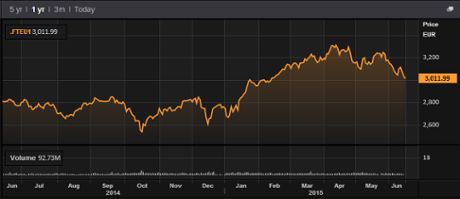
European stock markets hit four-month lows
Fears that Greece is on the verge of default have hit Europe’s stock markets in early trading, driving them down to their lowest levels since February.
The main indices are all in the red, for the third day running, as concern grows that there will not be a breakthrough in time.
The German Dax has shed another 71 points, or 0.6%, as investors digest those claims that EU leaders could bounce Greece into imposing capital controls this weekend.
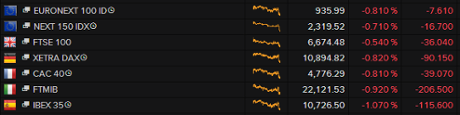
Connor Campbell, Financial Analyst at Spreadex, says the “perpetual handwringing” over Greece is hitting the markets.
Signs of progress are few and far between, leaving the markets to continue the negative performance that has been a regular feature of trading in the past month.
Each side is firmly entrenched in their belief that their proposal is the only feasible option’ not the kind of atmosphere that is going to yield a solution, especially with the Eurogroup meeting only days away.
Updated
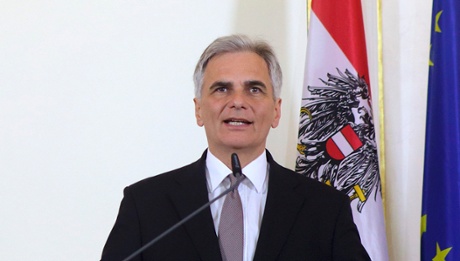
Could Austria’s chancellor, Werner Faymann, help break the deadlock?
Faymann is travelling to Greece today, and Bloomberg has flagged up rumours that he could be carrying a ‘compromise proposal’ to discuss with prime minister Alexis Tsipras on Wednesday.
It seems a little implausible. but still.....Faymann did tell the ANA news agency that Greece needs a five year plan to restore hope and prosperity.
He pointed out:
“Greece constitutes a warning on what happens when one applies only austerity.”
Updated
Spanish and Italian bonds hit by Greek fears
The interest rates on Spanish and Italian government debt is jumping this morning, as the Greek crisis continues to spook the markets.
The yield on 10-year Spanish bonds has popped by another 12 basis points to 2.5%, up from 2.38% last night.
That’s its highest rate in 10 months, meaning it will cost Madrid more to borrow money.
That suggests Greece’s deadlock is starting to send some shivers through the eurozone debt markets....
#Spanish 10-Year Yield Rises Above 2.5%, First Time Since Aug. 14; Spanish 30-Year Bond Yield Rises Above 3.5% pic.twitter.com/UIlXvXZu4F
— Francine Lacqua (@flacqua) June 16, 2015
#Eurozone contagion in one slide: Risk spreads of Italian, Spanish or Greek bonds over Bunds widen up to 19bps. pic.twitter.com/BfXqOGLiz5
— Holger Zschaepitz (@Schuldensuehner) June 16, 2015
Updated

Another important news story to watch out for this morning – the European Court of Justice will rule whether one of the eurozone’s financial crisis weapons is legal.
The ECJ has been deliberating for months whether the Outright Monetary Transactions programme, created by Mario Draghi in the white heat of the 2012 debt crisis, is permitted under European law.
OMT gives the ECB the ability to buy unlimited quantities of government bonds if a eurozone country suffers financing problems. That helped calm the crisis - would you go up Draghi in a financial arm-wrestling contest?
Back in January, a court official issued a preliminary opinion saying the bond purchase offer was permitted under the basic European Union treaty. The judges don’t have to follow preliminary opinions, but they probably will.....
Updated
After yesterday’s plunges, the European stock markets are likely to fall again this morning as investors nervously await developments.
With 20 minutes to go, IG are predicting that the FTSE 100 and German DAX will both dip into the red again:
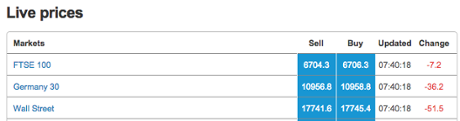
As Craig Erlam, senior market analyst at OANDA, explains:
“Negotiations have hit rough patches on numerous occasions throughout this process but this is the first time that they appear to have totally collapsed,”
“At this stage it is difficult to see how this will be resolved without significant compromises being made, something both sides have absolutely no interest in.”
Introduction: Greek deadlock grips the eurozone

Good morning, and welcome to our rolling coverage of the Greek bailout crisis and other key events across the world economy, the financial markets, the eurozone and business.
Greece and its creditors remain deadlocked this morning as the prospect of a default, and even a euro exit, continue to haunt the eurozone and stalk financial markets.
Following the collapse of talks on Sunday night, both sides have now dug in - insisting that the other one needs to compromise before progress can be made.
So we may face another day of rhetoric from both sides, ahead of Thursday’s eurogroup meeting – perhaps the last chance to make progress before the end of June.
Greece is nervously digesting last night’s claim that capital controls could be imposed as soon as this weekend.
Germany’s Süddeutsche Zeitung newspaper reported that EU leaders were drawing up an ‘emergency plan’ in case there was no deal by Friday. If that happened, they’d force Greece to close its banks for a few days.
Brussels insiders have denied that plan to us, but it is a reminder that this crisis could escalate over the days ahead.....
Capital controls for Greece as early as this weekend if no deal on Thurs, reports @SZ @CerstinGammelin http://t.co/xeo2EDaSCb
— Bruno Waterfield (@BrunoBrussels) June 16, 2015
Also coming up today...
Compared to the crisis brewing in Greece, economic data is merely a sideshow.
But we do find out this morning whether Britain’s shop prices kept falling last month, whether the eurozone unemployment rate fell in the first quarter, and how optimistic German firms are feeling:
- 9:30am BST: UK Consumer Prices index for May
- 10am: Eurozone unemployment in Q1 2015
- 10am: German ZEW confidence reading
I’ll be tracking all the main events through the day
Updated