A quick update: tonight’s talks started a little late. But Tsipras has now arrived:
The pm @atsipras while entering the #EU Commission a few minutes ago. pic.twitter.com/LiDNEaVJ8F
— EfiKoutsokosta (@Efkouts) June 24, 2015
Another update: And later, they left, ready for another dramatic day on Thursday....
Juncker has left the building. He waved at @traynorbrussels. Really. He did pic.twitter.com/URGMlyK4Fk
— Bruno Waterfield (@BrunoBrussels) June 24, 2015
Updated
Those top-level negotiations should be starting again anytime now, in the hope of making progress by morning....
* Greek government official says Tsipras, Lagarde, Juncker, Dijsselbloem, Regling, Draghi to meet again at 2100 gmt - RTRS
— Fabrizio Goria (@FGoria) June 24, 2015
And here’s confirmation that the eurogroup will convene again at 1pm local time on Thursday.
#Eurogroup to reconvene tomorrow at 13.00. Exit doorstep remarks Eurogroup President @J_Dijsselbloem: http://t.co/2HzAegvboV.
— EU Council Press (@EUCouncilPress) June 24, 2015
Oh, I can’t resist a couple more photos -- here’s Greece’s finance minister Yanis Varoufakis and chief economics spokesman Euclid Tsakalotos departing tonight’s unusually short eurogroup meeting....


And here’s Christine Lagarde too:

I’m going to take a break now -- as Thursday is going to be extremely busy.
So here’s Ian Traynor’s full report on events from another dramatic day:
I’ll try to pop back in if there are major developments in Brussels overnight, from the talks between Greece and her creditors:
#eurogroup will reconvene at 1 pm tomorrow ahead of summit. Does not leave much time ahead of 4 pm start.. #greece #grexit #greekcrisis
— Suzanne Lynch (@suzannelynch1) June 24, 2015
EU source says #eurogroup expecting a document by 11 am tomorrow morning ahead of 1 pm mtg #greece #greekcrisis #Grexit
— Suzanne Lynch (@suzannelynch1) June 24, 2015
Otherwise, see you again in the morning.... GW
Alexis Tsipras now has just 90 minutes grace, before another tussle with the IMF, ECB and EC at 10pm BST (midnight if you’re reading in Athens).
The look of a condemned man who knows he's in for some more Juncker slaps tonight pic.twitter.com/XhUXDirGyx
— Mehreen (@MehreenKhn) June 24, 2015
Snap summary: Eurozone ministers see no deal tonight

So to quickly recap.... Eurozone finance ministers have decided there’s no point talking late into the night about Greece, as an agreement is still some distance away.
Tonight’s meeting in Brussels quickly showed that there are still fundamental differences between Athens and its creditors over its bailout reform programme, with less than a week until it expires.
A meeting that was meant to go into the night and actually deliver a deal actually ended after barely an hour, once ministers had been briefed.
The Eurogroup swiftly concluded that it isn’t in any position to draw up the staff-level agreement needed to unlock aid for Greece.
Here's the scene inside tonight's #eurogroup meeting on #greece http://t.co/O2ZzaGL7Ct pic.twitter.com/MLO7dwlNmj
— Graeme Wearden (@graemewearden) June 24, 2015
Instead, they will meet again at 1pm CEST in Brussels on Thursday, for another crack at it:
Alex Stubb, Finland’s finance minister, is telling reporters outside the building that the work will continue, but time is running out.
Top-level talks will continue tonight - with the two sides still divided over what reforms Greece should implement.
At 11pm Brussels time (10pm BST) the Greek PM will meet the leaders of Greece’s creditors again in another attempt to crank out an agreement by the morning....
EU Sources confirms that the 2nd meeting among Tsipras+ Draghi+@J_Dijsselbloem+Juncker+Largarde+Juncker will start at 23:00 #Greece
— María Tejero Martín (@Maria_Tejero) June 24, 2015
So what’s the situation?
Athens is refusing to accept the pension reforms demanded by the IMF, including raising the effective retirement age faster and phasing out the “solidarity grant” paid to the poorest pensioners.
The IMF, though, is insistent that Greece’s proposal needs to be reworked, putting less of a burden on businesses and accelerating the reform process. In short, it wants more spending cuts and less tax rises, and simply doesn’t believe Greece’s maths.
As my colleague Larry Elliott puts it:
In the unlikely event that the extra revenues were collected in full, the IMF believes the one-off levy on bigger businesses coupled with the increases in corporation tax would hinder growth.
It thinks the Greek plan will only add up if there are immediate cuts in pensions and higher VAT on restaurants and medical supplies.
Today’s leaked documents showed that creditors have taken a red pen to Tsipras’s precious red lines.
Tsipras's red lines have been literally crossed: undesired proposals and phrasing errors corrected in red ink.#Greece http://t.co/yc5hahv3OU
— Finisterre67 (@Finisterre67) June 24, 2015
Updated
Are we closer to a deal? Bloomberg economist Maximu Sbaihi fears we’re further away!
“We are determined to continue work during the night if necessary” says Dijsselbloem leaving the #Eurogroup. A deal looked closer on Monday!
— Maxime Sbaihi (@MxSba) June 24, 2015
Leaving the meeting, Eurogroup president Jeroen Dijsselbleom tells reporters that ministers are “determined to continue work during the night if necessary,”.
We had feared that ministers wouldn’t emerge until dawn tomorrow, but actually they’re hitting the road before the sun sets.
Varoufakis leaves inconclusive Eurogroup meeting #Greece pic.twitter.com/4hhePdo1gM
— Derek Gatopoulos (@dgatopoulos) June 24, 2015
#eurogroup lasted just over an hour. unusually sensible of them to call it a day and retire to the bar
— Ian Traynor (@traynorbrussels) June 24, 2015
NO DEAL: Eurogroup ends early
NEWSFLASH: The eurogroup has broken up without a deal, according to Finland’s finance minister.
And talks are going to restart at noon BST tomorrow.
That's it for tonight. #Eurogroup will continue tomorrow at 13.00.
— Alexander Stubb (@alexstubb) June 24, 2015
There are dramatic scenes too, as the French delegation sprint through the room.
A bunch of French officials just ran out of the cafeteria. Sign #eurogroup about to wrap? #Greece
— Peter Spiegel (@SpiegelPeter) June 24, 2015
Updated
The Greek government has just released a statement slamming the new proposal tabled by creditors.
They say:
- The Greek government delegation came to today’s negotiation based on the text of the proposal which institutions had accepted as a base of discussion on Monday.
- The institutions, for their part, tabled a new proposal which transfers the burden [of austerity] to wage earners and pensioners in a way which is socially unfair while at the same time suggesting measures to avoid the increase of burden on those who have (to give).”
- The Greek side cannot agree with such a [change of] direction. Negotiations are continuing at all levels.”
Veteran political commentator Alexis Papachelas predicated that the tough bargaining could continue all the way through to Tuesday when Athens must meet a debt repayment of €1.6bn euro to the IMF.
“I don’t think anything will happen tonight. There is a very negative climate ... we should not be surprised by anything, this tough bargaining could continue all the way through to 11:45 on Tuesday,” he told Skai TV’s flagship news program.
“What worries me is not so much the drachma lobby in Greece but the drachma lobby that appears to be developing abroad.”
If in doubt....
EU sources indicate #Eurogroup postponed until tomorrow with #Greece PM Tsipras to meet creditors at 2200BST tonight pic.twitter.com/hbI2LX0i1G
— RANsquawk (@RANsquawk) June 24, 2015
OK, there’s now talk that Alexis Tsipras and Jean-Claude Juncker will meet again at 11pm Brussels time tonight for another session.
Likely scenario according to 2 off'ls: #eurogroup cuts short tonite, @atsipras resumes talks w/creditors overnight, #eurogroup resumes in AM
— Peter Spiegel (@SpiegelPeter) June 24, 2015
Updated
Eleni Varvitsiotis of Greek newspaper Kathimerini has also heard that the eurogroup meeting may be suspended.
Finance ministers, it appears, aren’t best pleased to be meeting *again* without a deal to sign off.
Finance Ministers seem to be annoyed by the fact that they are called 3 times in a week for a #Eurogroup and no formal paper to discuss
— Eleni Varvitsiotis (@Elbarbie) June 24, 2015
Info about suspending #eurogroup tonight, meeting of institutions for staff level agreement and another EG tomorrow morning
— Eleni Varvitsiotis (@Elbarbie) June 24, 2015
Today’s meeting between the Greek PM and the heads of the IMF, ECB and EU sounds like a gruelling affair:
Eurozone official: too much distrust and nervousness between @tsipras_eu and #institutions to reach a deal after 7hours of talks #Greece
— AnneSylvaineChassany (@ChassNews) June 24, 2015
Rumours are swirling that Alexis Tsipras, the Greek PM, will hold another meeting with Jean-Claude Junker tonight, once the Eurogroup has ended.
In which case..... there may not be much point in the finance ministers talking until dawn.
And indeed, Suzanne Lynch of the Irish Times has heard that ministers might break (at some point) and meet again in the morning...
EU source says tonight's #eurogroup likely to be suspended with ministers meeting in morning ahead of summit #greece #greekcrisis #grexit
— Suzanne Lynch (@suzannelynch1) June 24, 2015
Picture of the day?

Bloomberg has also flagged up that rumour that another emergency eurozone summit might be needed on Friday....
NO DECISION YET ON ANOTHER EURO-AREA SUMMIT, EU OFFICIAL SAYS - BBG. Other talk also downplaying chance of deal today.
— ForexLive (@ForexLive) June 24, 2015
With no breakthrough between Tsipras, Lagarde, Draghi and Juncker earlier, it’s hard to see how the finance ministers can really get anything done tonight.
All fin mins are now in, #Eurogroup can officially get underway. Consensus was little chance of deal, no draft to work on. Just discussion
— Open Europe (@OpenEurope) June 24, 2015
Rumours were swirling earlier that this could mean the meeting is quite short -- and that another emergency meeting called on Friday.
That would mean the issue is bumped back up to the EU leaders at their summit tomorrow night. No decision on that yet, though.
#Eurozone summit on Fri? "Much speculation, no decision. @DonaldTusk will take stock of sit in light of #eurogroup outcome," says #EU off'l
— Peter Spiegel (@SpiegelPeter) June 24, 2015
Updated
Photos: Inside the eurogroup
The ministers are all assembled, and ready to hear the state of play regarding Greece’s bailout programme following today’s intense talks between Alexis Tsipras and the creditors.
Here’s some photos from inside the room:


Is there any cause for optimism? Well, it’s not raining....
Apart from the sunny weather, this feels like monday's #Eurogroup all over again, doom and gloom from several fin mins.
— Jennifer Rankin (@JenniferMerode) June 24, 2015
Malta's fin min: even if there is an agreement, lots of challenges lie ahead for Greece and creditors... and it's going to a long night
— Jennifer Rankin (@JenniferMerode) June 24, 2015
Germany’s finance minister, Wolfgang Schäuble, has also joined the chorus of ministers saying a deal is unlikely tonight....
Schäuble: "Not optimistic that we have an agreement tonight. Work just starts now." pic.twitter.com/Hnht6jVK9e http://t.co/rA8qhaxa9m #Greece
— Yannis Koutsomitis (@YanniKouts) June 24, 2015
Hans Jörg Schelling, Austria’s finance minister, also plays down hopes of a deal tonight. Still lots of work to do, he says.
Austrian FinMin Schelling entering #Eurgroup with saying "it was to be excpected" - nothing "new on the table" "long way to go"
— Open Europe (@OpenEurope) June 24, 2015
Alex Stubb of Finland has arrived, and says:
I would be very positively surprised if there was a deal tonight.
There has been a lot of back of forth between the technical level and the political level, and we haven’t seen a concrete proposal yet, and we have to deal with it very carefully based on our parliamentary mandates....
We don’t take these issues lightly, he adds.
Her’s a clip of Pierre Moscovici, telling reporters that the fight to reach a deal continues:
Extraordinary #Eurogroup Doorstep @pierremoscovici Looking for a solution on #Greece http://t.co/uBwrdgYIc5 pic.twitter.com/Fs5bQvV5bB
— EU Council TV News (@EUCouncilTVNews) June 24, 2015
Vladis Dombrovskis, European Commissioner for the euro, does speak to the press.
He says that “We are in a process of very intensive negotiations”. Progress is being made, but we’re not there yet.
Will it be a late night?
Dombrovskis: It is likely that we are going to have a long night, but I cannot add any more at this stage.
Our man on the spot, @alexebarker, says @atsipras has left @EU_Commission HQ.
— Peter Spiegel (@SpiegelPeter) June 24, 2015
They’re closely followed by Pierre Moscovici, who tells the media (in French) that a deal is both ‘necessary and possible’.
Here comes Christine Lagarde....and the IMF chief just waves to the media and walks in.
Yanis Varoufakis has also just arrived, but the Greek finance minister also declines to speak to the press.
Updated
Good or bad sign? @J_Dijsselbloem walks into #eurogroup meeting without saying anything to press. Not sure I've seen that before #Greece
— Peter Spiegel (@SpiegelPeter) June 24, 2015
Slovakia: What will eurozone look like tomorrow?
You can always rely on Slovakia’s finance minister, Peter Kazimir, for a decent quote or two.
Three eurogroup meetings and two summits should be enough to reach a solution for Greece, he says pointedly ( he’s even clutching a book in case things get boring).
I’m curious to know what the eurozone will look like when this meeting is over, Kazimir adds - a hint that Greece might be closer to the exit door?
"It's Wed evening so I'm pretty curious what the #eurozone will look like when we finish," says @KazimirPeter on way into #eurogroup.
— Peter Spiegel (@SpiegelPeter) June 24, 2015
Three eurogroup meetings and two summits are enough to get resolution on Greece says Slovak fin min. Let's hope so.
— Jennifer Rankin (@JenniferMerode) June 24, 2015
Ahha - Mario Draghi has slipped into the meeting, fresh from his talks with Alexis Tsipras.
I guess #Draghi is no longer in the @atsipras meeting. He just walked into the #eurogroup meeting without saying anything. #Greece
— Peter Spiegel (@SpiegelPeter) June 24, 2015
#awkward....
Security guard just asked @jvanovertveldt walking into Eurogroup for his badge. And in his own country! Awkward
— Natalia Drozdiak (@nat_droz) June 24, 2015
Belgium: We have a moral obligation to the Greek people
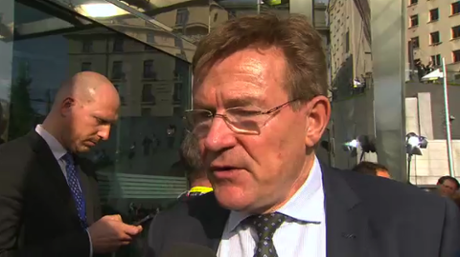
Belgium’s Johan Van Overtveldt then insists that the eurogroup must put the needs of the Greek people first.
We have a very big responsibility towards the Greek population, I think their suffering is immense. Can you imagine an economy that diminishes by 25% in a few years? That’s horrendous.
We have to stop that...We have a moral obligation here.
But surely the pension cuts and tax rises being pushed by the Institutions will make this worse?
Van Overtveldt argues that it’s wrong to say that Greece’s bailout programme has been very bad for the country; the problem is that it’s never been properly implemented.
Belgian finance minister Johan Van Overtveldt does speak to the press (good man!).
Can we still reach a deal?
First we must see what the institutions bring to the table. They have been negotiating very hard for the last 48 hours...
Is it time for give Greece a ‘take-it-or-leave-it” ultimatum?
Overtveldt: I don’t like these kind of deadlines. We need to reach a good deal for the Greek economy....that’s important for every Greek citizen. We also need a deal that is good for monetary union.
So if we can’t reach a deal today, we’ll see if we can get somewhere tomorrow, Overtveldt adds.
Βέλγος ΥΠΟΙΚ: αν ύπαρξει συμφωνία βασίζεται στην δουλεια που έχει γίνει τις προηγούμενες 48 ώρες pic.twitter.com/8CRN9GXq9L
— Eleni Varvitsiotis (@Elbarbie) June 24, 2015
Eurozone finance ministers arrive....
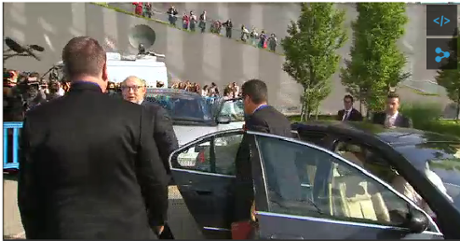
Well, that worked! Michel Sapin, France’s finance minister, just arrived. Don’t think he said anything to the press though.
Updated
There is also no sign of eurozone finance ministers arriving for tonight’s crunch meeting:
The Euro Working Group, which does the prep work for the Eurogroup, has ended its own meeting a few minutes ago - but otherwise, the wait continues.
Meeting between Greece and creditor institutions goes on and on. No sign when it will end. Waiting for the #eurogroup
— Jennifer Rankin (@JenniferMerode) June 24, 2015
Still no signs of a breakthrough in today’s top-level talks.
'Difficult', 'hard': verdict from sources so far after nearly five hours of Tsipras-creditor talks
— Danny Kemp (@dannyctkemp) June 24, 2015
There’s a certain amount of healthy competition among journalists in Brussels as they scramble for a desk to work at tonight.
Politico’s own liveblog has the details:
OVERBOOKED:While we’re all waiting for the Eurogroup ministers to arrive for their doorstop interviews at the Lex building, the Brussels press corps was waiting too … to be let into the building.
“People weren’t showing their best side,” according to Zeke Turner (@zekeft), “clambering for the limited number of workplaces provided by the Council.”
#Eurogroup not only will it run all night. you won't even get a seat #pfff #lex
— Ian Traynor (@traynorbrussels) June 24, 2015
Perhaps seats could be assigned according to each media outlet’s web traffic? ;)
Updated
Finland’s finance minister (and social media natural) Alexander Stubb has arrived in Brussels, and headed off for talks with fellow centre-right politicians.
Good evening from #Brussels, again. Kicking off with @EPP colleagues, then off to the #Eurogroup.
— Alexander Stubb (@alexstubb) June 24, 2015
Another sign that the eurogroup meeting will start late.
Updated
Back in Brussels, a Greek official has just warned that tonight’s eurogroup meeting might start late, as talks between prime minister Alexis Tsipras and its lenders continue....
#GREECE OFFICIAL SAYS START OF EUROGROUP MIGHT BE DELAYED and IMF IS BEING VERY TOUGH IN TALKS #forex #Eurogroup
— Ashraf Laidi (@alaidi) June 24, 2015
It was due to begin at 7pm local time, or in just under an hour’s time.
Markets hit by Greek worries
Most European stock markets ended the day in the red, as traders fretted about Greece’s bailout talks.
The Athens market fared badly; bank shares dropped up 10%, pulling the main ATG index down 1.8%.
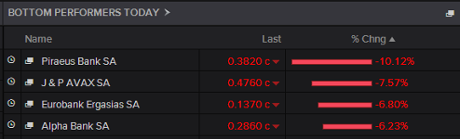
But it’s not a full-blown rout:
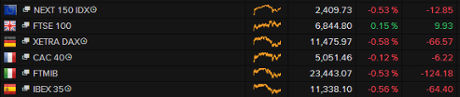
Joshua Mahony of IG says the City is “thoroughly confused” by the Greek situation. Many investors expect a deal eventually, but also foresee more drama ahead.
Unfortunately, beyond this month’s €1.6bn repayment due to the IMF, the €7.2bn currently on the line will not cover both July and August’s ECB payments. Thus unless we see an extension to the current bailout programme, we could see both sides back to the negotiation table this time next month.
Watch live as finance ministers arrive for the follow-up #Eurogroup meeting on #Greece: http://t.co/lYsDtOQZmS
— EU Council Press (@EUCouncilPress) June 24, 2015
Eurozone finance ministers should be arriving in Brussels soonish, for tonight’s Eurogroup meeting.
There’s a live video feed here -- currently showing an empty driveway and a few trees swaying gently in the late afternoon. Quite soothing really.
Today’s flurry of proposals, counter-proposals, leaks and verbal attacks are all terribly dramatic, but they may not mean negotiations will definitely fail.
As a senior official from one of the creditors put it to Reuters:
“Of course we want changes and they don’t, and this is part of the bargaining process, albeit less effective when done publicly.”
Updated
A Syriza government official has slammed the latest proposals from creditors as ‘absurd’, at a meeting of the coalition’s political committee.
#BREAKING: #Greece: minister tells political com. of #Syriza that last creditors' proposal is 'absurd' (party source) pic.twitter.com/3i80XtJcSg
— Rodrigo Barbosa (@RodaLarga) June 24, 2015
The pints of red ink spilled over the proposals submitted by Greece’s (democratically elected) government are a clear sign of how IMF bailouts really work, tweets economics professor Daniela Gabor.
every time IMF says 'country ownership', remember red ink and Track Changes. https://t.co/la5XY1wBUl
— Daniela Gabor (@DanielaGabor) June 24, 2015
Updated
Afternoon summary: Deal in doubt

It’s all gone eerily quiet in Brussels, so let’s quickly recap:
Alexis Tsipras is locked in talks with Greece’s creditors that could help determine whether Athens receives the bailout funds it needs to avoid bankruptcy.
Insiders say that the outcome of today’s negotiations with Christine Lagarde, Mario Draghi and Jean-Claude Juncker is highly uncertain, with no guarantee of a breakthrough.
Hopes of a deal tonight were badly dented this morning, after it emerged that Greece’s latest proposals have not been accepted by its creditors, putting the whole deal in doubt
Instead, the IMF is pushing Athens to make deeper cuts to pension spending, raise more from VAT, and also row back on its corporation tax hikes. See the five-page counter-proposal here.
Proposed Greek deal allowed Syriza to skirt around red lines. New creditor proposal seeks to shove them over them.
— Duncan Weldon (@DuncanWeldon) June 24, 2015
Tsipras has blasted the creditors as he headed to Brussels, suggesting they were trying to back ‘special interests’.
The repeated rejection of equivalent measures by certain institutions never occurred before-neither in Ireland nor Portugal. #Greece (1/2)
— Alexis Tsipras (@tsipras_eu) June 24, 2015
This odd stance seems to indicate that either there is no interest in an agreement or that special interests are being backed. #Greece (2/2)
— Alexis Tsipras (@tsipras_eu) June 24, 2015
This dramatic collapse in relations comes as eurozone finance ministers head to Brussels for their third Eurogroup meeting in six days. They should be arriving soon, and the talks could last late into the night.
#EU press corps required to cool heels outside Lex building before we can go to press tables for tonite's #eurogroup pic.twitter.com/b5Ntz7aieP
— Peter Spiegel (@SpiegelPeter) June 24, 2015
In short, the long Greek crisis is heading to the wire.
If the eurogroup cannot reach a deal, then EU leaders will be unable to rubber-stamp it at Thursday’s EU summit. That means Greece won’t be in a position to pass measures and access bailout funds before the whole package expires on 30 June, which means it almost certainly can’t avoid defaulting on the IMF that day.
Analysts fear that Tsipras will find it very hard to get political support for a bailout deal, especially if he is forced into fresh concessions today.
And anger is rising in Athens, which has seen protests in recent days.
One government insider told us:
“It is as if they don’t want to reach a deal with a government of the left....
“What the hell are they doing insisting that the vulnerable carry the weight of measures once again? It hasn’t worked before and it is not going to work now.”
Updated
Greece’s opposition centrist party, To Potami, has announced that the country should cut ‘excessive’ spending rather than hiking taxes.
Their leader, Stavros Theodorakis, met with commissioner Pierre Moscovici in Brussels today. And speaking afterwards, Theodorakis’ message chimed rather more closely with Greece’s creditors than with Alexis Tsipras’s position today.
Theodorakis said his party would back a deal, but also wants to add more pro-growth measures:
“This was a meeting in a very crucial moment, a very difficult day. Mr Moscovici reiterated the need to reach a deal today. He unequivocally insisted on this need. He said that he wants and that there should be a deal for Greece today.
He asked us whether there will be a European majority in the country. I reassured him that Potami has committed itself to support a deal, and I also told him that, I think, that the majority of the Hellenic Parliament will support a deal signed by the government and our European partners. He also wanted to know the stance of the Greek society.
I told him that what the Greek society really wants right now is for this torture to come to an end and the beginning of an era, without the of uncertainty that we experience today.
We need to cut down on excessive public spending, instead of imposing further taxes #topotami http://t.co/UmWNv9cpRF pic.twitter.com/MZOE1H2vKP
— ToPotami_Int'l (@ToPotami_Intl) June 24, 2015
Updated
Our Europe Editor, Ian Traynor, sees days of frenzied negotiations and activity ahead:
#grexit looks and sounds very intense. berlin is signalling this could run right through the weekend #sigh
— Ian Traynor (@traynorbrussels) June 24, 2015
Hopes of an early deal have been further dashed by the sight of the leaked counted-proposals from Greece’s creditors:
Basically the creditors have thrown out Greece’s proposals almost entirely. Back to Square 1.
— Frances Coppola (@Frances_Coppola) June 24, 2015
Never mind Jenga, this is more like Snakes & Ladders played with loaded dice.
— Frances Coppola (@Frances_Coppola) June 24, 2015
I’ve not seen so much red ink and crossings-out since my last college essay:
Learned what's meant with RED LINES in #Greece negotiations. IMF counterproposal. Looks like no deal tonight! #Grexit pic.twitter.com/JegPcL5LO3
— Dirk Hoeren (@DirkHoeren) June 24, 2015
Leaked: Greece's creditors' demands.
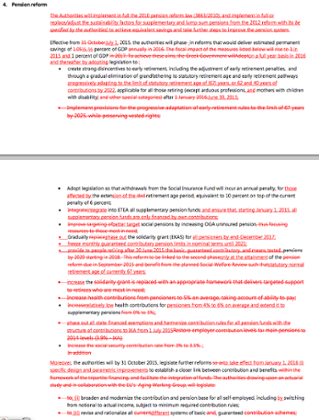
The five-page counter-proposal made by Greece’s creditors has just leaked - in several places.
And it confirms that Athens has been pushed to raise more from VAT and also make sweeping changes to its pensions system, including raising the retirement age faster and eliminating benefits for the poorest pensioners.
The red crossings out show items which are being rejected by creditors, and the underlined red sections show the new proposals.

The pensions section is a wholesale rewrite:
Swallowing all this will be very hard for the Greek PM, let alone his party.
As @LorcanRK points out pension reform counter-proposal will be bitter pill to swallow for SYRIZA who hve tried desperately to protect them
— Tomas Hirst (@tomashirstecon) June 24, 2015
Updated
Bad news: There still isn’t a deal. Good news: they’re still talking......
- 15:07:07 - OUTCOME OF TALKS BETWEEN GREECE AND CREDITORS IN BRUSSELS STILL VERY UNCERTAIN, NO DEAL YET - OFFICIAL CLOSE TO CREDITOR
Even if a deal is reached tonight in Brussels (or on Thursday morning), Alexis Tsipras will face a real fight to get it through the Athens parliament.
And German MPs will also be asked to vote, possibly at an emergency session.
Nina Schick of Open Europe, the think tank, explains:
If Greece and the creditors agree something by tomorrow (still not a given), the immediate challenge for Tsipras will be at home, where he’ll have to get the Greek parliament to back it. Despite Syriza’s election promises, what’s on the table now means that Tsipras has more or less capitulated completely to the demands of the creditors. It’s not likely to go down well.
With a majority of only 11 MPs, Tsipras will seek approval from the 200 MPs that form the Central Committee of Syriza. According to Greek press reports, 10-40 Syriza MPs are likely to revolt. Syriza’s junior coalition partner, the Independent Greeks, have also indicated that they could withdraw from the government. Tsipras could be left having to rely on the support of the opposition New Democracy. This in turn would open up the question of a referendum or new elections. Vassilis Primikiris, a senior member of Syriza’s hard-line Left Platform told Italy’s La Repubblica today:
“I doubt [Tsipras] can afford to pass the deal [in the Greek parliament] without our votes and with the opposition’s votes. That would mean there’s no longer a majority and that we should go to elections.” -Vassilis Primikiris, La Repubblica, 24 June 2015
As Greece’s largest creditor nation, the vote in the German Bundestag will also be key. With the Bundestag breaking for summer recess next Friday July 3rd, the vote will either have to be taken on the 29th or 30th of June – not allowing German MPs much time to consider the measures. A Bild report today suggests that a number of MPs from Angela Merkel’s CDU/CSU party are opposed a rushed vote on any new agreement with Greece. CDU MP Olav Gutting is quoted as saying, “I don’t consider it possible to approve anything on Monday or Tuesday.”
There is a possibility, then, that an emergency sitting of the Bundestag may have to be called. And while any deal backed by Chancellor Angela Merkel is likely to get through the Bundestag – it’s worth noting that with frustration towards Athens climaxing during the past five months, the breakdown in trust will surely come back to haunt Athens sooner or later – most likely when the discussion returns to an (inevitable) third bailout for Greece.
#Tsipras will have to get any deal through Greek parl - if MPs revolt, will have to call elections or referendum: http://t.co/85Gco4FBxr
— Open Europe (@OpenEurope) June 24, 2015
Updated
If you’re just joining us, check out my colleague Jennifer Rankin’s latest news story on the crisis:
Marcus Walker of the Wall Street Journal sums up the situation in the negotiating room in Brussels.
3-way chicken: Tsipras wants to avoid spending cuts IMF wants spending cuts or debt relief Merkel wants to avoid debt relief Who blinks?
— Marcus Walker (@MMQWalker) June 24, 2015
If deal rests on spending cuts: Tsipras has problem w Syriza. If deal rests on tax hikes: IMF has problem with DSA, and Merkel with IMF.
— Marcus Walker (@MMQWalker) June 24, 2015
(DSA= debt sustainability analysis. IE: If Greece ramps up taxes, growth will slow and the debt/GDP ratio will spiral even more)
The Curse of the Awards Ceremony:
Jus' sayin... #Greece pic.twitter.com/UHVS1BpRPv
— MARK GILBERT (@ScouseView) June 24, 2015
Updated
We’re keeping track of the state of play in Greece’s debt negotiations here:

Speaking of the IMF, Politico have published a great feature today on how it became entangled in such a mess in Greece.
It explains how Christine Lagarde is left with a mess created by her predecessor, Dominique Strauss-Kahn, as she struggles to ensure the Fund gets its money back.
Here’s a flavour:
Because Greece was in a monetary union, and couldn’t devalue its currency, the IMF introduced a “systemic exemption” that waived any condition related to debt, says Jean-Pierre Landau, who was then a deputy governor of the French central bank and now teaches at Sciences Po in Paris.
That was “a code word for the risk of contagion inside the euro area,” he notes. The IMF board, right from the beginning, found it hard to accept and “it created resentment and a lot of skepticism” within the institution, adds Landau, who knows the IMF well, having been its French board member in the early nineties.
The Greek bailout also created a precedent in terms of size. It was the largest ever implemented by the IMF, as a percentage of a given country’s stake in the Fund. Between the first and second bailout in 2012, the IMF ended up loaning about €30 billion to Greece. Some €23 billion is still owed, to be paid back until the end of 2030, starting with €5.5 billion due by the end of this year.
Then there were the forecasting mistakes. Sterne notes for example that the IMF revised down its estimate for Greece’s 2014 gross domestic product by some 22 percent in the space of 18 months. “In U.S. terms, that is the equivalent of revising away the combined output of the whole of California, New York and Florida,” he writes.
Why the IMF’s so hard on Greece
The IMF’s role in #Greece has been “one of the most credibility-sapping in its history”. http://t.co/Ifv8a5G2Kq
— Patrick Pechmann (@PatrickPechmann) June 24, 2015
A senior German official has told Reuters that any aid-for-reforms deal with Greece must include the support of the International Monetary Fund:
The official said that it was important for Berlin to have the IMF at the table, both for its expertise and its role in financing Greece.
Of course, the IMF’s “expertise” means it believes Greece needs debt relief - an issue Germany isn’t terribly happy about confronting at this stage.
The Athens stock market was deep in the red as Alexis Tsipras’s meeting with creditors began - down around 4.5%. Bank shares are down 10%.
Greece’s Esfyn newspaper has confirmed that the IMF presented Greece with new counter-proposals.
And they do indeed insisting on tougher pension and VAT reforms -- to yield a full 1% of GDP, and a smaller rise in corporation tax.
The IMF also wants early retirement rules to be tightened up faster, and ending lower VAT rates in Greek islands (a red line for Tsipras’s coalition partners, ANEL).
The new #IMF proposals to the Greek government via @EFSYNTAKTON and @NikosSverkos http://t.co/TxkBVTYKsh
— EfiKoutsokosta (@Efkouts) June 24, 2015
Updated
Here's why talks between Greece and creditors are in crisis again
Greece and its creditors are still deeply divided over three key areas -- corporate taxation, the overhaul of Greece’s pension system and value-added taxes.
That’s according to the latest counter-proposal from the Institutions, which the Wall Street Journal has seen. And which Greece has rejected.
According to the WSJ, Greece’s creditors won’t accept some of the tax rises on businesses, which they want toned down.
But they also want more money clawed from consumers through VAT hikes.
And Greece’s plan to raise pension contributions while protecting payments to existing pensioners is also being challenged. Creditors want more frontline cuts.
Divisions Remain as Eurozone Finance Ministers Meet Over Greece Deal
WSJ has a great breakdown of all the major divisions still left between creditors and Athens: http://t.co/P3CWkoNDH0 pic.twitter.com/BNGN42giMa
— Mike Bird (@Birdyword) June 24, 2015
Based on what's been reported of lenders' counter-proposals to #Greece, it's clear we're in for a long & difficult night #euro #Eurogroup
— Nick Malkoutzis (@NickMalkoutzis) June 24, 2015
Finally, here’s some footage of Alexis Tsipras arriving at the Commission. He resisted saying anything to the media, beyond a polite “Hi”.
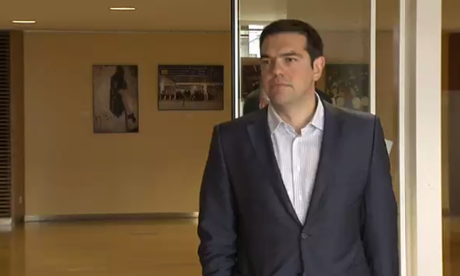
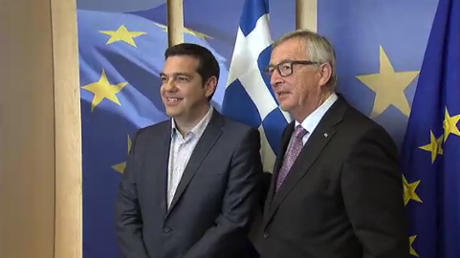
And then he vanished to meet Greece’s creditors, for some very serious talks.
No comment from either #Tsipras or #Juncker. Just a handshake with some forced smiles. #Eurogroup #Greece
— Jack Parrock (@jackeparrock) June 24, 2015
Just an arm around the shoulder #JunckerTsipras
— Danny Kemp (@dannyctkemp) June 24, 2015
Updated
Oh sorry, the photo in that last tweet isn’t from today (now deleted).
'They cancelled the kiss', our man says after Tsipras-Juncker fail to show up for the cameras
— Danny Kemp (@dannyctkemp) June 24, 2015
Updated
Looks like Commissioner Pierre Moscovici took out his frustrations on a biscuit at this lunchtime’s crisis meeting:

Updated
Oh sorry, they’ve turned off the video feed from the EC. Apparently Alexis Tsipras has arrived, but didn’t speak to the press.
#Tsipras arrives at @EU_Commission for some serious talking with creditors. No kisses, no backslapping, no statement.
— Rik Winkel (@RikWinkel) June 24, 2015
Alexis Tsipras is arriving at the European Commission to meet president Jean-Claude Juncker imminently. It will be streamed live here.
Two days ago, Tsipras got a jokey slap from Juncker, so I shudder to think how he’ll be greeted this time....
Kiss, slap or hug? Brussels press pack awaits clues on Greece crisis from @JunckerEU who is about to welcome @tsipras_eu to Berlaymont.
— James Kanter (@jameskanter) June 24, 2015
Sky’s Ed Conway is hearing that all isn’t lost between Greece and its lenders.....
My sources close to negotiations saying there's a "big gap" between the two sides. Bridgeable, but will take even more work than expected
— Ed Conway (@EdConwaySky) June 24, 2015
Fascinated by the latest twists and turns in the Greek crisis? Well, come along to the Guardian’s panel discussion in London tomorrow night...and have your say too:
The midday briefing in Brussels didn’t yield much information on the escalating Greek crisis.
After a fascinating discussion about senior management changes at the European Commission, the Brussels press pack were only told that:
The [Greek] proposals are a step in the direction to finding common ground for an agreement, and they are being discussed as we speak....at the highest level.
.@EU_Commission press room goes in deep on bureaucratic musical chairs as Greek crisis talks unfold a few floors above.
— Tom Nuttall (@tom_nuttall) June 24, 2015
The leaders of Greece’s creditors are sitting down in Brussels now to discuss the situation.
They must digest Alexis Tsipras’s dramatic attack on the IMF this morning, before the Greek PM joins them.
There are some very serious-looking faces around the table:


First footage of Brussels meeting, to be joined by PM Tsipras later #Greece pic.twitter.com/cUDKZtcL3s
— Derek Gatopoulos (@dgatopoulos) June 24, 2015
FTSE Athex Banking index drops >7% on debt talk angst. Acc to Greek official, #IMF has rejected Greek tax proposals. pic.twitter.com/hkqeoKkpDD
— Holger Zschaepitz (@Schuldensuehner) June 24, 2015
EU officials are briefing that talks with Greece have not broken down -- which I guess is meant to sound reassuring.
Reuters has the story:
Talks with Greece on a financing for reforms package are still going on and a meeting between international creditors and Greek Prime Minister Alexis Tsipras in Brussels will take place as planned, an EU official said on Wednesday.
Markets reacted nervously to a statement out of Athens by a Greek government official quoting Tsipras as saying that creditors have rejected certain proposals from Greece in last-ditch talks in Brussels.
An EU official close to the talks said.
“Nothing has broken down, negotiations are going on and the meeting with Tsipras will go ahead as planned.”
And here’s those nervous markets:

Updated

Jeroen Dijsselbloem, president of the Eurogroup of finance ministers, has confirmed that a Greek deal still hangs in the balance ahead of tonight’s meeting.
- EUROGROUP HEAD DIJSSELBLOEM ON GREECE TALKS SAYS “WE ARE NOT THERE YET, STILL A LOT OF WORK TO BE DONE”
Updated
Alexis Tsipras has also tweeted his criticism of the International Monetary Fund, meaning the gloves are well and truly off.
Η επιμονή συγκεκριμένων θεσμών να μην αποδέχονται ισοδύναμα μετρά, δεν έχει ξαναγίνει. Ούτε στην Ιρλανδία ούτε στην Πορτογαλία. 1/2
— a.tsipras (@atsipras) June 24, 2015
PM on IMF "technical staff" (Thomsen) rejection of Greek equivalent measures: They either do not want a deal or serve specific interests”
— Dimitris Yannopoulos (@DimitrisY) June 24, 2015
(That’s Poul Thomsen, the IMF’s top man in Europe)
And the “equivalent measures” are the new policies that Greece has proposed, to change its old bailout programme.
In short, Greece is unhappy that the IMF won’t support its plan to raise €8bn from taxes on businesses, shoppers, income tax payers and pensioners.
"Non-acceptance of equivalent measures never been done before. Not in Ireland or Portugal" says @atsipras. Doesn't mean proposal rejected...
— Peter Spiegel (@SpiegelPeter) June 24, 2015
#Greece officials say new @atsipras statement aimed at #IMF. Schäuble told Monday's #eurogroup to "stop blaming" IMF. Rock, meet hard place.
— Peter Spiegel (@SpiegelPeter) June 24, 2015
Updated
Tsipras: Creditors may be serving 'specific interests'
My colleague Helena Smith has got hold of the statement just released by the Greek government.
And it shows that prime minister Alexis Tsipras says the refusal of creditors to accept Athens’ latest proposals is not only unprecedented but has “never happened either in Italy, Portugal. Nowhere!”
Before departing for Brussels, Alexis Tsipras told his colleagues:
“This strange stance may hide two possibilities. Either they don’t want an agreement or they are serving specific interests in Greece.”
This would chime with what insiders told us earlier: that inside the governing far left Syriza party there are now many who are openly questioning whether the EU, ECB and IMF really want to cut a deal with the Tsipras administration.
Updated
The German, French, Spanish and Italian stock markets all tumbled by 1% as investors reacted to the news that Greek negotiations are faltering:
Spot the moment the Tsipras headlines came out. http://t.co/tzZkz4TZWg pic.twitter.com/2AOtvaCbuo
— Joseph Weisenthal (@TheStalwart) June 24, 2015
It’s not looking good at all.
According to FT Brussels bureau chief Peter Spiegel, Greece’s creditors are unhappy that Athens is backtracking on parts of the deal submitted early on Monday.
Told #Greece "prior actions" list submitted y'day walked back previous commitments, angering creditors. Story soon: http://t.co/heiO1Ph2u4
— Peter Spiegel (@SpiegelPeter) June 24, 2015
Prior actions are the measures that Greece must take before it receives any bailout funds.
Tsipras: Creditors won't accept our proposals
The wheels may be coming off.....
The Greek government has just criticised the country’s lenders for not accepting its latest proposals.
*TSIPRAS SAYS CREDITORS DIDN'T ACCEPT GREEK PROPOSALS: OFFICIAL
— Michael Hewson (@mhewson_CMC) June 24, 2015
Greek gov't briefing Tsipras is unhappy lenders not accepting some measures, says this is unprecedented, questions if they want deal #Greece
— Nick Malkoutzis (@NickMalkoutzis) June 24, 2015
And that has knocked shares across Europe, sending the Athens market down over 4%.
Eurozone government bonds are being hit too, driving up the yields (or interest rates) on Spanish and Italian debt.
Spanish and Italian 10yr bond yields jump as #Greece's Tsipras says proposals not accepted. pic.twitter.com/qHjQkuUWkB
— Holger Zschaepitz (@Schuldensuehner) June 24, 2015
Updated
Greek opposition leaders also heading to Brussels
Over in Athens the political opposition has stepped up criticism of the government’s proposed reforms, and are also heading to Brussels to rally for a deal:
Helena Smith reports:
It is not only Alexis Tsipras who is making his way from Athens to Brussels today.
Former prime minister Antonis Samaras and Stavros Theodorakis, leader of the centrist To Potami party, are both also departing for the Belgian capital today ahead of tomorrow’s EU summit.
Both say they want to make the case for Greece. Samaras, whose conservative-led government was ousted by Tsipras’ Syriza in January - is aiming to have a quiet word with German chancellor Merkel on the sidelines of the summit.
At €8bn – eight times more than savings outlined by his conservative government in December – Samaras says Greece has been forced to choose “between catastrophe and a very bad solution.”
Five months of drawn out negotiations and putting up a robust defence had been a fiasco, Samaras’s centre-right New Democracy party said.
Criticism of prime minister Alexis Tsipras’ finance minister Yanis Varoufakis is on the rise with Yannis Vroutsis, the former minister of labour, accusing the academic-turned politician of “getting a certificate in inaccuracy and lies.”
“If there any Greek who now believes Mr Varoufakis?” he asked this morning.
Varoufakis, though, was quite upbeat this morning, telling reporters that:
“We are entering the final stage of the negotiation which we hope, we strive, to be the last.”
Varoufakis: We hope this is the last stage of negotiations -VIDEO - http://t.co/X8Rg9QdPIt pic.twitter.com/TVdgfC0UGS
— enikos_en (@enikos_en) June 24, 2015
Updated
And here’s confirmation that eurozone finance ministers could work all night to get a deal:
- 10:32:01 - EU LEADERS WON’T NEGOTIATE ON GREECE AT SUMMIT ON THURSDAY, WANT DEAL AT EUROGROUP ON WED EVEN IF IT MEANS WORK THROUGH THE NIGHT - SENIOR EU OFFICIAL
Here’s further confirmation that Greece’s bailout deal remains up in the air, from Reuters:
- 10:14:30 - POSITIONS OF CREDITORS AND GREECE STILL APART BEFORE EU/IMF/ECB MEETING WITH TSIPRAS TODAY, NOT MUCH PROGRESS MADE ON TUESDAY - EU OFFICIAL
- 10:16:14 - VAT, PENSIONS, COMPANY TAXATION MAIN STICKING POINTS WITH GREECE AT THIS STAGE, DEBT RESTRUCTURING NOT DISCUSSED - EU OFFICIAL
The head of the Eurogroup has been told in no uncertain terms that finance ministers must agree a deal with Greece today, Brussels insiders say. However long it takes.
Eurogroup chief @J_Dijsselbloem told by leaders on Mon to get Greece settled on Weds even if takes all night, indicates senior EU official.
— James Kanter (@jameskanter) June 24, 2015
Updated
Tsipras in last-ditch bid to salvage deal

Alexis Tsipras’s trip to Brussels today is a “last ditch” bid to salvage his bailout agreement, says the Financial Times.
Echoing Ian Traynor’s warning that the deal could soon unravel, the FT says the Greek PM will be pushed to revise his reform plan at the meeting with Lagarde, Draghi and Juncker.
From Brussels, the FT’s Peter Spiegel writes:
According to a senior eurozone official, talks between Athens and negotiators from the bailout monitors — the International Monetary Fund, European Commission, and European Central Bank — have barely progressed since Mr Tsipras’ proposal was met with an outpouring of relief at a summit of eurozone leaders on Monday night.
That has raised concerns over whether a deal can be finalised this evening at a meeting of eurozone finance ministers in Brussels.
And crucially, Greece’s creditors aren’t on the same page.
Two officials involved in the talks said the IMF and the commission are at loggerheads over how many revisions are required, with the IMF concerned the proposal relies almost exclusively on increased employee contributions — essentially a new 3.9 per cent tax on labour — to make up shortfalls in the pension system.
The IMF has pushed for benefit cuts in the system to make it more sustainable in the long term. EU officials have termed the Greek public pension system one of the most generous in the 28-country bloc.
More here: Tsipras flies to Brussels to salvage bailout deal
And if that wasn’t bad enough, negotiations over the issue of debt relief aren’t getting anywhere.
Tsipras needs to be able to present some progress on that issue to keep his MPs onside, but creditors won’t budge until the current bailout programme is resolved.
Updated
This is not the best day for the president of the ECB to be cooling his heels on the Heathrow tarmac:
Still on the ground at Heathrow. But taking off imminently (apparently) #Draghiflightupdate
— Ed Conway (@EdConwaySky) June 24, 2015
Updated
Juncker, Draghi and Lagarde meeting today at 1100 BST and Juncker set to meet Tsipras separately to discuss latest Greek proposal later on
— RANsquawk (@RANsquawk) June 24, 2015
Brussels insiders are warning that today’s meeting of finance ministers could last until dawn....
EU source says #eurogroup will "sit all night if it has to" in order to close deal before Thursday's summit #greece #grexit #greekcrisis
— Suzanne Lynch (@suzannelynch1) June 24, 2015
#grexit tuesday midnight. thursday 1 a.m.? friday 2 a.m.? gotta be a better way of running europe...exhausting just thinking about it
— Ian Traynor (@traynorbrussels) June 24, 2015
Updated
Greek insiders question if deal can be reached
Over in Athens, the view this morning is that a deal with creditors has never been “so near or so far away,”
Our correspondent Helena Smith reports:
Senior government officials are saying openly this morning that divergence rather than convergence is now dominating talks. Outstanding differences are such that insiders have begun to question whether creditors want an agreement at all.
The International Monetary Fund’s apparent insistence that proposed taxes on businesses be withdrawn, putting a greater burden on wage earners and pensioners, has ignited fury.
“It is as if they don’t want to reach a deal with a government of the left,” said one well-placed source.
“What the hell are they doing insisting that the vulnerable carry the weight of measures once again? It hasn’t worked before and it is not going to work now.”
The front page headline of the Ta Nea newspaper today is indicative of the mood.
“They are demanding another €700m to close the deal,” the authoritative daily screamed from its front page.
Prime minister Alexis Tsipras has not been helped by the signs of mounting dissent within his own Syriza party over his leftist-led government’s proposed reforms.
At least ten MPS have indicated they will not support a deal as the proposals currently stand; at least ten more are wavering and it remains unclear what hardliners, gathered under the Left Platform faction led by energy minister Panagiotis Lafazanis will do. The minister, so far, has been uncharacteristically coy about what stance he - or his followers - will take saying he will only decide once a final deal is on the table. Those who advocate a return to the drachma have, if anything, been emboldened by the growing outcry over measures that at €8bn will do a great deal to further impoverish Greeks.
“Approval of the agreement or elections, the dilemma of the government,” declared another daily, Ethnos, from its front page.
“The ball is now with Syriza MPs.”
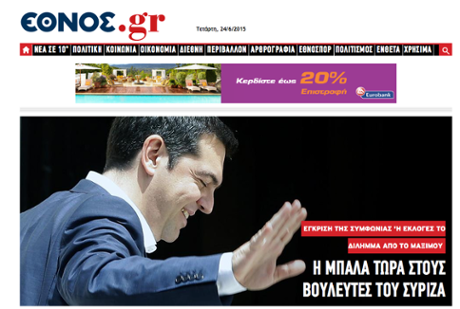
The small right-wing Independent Greeks party (ANEL) has added to mounting concerns (some are beginning to call it realisation) that the cash-for-reform deal in its current form will not get through parliament with MPS insisting that “red lines” are more important than inflicting needless pain on Greeks.
The only way out of the conundrum would perhaps be some kind of commitment by creditors to write down Greece’s debt load in the future.
More than ever, it is clear that Tsipras needs to be cut some leeway by creditors so that he can convince wavering MPs that the deal is workable and has to be passed.
So, this lunchtime’s meeting is absolutely crucial....
Updated
Assuming Mario Draghi’s flight isn’t badly delayed, he’s expected at the Justus Lipsius building in Brussels at 11am BST (1pm Athens time).
Tsipras arrives an hour later, to face his creditors’ concerns over the Greek bailout plan.
Press being told @Lagarde & #Draghi arriving at @EU_Commission HQ at noon. @atsipras due at 1pm. #Greece
— Peter Spiegel (@SpiegelPeter) June 24, 2015
Our spies at Heathrow report that Mario Draghi might be late landing in Brussels:
Today's emergency Tsipras meeting in Brussels might be a bit delayed. My flight from LHR, which contains Mario Draghi, is running late
— Ed Conway (@EdConwaySky) June 24, 2015
Spotted at Heathrow this morning: Mario Draghi. I can reveal that he is extremely efficient at going through security
— Ed Conway (@EdConwaySky) June 24, 2015
Updated
Greek stock market dips ahead of crucial meeting
The Greek stock market has fallen almost 2.5% at the start of trading, ahead of today’s emergency talks between prime minister Alexis Tsipras and creditors.
Bank shares (which soared on Monday and Tuesday this week), fell by almost 5%, as traders begin to fret that a breakthrough deal may not come tonight.
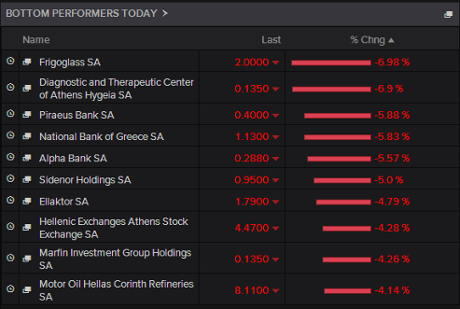
Tsipras’s emergency meeting with IMF chief Christine Lagarde and ECB chief Mario Draghi is a sign that the deal could yet unravel, as my colleague Ian Traynor reported from Brussels overnight:
Greece’s prime minister, Alexis Tsipras, arrives in Brussels on Wednesday for critical talks with the country’s creditors as the outlines of the latest proposed deal to avoid bankruptcy threatens to unravel, worsening the crisis.....
The other European markets are fairly flat, as investors await developments....
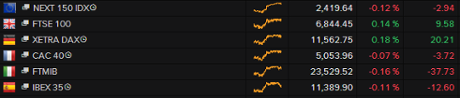
Updated
Here’s our analysis of the latest Greek proposal:
Updated
Wonkblog’s Matt O’Brien has taken a nailgun to Greece’s proposed reforms, and blasted the creditors for forcing Athens to cave in and propose new tax rises to satisfy their taste for budget surpluses.
He writes:
There’s only one reason to make Greece do more austerity, and it makes no sense at all.
That’s to try to make it pay back what it owes. Indeed, one European official said that the entire point of this was that they “want to get our money back some day.” The problem, though, is everybody knows Greece will never do that. Its debt should have been written down in 2010, but it wasn’t because it was “bailed out” to the extent that it was given money to then give to French and German banks. The longer Europe pretends this new debt will be paid back, the longer Greece’s depression will go on. Now, it’s true that Europe has lowered the interest rates and extended the maturities on Greece’s debt so far out that, for now at least, it’s like a lot of it doesn’t exist. But eventually it will, and at that point they’ll either need to extend-and-pretend some more or hope that Greece has returned to growth.
Until then, Greece will be stuck in its economic Groundhog Day. It keeps trying to resist these pointless budget cuts that just keep it in a perpetual state of high unemployment, but then gives in at the last minute. On second thought, history is just repeating itself as tragedy over and over again.
More here: Europe is destroying Greece’s economy for no reason at all
Updated
Larry Elliott: Greek plan doomed to fail
In case you missed it, our economics editor Larry Elliott has explained why the latest Greek proposal falls short:
The troika plan for the Greek economy has already failed twice, and it will fail for a third time if the economically illiterate plan being foisted on Athens is adopted. Greece requires growth and debt relief, but the proposals currently being discussed provide neither......
Greece has a number of severe economic problems. It suffers from a lack of demand, and a five-year slump has pushed it into deflation. Falling prices have added to the real, inflation-adjusted burden of the government’s debt, which currently stands at 175% of GDP. A fresh dose of austerity will make all these problems worse.
And as this chart shows, Greece has already been imposing a very significant fiscal tightening.
Interesting: IMF estimates of cyclically adjusted primary balances of the eurozone in 2014. #Greece @NYTimeskrugman pic.twitter.com/h3dh7HRe6q
— Markus Schuller (@panthera_s) June 21, 2015
Updated
EU officials are cagey about the chances of a breakthrough finally coming tonight, reports The Economist’s Tom Nuttall.
Eurozone diplomat on Greece: all to play for at Eurogroup tonight. But after Monday euro summit, mood is "less uneuphoric" than before.
— Tom Nuttall (@tom_nuttall) June 24, 2015
Don’t make any plans for the weekend.
Assuming a deal is reached soon, Greek MPs could hold a three-day debate on the package, starting on Saturday.
According to the Financial Times, Germany is insisting that the Greek parliament approves the new reform plan by Monday, before any aid is handed over
People briefed on Berlin’s thinking said months of fraught negotiations since the radical anti-austerity government came to power have undermined trust in Greece’s ability to fuflill its promises. German officials want Greek parliamentary approval before an extension of its bailout programme is presented to the Bundestag before it expires on Tuesday
More here: Berlin insists Greek parliament approves all reforms by Monday
Austria: Need real solution by Sunday

Austria’s finance minister has warned that Greece must produce a full timetable for implementing economic reforms, in order to get a deal.
Hans Jörg Schelling also warned Austrian radio station that a cut-and-dried solution must be found by Sunday:
“I expect that this will be offered by this evening ... If there is no real solution by Sunday this week, it is not foreseeable what the next step will be.”
The EC is also seeking a list of ‘prior actions’ from Greece; perhaps concerned that Athens will struggle to implement reforms.
Introduction: Tsipras summoned to Brussels for emergency talks
Good morning.
Greece’s future is in the balance today as Europe’s top politicians head back to Brussels for another series of top-level meetings.
At 7pm CEST (6pm BST) eurozone finance ministers will hold their third Eurogroup meeting in a week, in a bid to end months of tortuous negotiations. If they actually agree to the list of Greek reforms, then we could be a crucial step closer to a deal.
But several hurdles lie ahead. Last night it emerged that Greece’s creditors are split over the details of the latest proposal from Athens – with the International Monetary Fund not sharing the European Commissions optimistic view of the situation.
As we wrote last night:
The mild euphoria that characterised frantic diplomacy and another eurozone summit in Brussels on Monday dissolved swiftly on Tuesday as it became clear that Lagarde found the proposed temporary resolution inadequate and that German chancellor Angela Merkel was also having second thoughts....
Lagarde, who kept a low profile at Monday’s emergency summit, was said to have strong reservations about the proposed agreement on ideological terms opposed to the hard-left Tsipras government, but also because she does not think the putative agreement will put Greece on the road to recovery.
Sources familiar with Merkel’s thinking said the German leader faced a potential party revolt over extending a further lifeline to Greece without confidence it would succeed.
EU Observer has a good take too:
The IMF “thinks that the numbers are too soft,” an EU source said, referring to the fiscal targets, pensions and VAT levels under discussion.
More here: Greece’s creditors differ on bailout agreement
And that’s why Greek PM Alexis Tsipras is being hauled back to Belgium to meet the heads of the IMF, ECB, European Commission and the Eurogroup. They will attempt to resolve the remaining issues, so that EU leaders can sign the deal off on Thursday night.
#grexit tsipras summoned to brussels weds before eurogroup. with juncker, dijsselbloem, lagarde, draghi. confirmed in bxl #herewego
— Ian Traynor (@traynorbrussels) June 23, 2015
So Tsipras in Brussels today with three main creditors is either bad sign, or means they hope for big announcement. We'll see.
— Danny Kemp (@dannyctkemp) June 24, 2015
As we covered in yesterday’s liveblog, many experts fear that the €8bn squeeze on pensioners, consumers and firms contained in the proposals will wreck further harm on an already-weakened economy.
This is simply not what Tsipras was elected to deliver.
As Syriza MP Costas Lapavitsas put it:
“Many MPs, be them on the left or not, are very sceptical about accepting such a programme.
“How will they explain it to their voters? How will they return to their electoral constituencies and explain this agreement to them?”
That means getting this deal through the Athens parliament will not be easy. The possibility of fresh elections or a referendum hasn’t evaporated, if Tsipras cannot get his own party onside.
And the sight of protesters on the streets of the capital last night has shown that public anger over the prospect of fresh austerity is building.


And here’s very little time left - Greece’s bailout programme expires in less than a week.
There’s still optimism in the financial markets that a deal will be reached. But this story has a few twists and turns in it yet.
We’ll be tracking all the main events through another crunch day in the crisis.....
Updated