Tsipras: We have a strong mandate
Alexis Tsipras is giving his statement following tonight’s vote right now.
The Greek PM says that his government has a strong mandate to complete negotiations with its creditors towards a viable solution.
The priority now is a positive outcome in the negotiations....everything else comes afterwards.
#Tsipras: Gov't has strong mandate to complete talks with lenders for viable agreement. This is priority. Deal with rest later #Greece
— Nick Malkoutzis (@NickMalkoutzis) July 11, 2015
#Tsipras: Parliament gave government a strong mandate to complete negotiations. The priority now is successful conclusion of talks #Greece
— Kathimerini English (@ekathimerini) July 11, 2015
So questions of reshuffles, new coalition partners, fresh elections, unity governments, and all the other rumours flying around will have to wait. But probably not for long.
And that means it is time for bed.
We’ll be back with a new Greek crisis liveblog in a few hours, to cover the crucial Eurogroup meeting. Thanks for reading, following, and helping - goodnight! GW
Updated
It’s almost 5am, and journalists are waiting for Tsipras to issue his statement.
Περιμένοντας δήλωση πρωθυπουργού, πλησιάζει 5 πμ #vouli pic.twitter.com/FY3KWmhMn6
— George Bourdaras (@InsiderGR) July 11, 2015
Updated
As we wait, here’s a picture of Alexis Tsipras voting earlier:

Well, I was about to knock off, but apparently there’s a statement coming from the Greek PM. So we’d better hang on....
Tsipras to make statement soon. (It's 04:30 am!)
— Yannis Koutsomitis (@YanniKouts) July 11, 2015
Updated
Summary: Tsipras wins the vote
Alexis Tsipras has won crucial approval from the Greek parliament for the €13bn of austerity measures he is proposing to creditors, to obtain a third bailout programme.
After a late-night debate, 250 MPs out of 300 voted to give Tsipras, and finance minister Euclid Tsakalotos, a mandate to negotiate this weekend.

But, two Syriza MPs voted no, eight abstained, and seven were absent, potentially undermining the PM’s authority at a critical time.
Before the vote, Alexis Tsipras described the last few months as a war in which difficult battles were fought and some were lost.
Tsipras lost 17 members of his coalition. http://t.co/JB5B87Q6zy pic.twitter.com/Nz27AMp8a1
— Joseph Weisenthal (@TheStalwart) July 11, 2015
“Now I have the feeling we’ve reached the demarked line. From here on there is a minefield,”
Tsipras also admitted that the package of tax rises and pension reforms do not match the pledges he ran for office on in January.

But he pledged that some of the measures would help the economy, eliminate the danger of Grexit, and lead to meaningful discussion on debt relief:
“For the first time, we have on the table a substantial discussion for a debt restructuring.”
According to reports, some creditors have decided that Greece’s plan is serious enough to merit discussion on a third bailout
EU and IMF officials have given euro zone governments a positive assessment of Greece’s request for a new bailout, a source close to the matter said, making it likely they will agree on Saturday to open talks on lending Athens tens of billions of additional euros.
Eurozone finance ministers will discuss the issue at a Eurogroup meeting on Saturday. Diplomats have told the Guardian that there is no guarantee of a third aid package. Grexit is still a serious possibility, they say.
And there were protests outside parliament tonight, by groups opposed to a new austerity package.
Updated
Bill passes despite government rebels
Although the bill has passed with a big majority, 250 out of 300, the big question is how the coalition split.
And it appears that only 145 Syriza-ANEL MPs backed the plan, out of 162.
Some eight Syriza MPs abstained, two voted no, and seven didn’t turn up.
(Under Greek parliamentary law, those seven absentee MPs don’t count as rebels).
The scale of the rebellion is a blow to Alexis Tsipras, and raises doubts over his ability to get these measure put into law.
BUT, this wasn’t a formal vote of confidence. So you can’t assume that these MPs would rebel on a knife-edge vote that could bring the government down.
But analysts are suggesting that this could force a government shake-up.
Strong support for proposals in Greek Parl't (250/300 MPs) but problem for PM is only 145 from coalition, raising Qs about majority #Greece
— Nick Malkoutzis (@NickMalkoutzis) July 11, 2015
Questions now if Tsipras can continue with this set-up or whether he needs new MPs/coalition/elections. Also, will lenders trust him #Greece
— Nick Malkoutzis (@NickMalkoutzis) July 11, 2015
#Greece govt suffers wider losses than expected - Tough days ahead for Tsipras - Almost impossible to pass bailout laws under this coalition
— Yannis Koutsomitis (@YanniKouts) July 11, 2015
Here’s the official result:
- 250 MPs voted in favour,
- 32 against
- 8 abstained
Which means another 10 were absent, I think.
Updated
Lots of speculation swirling about how close the result was......
Now the influential energy minister, Panagiotis Lafazanis, has abstained!
Syriza's Lafazanis (energy minister) joins dissenters, abstains #Greece
— Derek Gatopoulos (@dgatopoulos) July 11, 2015
Govt has lost 10 votes, result will be close. Bill will pass due to opposition support but serious blow to govt. Reshuffle at v least
— NikiKitsantonis (@NikiKitsantonis) July 11, 2015
Alexis Tsipras’s Syriza party has 149 seats; its coalition partner ANEL has 13, giving 162 votes in the 300-strong parliament.
So he can only afford 11 rebels, before he’s relying on opposition MPs to back him.
MPs approve bailout plan
A majority of MPs have now backed the motion - but how many more Syriza MPs will rebel?
Government motion passes in parliament but coalition suffering more losses #Greece
— Derek Gatopoulos (@dgatopoulos) July 11, 2015
Updated
This is a nailbiter for Tsipras - he’s running the risk of not carrying enough of his own party with him.....
First NO by #syriza MP Gaitani from thessaloniki, brings votes from coalition to 154.. 151 the confidence threshold #Greece
— Janine Louloudi (@janinel83) July 11, 2015
Another member of Syriza’s Left Platform (the most radical wing), Costas Lapavitsas, has abstained....
Lapavitsas also abstains, gov't has lost 7 votes so far #Greece
— Nick Malkoutzis (@NickMalkoutzis) July 11, 2015
Six rebels have now abstained, raising the possibility that Alexis Tsipras will be dependent on opposition votes to get his plan through...
There go another two SYRIZA MPs. Total 6 votes.
— Theodora Oikonomides (@IrateGreek) July 11, 2015
Make that four abstentions from the government ranks:
Alternate Minister for Social Security Stratoulis abstains along with three others so far #Greece
— Nick Malkoutzis (@NickMalkoutzis) July 11, 2015
So far SYRIZA lost 4 votes: one deputy minister, one former minister, the speaker of parliament and an MP. No comment. #Greece
— Theodora Oikonomides (@IrateGreek) July 11, 2015
Much excitement when former finance minister Yanis Varoufakis is asked to vote (he’s gone off on a family trip)
Huge racket when Yanis Varoufakis' name is read out. #vouli
— Damian Mac Con Uladh (@damomac) July 11, 2015
Two government MPs have already abstained.....
Syriza lost two in vote so far (both abstained) #Greece
— Derek Gatopoulos (@dgatopoulos) July 11, 2015
Voting begins
AND WE’RE OFF. Voting is underway......on whether to give Alexis Tsipras the authority to negotiate with lenders, based on the €13bn package of measures drawn up yesterday.
The clocks have struck 3am in Athens, so we should be close to a vote (hopefully).
Every member of the government has deep black circles under their eyes. At least that's one thing we still have in common with them.
— Theodora Oikonomides (@IrateGreek) July 11, 2015
Parliament speaker Konstantopoulou says won't vote for new deal, will abstain tonight #Greece pic.twitter.com/lvvPz52LO6
— Derek Gatopoulos (@dgatopoulos) July 10, 2015
After that attack on Greece’s creditors, Zoe Konstantopoulou says she will abstain.
Parl't speaker Konstantopoulou (SYRIZA) says she could never vote for proposals under normal circumstances but will vote "present" #Greece
— Nick Malkoutzis (@NickMalkoutzis) July 10, 2015
Zoe Konstantopoulou, the Syriza MP and House speaker, is now accusing Greece’s lenders of blackmail, and criticising Germany for not making war reparations.
#now Ms. Konstantopoulou (Speaker&SyrizaMP) "Germany is acting like history and Greek people owe something to Germany" #Greece
— Yannis Karagiorgas (@IKaragiorgas) July 10, 2015
Zoe Konstantopoulou [Syriza, presidenta del parlamento] recuerda q Alemania aún NO ha pagado deuda de guerra a Grecia pic.twitter.com/DslZvsSgbb
— Principia Marsupia (@pmarsupia) July 10, 2015
There was speculation earlier that she might defy Alexis Tsipras and oppose the reform plan.
The Neo-Nazi Golden Dawn party are claiming tonight’s vote is unconstitutional, so we may have to wait longer for a result....
Golden Dawn has filed an injunction on unconstitutionality. MPs will need to vote on the injunction first. #Greece
— Yannis Koutsomitis (@YanniKouts) July 10, 2015
Over to Reuters, to explain how Greece’s creditors have given a positive assessment of the bailout request:
EU, IMF give thumbs up to Greek bailout request -source
EU and IMF officials have given euro zone governments a positive assessment of Greece’s request for a new bailout, a source close to the matter said, making it likely they will agree on Saturday to open talks on lending Athens tens of billions of additional euros.
Experts from the European Commission, European Central Bank and the International Monetary Fund spent Friday reviewing the Greek case for aid and proposals for economic reforms from Prime Minister Alexis Tsipras that will be conditions for any loans.
The positive evaluation, along with a conclusion that Athens currently needs some €74bn to meet its obligations, will form a key part of discussions among euro zone finance ministers when they meet in Brussels at 3 p.m. (2pm BST).
With Greek banks shut and subject to capital controls for the past week, failure to agree a new programme following five months of abortive negotiations had threatened effectively to force Greece out of the 19-state currency area, alarming EU leaders who have scheduled an emergency summit for Sunday.
One euro zone source, who has been sceptical of the leftist government’s commitment to a new reform programme, said it was now “100 percent certain” the ministers would agree to launch negotiations. In the meantime, they will also consider short-term aid to tide Athens over until the three-year loan deal that Tsipras requested has been agreed and funds can be disbursed.
Euro zone officials also expect to discuss Greek requests for some of its outstanding debt, currently worth some 175 percent of its GDP, to be rescheduled, although the creditor governments insist they cannot legally write any off entirely.
Germany, which has contributed more to the previous two Greek bailouts since 2010 than any other country, sounded wary on Friday after Tsipras submitted proposals broadly similar to terms that Greek voters rejected in a referendum last Sunday.
But France, Greece’s strongest supporter among the euro zone’s major powers, rushed to offer praise. President Francois Hollande called the offer of reforms “serious and credible”.
Dutch Finance Minister Jeroen Dijsselbloem, who chairs the Eurogroup of his euro zone peers and also the board of the European Stability Mechanism, which would provide any loans to Greece, described Tsipras’s proposals as a “thorough piece of text” but he declined to go into specifics on Friday.
Elected in January to end the austerity that has accompanied previous rescue programmes, Tsipras sought parliamentary backing for a new deal in a debate that is continuing into the early hours of Saturday. The vast majority of Greeks want to keep the euro.
Michael Michaelides, an analyst at Royal Bank of Scotland Group, is also concerned that a deal may not come on Saturday:
He told clients:
“Our concern has always been the hardening position of Germany and Netherlands in the negotiations,”
“A deal, whilst now more likely, is not quite nailed.”
Tsipras Vies for Greek Lawmakers’ Backing Before Weekend Talks http://t.co/AAQ85XNJNj via @business
— Nikos Chrysoloras (@nchrysoloras) July 10, 2015
Neonazi #GoldenDawn MPs now holding up #OXI posters in chamber. Say if MEPs can do it, they can. #vouli pic.twitter.com/h0AEad07rk
— Damian Mac Con Uladh (@damomac) July 10, 2015
Now Fofi Gennimata, head of the left-wing Pasok party, speaks.
She warns that Tsipras’s “bizarre and dangerous” negotiations have put Greece at risk, but confirms that her party will support the proposal.
#Gennimata - we are not giving you carte blanche but a clear mandate to keep Greece in Europe and the euro
— eva webster (@eva2world) July 10, 2015
Here’s how Panos Kammenos explained why the Independent Greeks would back the plan:
“We are going against what our conscience dictates, we are going against our public mandate ... with a heavy heart we will vote to not allow others to return on Monday with the same measures,”
Kammenos says he'll vote Yes because the dilemma is capitulation or civil war.
— Yannis Koutsomitis (@YanniKouts) July 10, 2015
Despite those misgivings, Kammenos says his Independent Greeks party will back the austerity proposals.
That suggests the package will definitely get voted through tonight, given the ND, To Potami and Pasok opposition parties are also going to back it.
The neo-Nazi Golden Dawn (3rd largest in parliament) has refused to support the plan; I’m sure Alexis Tsipras won’t miss their votes though.
Coalition partner attacks creditors
Panagiotis Kammenos, leader of the Independent Greeks (Tsipras’s junior coalition partner) has the floor.
He claims Greece’s creditors are using the euro as “a stick” to hit Greece with.
Kammenos criticises tonight’s austerity package, saying it contains “tough measures” that will hit Greece’s shipping industry, its farmers, ordinary workers.
And he claims that he’s not afraid of Greece’s exit from the euro; but suggests the threat of social breakdown is a worry.
Kammenos: "I'm not afraid of Grexit but I'm afraid of national division & civil war. I won't allow this to happen on my watch" #Greece
— Nick Malkoutzis (@NickMalkoutzis) July 10, 2015
That may mean he’s a reluctant Yes....
Greece is the splash in Saturday’s Guardian:
The Guardian front page, Saturday 11 July 2015 – Greece: the day of judgment is here pic.twitter.com/qeK2QQVOpk
— Guardian news (@guardiannews) July 10, 2015
Back in the Athens parliament, communist leader Dimitris Koutsoumbas says his KKE party won’t back the proposals (not a surprise).
#Koutsoumbas says trend for expulsion of countries from EZ will get stronger as part of imperialist-capitalist competition
— eva webster (@eva2world) July 10, 2015
Full marks to Stavros Theodorakis, leader of the centrist To Potami party, whose speech tonight lasts barely half a minute.
He had a simple message - we need a deal, so go and get it.
#Potami's #Theodorakis. Bring a deal. Nuff said (Stavros you're my hero)
— eva webster (@eva2world) July 10, 2015
Watch his ratings go through the roof tomorrow as bleary-eyed Greeks thank him #Greece https://t.co/ujPNtGIUuX
— Nick Malkoutzis (@NickMalkoutzis) July 10, 2015
Reuters is also reporting that Greece’s creditors have made a ‘positive’ initial assessment of the austerity plan (you can see full details here)
Updated
Video: Tsipas calls for MPs to back reform plan
Alexis Tsipras’s speech, urging MPs to support his austerity programme in the national interest, is now online:
Greece's international creditors believe its latest debt proposals are positive enough to be the basis for a new bailout worth €74 bln - AFP
— Eleftheria Kourtali (@EKourtali) July 10, 2015
As flagged up earlier, this deal is NOT done yet.
AFP’s Danny Kemp has heard that it’s a 50-50 shout; Greece still has serious work to do to persuade some eurozone neighbours.
That includes the bigger, and most powerful, member whose verdict will ultimately determine how this crisis plays out.
Chances of deal still 50-50 because hardliners like Germany have to be convinced, EU sources say
— Danny Kemp (@dannyctkemp) July 10, 2015
Greece's creditors make "positive evaluation"
HEADS-UP. Greece’s lenders have kicked the tires of the new austerity programme, and they’re not unimpressed.
AFP has the story:
Greece’s international creditors believe its latest debt proposals are positive enough to be the basis for a new bailout worth 74 billion euros, an EU source said Friday.
“There has been positive evaluation of the Greek programme,” the source said, with the EU’s bailout fund, the European Stability Mechanism ready to consider putting up €58bn plus €16 bn from the International Monetary Fund for a new debt rescue.
That suggests that Saturday’s crucial Eurogroup meeting could pave the way towards a third aid programme, rather than Grexit....
Creditors make 'positive evaluation' of Greek reform proposal for bailout worth 74 bn http://t.co/7QUWmgWVLJ via @AFP's @CSpillmann
— Danny Kemp (@dannyctkemp) July 10, 2015
Updated
The interim leader of the New Democracy party, Vangelis Meimarakis, now has the stand.
He blames Tsipras for creating the crisis; no other leader has brought Greece within three days of being thrown out of Europe.
ND are still backing Tsipras, though. The message is: with our support, go to Brussels and bring home a deal:
ND's Meimarakis (to Tsipras) says we will vote to give you a mandate to negotiate with the creditors and bring back an agreement on Sunday.
— Yannis Koutsomitis (@YanniKouts) July 10, 2015
Fighting talk from Alexis Tsipras;
We fought for the right of the Greek people. I'm sure this battle won't be in vain - Tsipras #Greece
— Omaira Gill (@OmairaGill) July 10, 2015
.@tsipras_eu We have a duty to continue fighting with pride. We have to make difficult decisions I'm sure. We will manage to stay in Europe.
— M. Caruso-Cabrera (@MCaruso_Cabrera) July 10, 2015
Tsipras says he hopes Greece has reached the end of a very difficult battle that has scarred the country’s recent history.

When he can get a word in, Tsipras is making the key point that the issue of Greece’s debt sustainability is finally on the table.
He says:
“For the first time, we have on the table a substantial discussion for a debt restructuring.”
For the first time, we're talking about the sustainability of our debt - Tsipras #Greece
— Omaira Gill (@OmairaGill) July 10, 2015
Updated
With tensions high, former Greek deputy prime minister Evangelos Venizelos begins yelling at Tsipras.
Venizelos screams at @tsipras_eu "you're lying" during his address in parliament
— M. Caruso-Cabrera (@MCaruso_Cabrera) July 10, 2015
Tsipras: We can put Grexit behind us
Prime minister Tsipras is arguing that, by backing his austerity plan, Greece can put the threat of Grexit behind it, and start the process of growth and investment.
#Tsipras: we have to agree that the package of reforms asked of us is tough. But we have the possibility of an agreement that can end grexit
— Janine Louloudi (@janinel83) July 10, 2015
#Tsipras: This deal will lead to a european programme. The Imf will only have a technical consulting role. The troika as we know it, ends.
— Janine Louloudi (@janinel83) July 10, 2015

Updated
I did the best I could, argues Alexis Tsipras:
I did what was humanly possibly in difficult circumstances - Tsipras #Greece
— Omaira Gill (@OmairaGill) July 10, 2015
And Tsipras also points out that it wasn’t he who claimed Greece was voting whether to stay, or leave, the eurozone.
I never asked the public for a No vote to mean a Grexit or rupture - Tsipras #Greece
— Omaira Gill (@OmairaGill) July 10, 2015
Alexis Tsipras begins by admitting that he has made mistakes in the negotiating process.
And he concedes that the offer has many differences from his pre-election promises (indeed!)
We negotiated as long as we could, and are now looking to avert a “political” Grexit. But there are are pitfalls ahead.
#Tsipras: Yes we made mistakes during the negotiations, no one makes no mistakes, first of all not me. #greece
— Janine Louloudi (@janinel83) July 10, 2015
#Tsipras in parliament: "From now on there is a minefield ahead, there are traps and I cannot hide that from anyone"
— Janine Louloudi (@janinel83) July 10, 2015
Here comes Alexis Tsipras....
Greek PM @tsipras_eu begins addressing parliament. #Greece pic.twitter.com/KkD53QUWnK
— M. Caruso-Cabrera (@MCaruso_Cabrera) July 10, 2015
Debate begins
The #IMF's report on the greek debt released after the announcement for the referendum says the fin min @tsakalotos pic.twitter.com/WVwDtXe6AP
— EfiKoutsokosta (@Efkouts) July 10, 2015
Euclid Tsakalotos, the new finance minister, introduces the bill.
He reminds MPs that the IMF was prompted to release its debt sustainability analysis after last Sunday’s referendum was called.
We’re in a better position than before the referendum, he argues, but concedes that the austerity programme on the table will hurt growth.
This isn't going to plan..TSAKALOTOS: Greek proposals better than Juncker’s plan. Have recessionary character. Better than before referendum
— Lena Komileva (@komileva) July 10, 2015

Updated
You can watch the debate here:
#Greece FinMin Tsakalòtos speaking now ► http://t.co/yxfL5nBhKi #GreeceCrisis
— Yannis Koutsomitis (@YanniKouts) July 10, 2015
And they’re off! Greek MPs are finally debating the bailout plan. Result, with any luck, in 3 hours.
Here we go. Deputy speaker Alexis Mitropoulos in the chair. Long night ahead. Voted expected at 3am. #Greece pic.twitter.com/dqE6FZ6okN
— Damian Mac Con Uladh (@damomac) July 10, 2015
Greece’s capital controls will remain in place at least until Monday, and possibly rather longer than that.
So local readers should check out this guide by journalist Omaira Gill on how to keep accessing ATMs as safely and easily as possible:
It's 23:45. Do you know where your nearest ATM is? 10 Tips for Better ATMing http://t.co/1KpHtn8svr #Greece #CAPITALCONTROLS
— Omaira Gill (@OmairaGill) July 10, 2015
The real opprobrium this evening has been left for former finance minister Yanis Varoufakis whose unexpected take of leave, on such an important occasion, has caused outrage among his fellow MPs.
Accusing the academic-turned-politician of leading Greece to this place - where it has been left staring into the abyss of euro exit, its banks closed, capital controls enforced - the Pasok MP Andreas Loverdos told SKAI TV.
“Yanis Varoufakis was the worst finance minister this country had since the restoration of democracy in 1974. The fact that he has preferred to get on a boat and go to Aegina [the Saronic Gulf island 16 miles north of Athens] for family reasons is totally unacceptable and shows just how superficial he is.”
The Greek government produced a statement saying Varoufakis had written the president of the parliament a letter explaining that he could not be present “for family reasons.”
It says:
“In fact he makes it clear he supports the government, and if he were present would vote ‘yes,’”
Updated
Skai news reports #Greece parliament vote will happen in roughly 4 hours. 3AM local time.
— M. Caruso-Cabrera (@MCaruso_Cabrera) July 10, 2015
Greek vote may not come for hours

And here’s the reason we are facing a long night, from our correspondent in Athens Helena Smith.
It may be the most important vote in recent modern Greek history but the president of the parliament, Zoe Konstantopoulou, has decided its 300 members will have to wait.
A stickler for following the rules, the young Konstantopoulou is insisting that as the bill is being fast-tracked parliament will have to convene on two consecutive days. As lawmakers were waiting for the session to begin, the fiery leftist called a meeting of parliamentary vice presidents to explain the situation. The meeting is still ongoing.
Sources are saying that as a result the chamber will not start debating until one minute past midnight. The vote is expected to take place around 4 AM (2am BST) although if MPs are feeling loquacious, ballots may not be cast until around 6am (4am BST)
Konstantopoulou’s formalism is causing waves with several MPs criticising the move on television tonight. With the eyes of the world now focused on Athens, they want to endorse the proposed reforms ASAP.
Quite.
Updated
It’s going to be a late night, guys...
#Greece Parliament debate to begin at 1 minute past midnight so that it's "tomorrow" (for procedural reasons). They are fucking kidding us.
— Theodora Oikonomides (@IrateGreek) July 10, 2015
It’s important to remember that Greece hasn’t actually agreed anything with the eurozone.
And there’s no guarantee of success this weekend.
As one eurozone official told our Ian Traynor:
“I’m not optimistic,”
“There are too many problems, not enough time, too many people who do not believe the Greeks will deliver their side of the bargain.”
An EU diplomat said eurozone creditors were very fed up with “five months of manipulation” by the Greek side and worried whether or not Tsipras would really push through the reforms demanded by creditors. “It doesn’t matter what they say, they will never do it.”
Here’s Ian’s scene-setter for a dramatic weekend, possibly historic, weekend ahead:
Another poll has shown that just over 60% of Greeks favour a new bailout programme; coincidentally, the same percentage that voted NO last week.
University of Macedonia poll for @skaigr Remain in the #euro with new MoU 60.5% #Grexit - return to drachma 28% #Greece #eurozone #politics
— Manos Giakoumis (@ManosGiakoumis) July 10, 2015
More than half of Greeks fear the impact of leaving the eurozone, according to a poll tonight:
Skai TV poll Grexit risk makes you feel: Fear 55.5% // Hope 16.5% // Nothing 20.5% #Greece pic.twitter.com/m5KeFxSo11
— Derek Gatopoulos (@dgatopoulos) July 10, 2015
Exactly a week ago, tens of thousands of passionate no campaigners packed out Syntagma Square, in a huge demonstration calling for Greece to reject its creditors demands.
It’s a different picture tonight:


Updated

The FT has launched an profile of Alexis Tsipras tonight, outlining how a pragmatic leader has morphed into a hardliner, to Brussels’ growing annoyance:
Until:
For months, eurozone officials assumed Mr Tsipras was simply attempting to maximise concessions before he struck a deal. But some now believe the brinkmanship has always been a way to exit the binding constraints of the euro while blaming European authorities if Grexit goes wrong.
Alexis Tsipras in 1990: "If you start a struggle, it's very important to know when to stop." http://t.co/F0UNMDpCAQ pic.twitter.com/jMIOQQUr8M
— Duncan Robinson (@duncanrobinson) July 10, 2015
I guess we’ll find out on Saturday whether Wolfgang Schäuble really wants Grexit, or whether the blame lies elsewhere.....
They bluffed, it was called. Not much more to it.. http://t.co/eRcb9KMZBU "Germany won’t spare Greek pain" by Yanis Varoufakis
— Lorcan Roche Kelly (@LorcanRK) July 10, 2015
Updated
Varoufakis: Schäuble wants Greece pushed out
In the Guardian tonight, Yanis Varoufakis argues that German finance minister Wolfgang Schäuble has been leading a cabal of eurozone countries who want Greece kicked out:
That, the former finance minister says, is why they refused to engage with the debt restructuring issue which is vital to Greece’s recovery.
After the crisis of 2008/9, Europe didn’t know how to respond. Should it prepare the ground for at least one expulsion (that is, Grexit) to strengthen discipline? Or move to a federation? So far it has done neither, its existentialist angst forever rising. Schäuble is convinced that as things stand, he needs a Grexit to clear the air, one way or another. Suddenly, a permanently unsustainable Greek public debt, without which the risk of Grexit would fade, has acquired a new usefulness for Schauble.
What do I mean by that? Based on months of negotiation, my conviction is that the German finance minister wants Greece to be pushed out of the single currency to put the fear of God into the French and have them accept his model of a disciplinarian eurozone.
Here’s the full piece:
Germany won’t spare Greek pain – it has an interest in breaking us. @yanisvaroufakis writes for the Guardian http://t.co/gN745FACTF
— Jonathan Freedland (@Freedland) July 10, 2015
Updated
After days of putting pressure on Europe, the US government has welcome the news that Greece has submitted new reform plans.
It’s not celebrating yet, though.
White House spokesman Josh Earnest said:
“We are pleased to see that Greece has taken the step of putting forward a specific proposal, but it’s one that their creditors will have to evaluate.”
Former finance minister Yanis Varoufakis has been spied on a boat, heading away from Athens (reminder, he’s already showed support for the government’s proposal).
Varoufakis spotted on a boat to his holiday home -PHOTOS - http://t.co/0LLHd2MJf6
— enikos_en (@enikos_en) July 10, 2015
And Varoufakis hit back against criticism on social media ; he is spending time with his daughter (who lives in Australia)
Ευτυχώς υπάρχουν άνθρωποι που σέβονται τι σημαίνει να θέλω να περάσω το ΣΚ με την μικρή μου κόρη πριν επιστρέψει στην Αυστραλία όπου ζει...
— Yanis Varoufakis (@yanisvaroufakis) July 10, 2015
Perhaps Yanis could also explain to islanders why their low VAT rates are to be abolished, despite his best efforts...
Updated
The actual rally in Athens looks quite peaceful:
From Communist-backed rally outside parliament #Greece pic.twitter.com/44ukS1tfQp
— Derek Gatopoulos (@dgatopoulos) July 10, 2015
And well-attended:
Communist rally outside #Greece parliament, from BBC position. 1st time I saw this from here was June 2011 #dejavu pic.twitter.com/2D44FsIHPx
— Matina Stevis (@MatinaStevis) July 10, 2015
Riot police blocking Antarsya rally in Athens @MakisSinodinos: Μπροστα απο τη παλαιά Βουλη για τη πορεια της ΑΝΤΑΡΣΥΑ pic.twitter.com/XrwiMkMRyr
— Janine Louloudi (@janinel83) July 10, 2015
Riot police have scuffled with protesters at tonight’s anti-austerity rally in central Athens:


Left Platform's endorsement means Tsipras stays on and implements potential agreement. Now it's up to Tsakalotos to convince the Eurogroup.
— Yannis Koutsomitis (@YanniKouts) July 10, 2015
Greek media are reporting that the Left Platform of Syriza will support the reform plan in tonight’s vote, despite their misgivings over piling fresh austerity on Greece.
That raises the chances that Tsipras gets the deal though, without losing his own majority:
Obstacle 1, cleared. Now to the weekend and the creditors. https://t.co/Gv7zF8qn3O
— Duncan Weldon (@DuncanWeldon) July 10, 2015
Protest dog joins the Athens "no" rally at #syntagma pic.twitter.com/rk7VqVL3Mi
— Emma Graham-Harrison (@_EmmaGH) July 10, 2015
More on the rally, from Emma Graham-Harrison in Athens:
Hundreds of marchers at a “no” rally, many carrying the flag of communist trade union PAME are marching though Syntagma square in front of parliament.
“They took the no and made it a yes” said protestor Giorgos Tsolakas, 34.
“I don’t support Tsipras, I support the no, because I believe there is no future for us, the youth and workers”
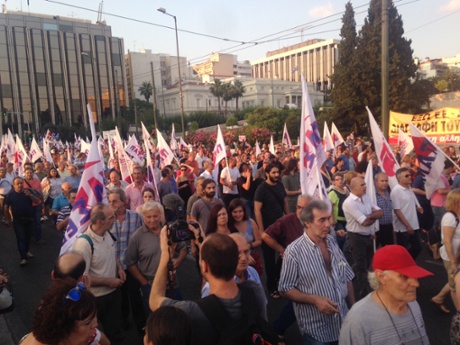
Protest dog joins the Athens "no" rally at #syntagma pic.twitter.com/rk7VqVL3Mi
— Emma Graham-Harrison (@_EmmaGH) July 10, 2015
Updated
Protests in Athens
Meanwhile an anti-austerity rally has been taking place in Athens, as parliament debates the new Greek proposals to its creditors.

Updated
There are few red lines in the quest to keep Greece in the eurozone for years to come, but nominal debt reduction is one of them, according to Slovakian finance minister Peter Kazimir .
Writing in the Financial Times (£) he said his government’s preference was not to eject any country from the eurozone.
And he warned of two dangers in the background: “protracted chattering and political bickering without reforming action” and, even after resolving the current crisis, how to reinvent the European project to make sure the same problems do not recur.
European markets jump on Greek hopes
Stock markets have moved sharply higher on optimism that Greece’s new proposals can form the basis of a deal with its creditors to avoid the country being ejected from the eurozone:
- The FTSE 100 finished 1.39% higher at 6673.38
- Germany’s Dax has climbed 2.9% to 11,315.63
- France’s Cac has closed up 3.07% at 4903.07
- Italy’s FTSE MIB has added 3% to 22,937.40
- Spain’s Ibex has ended up 3.08% to 11,036.1
Meanwhile on Wall Street the Dow Jones Industrial Average is currently 1.28% or 224 points higher.
On the bond markets, Italian, Spanish and Portuguese yields fell back between 4 and 7 basis points. Greek ten year yields fell 5 percentage points while the two year dropped 25 basis points.
More from Tsakalotos courtesy of Nick Malkoutzix, deputy editor of Greek daily Kathimerini:
Tsakalotos says four "legs" to programme: Fiscal, reforms, investment (Juncker) & debt relief #Greece #euro
— Nick Malkoutzis (@NickMalkoutzis) July 10, 2015
Tsakalotos suggests that proposal for ESM-ECB debt swap will go ahead as part of third programme #Greece #euro
— Nick Malkoutzis (@NickMalkoutzis) July 10, 2015
Tsakalotos says there as "grey areas" that still have to be negotiated, such as monitoring of programme #Greece #euro
— Nick Malkoutzis (@NickMalkoutzis) July 10, 2015
Tsakalotos urging MPs to evaluate programme as a "whole," says it is in the spirit of Monday's agreement between party leaders #Greece #euro
— Nick Malkoutzis (@NickMalkoutzis) July 10, 2015
Tsakalotos also said the European Central Bank exerted pressure on the eurozone countries to find a solution to the crisis in the last month (quote from Reuters).
Greek FinMin Tsakalotos: Greek capital controls can be quickly reversed
— Live Squawk (@livesquawk) July 10, 2015
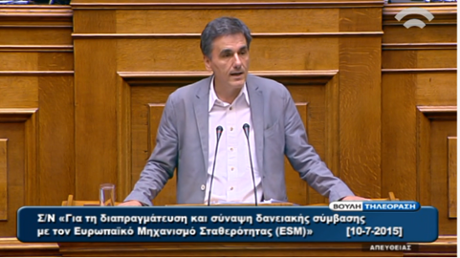
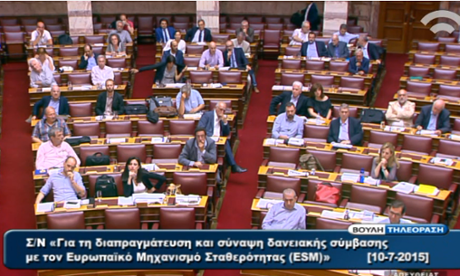
Here is Greek finance minister Euclid Tsakalotos addressing parliament now:
Greek banks could need up to €14bn fresh capital - report
Greek banks have a cushion of around €750m, enough to last until Monday night, a senior Greek banker has told Reuters.
But they will need €10bn to €14bn of fresh capital to keep them afloat, the banker told Reuters, even if a deal is reached with the country’s creditors over the weekend.
Earlier Moody’s had suggested the banks could run out of deposits by Sunday. The ratings agency said:
Bank deposits could run out by Sunday because of outflows. With emergency liquidity assistance from the Eurosystem frozen at €89 billion, we estimate that Greek banks have limited headroom to deal with daily deposit outflows (estimated at between €100-150 million) and will likely exhaust their liquidity resources in the coming days.
Policymakers from the European Central Bank have also hinted that, in the absence of any agreement by Sunday, the ECB may curtail ELA, rather than just keeping it at the current level.
We expect banks’ asset quality to deteriorate significantly and for the banks to require recapitalisation, with or without a third bailout.
And even when the banks re-open capital controls could still be kept in place:
.@OxfordEconomics on Greece: "capital controls are almost certainly here to stay for months, if not years".
— Duncan Weldon (@DuncanWeldon) July 10, 2015
Updated
So it could all get very tight:
#Greece gov't in risk of losing parl majority. They can afford up to 12 No votes. It looks like No votes are now between 6 and 8.
— Yannis Koutsomitis (@YanniKouts) July 10, 2015
However:
Syriza MP @rachelmakri announced Parliament that she will vote against the government's reform proposal. #Greece pic.twitter.com/gUmho4kA34
— spyros gkelis (@northaura) July 10, 2015
Varoufakis supports new proposals
Yanis Varoufakis may not be in parliament for the vote but he has shown his support for his successor Euclid Tsakalotos in tomorrow’s Eurogroup meeting:
Αύριο ο Ευκλείδης αξίζει την στήριξη όλων μας. Την δική μου την έχει στο ακέραιο. Μετά θα αξιολογήσουμε το αποτέλεσμα pic.twitter.com/yOUhhP8hRO
— Yanis Varoufakis (@yanisvaroufakis) July 10, 2015
Which seems to roughly translate as
Tomorrow Euclid deserves the support of us all. My own has in full. Then we will evaluate the effect.
#Varoufakis says he votes in favour of Greek proposal in letter to House Speaker Konstantopoulou https://t.co/QZuCfx4ZKa
— Daphne Papadopoulou (@daphnenews) July 10, 2015
Updated
The YouGov poll also shows that support in Germany for a Grexit is falling. A month ago 59% of Germans wanted Greece to leave the eurozone but that number has now fallen below 50% for the first time since February, and opposition is at a high of 37%.
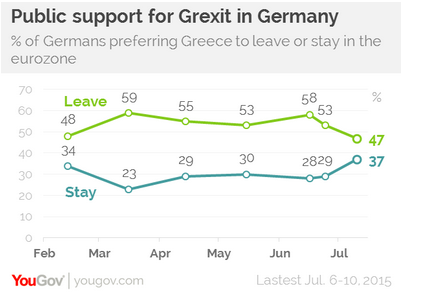
The full results are here:
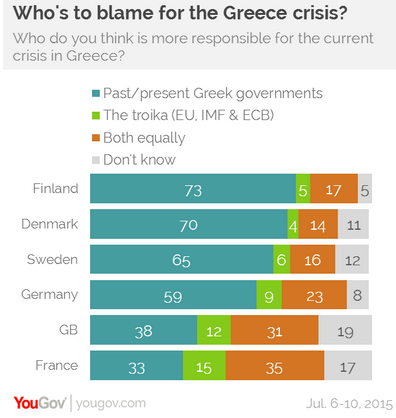
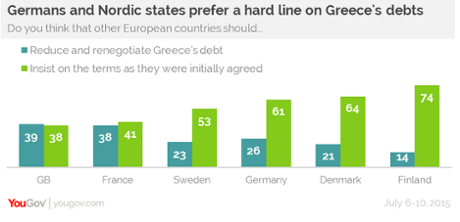
Greece: Germans and Finns back a hard line, but support for Grexit wanes
Some interesting results from a YouGov poll on attitudes towards Greece, which shows the British and French much more sympathetic than Germany or the Nordic states.
Lithuanian president Dalia Grybauskaite is sounding a cautious note.
Reuters reports her comments to reporters:
It is probably too early to evaluate [the proposals] because they are based on old information and it seems those proposals will really not be enough.
We take the document of proposals as [indicating] Greece’s wish to go back to the negotiating table. It’s too early to start guessing how the negotiations will end.

Here’s the formal agenda for Saturday’s Eurogroup meeting:
The Eurogroup will discuss the recent request by the Greek authorities for financial assistance from the European Stability Mechanism (ESM) and their new proposals for a reform agenda.
The European Commission, the European Central Bank (ECB), and the International Monetary Fund (IMF) will present their assessment of risk to financial stability in the euro area, Greece’s financing needs and the sustainability of its public debt.
Based on this assessment ministers will exchange views on whether there is a sufficient basis to start formal negotiations on a new financial assistance programme for Greece.
ESM financial assistance programmes are negotiated by the Commission, in liaison with the ECB, on the basis of a mandate by the Eurogroup. When possible, active participation of the IMF is sought.
Here’s a nice chart showing the looming repayments which face Greece. The ECB looks particularly looming:
Here are all the key dates for Greece http://t.co/n1OPoqtM4m pic.twitter.com/uyuLEXOBbF
— World Economic Forum (@Davos) July 10, 2015
Guy Verhofstadt, the leader of the liberal group in the European Parliament who laid into Alexis Tsipras on Wednesday and saw his attack go viral, seems a little more consiliatory now. He tweeted earlier:
New Tsipras' plan contains improvement in the fight against corruption & privileges of different groups #Greekcrisis
— Guy Verhofstadt (@GuyVerhofstadt) July 10, 2015
Proposals #Greece can lead to deal this weekend. But the real work starts now, towards integration of euro area & a structural debt solution
— Guy Verhofstadt (@GuyVerhofstadt) July 10, 2015
Greece will have to deliver, but Europe as well ! By creating a treasury & debt management system for a sustainable solution for all
— Guy Verhofstadt (@GuyVerhofstadt) July 10, 2015
We have created in #Europe a currency Union without a political Union. This is simply not sustainable.
— Guy Verhofstadt (@GuyVerhofstadt) July 10, 2015
And it’s not just France that deserves some credit if a deal is done, apparently:
If going viral leads to solutions, we should try it more often in Europe http://t.co/NeMiNXbRta via @POLITICOEurope #GreekCrisis
— Guy Verhofstadt (@GuyVerhofstadt) July 10, 2015
The US and Russia have both been voicing their views on the latest developments in Greece.
US Treasury secretary Jack Lew said both sides needed to rebuild trust, but a deal did appear closer and the position was better than just a couple of days ago. He said it was critical Greece took the difficult steps necessary, including structural reform.
Meanwhile Russia’s president Putin said he hoped the crisis would be resolved soon, and confirmed once more that Greece had not asked for financial aid. Reuters reports:
Implying criticism of the European Union’s handling of the crisis, he asked at a news conference in the Russian city of Ufa where the EU had been when problems were accumulating in Greece.
How do the latest set of Greek proposals differ from those on the table when negotiations were abandoned nearly two weeks ago? Here we take a look at the differences:
Yanis Varoufakis will apparently not be at today’s vote:
Former FinMin #Varoufakis tweets he will not be present at parliament vote due to family reasons #Greece
— Kathimerini English (@ekathimerini) July 10, 2015
If a deal to keep Greece in the eurozone fails, and the country leaves the single currency, it would need up to €33bn in transitional funding to help support its economy, according to Open Europe.
Up to €1.84bn of this could come from the UK, which would not go down well with the UK’s eurosceptics ahead of a referendum.
Open Europe’s Raoul Ruparel writes:
Open Europe estimates that, in terms of bare essentials, Greece could need between €18bn and €33bn in transitional funding to help support its economy after Grexit. This would cover things such as certain debt payments, some deficit funding and money to bolster reserves to aid in managing the new currency. It does not include the cost of bank recapitalisation which might be managed via nationalisation. If money was needed for this the cost could jump by tens of billions. Of course, there would be much wider costs to Grexit to both the Eurozone and Greece in terms of economic decline, contagion and Greek default on direct Eurozone exposures.
This money is unlikely to be provided entirely by the Eurozone. Open Europe expects it could be split equally between the Eurozone, the EU and the IMF. The Eurozone could provide funds bilaterally while the EU would utilise either the Balance of Payments assistance facility or the European Financial Stabilisation Mechanism. From the UK perspective this could mean underwriting shares of between €1bn and €1.84bn. While the cost of transitional funding should be predominantly shouldered by the Eurozone, there is a geopolitical and humanitarian case on the part of other EU members for helping stabilise Greece and keep it inside the EU. Furthermore, with a default and devaluation there might be more hope of these loans being repaid by Greece.
The full report is here:
How much financial help might Greece need under Grexit?
Summary: Tsipras seeks support, but has he done enough?
A quick recap.
Greece is inching closer to agreeing a third bailout deal that would avert bankruptcy and preserve its place in the eurozone, but it’s not a done deal yet.
Alexis Tsipras has urged his party to support the €13bn of austerity measures proposed late last night, which broadly match the policies which he refused to accept in the protracted battle with creditors.

The Greek prime minister told MPs that:
We are confronted with crucial decisions.
“We got a mandate to bring a better deal than the ultimatum that the Eurogroup gave us, but certainly not given a mandate to take Greece out of the eurozone.
We are all in this together.”
Five MPs have said they will rebel, but the plan will be approved at a vote - probably late tonight - as opposition parties are supporting it.
GREEK MAIN OPPOSITION NEW DEMOCRACY PARTY SAYS AUTHORISES PM TSIPRAS TO REACH A DEAL, TO KEEP COUNTRY IN EURO ZONE - RTRS
— Reuters Italia (@reuters_italia) July 10, 2015
The heads of Greece’s creditors have discussed the plan by phone, but no details of the call have leaked (yet).
France has thrown its weight behind the plan -- reflecting its strong desire to keep Greece in the eurozone (and the fact French officials helped with the plan).
But Slovakia’s finance minister has questioned whether Greece has delivered enough, while Latvia’s PM isn’t sure that their parliament would approve a bailout.
Angela Merkel faces a tough fight getting a deal through the Bundestag, says the joint CEO of the Berlin stock exchange.
And Michael Fuchs, deputy parliamentary floor leader of Merkel’s CDU party, has said it’s hard to trust the Greek proposal.
Tsipras also faces criticism for proposing measures which he spent months opposing:
One Greek newspaper says the country has reached its ‘day of judgement’. Another hopes that the European Central Bank might offer more emergency liquidity, to allow its banks to reopen. Here’s our round-up.
Eurozone finance ministers will meet on Saturday to evaluate the proposal. That meeting will be crucial to deciding whether Greece gets a third bailout. If they give the thumbs down, then EU leaders will gather on Sunday to plan for Greece’s exit from the single currency.
Over in Thessaloniki, young voters have told us they are still proud of last Sunday’s “No” vote, even though Tsipras now appears to be saying “Yes” to lenders.
Greek islands are facing up to the prospect of higher VAT rates, which could hurt tourism.
And European stock markets have continued to surge, as the chances of Greece leaving the single currency and default recede. France’s CAC has soared over 3%.
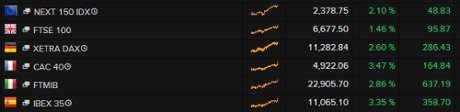
Mike van Dulken, head of research at Accendo Markets, explains.
“Equities are handsomely positive this morning thanks to Greece delivering what appears to be a more promising set of reforms proposals required to unlock the €53.5bn bailout it needs to secure its future within the Eurozone.
A potential softening of neighbouring (read German) rejection on Greek debt relief after international pressure is also helping as is a second day of gains in China, reversing some of the recent rout.
Updated
The largest opposition party, New Democracy has declared that it ‘authorises” Alexis Tsipras to reach a deal to keep Greece in the euro.
1/2 Niki Kerameus (New Democracy MP) "Now is the time to do everything possible to keep Greece within the Eurozone..." #greferendum #grexit
— Sacha Nauta (@SachaNauta) July 10, 2015
2/2 Kerameus:"Now is not the time to discuss why Syriza went from promising 12bn in grants to proposing 12bn in austerity measures." #grexit
— Sacha Nauta (@SachaNauta) July 10, 2015
I suspect *that* time will come soon enough....
Updated
The French ambassador to the US has no doubts about where the credit should go if a compromise is reached by the two sides:
#Greece. France has bern working quietly, these last days, to bridge the differences between both sides.
— Gérard Araud (@GerardAraud) July 10, 2015
Meanwhile Fitch has said an eventual exit from the eurozone is now the probable outcome for Greece:
[The ratings agency’s global head of sovereigns] James McCormack, says the referendum’s ‘no’ vote was a defining moment, providing a substantial boost to the position of the Syriza-led government in its negotiations with creditors. However, Greece may have miscalculated:
“Greece’s strong argument in favour of greater accommodation on the part of creditors faces several hurdles that are likely to prove collectively insurmountable. The referendum might have tipped the balance of how other eurozone countries weigh the risks of Greece’s continued membership in the common currency area versus its exit, but this may become clear only once the history is written.”
Greek’s banks could run out of deposits by Sunday, according to ratings agency Moody’s.
Moody's on Greece: "Bank deposits could run out by Sunday because of outflows. Total Eurosystem funding exceeds sector’s private deposits."
— Kamal Ahmed (@bbckamal) July 10, 2015
Meanwhile Reuters is reporting that the European Central Bank is likely to hold a telephone conference on Monday to discuss emergency liquidity assistance to Greece’s banks.
Eurogroup president Jeroen Dijsselbloem has said he is waiting for a technical analysis of the latest Greek proposals before commenting on its content (courtesy Reuters).
*DIJSSELBLOEM SAYS INSTITUTIONS TO REPORT ON PROPOSALS TONIGHT
— Stavros Kallinos (@StKallinos) July 10, 2015
Busy, busy as the last ditch talks continue. Here’s the Finnish finance minister:
Morning and early afternoon on the phone, non-stop. #Eurogroup in Brussels tomorrow.
— Alexander Stubb (@alexstubb) July 10, 2015
Non-stop? Still enough time to tweet, it seems..
Angela Merkel faces 'huge' challenge over Greece

Artur Fischer, the joint CEO of the Berlin Stock Exchange has just told Kate Connolly in Berlin about the huge domestic consequences a third bailout might have for Merkel.
“This is the toughest time in her chancellorship so far. Can she resist the voices of opposition within her own party to push through a third bailout in the Bundestag that most of them are against?” he asked.
“She is facing huge internal difficulties that have the potential to end her chancellorship.”
He told The Guardian that no one involved in politics or finance in Berlin was taking a summer break “or else they’re not going far so that they can get back quickly,” he said, “because no one expects this to be over soon.”
If a bailout were to be on the cards, it is likely the Bundestag would vote on it early next week, he said.
“But then it has to be agreed on amongst all the parties and we’re looking at another two weeks”.
He added that the Greek government’s “willy nilly” attitude to agreeing to new proposals, including setting the referendum, had set the country back even further, citing the number of Greek businesses that have and will go to the wall as a result of the banks having been closed. “The Greek government has destroyed a huge amount of value over the past few months, which has not been factored in.””In my mind it has lost all its credibility,” he said.
Germans, Fischer added, have been willing to back previous bailouts for Greece, but had the feeling that the money had gone no where.
“There are many cultural differences at play here, including the fact that we Germans hate uncertainty. We invent a DIN Norm (or standard) for everything, including chairs, to ensure they will fit under tables, we like that certainty so much. That love of certainty means I always turn up at a meeting on time. So we don’t like throwing money at something not knowing where it’s going.”
And here are the five holdouts:
These are the #Syriza MPs who say "no" to the proposal -Leoutsakos, Ntavanelos, Papadogianni, Lapavitsas, Petrakos- http://t.co/DLa48qIpuc
— Danai Dasopoulou (@d_daso) July 10, 2015
Greece’s new austerity plan is being discussed at committee level now, and some MPs are unhappy:
* Five hardline leftists in Greek ruling syriza say Greek Eurozone exit preferable to deal with austerity and without debt relief - RTRS
— Fabrizio Goria (@FGoria) July 10, 2015
There are around 40 MPs in the Left Platform, the more radical left-wing of Syriza, so only losing 5 votes would be quite a triumph for Tsipras....
Other MPs have warned that Greece isn’t in a position to rupture from Europe.
SYRIZA MP Mitropoulos "There have been mistakes on all sides in negotiations. We cannot manage a Grexit" #Greece #euro
— Nick Malkoutzis (@NickMalkoutzis) July 10, 2015
There is an interesting take in today’s Bild as to why US President Barack Obama is taking such an interest in the Greek crisis, apparently calling Merkel and Tsipras on a regular basis, out of fear of the impact on the global economy and even global security that a Grexit might have, writes Kate Connolly in Berlin.
The German tabloid quotes a top German diplomat who explains why the US is so flummoxed over why Greece - which after all has an economy about the size of Tennessee’s - is considered such a headache in Europe.
“Viewed from Washington, it’s to do with keeping on feeding a cute little animal with peanuts,” the diplomat said.
It goes on to quote German finance minister Wolfgang Schäuble, who said yesterday that:
“I offered to my friend Jack Lew (his US counterpart) that we would take Puerto Rico into the Eurozone, if the USA took Greece into the Dollar Union. He thought I was joking”.
Former Germany ambassador to Washington, Wolfgang Ischinger told the paper:
“It’s easy for President Obama to advise us to save Greece. It’s the Europeans who have to bear the costs, not the USA.”
Debt campaigners have been reminding Germany that Greece needs meaningful debt relief:
Last night at German Embassy in London we sent the message to Angela Merkel that @George_Osborne @David_Cameron won't pic.twitter.com/Y0WjjHpCOh
— JubileeDebtCampaign (@dropthedebt) July 10, 2015
The IMF’s outgoing chief economist, Olivier Blanchard, has published a defence of the Fund’s role in the Greek bailout saga.
It includes a pop at the eurozone for ignoring the need for Greek debt relief:
- Until the referendum and its potential implications for growth, we believed that, under these assumptions about the primary surplus, debt sustainability could be achieved through the rescheduling of existing debt, and long maturities for new debt. This was reflected in the preliminary debt sustainability analysis (DSA) we put out before the referendum. Our assessment was seen as too pessimistic by our European partners to whom we had communicated our views about the need for debt relief long before publishing the debt sustainability analysis. We believe that current developments may well imply the need for even more financing, not least in support of the banks, and for even more debt relief than in our DSA.
Blanchard gives rather less attention to ghastly forecasting record of Greece’s lenders, arguing:
- The decrease in output was indeed much larger than had been forecast. Multipliers were larger than initially assumed. But fiscal consolidation explains only a fraction of the output decline. Output above potential to start, political crises, inconsistent policies, insufficient reforms, Grexit fears, low business confidence, weak banks, all contributed to the outcome.
In a stunning swan song IMF’s Olivier Blanchard nails Eurozone’s ghastly blunders http://t.co/W27kALK5oT pic.twitter.com/w9bQMvsxXz
— Ann Pettifor (@AnnPettifor) July 10, 2015
Slovakia’s finance minister isn’t convinced (yet, anyway) that Greece’s reforms plan is solid enough to deliver a deal:
It seems we have progress on #Greece. It's still not clear whether this will be enough and no further frontloading will be needed #Eurozone
— Peter Kažimír (@KazimirPeter) July 10, 2015
Peter Kažimír also has misgivings over Athens’ ability to deliver these proposals:
Following latest developments, listening to #Greece govt officials one can wonder how quickly can caterpillar turn into butterfly #Eurozone
— Peter Kažimír (@KazimirPeter) July 10, 2015
Latvia could struggle to back Greek deal
The view from Latvia has been expressed by prime minister Laimdota Straujuma, speaking on state broadcaster Deutschlankfunk (dlf.de) this morning.
Straujuma said that the Latvian parliament would have to vote on any new bailout. It would be the first time it had been directly involved, as during bailouts 1 and 2, the country was not yet part of the Euro. She told DLF she would have difficulty persuading her parliament to support such a move.
“It will be very hard for me to persuade the parliament. And for the parliament it will be difficult to vote for it, because the average Pension in Latvia is considerably less than in Greece, and if you were to ask the Latvians today whether they are willing to lend money to Greece, you can probably guess what their answer would be.”
Straujuma said that discussions with her counterparts in the other Baltic states of Estonia and Lithuania - all of whom have gone through extensive periods of austerity and reform implementation - had shown they were of the same opinion.
“At the moment I see no reason for Latvia to give money to Greece,” Straujuma said, adding:
“Humanitarian aid is another matter. If money is needed for Greek hospitals or for medicines, the Latvians will help. Greece is an EU member, but it’s the Greek government that is responsible for what happens”.
Updated
In the Czech Republic, there are deep-seated anxieties that the Greek crisis could unleash old Cold War tensions.
Writing in the leading financial daily, Hospodarsky Noviny, leading commentator Daniel Anyz explains the geopolitical dimensions of the crisis, and the consequences of Grexit.
“(Russian president Vladimir) Putin needs very little imagination to consider what an exit of Greece from the Eurzone would trigger. The feeling of bitterness towards Europe would deepen and Greece would move a step closer towards Russia.”
Anyz says that Greece could alter its behaviour on the world stage, according to how the crisis is dealt with.
“Would Athens change its view on the sanctions against Russia? Would Greece continue to support Nato military operations? Would it still allow the military ships of its partner countries into its harbours? “A Grexit would play right into Putin’s hands. Greece would turn into an extremely problematic European partner with separatist tendencies. Then it’ll be even harder to find consensus in Nato on important decisions.”
More here: Grexit by Řecko přiblížil Putinovi
Back in Athens, Syriza MPs are arguing that Greece should hunker down, and live to fight another day.
#Greece LaborMin Skourletis: Current balance of power [in Eurozone] makes capitulation inevitable now. We'll reach our aims at a better time
— Yannis Koutsomitis (@YanniKouts) July 10, 2015
SYRIZA's #Lapavitsas: I was proved right. We cannot handle a Grexit. We need to be prepared, we will face it in the future #Greece
— Kathimerini English (@ekathimerini) July 10, 2015
Greek No voters still proud, despite austerity u-turn

Angelique Chrisafis has been speaking to young No voters in Thessaloniki about the latest bailout proposals:
In Greece’s northern second city, where younger Greeks mainly voted No in Sunday’s referendum on a bail-out deal, many people in their 20s have come to see themselves as a lost generation whose adult lives have been dominated by austerity. With a youth unemployment rate in the city that has reached 65%, there are few job prospects and many face living with parents and relatives for years to come.
Among some young No voters in the city this morning, there was a feeling that there was still a lot to play for and much bargaining to be done in Brussels before a deal shaped up. Many felt that now that Greeks’ voice had been heard with the No vote, any austerity measures — which many felt had always been inevitable — could be tempered by debt-relief in a more favourable package.
Christos, 27, who had a Masters degree in transport engineering, was standing at the bar of the coffee-shop where he had managed to get a job after graduating. He was lucky as many of his engineer friends were unemployed. But the coffee-shop’s trade has halved since the banks were shut and capital controls imposed.
He voted for Alexis Tsipras in January but didn’t vote in the referendum. But he said he now had faith in Tspiras’s negotiations and the new proposals were not a betrayal.
“I think everyone has always known that things were going to be very difficult now and in the coming years. The deal will be very difficult for us, but it’s probably the best solution. Better a deal than no deal. I think our only chance is to continue on our road in the eurozone.
The No vote was a way for Greeks to express their feelings to Europe, there’s a certain happiness that the No vote has been heard. And it seems there has been an understanding that more should be put on the table for Greece, in the form of debt relief. There has been progress.”
Valentine, 26, who runs a retro vintage clothing shop that sells clothes by the kilo, said:
“I’m so proud of the No vote, it will be remembered as a key moment in Greek history. I trust Tspiras, even if some people don’t.”
She felt much was going on behind the scenes and the next few days would show whether a deal could be made or whether Greece would roll towards a Grexit.
“We always knew, whatever the referendum result, that it would be difficult whatever happens. We had never forgotten that.”
Greece’s fate will effectively be decided tomorrow, flags up Ian in Brussels:
Saturday’s eurozone finance ministers meeting will be decisive in deciding whether negotiations over a third bailout begin, or whether leaders should start planning for Grexit on Sunday.
#greece d-day sat, not sun,€group decision on whether to open new programme negs. eu official wd be 'astonished' if heads overturned finmins
— Ian Traynor (@traynorbrussels) July 10, 2015
Alexis Tsipras’s battle against the creditors has ended in ignominy, writes our economics editor Larry Elliott:
Greece now faces a fresh wave of austerity policies – increases in VAT, public sector wage cuts, less generous pensions – that will put the brake on activity. This approach has been tried repeatedly over the past five years and it has failed repeatedly. It will fail again.
Greece is like Sisyphus, the king of Corinth who according to legend angered the gods and was condemned to push an enormous rock to the top of a hill. When Sisyphus neared the summit, the boulder would slip from his grasp and tumble back down to the bottom of the slope, forcing him to start again.
Alexis Tsipras, too, has angered the gods, in this case the European commission, the European Central Bank, the International Monetary Fund and most of the 18 other countries that are members of the single currency. His punishment for his five-month show of defiance will be to have Greece’s boulder replaced by an even bigger one.
More here:
Updated
German Social Democrat MEP Axel Schäfer has welcomed the Greek reform list.
He calling it an “important development, because the government as well as the most important opposition parties have agreed on it.”
As to whether the creditors will accept it, he said: “I hope so.”
Greece must receive a further bailout package, he said, adding:
“That is to say, it needs new financial measures that can be paid back over a very very long timeframe.”
Schäfer is of the view that a majority of the Bundestag would vote in favour of a third bailout, although he added Merkel would find it easier to get the agreement of SPD politicians than those within her own conservative bloc. [SPD are the junior coalition partner with Merkel’s CDU/CSU]
A group of pensioners have held a protest outside the Greek finance ministry this morning:


Update: I thought this was an anti-austerity demo, but a reader kindly flags up that they are actually protesting against having to queue up at banks for hours once or twice a week to get just a fraction of their pensions, under the current capital controls.
Updated
Tomorrow’s eurogroup meeting will be a clash between the countries who are determined to keep Greece in the euro, and those who are (or were) ready to see them leave:
Royal Bank of Scotland have divided up the teams:
Mood has turned: After Athens has submitted proposals, support for #Greece has gained strength. RBS sees deal likely. pic.twitter.com/FUL5LqNQAO
— Holger Zschaepitz (@Schuldensuehner) July 10, 2015
What the Greek papers say

My colleague Emma Graham-Harrison has rifled through the Greek newspapers, and reports:
I Avgi, a leftist paper close to Syriza has a large picture of Tsipras with the headline “The day of judgement” over an article laying out some of the basic details of the proposal.
An editorial titled “Structural violence” condemns Greece’s partners for their cruelty.
Several other front page articles remind readers of the cost of austerity, including a warning from the statistics agency that one in three Greeks are in danger of falling into poverty.
Ta Nea, the country’s top selling daily newspaper went with one of the top concerns for middle-class Greeks, the fate of their savings.
“How the deposits are being saved” was the headline, over an article detailing how Tsipras’ plans push back the risk of “haircuts” to the savings accounts of ordinary citizens.
It also has a cartoon of Greeks queuing on a diving board over an empty public swimming pool, with the European Central Bank president, Mario Draghi, holding a slowly dripping hose. “Oh Draghi!” a would-be swimmer shouts.
#Greece front pages Ta Nea: How can deposits be saved? Agreement foresees €12bn dowry for banks [Draghi with hose] pic.twitter.com/9oBPdpLTJi
— Damian Mac Con Uladh (@damomac) July 10, 2015
Centre-right paper Kathimerini has an opinion piece by influential managing editor Nikos Konstandaras saying the heavy burden of Greece’s future hangs on the prime minister, Alexis Tsipras, alone (here is the English language version).
“In these hours, Tsipras must be desperately lonely. It is inconceivable that a whole country – one that is a long-time member of the European Union – should come to a point where it depends on one person to determine its fate, not on institutions or procedures,” Konstandaras writes in the front-page editorial.
“Tsipras has to measure himself against history, to choose a road that will lead either to salvation or tragedy.”
He says if Tsipras is willing to take on his own party to push though a deal some of its harder-left members don’t support, he will find more allies than he has lost, “many more than he can imagine”
Rightwing paper Democratia gave the impression that the package was all but a done deal:
“You have a package – the moment of truth”, the front page headline read, adding “Parliament rushes to give approval.”
Updated
German politicians have been reacting through the morning to the Greek proposals, and all of them are voicing scepticism.
First up this morning on the state broadcaster ZDF’s Morgenmagazin programme, was Alexander Graf Lambsdorff, vice president of the European Parliament, and a member of Germany’s liberal FDP .
Kate Connolly watched the interview and has translated the most salient points:
Lambsdorff said he had been studying the document this morning, but felt that several issues were missing from it:
“for example there’s nothing in there about the roll of the Orthodox Church, which is after all, the biggest landowner in Greece. There’s little about reform of the financial authorities and that is a very decisive question, because whether you set the corporate tax at 26% or 28% is in the end not nearly so important as whether you actually collect it. That is the problem. Several important things are missing in this programme.”
To ZDF’s question as to what the difference was between these proposals and what the Greeks turned down at the referendum, Lambsdorff said:
“That’s precisely the point. That is the core issue here. And it is also the reason why we in the FDP say how can... a Tsipras government that allowed precisely this programme to be rejected by his people with 61%, now stand again in front of the people and credibly say: ‘we’re doing all of that afterall’ and then to credibly stand up on the international stage and say: ‘yes, we take ‘ownership’, as it’s called – we’ll take that on board as our responsibility and implement it’.
I’m missing the belief that a third bailout is possible.”
Lambsdorff added that he was sceptical that the Greek problems were anyway near to being solved.
“He has Frau Merkel and Herr Schäuble precisely where he wants to have them...that might put pressure on them to give in, but I think that cannot possibly happen. A third bailout with a haircut in the Eurozone – that will not solve the Greek problems.”
Lambsdorff isn’t the only one voicing doubts:
German lawmakers confused as to why Tsipras is now submitting a proposal he once slammed. http://t.co/bOKgGEjZdk pic.twitter.com/LAQ22Zr8uU
— Joseph Weisenthal (@TheStalwart) July 10, 2015
Updated
Our Europe editor, Ian Traynor, points out that these austerity measures, although tough, are largely what was being demanded by creditors to unlock the final €7bn of Greece’s last bailout.
They’re could now unlock a three-year aid package instead:
#greece but if it works, @atsipras done well - parlayed 5months lifeline into 3-year 53 bn for same concessions #niceone
— Ian Traynor (@traynorbrussels) July 10, 2015
However some creditors, such as Germany, argue that a new bailout should come with tougher conditions and deeper reforms. We shall see....
Updated
So, what has Alexis Tsipras got for five months of deadlock, angst and the lockdown of his banking sector?
Well, he’s managed to get EU officials to take a hard look at Greece’s debt mountain, and consider measures to make them sustainable.
Debt sustainability will definitely be on the table of #Eurogroup acc to EU officials #Greece
— Yannis Karagiorgas (@IKaragiorgas) July 10, 2015
And although debt relief would probably have been discussed eventually, the crisis has “smoked out” the IMF and the US Treasury to demand debt relief for Greece.
Greek MPs are expected to start debating this package of measures this evening, with a vote “very late” tonight:
Greek proposal to lenders & loan request to be examined by Parlt cttee at 3pm w debate to begin at 7pm + vote very late
— NikiKitsantonis (@NikiKitsantonis) July 10, 2015
(and where the Greek parliament is concerned, that can be really quite late indeed)
Scepticism in Germany
As German politicians pore over the Greek proposals, some officials and economists are voicing scepticism about much of the Greek’s reform ideas, writes Kate Connolly from Berlin.
Michael Fuchs, deputy parliamentary floor leader of Merkel’s Christian Democrats, was quick to raise concerns.
Fuchs warned:
“We have to be very careful because honestly, because I have a little bit of a problem to trust it because what is the difference between Sunday and today?
On Sunday the Greek people voted against these measurements.
But financial experts have welcomed what they see as growing signs that an agreement can be reached.
Markets reacted positively to the existence of a document, saying that it sent out a positive signal. In the first quarter hour of trading the Dax rose by around two per cent, the Mdax climbed by a similar amount, and the TecDax by 2.5 per cent.
The Postbank’s chief economist Marco Bargel welcomed the proposals as a starting point, saying:
“The Greeks are coming closer to the creditors. That was not to be expected after Sunday’s referendum. The markets are expecting a successful conclusion, as the appreciation of the Euro and the higher returns of German federal bonds shows”.
However others were more sceptical: Jörg Krämer from the Commerzbank says that the Greek government has not presented anything new.
“Other than a few cosmetic improvements, the Greek government has presented the very same list of reforms which it advised its people to reject just a week ago.”
He told Spiegel, the list was no guarantee that the reforms would actually be implemented. “Often times in the past they have not been implemented,” he said. Any agreement on the basis of the document looked like being a ‘lazy compromise’ which would “strengthen the reform opponents of other countries, and would ultimately lead to the weakening of the single currency”.
The Sunday crisis summit might yet be cancelled, reports our Europe editor Ian Traynor.
If, and it’s a big if, eurozone finance ministers give the thumbs-up on Saturday.
#greece if agreement sat on new deal, no need for sun summit - eu official
— Ian Traynor (@traynorbrussels) July 10, 2015
Creditors to discuss Greek proposal
Newsflash: IMF chief Christine Lagarde, ECB president Mario Draghi, European Commission head Jean-Claude Juncker and Eurogroup president Jeroen Dijsselbloem are to discuss the Greek proposals at noon BST.
This is worrying - industrial output across Greece’s factories tumbled by 4% in May.
That suggests the country was falling deeper into recession even before the imposition of capital controls at the end of June.
#Greece | MAY INDUSTRIAL PRODUCTION Y/Y: -4.0% V 0.4% PRIOR pic.twitter.com/at56Vi3elO
— Ioan Smith (@moved_average) July 10, 2015
Toll that Greek crisis is taking on economy evident in 4.0% y/y drop in industrial production in May; manufacturing down 2.7% y/y
— Howard Archer (@HowardArcherUK) July 10, 2015
Updated
Jeroen Dijsselbloem, president of the eurogroup of finance ministers, received Greece’s proposal overnight.
And he has suggested that the eurogroup could take a “major decision” on the Greek crisis on Saturday:
Eurogroup's Dijsselbloem: Could make 'major decision' about Greece at meeting, Saturday. More: http://t.co/WxRMUAdHtG pic.twitter.com/E8I2FEblp6
— Reuters Live (@ReutersLive) July 10, 2015
Euro ministers should give an early verdict today:
An influential Syriza MP, party secretary Dimitris Vitsas, has told Greek TV that he believes Tsipras’s party will stay united, if creditors commit to discussing debt relief this autumn.
SYRIZA MP Vitsas "Atmosphere in parliamentary group is fine. We're all working for an agreement" #Greece #euro
— Nick Malkoutzis (@NickMalkoutzis) July 10, 2015
SYRIZA MP Vitsas: "We want clear reference to debt relief & a commitment from lenders to begin discussing this from October" #Greece #euro
— Nick Malkoutzis (@NickMalkoutzis) July 10, 2015
SYRIZA MP Vitsas tells Skai TV that he's "sure" parliamentary group will remain united #Greece #euro
— Nick Malkoutzis (@NickMalkoutzis) July 10, 2015
Readers with a decent grasp of Greek can read the full proposals here, on the Athens parliament website.
There’s an English translation here on Naftemporiki.gr.
Greek bond yields are tumbling this morning, as investors deduce that Athens is less likely to default on its loans.
Chart of the day: #Greece's 2y yields in free fall as France's Hollande calls Greek proposals serious and credible . pic.twitter.com/mkUfchyPbH
— Holger Zschaepitz (@Schuldensuehner) July 10, 2015
(yields measure the interest rate on a bond, and fall when prices rise)
The yield on Greek two-year bonds is still alarmingly high, at 36%, which suggests there is still a high chance of restructuring. But that’s down from almost 55% yesterday.
French president Francois Hollande has also called Greece’s proposals “serious and credible”, and a sign that Athens is determined to stay in the eurozone.
Greek parliament to begin debate at committee level at 3pm, BBG reports.
— Holger Zschaepitz (@Schuldensuehner) July 10, 2015
France: These are serious, credible proposals
The French government is urging its fellow eurozone members to support Greece’s bailout proposal.
European affairs minister Harlem Desir told Radio Classique this morning that:
“It is a very significant moment for Greece, but also for Europe.
“The proposals which have been put forward are all serious, credible, comprehensive.”
And economy minister Emmanuel Macron has just said that “major advances” have been made in recent days. He’s “reasonably optimistic” about a deal.
French officials have been in Athens this week, working on the reform plan. So having assisted with Greece’s homework, they’re helping to mark it too...

The tax status of certain far-flung Greek islands will be affected by the new proposals, reports my colleague Angelique Chrisafis who is in Greece.
The creditors had insisted last month that Greece completely scrap its special low VAT rates for distant Greek islands. This special VAT discount rate has been in place for decades, to help certain islands which are far away from the mainland and have to pay high costs to bring essential goods long distances from Athens or Thessaloniki.
Under the new proposals, the Greek government has agreed to remove the special VAT discount, initially targeting only the richest and least remote of those islands, which would include the tourist-magnet of Mykonos. But it seems that the special measures would remain in place to help the most remote islands - and presumably the smaller and poorer of those islands, whose dwindling populations have already been hit hard by the crisis.
Fuller details of which islands are concerned should emerge later today.
You can read Angelique’s report from Rhodes last month on why the VAT rate on the islands is a contentious issue and was previously one of the Greek government’s sticking points.
"Either we'll carry on all together or we will all fall together," Greek PM #Tsipras tells SYRIZA lawmakers #Greece
— Kathimerini English (@ekathimerini) July 10, 2015
Tsipras appeals for party unity

Alexis Tsipras has met with MPs from his Syriza coalition in Athens.
The PM has urged them to back the €13bn austerity plan submitted last night, according to one government official who spoke to Reuters.
Tsipras said:
“We are confronted with crucial decisions,”
We got a mandate to bring a better deal than the ultimatum that the Eurogroup gave us,but certainly not given a mandate to take Greece out of the eurozone.”
And there was an appeal for party unity:
“We are all in this together.”
It really is a dizzying turnaround:
Tsipras trying to get backing from his MP's for reform proposals that are tougher than those rejected in last week's referendum.#Greece
— Gavin Hewitt (@BBCGavinHewitt) July 10, 2015
TOTALLY CAVED IN --->TSIPRAS TELLS PARLIAMENTARY GROUP HE HAS MANDATE FOR BETTER DEAL, NOT TO TAKE GREECE OUT OF EUROZONE
— Ishaq Siddiqi (@IshaqSiddiqi) July 10, 2015
But many Syriza MPs are likely to back Tsipras, judging from these photos:


Here’s the picture across Europe’s major stock markets, via Reuters:
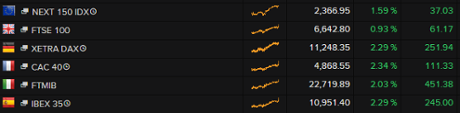
Investors are a little surprised by the scale of Alexis Tsipras’s climbdown:
As Connor Campbell of Spreadex.com explains:
In a strange turn of events considering the resounding ‘no’ cried out by the Greek people to austerity, Tsipras submitted a proposal to creditors on Thursday that contains around €13 billion in cuts and tax rises, €4 billion more than the plan the public rejected.
The concessions this reflects, especially on primary budget surpluses, VAT and pensions (i.e. all the ‘red lines’), and the swelling chances of a deal actually being made, is in no doubt the reason behind the robust early gains of the DAX and CAC.
However there is still more work for Tsipras to do, and in many ways the most difficult task lies ahead; the Greek PM now has to try and convince his government this Friday to back the €13 billion plan, one that seemingly flies in the face of the anti-austerity rhetoric that has been Syriza’s bread and butter since before the party was elected.
Markets cheer #Greece's bailout plan: Germany's Dax jumps >2% above 11k. pic.twitter.com/1OwEJXtT75
— Holger Zschaepitz (@Schuldensuehner) July 10, 2015
Updated
From VAT rises to defence spending cuts, here’s a breakdown of what Greece ahs submitted to:
Another sign of market confidence: Money is flowing out of German government bonds this morning and into Italian debt.
SG: Mr Market assumes that Greek deal flies (for now). 10y Bund yields jump 8bps while 10y Italian ylds drop by 13bps pic.twitter.com/8gWZEXNmKd
— Holger Zschaepitz (@Schuldensuehner) July 10, 2015
The euro is rallying this morning too, up over half a cent against the US dollar in early trading.
What difference a day makes: #Euro gains, briefly touches $1.1135, Highest since Jul1 as overnight Greek proposal has rekindled deal hope.
— Holger Zschaepitz (@Schuldensuehner) July 10, 2015
Markets jump
European stock markets have jumped, as investors hail the news that Alexis Tsipras has submitted a new list of reforms to Greece’s creditors.
The French CAC leapt by 2.4%, the German DAX gained 1.6%, and in London the FTSE 100 is up 70 points or 1%.
Traders are still a little cautious, though, after the roller-coaster ride this year.
As Chris Weston of IG explains:
The Greek public voted against austerity last Sunday, yet what we have seen is a giant step closer towards the Creditors’ prior proposal which was subsequently rejected, ironically by Tsipras.
There will be factions within the Greek parliament that simply won’t know what Tsipras is playing at, so when the Greek parliament vote on these measures today it is by no means a done deal.
Introduction: Deal hopes rise after Tsipras capitulates
Good morning, and welcome to our rolling coverage of the Greek bailout crisis.
Leonardo Da Vinci once scribbled in his notebook:
It is easier to resist at the beginning than at the end.
And Alexis Tsipras appears to have taken this to heart. Last night, the Greek PM finally submitted an economic reform plan that looks terribly similar to the measures he’s been battling for months, in return for a €53.5bn bailout.
Greece is now proposing sweeping changes to VAT, standardising at 23%, and abolishing exemptions on its islands (starting with the most popular). Corporation tax will rise to 28% (as its creditors demanded), not the 29% Greece wanted. And it will crack on with raising the retirement age to 67.
As we covered in last night’s liveblog, analysts say it looks like a comprehensive climbdown by Athens, after European leaders called a summit on Sunday to plan for Greece’s exit from the eurozone.
Alexis Tsipras is meeting with his MPs this morning to discuss the plan. That could be a bumpy meeting, given Syriza’s opposition to austerity.
But it does appear that Greek MPs will approve the plan; a vote is expected today, so that the country’s PM and finance minister can negotiate at this weekend’s crunch meetings.
Bill submitted last night authorises Tsipras & Tsakalotos to negotiate with lenders. Has to pass through ctte, then plenary #Greece #euro
— Nick Malkoutzis (@NickMalkoutzis) July 10, 2015
The goal - an agreement that would allow Greece’s banks to reopen and some level of normality to return.
But how will the plan be received across Europe? And how will the Greek people react to the news of another programme, especially after being promised that Syriza would end the cycle of austerity?
We’re about to find out....
Updated