On that note it’s time to close up for the evening, and indeed the week. Thanks for all your comments, and we’ll be back next week (unless anything dramatic happens later.)
Meanwhile according to Reuters, index compiler MSCI says it is monitoring investors’ access to Greek equity markets. Any restrictions may lead it to change Greece’s to a standalone market from emerging market. MSCI said:
Some measures available to Greek authorities to manage the economic situation, e.g., imposition of capital controls, could have a significant impact on the replicability and investability of the MSCI Greece Index and consequently the MSCI Emerging Markets Index.
Any move would come after a public consultation.
Updated
Some evidence is emerging that big banks are becoming even more cautious in their dealings with Greece, writes Jill Treanor.
Morgan Stanley is said to be telling clients that while it is happy to take their orders to buy and sell stocks on the Athens stock market it is less willing to take any risks associated with settling the transactions.
Barclays is also rumoured to be adding in an extra layer of approvals from its risk management department before dealing in Athens. Neither bank would comment.
Over In Athens opposition MPs say prime minister Alexis Tsipras now faces the toughest of choices - either he bites the bullet and accepts implementing €5bn worth of austerity measures or he allows Greece to go bankrupt at the end of the month. Helena Smith reports:
Ahead of a weekend of what is bound to be feverish negotiation within his party’s own ranks, the Greek prime minister will soon have to make the most difficult of decisions.
“There is no good scenario,” Anna Asimakopoulou, a shadow finance minister with the opposition New Democracy party told me this afternoon. “There is a bad scenario and a worst-case scenario. Either Tsipras agrees to take austerity measures worth €5bn, because that is what the Europeans are asking, or he takes Greece out of the eurozone And the problem is this. He doesn’t have a mandate for either.”
The rhetoric has got so heated in the week since talks between Athens and international creditors broke down that many fear the radical left leader will have no choice but to chose the latter.
Updated
More from EC president Donald Tusk:
Have discussed #Greece situation with @ECB Draghi, IMF @Lagarde, @JunckerEU & @J_Dijsselbloem to prepare Euro Summit Monday
— Donald Tusk (@eucopresident) June 19, 2015
US Fed member warns on Greek risk
More concern from the US over the Greek crisis, as reported by Reuters:
The possibility that Greece’s mounting debt woes could disrupt world financial markets and impact the U.S. economy has been a big topic of discussion at the Federal Reserve, a top Fed official said on Friday.
Though the baseline forecast is that even a Greek exit from the euro zone would not have a large spillover effect on the U.S. economy, there are concerns about the “tail risk,” San Francisco Fed President John Williams said.
Markets mixed as Greek uncertainty continues
After another testing week for the eurozone - and further crisis talks between Greece and its partners on Monday - global markets turned in a mixed performance. The final scores showed:
- The FTSE 100 finished up 2.57 points or 0.04% at 6710.45
- Germany’s Dax dropped 0.54% at 11,040.10
- France’s Cac closed up 0.25% at 4815.37
- Italy’s FTSE MIB added 1.07% to 22,699.37
- Spain’s Ibex ended up 0.67% at 10,944.3
- The Athens market added 0.57% to 687.33
On Wall Street the Dow Jones Industrial Average is currently up 52 points or 0.29% higher.
Russia says Putin and Tsipras did not discuss aid for Greece
The Kremlin said there was no discussion of financial aid for Athens at today’s meeting between Russian president Vladimir Putin and Greek prime minister Alexis Tsipras, according to Reuters:
Asked whether financial assistance had been discussed at the meeting on the sidelines of the St Petersburg International Economic Forum, Kremlin spokesman Dmitry Peskov said: “No, no, no.”

Updated
An early schedule for Monday’s EU summit:
From 18.00 (central European time)- Arrival of the Heads of state or government of the Euro area (not in protocol order)
19.00 - Working dinner
At the end of the meeting - Press conference by the President of the European Council and the President of the European Commission
Another €1.2bn has been withdrawn from Greek banks today, according to Reuters.
That brings the total outflow for the week to €4.2bn amid growing concerns about the lack of a deal between Greece and its creditors. One banker told Reuters:
Today was a more difficult day compared to yesterday. Monday will likely be tough as well.
Monday of course sees a summit of EU leaders, and another meeting of the European Central Bank after it raised the emergency liquidity ceiling for Greek banks today - for the second time this week.
And more from eurozone member Slovakia on Greece. Earlier prime minister Robert Fico said his government was ready for Greece to leave the eurozone, although he would rather it didn’t happen.
Now Slovakia’s finance minister Peter Kažimír has used his Twitter account to chip in , warning Greece to accept reality:
The #Greece window is closing here, and it's closing quite rapidly.
— Peter Kažimír (@KazimirPeter) June 19, 2015
What has to come in the coming 72 hours is Sisyphean task on both sides to prevent ' accident'. Athens needs to move now. #Greece #eurozone
— Peter Kažimír (@KazimirPeter) June 19, 2015
My personal preference is to reach an agreement which will help #Greece without weakening the strength and credibility of #eurozone
— Peter Kažimír (@KazimirPeter) June 19, 2015
We are NOT sending #Greece out of the #eurozone, on the contrary. Greece, however, has to accept the reality and stop politicising
— Peter Kažimír (@KazimirPeter) June 19, 2015
PM #Tsipras succeeded to take GR to EZ summit, but institutions need to back all with economically sustainable substance, jointly with EG
— Peter Kažimír (@KazimirPeter) June 19, 2015

Updated
More demonstrations have been called ahead of Monday’s key summit:
#Greece Syriza calls for demo "against austerity and for the country's dignity". Sunday 21st June at #syntagma. TRMT @doleross
— spyros gkelis (@northaura) June 19, 2015
Greece has to chose between a good deal and default - EC president Tusk
Monday’s emergency summit of EU leaders was convened yesterday by President of the European Council Donald Tusk, and in a new video he repeated the warning that time is running out for a deal and said the time for games was over.
He said the situation was getting critical, with four months of negotiations not leading to the necessary compromise.
Thursday’s Eurogroup meeting did not manage to break the deadlock and - in a possible dig at noted game theory adherent and Greek finance minister Yanis Varoufakis - he said:
The game of chicken needs to end and so does the blame game. This is not a game and there is no time for any games.
He said the purpose of Monday’s summit was
to make sure we all understand each other’s positions and the consequences of our decisions.
We need to get rid of the illusion there will be a magic solution at the leaders level. The summit will not be a final step. There will be long detailed technical negotiations. That remains the job of finance ministers.
And in a warning to the Greeks he added:
We are close to the point where the Greek government will have to chose between accepting what I believe is a good offer of continuing support, or head towards default. At the end of the day it can only be a Greek decision and a Greek responsibility.
President #Tusk @eucopresident on the #Euro #Summit of 22 June on #Greece http://t.co/0328lgEJlz pic.twitter.com/SAMlBHTye7
— EU Council TV News (@EUCouncilTVNews) June 19, 2015
Updated
This would appear to be an obvious move, but still..
EURO ZONE MINISTERS TO DISCUSS ON MONDAY HANDLING OF GREEK DEFAULT IF NO NEW GREEK REFORM PROPOSALS ARRIVE: RTRS
— Brenda Kelly (@Brenda_Kelly) June 19, 2015
Summary: Greek banks get a lifeline, for now

Time for a quick recap.
The European Central Bank has agreed to a request from Greece for extra emergency liquidity to allow its banking sector to keep running as worried savers continue to withdraw cash.
The decision means Greek banks should not run out of funds in the next few days, despite the threat that the country could fail to reach a bailout agreement and potentially exit the euro.
It appears that the ECB has only given Greek banks enough extra funds to last until Monday night, when EU leaders will hold a summit to discuss the crisis.
Athens made the request after eurozone finance ministers again failed to get close to a deal at talks on Thursday. That triggered renewed fears of a bank run in Greece.
But the streets have been calm today, with depositors telling us that they aren’t prepared to be frightened into emptying their accounts.
Banking insiders have also said that withdrawals have been manageable.

Greek prime minister Alexis Tsipras has predicted that Monday night’s summit will yield a deal, adding:
“All those who are betting on crisis and terror scenarios will be proven wrong.”
And he remained defiant, telling an audience in St Petersburg that Europe should return to its core values of solidarity and social justice.

EU finance ministers have sounded generally downbeat today, as they reconvened in Luxembourg [photos here].
George Osborne, Britain’s chancellor of the Exchequer, urged Greece’s government to reach a deal now, before it is too late.
We have entered the eleventh hour of this Greek crisis and we urge the Greek government to do a deal before it is too late.
We hope for the best, but we now must be prepared for the worst.
And Germany’s Wolfgang Schäuble says he’s not sure anything “sensational” will be achieved on Monday night.

German finance minister Wolfgang Schäuble isn’t hopeful of a major breakthrough this weekend.
Speaking after the European finance ministers meeting ended, a gloomy-sounding Schäuble said:
“We have to wait and see what and whether something happens in Greece by Monday....But I’m not sure I’ll be able to announce anything sensational or new.”
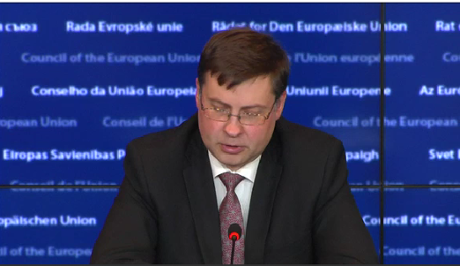
Extending more emergency liquidity funds to Greece is only a temporary measure, warns EC vice-president Valdis Dombrovskis.
Speaking in Luxumbourg, Dombrovskis said:
It is very clear that to regain financial stability a clear agreement is needed on the programme, and a credible strategy needs to be presented by the Greek authorities showing how they will regain financial stability and economic growth.
Banking insiders have told the Guardian that the decision to hold an EU summit on Monday night calmed nerves on the streets today, helping preventing a bank run.
One banker explained:
“We’re not observing panic because Monday’s EU summit has been taken as a rather positive sign that we are moving towards a solution
Whatever that solution will be, whether long, short, comprehensive or not is another thing. But this is what the [Greek] government has wanted for some time and if it tackles the debt, which no one has wanted to battle, all the better.”
#Greece the truth is that no panic at banks as Greeks almost inured now to drama after five years on the great Greek crisis train
— Helena Smith (@HelenaSmithGDN) June 19, 2015
#Greece bankers here this morning seem genuinely bemused by speculation that banks could close by Monday
— Helena Smith (@HelenaSmithGDN) June 19, 2015
In the absence of a formal announcement from the European Central Bank, there are conflicting reports on how much extra help Greek banks have just been given.
CNBC believes the ECB has raised the emergency liquidity limit by €3.3bn, pretty much what we think Athens asked for:
CNBC sources confirm that the ECB has raised the ELA for Greece by 3.3 billion euros: http://t.co/QIb6SKdJqv
— CNBCWorld (@CNBCWorld) June 19, 2015
But the Financial Times’s eurozone economy correspondent, Claire Jones, reckons Greece only got enough to last until Monday night.
She writes:
Policy makers on the governing council granted a smaller rise than the €3bn increase in emergency liquidity assistance (ELA) requested by the Bank of Greece, the country’s central bank. The rise is meant to cover Greek banks for today and until close of business on Monday.
ELA ceiling raised, but not by as much as requested by the Bank of Greece (€3bn), acc. to one source. Supposed to cover today and Monday.
— Claire Jones (@senoj_erialc) June 19, 2015
Updated
The European Central Bank is going to reassess Greece’s emergency funding programme again on Monday, says Reuters.
That means Monday will be a very crucial day indeed, give eurozone finance ministers and EU leaders will both be holding crunch meetings to discuss Greece.
Tsipras calls for EU solidarity, in Russia
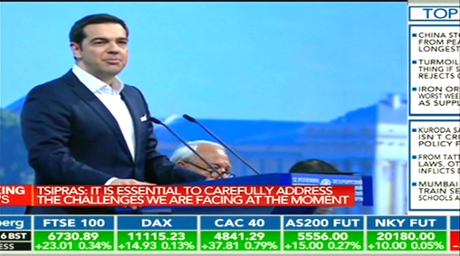
Greece’s prime minister, Alexis Tsipras, has just launched an attack on Europe’s fixation on austerity, in a speech in St Petersburg.
Just as the ECB decision was emerging, the Greek leader used his trip to Russia to call for more solidarity and social justice, shortly after a speech by Vladimir Putin.
Tsipras said:
As all of you are aware, we are at the moment at the centre of a storm of a whirlpool, but we live near the sea so we’re not scared of the sea. We are ready to go to new seas to reach new safe ports.
That sounds rather like a reference to a warmer relationship with Russia, at a time when Moscow is facing tougher sanctions over Ukraine.
Tsipras continued:
The problem we are facing is deeply rooted in the process I have described. The EU should pursue its own path. The EU should go back to its initial principals of solidarity and social justice. Ensuring strict economic measures will lead us nowhere. The so-called problem of Greece is the problem of the whole European Union.
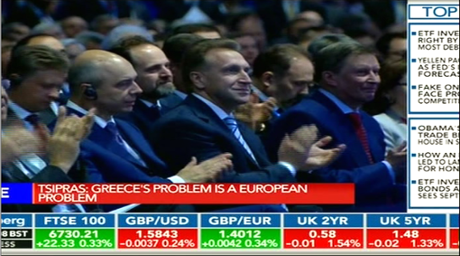
The sight of Tsipras pressing the flesh in Russia at this vital time may not please EU leaders (although, as a German spokesman pointed out, the Greek leader can go where he likes).
They may be more disappointed that he didn’t give any sign of embracing the structural reforms demanded by creditors.
My colleague Mark Rice-Oxley watched the speech and tweeted the key points:
Here comes Tsipras at #SPIEF. "Why am I here, not in Brussels? I am here because I believe (Russia) has a big role to play..." In Greece?
— mark rice-oxley (@markriceoxley69) June 19, 2015
Tsipras: "The economic centre of the planet has shifted. There are new economic forces that are playing a role."
— mark rice-oxley (@markriceoxley69) June 19, 2015
Really, Alexis? #SPIEF "Greece still preserves the status of centre of stability in the region."
— mark rice-oxley (@markriceoxley69) June 19, 2015
Tsipras tells Russians: "we are at the moment at the centre of a storm , but we live near the sea so we're not scared...
— mark rice-oxley (@markriceoxley69) June 19, 2015
Tsipras tells Russians (2) .... "We are ready to go to new seas to reach new safe ports."
— mark rice-oxley (@markriceoxley69) June 19, 2015
The ECB’s decision is reassuring news for anyone heading to Greece in the days ahead, as it cuts the risk of an immediate banking crisis.
Tourists are already being advised to carry more paper money than normal. Just in case.
My colleague Miles Brignall explains:
Andrew Brown, from Post Office Travel Money said: “Looking back to the last time that things reached a head in Greece in 2013, the short term impact was a lack of availability of cash at ATMs and a reluctance by shops and restaurants to accept credit or debit cards.
“With that in mind, we are advising customers travelling to Greece in the coming weeks to be prepared and ensure that they budget carefully, taking enough cash in euros to see them through their holiday.”
ECB grants Greece more emergency liquidity
Journalists in Athens have also heard that Greek banks are getting extra emergency liquidity, to cover the deposits they have been losing.
ECB sources tell @capitalgr #Greece ELA raised, there's no problem with banks funding, and they expect a positive outcome on Monday (Summit)
— Efthimia Efthimiou (@EfiEfthimiou) June 19, 2015
ECB to up ELA for Greece but unclear how much, acc to banking source who says no prob with funding of Greek banks, expect p+ve outcome Mon.
— NikiKitsantonis (@NikiKitsantonis) June 19, 2015
Bloomberg confirms that the ECB has accepted Athens’ request for more emergency liquidity. But again, they don’t know if Greece got the full €3.5bn it asked for....
ECB SAID TO RAISE GREEK ELA CEILING
— Francine Lacqua (@flacqua) June 19, 2015
Reuters has just snapped that the ECB has raised the emergency funding cap for Greeks banks, quoting a banking source.
But they don’t say how much by.....
Greek savers haven’t suddenly become nervous, of course -- deposits have been falling since December (when the previous government called snap elections):
There are fears of a run on Greek banks - but it could be more of a jog: http://t.co/JFo51uYDYU pic.twitter.com/XhVQx1clEn
— CNBC (@CNBC) June 19, 2015
Analysts at Capital Economics explain that Greece really, really needs extra liquidity from the ECB.
An estimated €3bn has been taken out of the banking sector this week, including around €1bn yesterday....
With €3bn bank deposits leaving Greece this week, capital controls will be needed if #ECB doesn't increase ELA limit https://t.co/Rq6K70P40z
— Capital Economics (@CapEconEurope) June 19, 2015
Newsflash: The European Central Bank has reportedly ended its call on whether to grant Greece extra emergency liquidity to help its banks stay afloat......
*EU OFFICIAL SAYS ECB ELA CALL HAS ENDED *EU OFFICIAL DECLINES TO COMMENT ON ECB GREECE ELA DECISION
— Michael Hewson (@mhewson_CMC) June 19, 2015
That’s via Bloomberg.
Updated
Greek media: Merkel wants an end to insults
The president of Cyprus Nikos Anastasiades has intervened on Greece’s behalf, calling the German chancellor Angela Merkel.
Our Athens correspondent Helena Smith says:
Sources in Nicosia, the Cypriot capital, say president Anastasiades called the German leader, with whom he gets on well, at the request of the Greek president Prokopis Pavlopoulos.
The phone call - details of which have filtered through this morning - was marked by a surprising appeal Angela Merkel is reported to have made almost right off the bat.
“Tell Tsipras to stop insulting me and members of my government. I also have voters I have to convince, it’s not just Mr Tsipras [who has them],” the chancellor was quoted as saying, by a number of Greek media.
Cyprus, which suffered the euro zone’s first bail-in after its banking system collapsed back in 2013 - partly because of its exposure to Greece - has been keen to keep a distance from Athens. After faithfully implementing reforms the island nation is beginning to see the first signs of economic recovery.
“Given that perceptions are everything they really want to keep a distance,” an EU diplomat based in Nicosia told me.
“They want to ensure that Cyprus is different, that there’ll be no contagion [in the event of Greece exiting the euro zone] and so have been walking a very fine line between having a natural bond with Greece and keeping on board with the rest of the euro zone.”
Updated
Here’s the latest Greek odds from UK bookmaker Paddy Power:
- 4/5: Greece to adopt an official currency other than the Euro by the end of 2017
- 6/5: European Commission to confirm that Greece has ‘defaulted’ on debt in 2015
- 9/4: Greece to hold another general election in 2015
- 2/1: Greece to exit the Eurozone this year
Update: Reader Oli Hawkins flags up that you get better odds on Grexit elsewhere....
@graemewearden Those odds are terrible! https://t.co/KoN3K0ZvZW
— Oli Hawkins (@olihawkins) June 19, 2015
Updated
Here’s how Greek papers are covering the crisis:
Headlines #Greece "Last Chance for Deal" "Knife at our Throat" "SOS Greece" pic.twitter.com/qhwwmj8Ng7
— Derek Gatopoulos (@dgatopoulos) June 19, 2015
Awkward...
Ouch. @George_Osborne got number of eurozone countries wrong in Ecofin BSR debate. He said 18. It's 19. Greece hasn't gone yet George
— Bruno Waterfield (@BrunoBrussels) June 19, 2015
While we await the ECB’s decision, here are some photos from inside today’s meeting of European finance ministers:


Angela Merkel’s spokesman, Steffen Seibert, has said there is still time for a deal between Greece and its creditors.
“It’s not too late for this and of course we hope that such an agreement is possible.”
A German finance ministry spokeswoman has denied that EU leaders could decide to impose capital controls on Greece at Monday night’s emergency summit.
Capital controls are a decision for an individual country, she explained.
The European Central Bank is about to begin deliberating whether to agree to Greece’s request for more emergency assistance to keep the Greek banking sector running.
ECB Council to hold midday teleconference on request for more emergency assistance to Greek banks after #eurogroup deadlocks, again. @ecb
— James Kanter (@jameskanter) June 19, 2015
Eurogroup meeting called on Monday
It’s official... eurozone finance ministers will meet again on Monday, at 3pm CET.
That will allow them to prepare the ground before eurozone leaders meet on Monday night to discuss the Greek crisis.
So, if Greece does come up with new proposals, as it was urged last night, they could be examined then.
Additional #Eurogroup meeting at 3 pm on Monday 22 June in Brussels to prepare eurozone summit
— Jeroen Dijsselbloem (@J_Dijsselbloem) June 19, 2015
Bank of Greece: the banking system is stable
Greece’s central bank has issued a statement this morning, in which it declares that the banking system remains stable.
Here's Google translation of Bank of Greece statement #Greece pic.twitter.com/6lSt07WmMw
— Derek Gatopoulos (@dgatopoulos) June 19, 2015
This meeting appears to have been aimed at mending fences between Stournaras and the leftist-led government, says our correspondent Helena Smith
Earlier this week, the governing Syriza party accused Stournaras, a former finance minister in the previous pro-bailout conservative led government, of fear-mongering after warning in his annual report that failure to find a deal would push Greece into uncontrollable economic collapse.
Updated

Over in Athens our correspondent Helena Smith has been speaking with bankers who say while the Bank of Greece has indeed requested a cash injection from the ECB today, bank officials are far from panicked - at this point.
She writes:
Bankers this morning are, if anything, in sanguine mood. The outflows Greek banks have seen in recent days have been limited to cash withdrawals mostly of small amounts. Transfers of large sums abroad have apparently not be seen.
“Those who had money to take out have taken it out,” said one official speaking on condition of anonymity. “What we have been seeing is cash outflows by depositors with small portfolios withdrawing amounts of between five and 10,000 euro. That has depleted reserves and meant bank buffers have to be reinforced,” he told me this morning.
“If there is any panic it is illusory. We haven’t seen it.”
A lot of savers, he added, had elected not to break long-term deposit accounts.
Echoing government insiders, finance sources rubbished suggestions of an imminent close-down of Greek lenders. Reports that banks might close on Monday “simply didn’t add up,” said another banker.
“It just doesn’t make sense that when they have proclaimed an emergency EU summit to try and end this highly volatile situation banks don’t open. I really don’t think that is going to happen.”
Updated
Russia is ready to look at financial aid for Greece, according to its deputy prime minister today.
Arkady Dvorkovich, Russia’ s deputy prime minister, told an audience of Russian business leaders today that Russia was ready to consider financial help - contradicting statements from the finance ministry only yesterday that the Kremlin couldn’t afford to help.
Dvorkovich said:
“We support any decision [to resolve the Greek debt crisis] that will be proposed by Greece and our European partners. The first priority for us our investment projects and trade with Greece. If financial support is required we will look at this question.”
“The priority for us is a stable Europe and a stable Greece. We will support all possible means to resolve the Greek debt crisis.”
He said that many countries, Greece included, wanted to lift European sanctions against Russia as soon as possible. “These countries think about business, about the private economy and not about politics. We think that this is a constructive approach.”
He said the Russian government would definitely be consulting more with countries that support lifting sanctions, than those that do “not want to continue economic dialogue”.
However on Thursday Russia’s deputy finance minister Sergei Storchak said that Greece had not applied for financial aid and that Russia did not have budgetary resources to help.
Greek officials, including prime minister Alexis Tsipras, are on a visit to Russia today.
Earlier, they signed a ‘joint memorandum’ to extend the planned Turkish Stream gas pipeline to Europe, with Russian state development bank VEB providing funding.
Greece, Russia sign memorandum on gas pipeline to Greece: Moscow http://t.co/G1pbxdyYTA pic.twitter.com/8bt2fKFwXp
— FRANCE 24 (@FRANCE24) June 19, 2015

There’s not too much love for Greece from fellow eurozone member Slovakia today.
Prime minister Robert Fico told a press conference in Bratislava that his government are ready for Greece to leave the eurozone, although he’s rather it didn’t happen.
As Fico put it:
“We wish for Greece to remain in the euro zone but not at any cost”.
“Slovakia is prepared mentally and technically for the crisis scenario of Greece exiting the euro zone. We will insist on Greece doing its homework,”
French president Francois Hollande sounds a little more supportive, telling another press conference today that:
“It is very important that talks continue and this discussion reaches a compromise solution and that compromise solution must be according to European rules.”

My colleague Jon Henley is in the Greek capital today. He reports that Athenians are nervous, but not hysterical about the threat of a bank run.
Jon writes:
It was not what anyone would call a panic: the banks were all open, the cashpoints were dispensing notes, the cafes were busy, the sesame-seed bagel stands doing a brisk morning trade. But as rumours swirled of multi-billion euro cash injections and possible bank closures by Monday, a steady stream of people – though never enough to call queue – were withdrawing money from the National Bank branch on Athens’ central Syntagma Square.
“Yes, I’m worried,” said Dimitris, who works for an insurance company and, given that he had just taken out €1,000 in 50-euro notes, was understandably reluctant to supply a surname.
“I”m worried because this is now starting to get really very uncertain indeed. The government is not telling us what it will do, how it intends to solve this thing. I am making sure I have enough for the first part of next week. Just in case.”
With the headline in Friday’s Kathimerini newspaper warning that the Bank of Greece had asked the European Central Bank for €3.5bn of emergency funding to shore up some €3.2bn of deposits that have haemmorhaged from Greece’s largest since Monday, some customers were holding back out of principle.
“I don’t feel 100% secure, that’s certainly true,” said Giota Georgiades, who works for a timber and paper import agency.
“But I don’t want to take all I have out of the bank. If everyone did that, the whole banking system would collapse.”
Like almost everyone at the cashpoint, Georgiades – who had withdrawn just €30, “enough for today and maybe tomorrow” – said she was confident a way out would be found from her country’s face-off with its creditors: its eurozone partners, the European Central Bank and the International Monetary Fund.
Jon’s full report will be online shortly...
Greeks friends on Twitter are keeping their spirits up:
went to the ATM this morning but someone was already there. on poros, that's a bank run! happy weekend everyone and be nice to each other.
— Diane Shugart (@dianalizia) June 19, 2015
I love this! I haven't encountered any queues at ATMs either. https://t.co/GLJHzIcHdg
— Damian Mac Con Uladh (@damomac) June 19, 2015
Updated
Greek government bond yields are dropping this morning, suggesting that traders are slightly less worried about a default.
The yield on two-year Greek debt has dropped to 28.6%, from 30.4% last night.
Yields show the rate of return on a bond, and rise when the price falls (and vice versa). So a dip in yields is a sign of higher confidence.
Markets betting on a deal as Athens has no choice amid bank run. 2yr #Greece yields 28.7%, down 150bps. pic.twitter.com/9ZWmnXpjil
— Holger Zschaepitz (@Schuldensuehner) June 19, 2015
HOWEVER. Greek yields do remain extremely high -- Athens certainly couldn’t issue any new debt at such high interest rates.
I’m not seeing or hearing any signs of panic at Greek banks today, despite Kathimerini’s report that €1.2bn was taken out yesterday.
One bank official has told Reuters:
“There are no lines or panic, it has been a quiet and gradual phase of withdrawals.
“They are due to worries whether a deal will be clinched with the country’s lenders.”
Reassuring news from the Athens stock market. The main ATG index has risen a little in early trading, up nearly 0.5%.
Shares in the major banks are up around 2%. That suggests investors are holding their nerve, and believe savers are doing the same....
#Greece | Athens market in positive territory: General Index 0.43%, banks 1.82% | Investors see an agreement?
— Yannis Koutsomitis (@YanniKouts) June 19, 2015
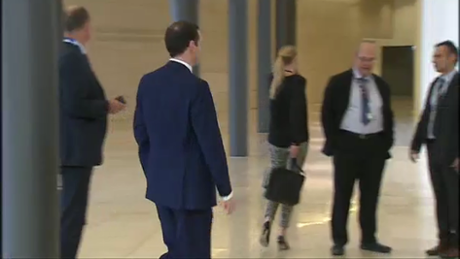
Osborne: Time to prepare for the worst
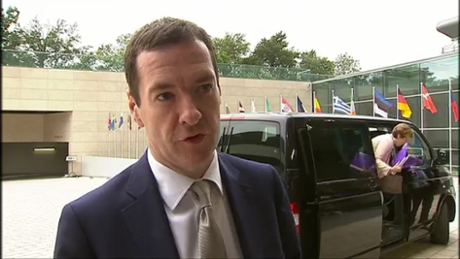
UK chancellor George Osborne has urged Athens to reach a deal with its lenders.
Arriving at today’s meeting of finance ministers, he says:
We have entered the eleventh hour of this Greek crisis and we urge the Greek government to do a deal before it is too late.
We hope for the best, but we now must be prepared for the worst.
Britain has “taken measures” to increase economic security to handle risks from abroad, he adds.
A reporter asks Osborne what “the worst” is, but I don’t think he replies before vanishing into today’s meeting.
Updated
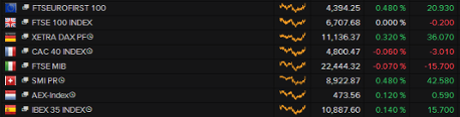
There is a total absence of panic in the European stock markets in early trading:
The Athens market opens in a few minutes....
EU finance ministers are arriving back in Luxembourg -- and sounding downbeat about Greece.
Luis Des Guindos, Spanish fin min #ECOFIN doorstep on #Greece "I'm worried.I don’t know what we’re going to do.We just have a few days left"
— Ryan Heath (@PoliticoRyan) June 19, 2015
"Most likely a #eurogroup on Monday says @alexstubb of Finland. No new doc since 20 Feb" on #Greece #ECOFIN
— Ryan Heath (@PoliticoRyan) June 19, 2015
Tsipras: There will be a deal

Greece’s prime minister has welcomed the decision to call an emergency summit on Monday night.
In a statement, Alexis Tsipras declared that Greece will reach a solution that will allow it to stay in the euro area and return to growth:
“Τhe (euro zone) leaders summit on Monday is a positive development on the road toward a deal.
“All those who are betting on crisis and terror scenarios will be proven wrong.
There will be a solution based on respecting EU rules and democracy which would allow Greece to return to growth in the euro”
Greek PM Tsipras: Euro Summit On Greece Is Positive Development -- RTRS -Those Betting On Crisis Will Be Proven Wrong
— Live Squawk (@livesquawk) June 19, 2015
Updated
These charts show how Greek deposit levels have fallen steadily this year, prompting the ECB to steadily provide more and more emergency liquidity.
#ECB said to plan Emergency Greek aid call amid bank run http://t.co/WBWgadIU77 #Greece #Grexit pic.twitter.com/7j08e5HIbH
— Holger Zschaepitz (@Schuldensuehner) June 19, 2015
Greek newspaper Kathimerini reports that the Bank of Greece has asked the ECB for another €3.5bn of emergency funding, to handle the deposit flight.
It also says that €1.2bn was taken out of banks on Thursday, on top of the €2bn between Monday and Wednesday.
More here:
Bank of Greece asks ECB for extra cash flow via ELA
Today’s ECB session comes just two days after it extended another €1.1bn of emergency liquidity to the Greek banking sector.
But the fear is that funds are leaving banks faster than the ECB can put them in.
Especially after ECB executive Benoît Cœuré told yesterday’s meeting that he didn’t know if Greek banks would be able to open on Monday.
#grexit ecb put up 1bn+ in ELA on weds, looks like more today. stopping or starting a #bankrun?
— Ian Traynor (@traynorbrussels) June 19, 2015
@traynorbrussels @graemewearden After Coeure's alleged remarks I would say fuelling, since it has already started
— Dave (@blackdoginet) June 19, 2015

The AFP newswire has more details of the European Central Bank’s emergency meeting:
The European Central Bank’s decision-making governing council will hold an emergency session Friday to discuss a request from the Bank of Greece for an increase in liquidity to Greek banks, sources familiar with the matter told AFP.
The council will hold a teleconference at around midday (1000 GMT) to discuss a possible increase in the Emergency Liquidity Assistance facility, as deposit withdrawals from Greek banks have accelerated in recent days, sources said, speaking on condition of anonymity. An ECB spokesman declined to comment.
Introduction: Emergency meetings as Greek crisis hits new highs
Good morning.
More than five years after it began, Greece’s debt crisis is rattling towards a climax after finance ministers failed to make any progress towards a deal last night.
And with deposits leaving its banks at a faster rate this week, Europe could be facing a full-blown banking crisis:
As we covered in yesterday’s liveblog, EU leaders will take on the responsibility for tackling the crisis, when they hold an emergency summit on Monday evening. That was triggered by growing fears over Greece’s banking sector, we understand, after over €2bn was taken out between Monday and Wednesday:
#grexit top eurogroup participant tells @guardian timing of Monday summit to do with fear of bank run/collapse
— Ian Traynor (@traynorbrussels) June 18, 2015
And the sight of pro-EU demonstrators protesting against the government’s stance last night has shown we are entering a new phase in this long crisis.
Photos: Pro-EU demo in Athens tonight after dramatic day http://t.co/KDLYWrujY7 pic.twitter.com/K0ENgXg1Rr
— Graeme Wearden (@graemewearden) June 18, 2015
So what happens today?
The European Central Bank will hold an emergency meeting to discuss whether to extend more emergency liquidity to Greece’s banks, to allow them to keep running as savers withdraw their
That meeting is scheduled for 11am BST, or 1pm Greek time, according to Bloomberg TV.
There could be more action in Luxembourg today, where European finance ministers will be holding further meetings. Not about Greece, though, but I think we can guess what they’ll be chatting about over the orange juice and croissants.
This morning starts with four breakfast meetings: hotel, @EPP, #EIB and #Ecofin.
— Alexander Stubb (@alexstubb) June 19, 2015
The press pack are poised for action:
I've woken up this morning to the realisation that I'm still in #Luxembourg.
— Peter Spiegel (@SpiegelPeter) June 19, 2015
Greece’s prime minister Alexis Tsipras is (I think) still in Russia. He was due to meet with President Vladimir Putin at some point.
But the big question is how the Greek people, battered by years of deadlock, austerity and division, respond to the latest developments which are dominating the front pages....
Guardian front page, Friday 19 June 2015: Fears over Greek banks as talks collapse in acrimony pic.twitter.com/EPSD5JX8ZX
— The Guardian (@guardian) June 18, 2015
Friday's FT front page: EU calls crisis summit after Athens bailout talks collapse #tomorrowspaperstoday #bbcpapers pic.twitter.com/IA3q30tBRx
— Nick Sutton (@suttonnick) June 18, 2015
Friday's Times front page: Greek banks on brink of collapse as savers panic #tomorrowspaperstoday #bbcpapers pic.twitter.com/SdS1OylzP2
— Nick Sutton (@suttonnick) June 18, 2015
We’ll be tracking all the main events through the day...
Updated